 By
Using Notion as a fundraising CRM means turning a Notion database into your investor pipeline: one row per investor, a page per conversation, a few views to sort by stage. Founders do the same thing in Airtable, in HubSpot, or in a plain spreadsheet. We read these setups every week when founders bring us a raise, and the honest verdict is simple. They work early, then they quietly stop pulling their weight. Visible, which runs investor pipelines for a living, says a spreadsheet starts to crack around relationship 20 (Visible.vc). The question is when yours will.
Can you use Notion as a fundraising CRM?
Yes, Notion handles a fundraising CRM’s core job well. It holds every investor, every note and every next step in one place you and a co-founder can both see. For a first raise with a short list, that’s genuinely enough, and I wouldn’t talk anyone out of it.
The useful move is to zoom out to the whole job, which is wider than tracking. A raise asks a tool for five things: find investors who fit, judge that fit, reach the right partner, track replies, and keep the deck and data room ready. Here’s how a do-it-yourself Notion or Airtable build compares with purpose-built fundraising CRMs on the two jobs that decide most raises.
| Tool | Finds investors for you | Tracks the pipeline | Starting price (Nov 2026) |
|---|---|---|---|
| StartWise | Yes, ranked by fit, with the named partner | Yes | Free to start |
| Notion or Airtable (DIY) | No, you add every contact | Yes, once you build it | Free; Airtable Team $20 a seat |
| HubSpot | No, built for sales leads | Yes, with sales stages | Free CRM tier |
| Foundersuite | Yes, 216,000-investor database | Yes | Free Basic; $745 a year |
| OpenVC | Yes, 16,000+ investors | Yes | Free core |
The pattern jumps out of that table. On tracking, the DIY tools and the paid ones basically tie. On finding investors, Notion and Airtable score a flat no, because a blank database is exactly that. You fill it. And filling it, name by name, is the slow part nobody warns you about when they share their clever Notion template.
Is Airtable a good fundraising CRM?
Airtable makes a good fundraising CRM for the same reason Notion does, with more spreadsheet muscle underneath: linked tables, filtered views and calendar reminders for follow-ups. Plenty of founders run a real raise on it and never hit a wall.
Airtable’s own fundraising template (Airtable) gives you a working CRM out of the box:
- A profile for each firm and investor
- Every interaction logged, with the latest touch rolled up
- Reminders when too long passes since the last contact
- A deck library that tracks who you sent it to, and when
That covers tracking cleanly, and the price is small: its Team plan runs $20 a seat per month, billed annually (Airtable pricing). What the template doesn’t cover is the list itself. You still supply every name, because Airtable hands you a structure, not investors. In the setups we review, this is exactly where founders burn a weekend wiring up views and still stare at an empty pipeline on Monday.
Can HubSpot work as a fundraising CRM?
HubSpot can run a fundraising pipeline, but it was built to sell to customers, not to raise from investors, so you’re adapting a sales CRM to a job it never had in mind. Its deal stages assume a buyer. Its automations assume a quota. Its free tier holds only the contacts you import yourself.
Metal’s own comparison guide puts it bluntly: HubSpot ships with no investor data (Metal). So the thing a raise needs most, HubSpot leaves entirely to you.
A sales CRM tracks the deals you create. A raise needs the investors you haven’t met yet.
That gap matters more than it sounds. The hard part of raising isn’t logging a conversation. It’s knowing which partner to start the conversation with. We’ve watched founders bend HubSpot into shape for a week, then still come to us with the only question that actually matters: who do I email first?
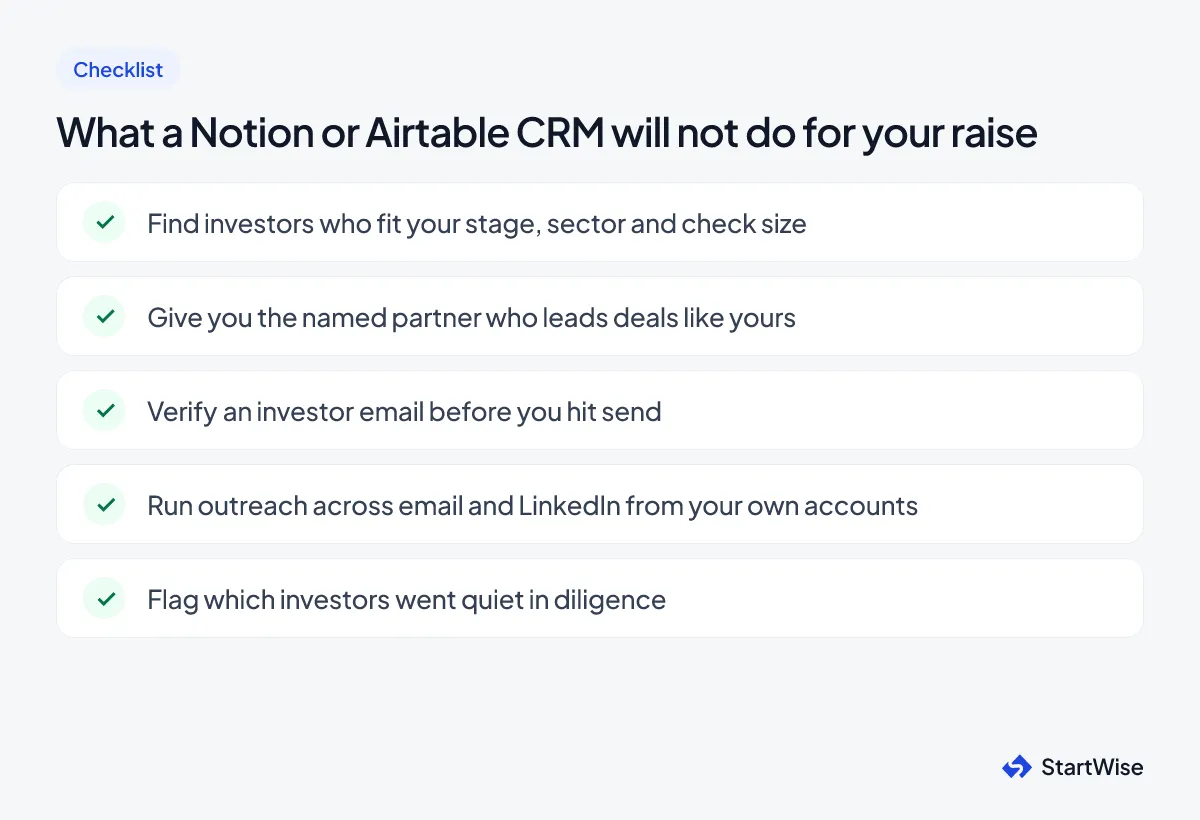
What a generic tool will not do for your raise
A generic tool won’t do the two jobs that actually move a raise: finding the investors who fit your round, and handing you a verified way to reach the partner who leads deals like yours. Tracking is the job everyone optimizes, and it’s the one a free Notion board already nails.
The jobs that stay stuck sit upstream of the pipeline. Reviewing seven fundraising CRMs in October 2026, Value Add VC found that only Foundersuite ships a built-in investor database; every other tool on its list assumes you’ve already found your targets (Value Add VC). That assumption is the whole problem. A database you fill by hand isn’t research. It’s data entry.
StartWise's position
Founders reach for a CRM to fix tracking. But tracking is the one job a free Notion or Airtable board already does. The jobs that are actually stuck are finding the investors who fit and reaching the named partner, and no template solves those.
The numbers back the reframe. The average fundraising pipeline on Visible holds 52 investors (Visible.vc), small enough that no founder needs software to remember the names. What they need is help getting to the right 52 in the first place, and a verified way to reach each one. When a founder’s Notion board lands on our desk, the rows are never the problem. The gaps between them are.
Your Notion board tracks investors fine, but it can't find them. StartWise researches your first 20 investors free, ranked by fit, with the named partner for each.
When should you switch from Notion to a fundraising CRM?
You should switch from Notion to a dedicated fundraising CRM when tracking starts costing more time than it saves, which two companies that live in investor pipelines both peg at around 20 active relationships. Visible says a spreadsheet cracks around relationship 20 (Visible.vc). Metal’s guide says founders hit the ceiling of manual tracking at roughly the same point (Metal).
Watch for the signals, not the calendar. Here’s when the DIY board has outlived its usefulness:
- You’re juggling more than 20 live investor conversations at once
- Follow-ups slip because nothing reminds you
- A co-founder needs the pipeline status without pinging you first
- The deck, the data room and your notes live in three different tabs
The good news is that switching rarely costs much, and that’s the part Metal’s guide leaves out. OpenVC keeps most of its core free, with 16,000+ investors and a built-in CRM (OpenVC), and Signal by NFX is 100% free (Signal by NFX). Paid tools climb from there. Foundersuite runs a free Basic plan and $745 a year for Silver, while a sales-grade tool like Affinity starts near $2,000 per user a year (Value Add VC).
My honest take, after watching dozens of these migrations: the tool switch is the easy part. If you want to stay on a sheet a while longer, our investor pipeline tracker hands you the funnel math and the fields that matter, and do you need a fundraising CRM yet walks the spreadsheet-versus-CRM call by stage. Paying for a CRM before your tracker actually breaks usually just replaces the harder work of finding and reaching investors.
What to do this week
Here’s the move this week, whatever stage you’re at. It takes about an hour, and most of it is plain honesty with yourself.
- Count your active investor conversations. Under 20? Keep Notion or Airtable, and put the saved time into outreach.
- Write down the two jobs you’re actually stuck on. For most founders it’s finding fit and reaching the partner, not tracking.
- If finding investors is the stuck job, start with a free option, and our best tools to find pre-seed investors ranks them by job.
- Only pay for a CRM when the tracking genuinely breaks, never because a fresh template felt productive.
We’ll keep saying it because it keeps being true: buy the tool for the job that’s stuck. A pretty Notion board feels like progress, and that’s exactly why it’s a trap, because the hour you spend recoloring stage columns is an hour you didn’t spend getting in front of an investor who fits. Filling it with the right names is the actual work.
