
 By
By 
A fundraising CRM is software that organizes investor outreach: who you’ve contacted, where each one sits in your pipeline, and what to do next. Most articles on the topic skip the only question that matters and hand you twelve tools to buy. The average fundraising pipeline tracked on Visible holds 52 investors (Visible, 2026). At pre-seed you’re usually managing far fewer than that, and in our review room we spend more time telling founders to close their CRM tab than to open one. Here’s the honest call.
What’s the best fundraising CRM for startups?
The best fundraising CRM for startups is the lightest tool that still keeps your raise organized. For most pre-seed founders, that’s a spreadsheet. Dedicated CRMs earn their price later, once your pipeline and investor updates genuinely outgrow a single sheet. Here’s how the real options compare for a first raise.
| Tool | Best for | Cost | The catch |
|---|---|---|---|
| StartWise investor portal | Finding and reaching investors for your stage, then tracking outreach in one place | Free to start. Start investor outreach → | Built to find and reach investors, not for deep ongoing IR reporting |
| Google Sheets tracker | A focused pre-seed raise under ~50 investors | Free | You bring the discipline; no reminders or email sync |
| OpenVC | A free dedicated fundraising CRM plus investor matching | Free | Lighter on investor updates and data-room depth |
| HubSpot (free tier) | Founders already living in a sales CRM | Free tier; paid upgrades | Generic sales tool with real setup friction |
| Visible.vc | All-in-one CRM, updates, and data room at seed and beyond | Paid | Overkill for a lean pre-seed raise |
| Foundersuite | Series A prep with deep pipeline and IR features | Paid | Priced and built for later-stage rounds |
Positioning is from each tool’s site and our reviews of what founders actually use, checked this week. The link in the StartWise row starts investor outreach for your stage and industry, not another blank sheet to fill.
Do you actually need a fundraising CRM at pre-seed?
You probably don’t need a dedicated fundraising CRM at pre-seed. The pipeline is small. Founders meet 50 to 70 investors to close a seed round (Carta, via Notion’s fundraising guide), and a good pre-seed investor list runs smaller still. A tool built to manage hundreds of relationships is solving a problem you won’t have for a year.
Other data points to the same conclusion. DocSend found early-stage founders meet with over 50 investors before closing (DocSend 2025, via Qubit Capital), and that’s a two-month sprint of outreach, not a system you’ll live inside for years. If a paid tool genuinely makes those weeks smoother, rent it for the quarter and cancel after. Just don’t mistake owning the tool for doing the work.
We review founders’ raise plans most weeks, and the ones who buy a CRM first tend to have the emptiest pipelines. The tool feels like progress. It isn’t.
What actually moves your raise is the quality of your list and how many of them you reach. A CRM records that work. It doesn’t do it. So the real question isn’t which CRM to buy. It’s whether the thing slowing you down is bookkeeping at all.
The three jobs a fundraising CRM actually bundles
A fundraising CRM bundles three separate jobs, and you rarely need all three from one tool at pre-seed:
- Finding the right investors for your stage, sector, and check size.
- Tracking who you’ve contacted and where each one sits.
- Updating investors once they’re in your pipeline or on your cap table.
Tracking is the easy job, and it’s the one every “you need a CRM” article obsesses over. A spreadsheet with the right columns does it for free. Our investor pipeline tracker is a Google Sheet, and it runs a full pre-seed raise without a subscription.
Finding and reaching investors is the hard job, the one that decides whether you raise. That’s targeting, warm intros, and a cold email that gets replies. No CRM writes those for you. Updates come third, and they only start mattering once someone’s actually in, which for a first-time founder is weeks away.
Map that onto real tools and the overpaying gets obvious. The finding job is served by investor-matching (OpenVC, or StartWise’s portal for your stage and sector). The tracking job is a free sheet. The updating job is where Visible and Foundersuite genuinely shine, with data rooms and update logs built in, but that’s a seed-and-beyond need. A pre-seed founder who buys the all-in-one is paying for two jobs they won’t run for months.
Buy a tool for the job you’re stuck on. Most founders are stuck on the finding, then reaching, and reach for software that only helps with the tracking.
The hard part of a raise isn't tracking investors, it's finding and reaching the right ones. StartWise matches you to investors for your stage and industry and runs the outreach.
When does a spreadsheet stop working?
A spreadsheet stops working at a specific point, not on a feeling. Visible puts the break around 20 active relationships (Visible, 2026). In the raises we see, a disciplined founder holds a clean sheet well past that, closer to 40 or 50 live conversations, before the cracks show. The trigger is never the count alone. It’s the count plus a second person who needs to see the pipeline.
20
active investor relationships is where a spreadsheet starts to crack, per Visible. Below that line, a well-built tracker is usually enough. (Visible, 2026)
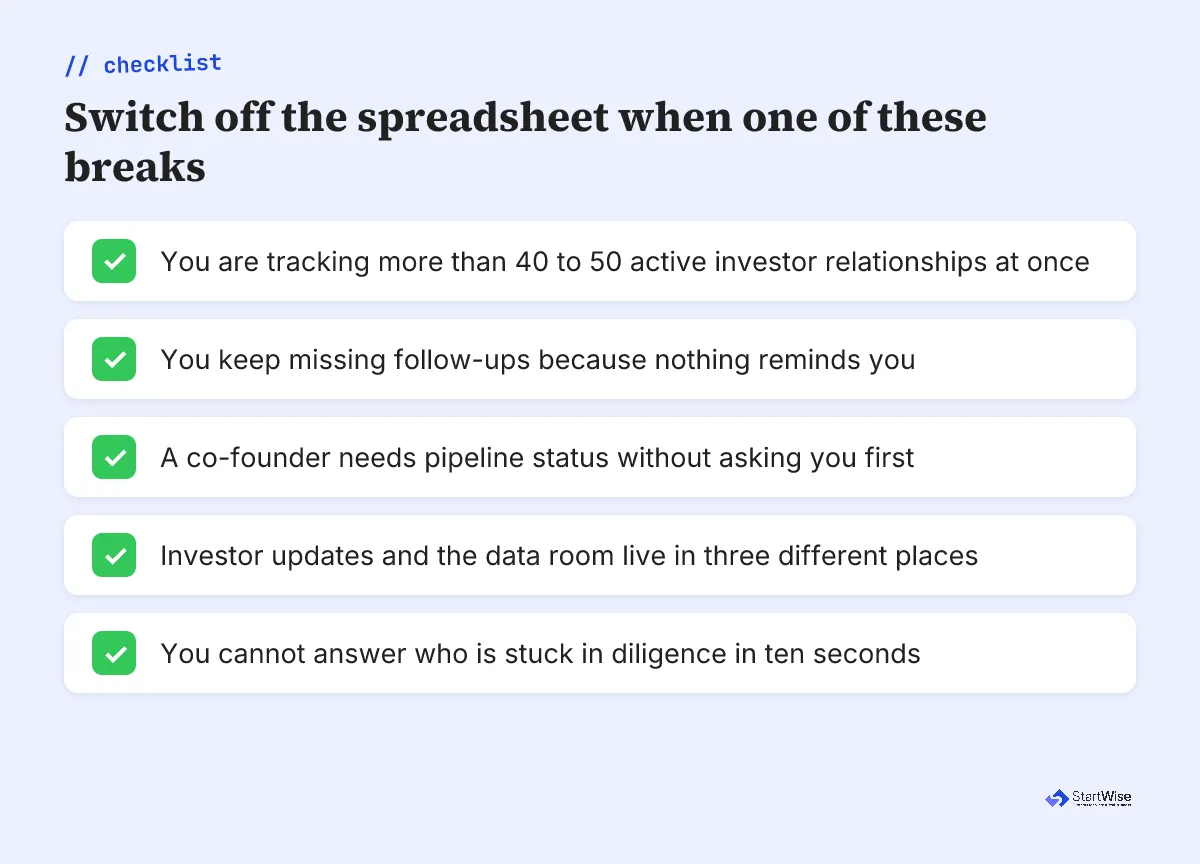
The honest signals that you’ve outgrown the sheet are concrete, not vibes. Watch for these:
- You pass 40 to 50 active investor relationships at once.
- You keep missing follow-ups because nothing reminds you.
- A co-founder needs pipeline status without pinging you.
- Your updates and data room live in three different tools.
The one I see catch founders most is the co-founder signal. A solo sheet works until your co-founder needs to know, right before a partner call, where a specific fund stands, and neither of you can answer without a long scroll. That’s the moment a shared, reminder-driven tool earns its price. The follow-up you miss costs more than the subscription.
When two of those are true at once, pay for the workflow. Not before. A paid CRM you adopt at investor number three just adds a tab you forget to update.
What a fundraising CRM won’t do for your raise
A fundraising CRM won’t get you a single meeting. It’s bookkeeping, and good bookkeeping is worth having, but founders treat the setup as if it were the raise. The median seed raise takes 12 to 20 weeks (DocSend, via Notion), inside which you’ll run 20 to 40 first meetings to convert a handful into term-sheet talks. The average time to close a seed round has stretched to 5.2 months (NVCA, via Qubit Capital). None of that timeline shortens because your pipeline is prettier.
A CRM records the raise. It doesn’t run it. The founders who confuse the two spend week one configuring stages instead of sending emails.
Here’s the part every tool page buries. The work that closes the gap between “150 investors in a sheet” and “one term sheet” is targeting and outreach, and that’s exactly where a first-time founder is weakest and most alone. A tidy pipeline can hide an empty one.
StartWise's position
A fundraising CRM is bookkeeping, not a source of meetings. At pre-seed your pipeline is small enough that a disciplined tracker does the job, and paying for a CRM before that tracker breaks is usually a way to avoid the harder work: sharper targeting and more outreach. Spend the money there instead.
That’s the whole trap in one line. A tool that helps you track investors feels productive, so you reach for it before you’ve done the finding and reaching it can’t do. We’d rather see you send ten more warm intros than migrate to a nicer dashboard.
What to do this week
Pick the tool that fits where you’re actually stuck, then stop shopping. Here’s the order we’d tell any pre-seed founder to run:
- Build a qualified investor list of 100 to 150 real targets before you touch any CRM.
- Track them in a free pipeline spreadsheet with columns for stage, next action, and follow-up date.
- Spend your money on the finding and reaching, not the tracking, since that’s what a pre-seed raise actually turns on.
- Upgrade to a paid CRM only when two switch-signals are true at once, and time the subscription to your active outreach quarter.
The best fundraising CRM is the one you’ll actually keep updated. For most founders about to send their first investor email, that’s a spreadsheet and the discipline to work it every day.