
 By
By 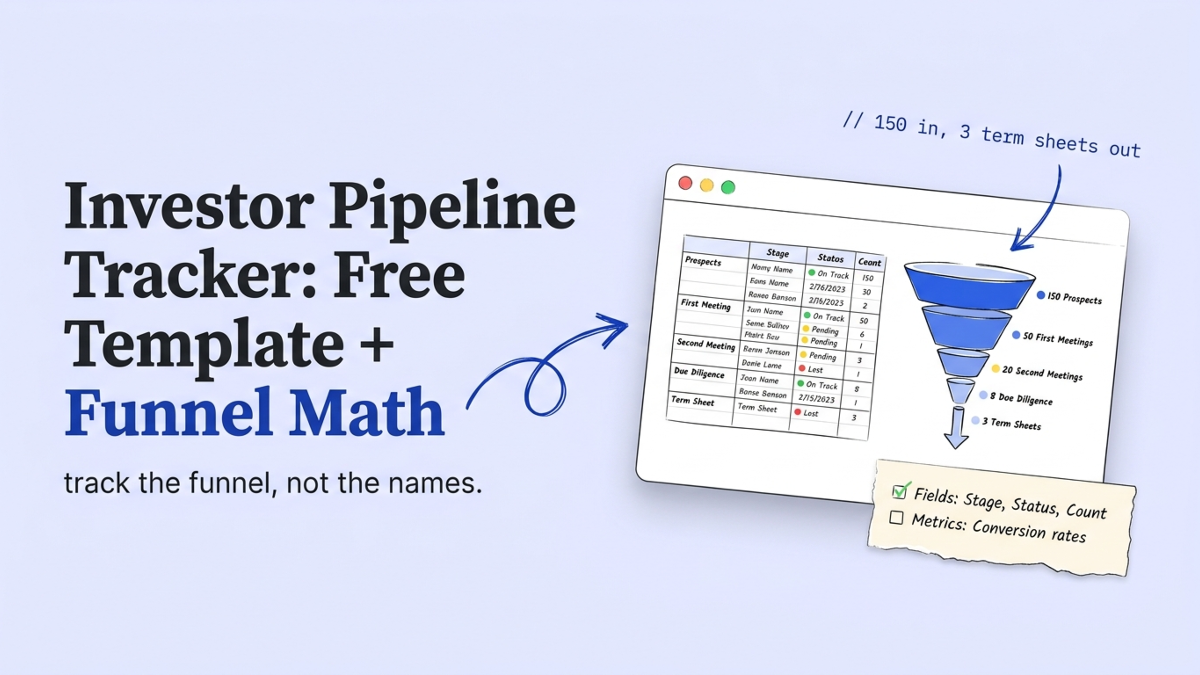
An investor pipeline tracker is the spreadsheet where you follow every investor in your raise by stage: who you’ve researched, who you’ve pitched, who’s in diligence, and who’s next. Most founders build one as a flat contact list, then wonder why the raise drifts. In the raises we watch at StartWise, the ones that close fast treat the sheet as a funnel rather than an address book. Here’s the free template, the six stages, and the funnel math that tells you how many names to load.
What is an investor pipeline tracker?
An investor pipeline tracker is a spreadsheet that maps every investor in your raise to a single stage, from first research through to wired funds, so you can see the whole process on one screen. Think of it as a CRM for your fundraise. Sales teams have tracked deals this way for decades, and you’re doing the same thing with checks instead of contracts.
The job is simple. Each investor sits in exactly one stage, and each one carries a next action with a date. That’s the whole discipline.
We keep seeing founders run a raise out of memory and a cluttered inbox. It feels fine at 10 investors. At 80 it falls apart, and the warm lead who asked for your model three weeks ago has quietly gone cold while you were chasing newer names.
How many investors should your pipeline hold?
Build the pipeline backwards from the number of term sheets you want. This is the step most templates skip, and it’s the one that decides whether your raise has a prayer. To end up with 1 to 3 term sheets at seed, you need roughly 100 to 150 targeted investors at the top. That list narrows to 50 to 70 who qualify, then 15 to 25 first meetings and 8 to 15 second meetings (Capwave, 2026).
Each stage loses most of the one before it. That’s normal in every raise we watch, and it’s why a list of 30 names almost never closes a round.
| Stage | Target count | What moves them forward |
|---|---|---|
| Top of list | 100 to 150 | Fit your stage, sector, check size |
| Qualified | 50 to 70 | A warm path or a sharp cold angle |
| First meeting | 15 to 25 | A deck that earns 20 minutes |
| Second meeting | 8 to 15 | Traction and a clear ask |
| Term sheet | 1 to 3 | Diligence holds up |
The conversion between stages is where the real signal lives. Targeted cold outreach pulls a 15 to 25% response; an untargeted blast pulls 1 to 3% (Capwave). Warm introductions convert 3 to 5 times better than cold and close a round about 40% faster. So note how each investor reached you. That one column does more work than any other in the sheet, because it tells you which paths are paying off before you burn the list.
Common mistake
Blasting 300 generic emails feels like a big pipeline. It isn't. Untargeted cold outreach lands a 1 to 3% response (Capwave, 2026), so 300 names buys you maybe six replies and a reputation among investors who all talk to each other.
Visible still recommends starting with a list of at least 50 and scaling from there (Visible, 2023). Treat 50 as the floor. The size you actually need flows straight from your pre-seed raise plan.
Which fields belong in the tracker?
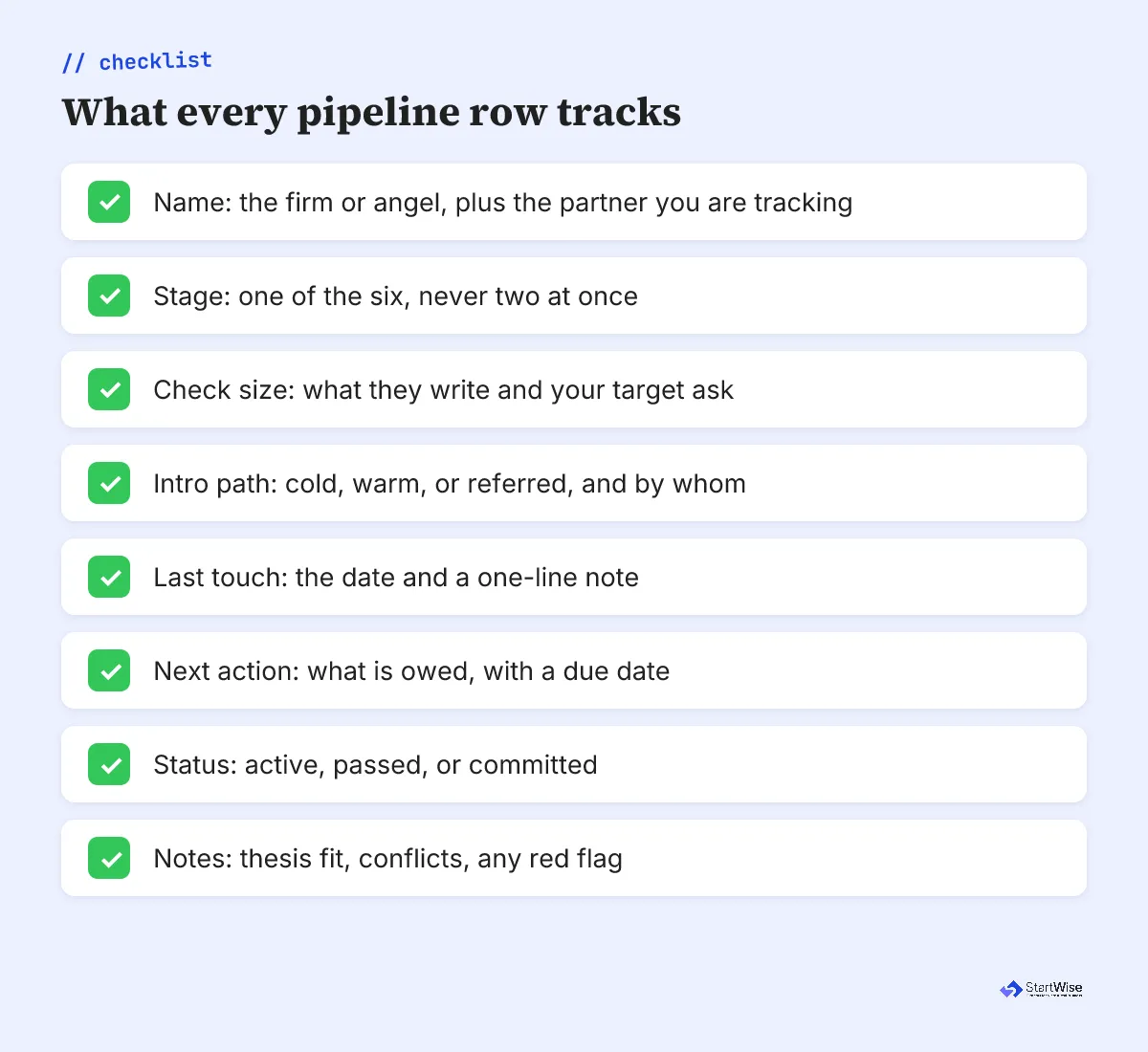
Every row needs eight fields, and no more. The temptation is to add columns until the sheet looks impressive, and a tracker you don’t update is worse than no tracker at all, since every extra field is one more thing to keep current. Resist it.
Here’s the full spec. Copy it straight into a Google Sheet or Airtable and you have your template:
- Name. The firm or angel, plus the specific partner you’re tracking.
- Stage. One of the six below, never two at once.
- Check size. What they typically write, and the amount you’re asking them for.
- Intro path. Cold, warm, or referred, and by whom.
- Last touch. The date and a one-line note on what happened.
- Next action. What you owe them or they owe you, with a due date.
- Status. Active, passed, or committed.
- Notes. Thesis fit, portfolio conflicts, any red flag.
Two of those fields carry the raise: stage and next action. Sort by next-action date every morning and your day plans itself. My honest take, after watching dozens of founders run this, is that the fancy fields like sector tags, fund size, and assets under management are procrastination dressed up as preparation. They feel productive. They close nothing.
What are the six stages of an investor pipeline?
Six stages take an investor from a name on your list to money in the bank: Research, Outreach Sent, First Meeting, Second Meeting, Diligence, and Term Sheet. Techstars frames its worksheet around a similar set, running from “new” all the way to “wired” (Techstars). The stages we see work best keep it this simple, because more stages just mean more dithering about which box a contact belongs in.
- Research. You’ve found the investor and confirmed they fund your stage and sector. No contact yet.
- Outreach Sent. You’ve emailed or asked for an intro. The clock starts now.
- First Meeting. They took a call. A 25 to 35% response-to-meeting rate here is strong; below 15% means your targeting or message needs work (Capwave).
- Second Meeting. They came back. More than half of first meetings that go anywhere reach this stage, so a second meeting is real interest, not politeness.
- Diligence. They’re reading your data room and taking references.
- Term Sheet. An offer, with numbers attached.
Add one bucket outside the funnel: Passed. Don’t delete a no. Investors who pass at pre-seed often lead your next round, and the note on why they passed is worth keeping. Keep the warm ones on your investor update email list so they watch you execute long before that round opens.
Why do most investor pipelines stall?
Most pipelines stall because nobody owns the next move. The stall we flag most: a row sits with a blank next-action field, the founder forgets it, and a warm investor quietly cools while you chase newer, shinier leads. The tracker didn’t fail. The discipline did.
The second killer is tracking the wrong thing. Founders log how many emails they’ve sent and feel busy, but activity isn’t progress. The number that predicts a close is your conversion rate between stages, and you can’t see it if every investor is dumped in one undifferentiated list.
A contact list is a vanity total. A pipeline is a slope.
StartWise's position
Traction is a slope, not a number, and so is your raise. The founders who close read the movement between stages week over week, not the count of names in the sheet. A funnel that narrows 100 to 150 investors down to 1 to 3 term sheets (Capwave, 2026) only works if you watch the slope, not the headcount.
So build the tracker to surface motion. Every Friday, ask one question of each active row: did this investor move a stage this week, yes or no? The names that haven’t moved in two weeks are either dead or waiting on you. Find out which, today.
Spreadsheet stalling? StartWise runs your pipeline as a live tracker and routes you to investors who fund your stage.
Spreadsheet or live tracker: when to upgrade
A spreadsheet is the right tool right up until it isn’t. For most pre-seed and seed raises, a Google Sheet you update daily beats any software you won’t open. Start there. The upgrade question only matters once the sheet starts costing you deals, and our guide to whether you need a fundraising CRM yet walks through the exact breakpoints.
Here’s where it breaks: parallel threads with 80-plus investors, two co-founders editing the same row, reminders you keep missing, and no view of who actually opened your deck. At that point a dedicated tracker or a fundraising portal pays for itself in the deals you’d otherwise drop.
| Google Sheet | Live tracker or portal | |
|---|---|---|
| Cost | Free | Free to paid |
| Setup | Minutes | Minutes |
| Reminders | Manual | Automatic |
| Deck view tracking | None | Built in |
| Best for | Under 50 investors | A busy, parallel raise |
The honest answer for most founders reading this: start in a sheet today, and switch the week it stalls. We’ve watched founders lose a hot lead to a missed follow-up they’d have caught with one automatic nudge. Whichever you pick, the rule holds. The tool you actually update wins.
How fast should the pipeline move each week?
A pipeline only earns the name if it moves every week. Capwave’s 2026 fundraising data puts real numbers on the cadence: research 10 to 15 new investors, send 10 to 15 outreach emails, and book 3 to 5 first meetings every week you’re actively raising (Capwave, 2026). Hold that rhythm and a 100-to-150-name pipeline clears in roughly ten weeks.
| Weekly target | Count |
|---|---|
| New investors researched | 10 to 15 |
| Outreach emails sent | 10 to 15 |
| First meetings booked | 3 to 5 |
The exact numbers matter less than the habit. A raise runs on velocity, and we watch founders stall the week the rhythm breaks. One busy fortnight with no new outreach, and the funnel goes quiet right when momentum should be building.
So guard the outreach block on your calendar the way you’d guard an investor call. That block is the raise.
What to do this week
Set the tracker up before your first investor call, not during your raise. It takes an hour. The founders we see raise fastest already have this sheet built and loaded before they send a single email, so their first week goes to outreach instead of setup.
- Open a Google Sheet and add the eight columns above. Skip every field that isn’t one of them.
- Load 100 to 150 targeted investors who fund your stage and sector. Mark each one’s intro path: cold, warm, or referred.
- Drop everyone into the Research stage and give each a next action with a date.
- Sort by next-action date and work the top of the list first.
- Block 30 minutes every Friday to move stages, kill dead rows, and read your conversion.
Do that, and your raise stops being a pile of half-remembered email threads. It becomes a funnel you can read in one screen, which is the only honest way to know whether you’re on track or quietly running out of names. Build the slope. Then work it.