
 By
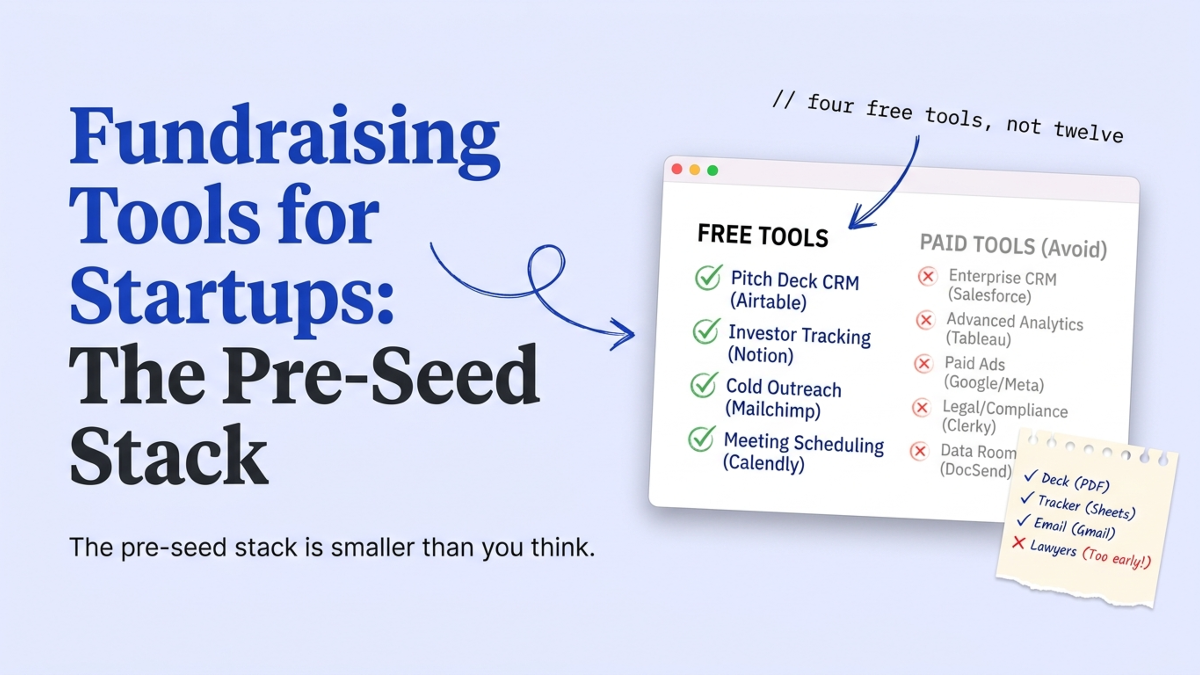
Fundraising tools are the software founders use to find investors, share a deck, track outreach, and manage equity during a raise. At pre-seed, you need far fewer of them than the roundups suggest.
Most lists stack ten or more platforms and tell you to adopt all of them. The real job of a first raise fits in four tools, three of them free. With the average pre-seed instrument on Carta hitting a record $276,000 in Q2 2026, paying $250 a month for tooling before a term sheet is backwards.
What fundraising tools do startups actually need?
Startups raising pre-seed need four tool categories: investor discovery, deck sharing, a lightweight CRM, and a cap table. Everything else on the typical roundup is a nice-to-have or a problem you don’t have yet. Here is how the common options compare, with the all-in-one route in row one and point tools for founders who would rather assemble their own.
| Tool | What it does | Free option | When you need it |
|---|---|---|---|
| StartWise (all-in-one) | Plan, model, deck review, network map, outreach | Yes, Generate my Atlas free → | Day one, if you want one workflow |
| OpenVC | Investor discovery, CRM, deck sharing | Free, 18,408 investors | Pre-seed, right away |
| Papermark / DocSend | Deck-link analytics, data room | Free tier | When investors open your deck |
| Carta / Pulley | Cap table, SAFEs, 409A | Free to 25 stakeholders | After your first SAFE |
| Visible / Foundersuite | Investor updates, CRM | Limited free, then paid | Seed and beyond |
From the raises we review, the honest read is simpler than the roundups make it: point tools each do one job well, and an all-in-one bundles them so you stop stitching logins together. What doesn’t work is paying for five of these at once before a single investor has replied.
Either path works.
Why most pre-seed founders over-tool the raise
Pre-seed founders over-tool because the roundups are written by the tools. The average pre-seed raise is small and short, so a paid stack rarely pays for itself before the round closes.
Carta’s State of Pre-Seed for Q2 2026, summarized by Finro, puts the average instrument at a record $276,000, up 27% year over year, with $3.19 billion raised across more than 11,500 instruments. That is a lot of founders raising a modest first check.
Now look at the advice they get. Papermark’s 2026 guide lists ten tools. Qubit Capital names seventeen and argues that sophisticated founders use sophisticated tools across their whole workflow.
Neither tells you what to skip. So we keep seeing founders sign up for everything, and their attention leaks into dashboards instead of conversations.
StartWise's position
At pre-seed, your tool stack is a rounding error. We review founder decks and fundraising materials every week, and no raise we've seen stalled because of the CRM. Raises stall on a deck that can't earn the second meeting, or an investor list with no warm paths.
The money follows the same logic. A $276,000 raise can’t carry a $250-a-month tool bill and still feel lean to the investor reading your runway.
The four tools worth setting up
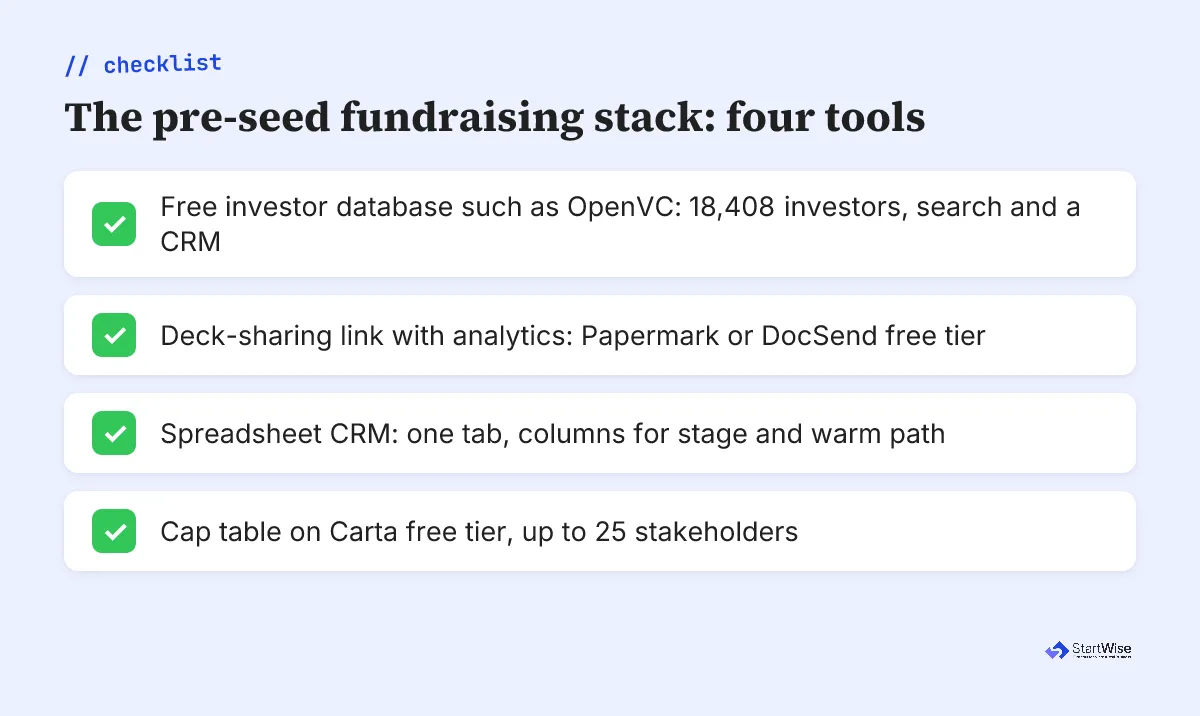
Four tools cover a pre-seed raise end to end: a free investor database, a deck-sharing link, a spreadsheet CRM, and a cap table. Three of them cost nothing, and the fourth is free until you have real complexity. These are the four we set up with founders before anything else, and you can wire them together in an afternoon.
- Investor database. OpenVC lists 18,408 investors for free, with search, a CRM, and deck sharing built in. Waveup’s 2026 review notes that the warm-path column, not the list size, is what predicts meetings. Filter to investors who back your stage and sector, then mark who you can reach warm.
- Deck-sharing link. Papermark or DocSend give you a trackable link on a free tier, so you’ll see who opened the deck and which slide lost them. That signal tells you which investors to follow up with first.
- Spreadsheet CRM. One tab. Columns for investor, stage, warm path, last touch, and next step. A 6-to-8-week raise of 50-plus conversations fits in a spreadsheet long before it needs software.
- Cap table. After your first SAFE, Carta’s free tier handles up to 25 stakeholders, which is plenty when 93% of Q2 2026 pre-seed rounds were SAFEs. Keep it clean from the first check.
If you would rather not wire four accounts together, an all-in-one covers the same jobs. The point is the shape of the stack, not which logo sits in each slot.
What can’t a fundraising tool fix?
No tool fixes the two things that actually gate a pre-seed raise: warm access to investors and a deck that earns the next meeting. Software moves names around a board. It doesn’t get a partner to reply, and it doesn’t make a weak problem slide compelling.
I’ve watched founders with immaculate CRMs raise nothing, and founders with a messy spreadsheet and six warm intros close in a month.
The numbers back the pattern. Qubit Capital’s own guide notes that early founders average 50-plus investor meetings before closing, with a mean seed round taking 5.2 months.
Those meetings come from warm paths, which is why Waveup flags the warm-path column as the one that predicts outcomes. A thousand cold names is a thousand ways to get ignored.
No raise we’ve reviewed stalled because the founder picked the wrong CRM. They stall on a deck that can’t earn the second meeting.
So before you compare tiers, do the two things that move the raise. Map who in your network can open a door, and get your deck read by someone honest. A warm intro beats a perfect outreach sequence, and the tooling is the easy 10% once those are handled.
Warm paths predict meetings more than any CRM. See who in your network can open an investor door.
Which fundraising tools can you skip until later?
Skip the paid upgrades until a free tool visibly breaks. That means no paid investor database, no paid CRM seat, no equity-crowdfunding platform, and no premature data room.
Waveup’s guide puts the upgrade trigger plainly: pay for a database when a team of three uses it weekly, or at Series B when a full deal history starts to matter. Pre-seed is neither.
24 docs
A typical seed data room holds about 24 documents in six folders, and most pre-seed deals close on a deck and a SAFE. Building one before an investor asks is motion without progress. (Papermark, 2026 fundraising tools guide)
The pattern repeats across categories. Revenue-based financing, crowdfunding campaigns, and paid analytics suites all solve problems a pre-seed founder hasn’t hit yet. Our fundraising CRM breakdown walks the spreadsheet-versus-paid call stage by stage, and the data room checklist shows what belongs in a folder once diligence starts.
What to do this week
Build the minimal stack in one sitting, then spend the rest of your time on the parts software can’t do. Here is the order that works.
- Open a free OpenVC account and filter to 40-60 investors who back your stage and sector.
- Add a warm-path column to the list and mark every investor you can reach through a mutual connection.
- Set up one deck-sharing link on a free tier so you can see who opens your deck.
- Start a one-tab spreadsheet CRM with investor, stage, warm path, and next step.
- Hold the paid upgrades. Revisit them only if a free tool is visibly slowing you down.
Then go get the deck reviewed and the intros lined up. That is where a pre-seed raise is actually won. For the full pre-raise sequence, our pre-seed fundraising checklist and how to raise a pre-seed round cover the money and materials side, and the cap table mistakes post keeps that fourth tool clean from the first check.