
 By
Pitch deck storytelling means ordering your slides so each one earns the next, turning ten separate claims into a single argument. It’s not a hero’s journey, and it’s not an emotional roller coaster. We review decks every week at StartWise, and the ones that fall apart almost always have strong individual slides with no single thread running between any of them. The reader builds it alone. In Papermark’s 2026 data, 16% of investor views end within 10 seconds, so most of them never do.
What does pitch deck storytelling actually mean?
Pitch deck storytelling is the order and logic that make your slides add up to one claim: this is worth a meeting. It’s not decoration, and it’s not a literal narrative with a protagonist and a villain. Most advice gets this wrong, and we see the fallout in reviews. It borrows the hero’s journey from screenwriting and tells you to cast your customer as the hero and your own product as the magic sword that finally saves them.
That framing sounds good in a blog post. It falls apart on a screen at 11pm when a partner is clearing their inbox.
A deck’s story is closer to a legal argument than a movie. You state a claim, back it with evidence, and move to the next claim without ever leaving a gap a skeptical reader can quietly fall into. Each slide has one job and one handoff. When the handoff is missing, the investor stops following, and a reader who stops following stops reading.
Why do investors skim your deck instead of reading it?
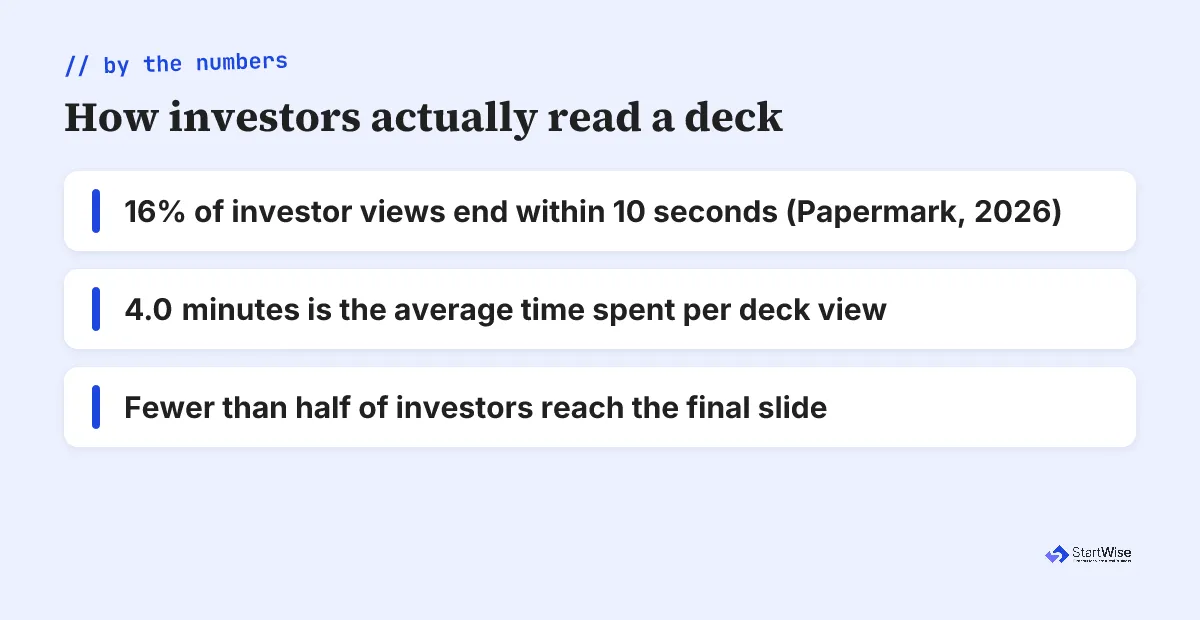
Investors skim because they see hundreds of decks and give each one a few minutes at most. Papermark’s 2026 Fundraising Report, built on 24,541 decks and 358,672 investor views, puts the average at 4.0 minutes per view. The same data shows 16% of those views ending within 10 seconds, and fewer than half of all readers ever reaching the final slide at all (Papermark, 2026). That window keeps narrowing. DocSend’s earlier research already clocked investors at under three minutes on a typical deck back in 2020 (DocSend, 2020).
So the deck is read, not watched. There’s no founder in the room to narrate, to read the mood, to circle back when a face goes blank. The slides carry the whole argument on their own, usually with the sound off and a thumb on the trackpad.
This is the detail storytelling advice skips. A keynote earns 20 minutes of attention and a live performer. Your cold-outreach deck earns a silent skim. For how that attention splits across slides, we broke down the timing in how long investors spend on a pitch deck. The takeaway for narrative is simple: design for the reader who’ll quit at slide three, not the one who stays to the end.
Your deck is an argument, not a hero’s journey
The real narrative is a chain of six questions, each slide answering one and handing the next a reason to exist. Storytelling frameworks like the ones Qubit Capital catalogs (POPP, the six-part arc, the hero’s journey) aren’t wrong so much as aimed at the wrong format (Qubit Capital, 2026). They’re built for a performance. Your deck needs to survive a read.
Here is the chain we look for when we review a deck. Each row is a slide, the question it answers, and the “therefore” it has to hand the next slide.
| Slide | Question it answers | Therefore it hands the next slide |
|---|---|---|
| Problem | Who hurts, and how much? | This is worth solving now |
| Why now | What just changed? | The window is open today |
| Solution | How do you fix it? | It is buildable, and it is yours |
| Traction | Is it working yet? | The risk is dropping fast |
| Team | Why will you finish? | Bet on these people |
| Ask | What do you need? | Fund this specific milestone |
When one “therefore” is missing, the chain breaks and the reader falls through the gap. A gorgeous solution slide means nothing if the problem slide never proved anyone is hurting. And the problem has to be real. A staged one reads as staged. CB Insights’ March 2026 teardown of 431 shutdowns found 43% failed on poor product-market fit (CB Insights, 2026). No amount of narrative can fake demand that isn’t there.
Investors aren’t watching your story. They’re auditing your argument with the sound off.
My honest take: for a pre-seed deck, skip the hero’s journey entirely. The founders who try hardest to be cinematic are usually the ones hiding a thin problem slide behind a big feeling.
Can an investor follow your story from the slide titles alone?
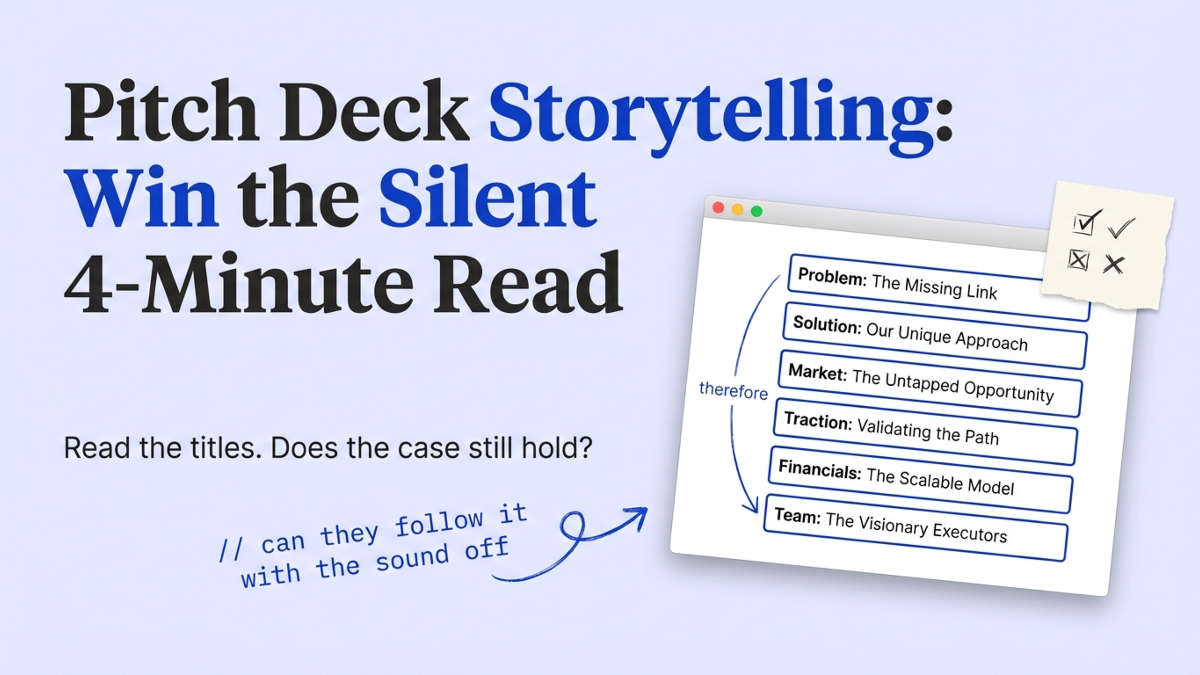
The fastest test of your narrative is to read only the slide titles, top to bottom, and ignore every body. If the titles alone make the argument, the story holds. If they read as a filing cabinet (Problem, Market, Product, Team, Ask), there’s no story, just labels, and the reader has to assemble the thread you were supposed to give them.
StartWise's position
Most pitch deck storytelling advice makes a pre-seed deck worse, not better. Hero's-journey and emotional-arc frameworks add theater that buries the three or four numbers an investor scans for first. After reviewing decks daily, our take is that the ones earning meetings read like a tight argument, not a story: one claim per slide, each handing the next a reason to keep going.
So rewrite every title as a claim, not a category. “Market” becomes “Freight brokers waste 11 hours a week on manual quotes.” “Traction” becomes “Revenue tripled in the last two quarters on zero paid spend.” Now a reader who gives you 30 seconds still leaves with your argument. We cover claim-style titles slide by slide in the pitch deck template breakdown.
Not sure where your deck's argument leaks? Get it read slide by slide.
Where founders break their own narrative
Founders break their own story in a handful of predictable places, and we flag the same ones over and over in reviews. The slides are fine on their own, but they’re wired together wrong. The connective logic is what leaks.
- Emotion where proof belongs: a heartfelt founder origin story on slide two, then a problem slide with no number proving anyone else feels it.
- Features with no “so what”: the product slide lists what it does but never says why that changes the customer’s day. Read our traction slide guide for what counts as proof instead.
- Buried traction: the one graph that is going up in the right direction sits on slide nine, past the point most readers quit.
- A disconnected ask: the raise amount appears with no milestone, so “$750K” reads as a number, not a plan. An ask has to close the argument the whole deck built.
Each of these is a broken “therefore.” Fix the handoff and the story reconnects, usually without adding a single slide.
How to pressure-test your deck’s story this week
We run three fast reads on a deck before it goes to anyone who matters, and you can do all three yourself. None of them take more than ten minutes, and each one catches a different break.
- The title-only read. Hide every body. Read the titles alone. If they don’t make the argument, rewrite them as claims before you touch anything else.
- The “therefore” walk. Put two slides side by side and say “therefore” out loud between them. If the sentence doesn’t make sense, the handoff is missing. Do this for all six pairs.
- The 10-second cut. Give the first three slides to someone cold for 10 seconds, then take it away. Ask what we do and why now. If they can’t answer, your opening loses the 16% who quit early.
Run those three this week, fix every broken “therefore,” and you’ll have something rarer than a pretty deck: one an investor can actually follow at a skim. That’s the whole job. Keep the sound off and see if the argument still stands.