
 By
How long investors spend on a pitch deck is the question founders obsess over, but the data behind it points somewhere more useful. The honest answer sits under two minutes for a cold, first-time read, and it keeps shrinking. We review founder decks before they go out, and the figure people quote back to us is almost always DocSend’s old 3 minutes 44 seconds. That average buries the part that matters. The attention is front-loaded, it moves around, and it’s gone the moment a reader hits a red flag.
How long do investors spend on a pitch deck?
Investors spend under two minutes on a pitch deck the first time they open it. A seed-stage deck now gets about 1 minute 56 seconds of total viewing time, down 24% since 2021, per Spotlight on Startups’ 2026 read of DocSend behavioral data (National Law Review). Older DocSend numbers put the first pass at 3 minutes 44 seconds. Papermark’s 2024 study of 3,000 decks landed at 3.2 minutes (Papermark).
So which is right?
All of them, depending on the deck and the year. The spread from 1:56 to 3:44 is the finding, not a contradiction. A warm, funded deck earns more time, and a cold one from an unknown founder gets a quick scan and a verdict. When we review a deck, we don’t chase a single number, because it misses what every one of these studies agrees on: your window’s short and getting shorter.
So we plan for two minutes, and you should too.
Why investor attention keeps shrinking
Investor attention keeps shrinking because deck supply went up while reader patience went down. Total viewing time on a seed deck has dropped 24% since 2021 (Spotlight on Startups, 2026), and an active VC partner sees somewhere between 200 and 400 decks a month, per TechCrunch data cited in spectup’s analysis. More inbound per reader means they’ll skim faster on each one.
We watch the intro set the clock. Cold decks average 2 minutes 31 seconds and convert to a meeting 3% to 5% of the time; warm-intro decks average 4 minutes 18 seconds and convert 40% to 50% (PitchGrade). A stranger won’t extend much benefit of the doubt, which is the same reason who actually viewed your deck tells you more than a raw open count.
The trend
A seed deck lost about a quarter of its attention in five years, and the slide investors trim first is market context. Every year you plan a raise, assume you've got less time than the founder who raised last year, not more.
Which slides get the most attention?
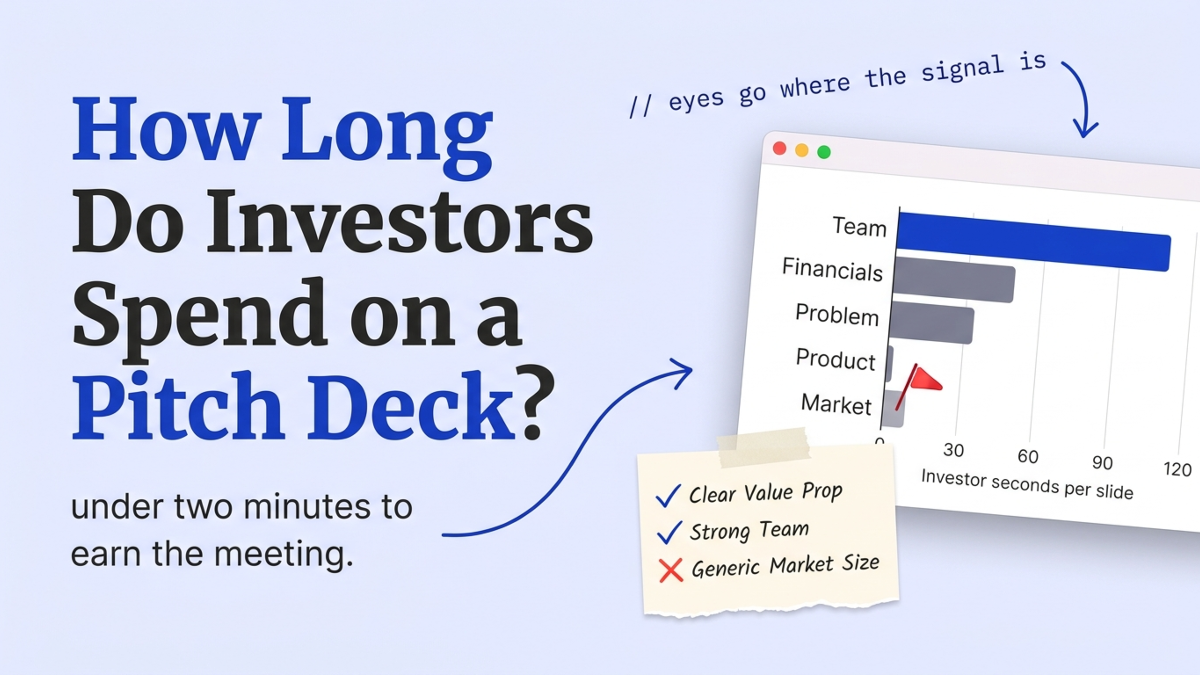
The slides that get the most attention are the team, financials, and problem slides, in that order. DocSend’s 2024 per-slide data gives the team slide about 1 minute 2 seconds, the financials slide 52 seconds, and the problem slide 38 seconds (PitchGrade). Papermark’s 2024 study frames the flip side: 23 seconds on the cover slide, then roughly 15 seconds on each following slide across 8 million data points.
Read those two numbers together and the lesson lands. Most of your slides won’t get more than a glance. A few earn a real look, and they’re the ones carrying proof about the people and the money. Put your evidence there. That same attention curve is how your deck gets scored: the slides investors dwell on carry the most weight in the grade.
| First read | Time on the slide | Source |
|---|---|---|
| The whole deck | Under 2 min to 3.2 min | DocSend, Papermark |
| Cover | 23 seconds | Papermark, 2024 |
| Team | About 1 min 2 sec | DocSend, 2024 |
| Financials | About 52 seconds | DocSend, 2024 |
| Problem | About 38 seconds | DocSend, 2024 |
| Most other slides | About 15 seconds | Papermark, 2024 |
That allocation should decide where your best evidence goes. If your sharpest number is buried on slide nine next to the traction story, it competes with a 15-second glance. We keep pushing founders to move it onto a slide the data says people actually stop on.
Do investors read a deck in order?
No, investors don’t read a deck front to back, and building yours as if they do is the structural mistake we flag most. They scan for signals, jump to the slide that answers the question forming in their head, and stop the moment they find a red flag (Spotlight on Startups, 2026). The read is a search, not a story told start to finish. Nobody reads in order.
That’s why the opening slides carry so much weight. About 31% of investors bounce within the first 10 seconds, and those who make it past slide 3 have roughly an 82% chance of finishing the deck (spectup). Your first three slides are a filter for the other nine.
Your first three slides decide whether the rest get read.
Here’s what a fast reader is actually hunting for on that skim:
- A problem they believe is real, stated in the title, not buried in the body.
- Who you are and why this team, since the team slide pulls the most time.
- One number that suggests the thing is working, wherever you can show it early.
- A reason it’s urgent now, so the deck doesn’t read as a someday idea.
StartWise's position
A deck dies in the first 90 seconds of a skim, so build for the skim first and the deep read second. If reading only your slide titles top to bottom tells the whole story, you pass. If a reader has to open the body text to follow along, you have already lost the fast readers, who are most of them.
Want to know what your deck says in the first two minutes? Get slide-by-slide feedback before you send it.
How to design a deck for a two-minute skim
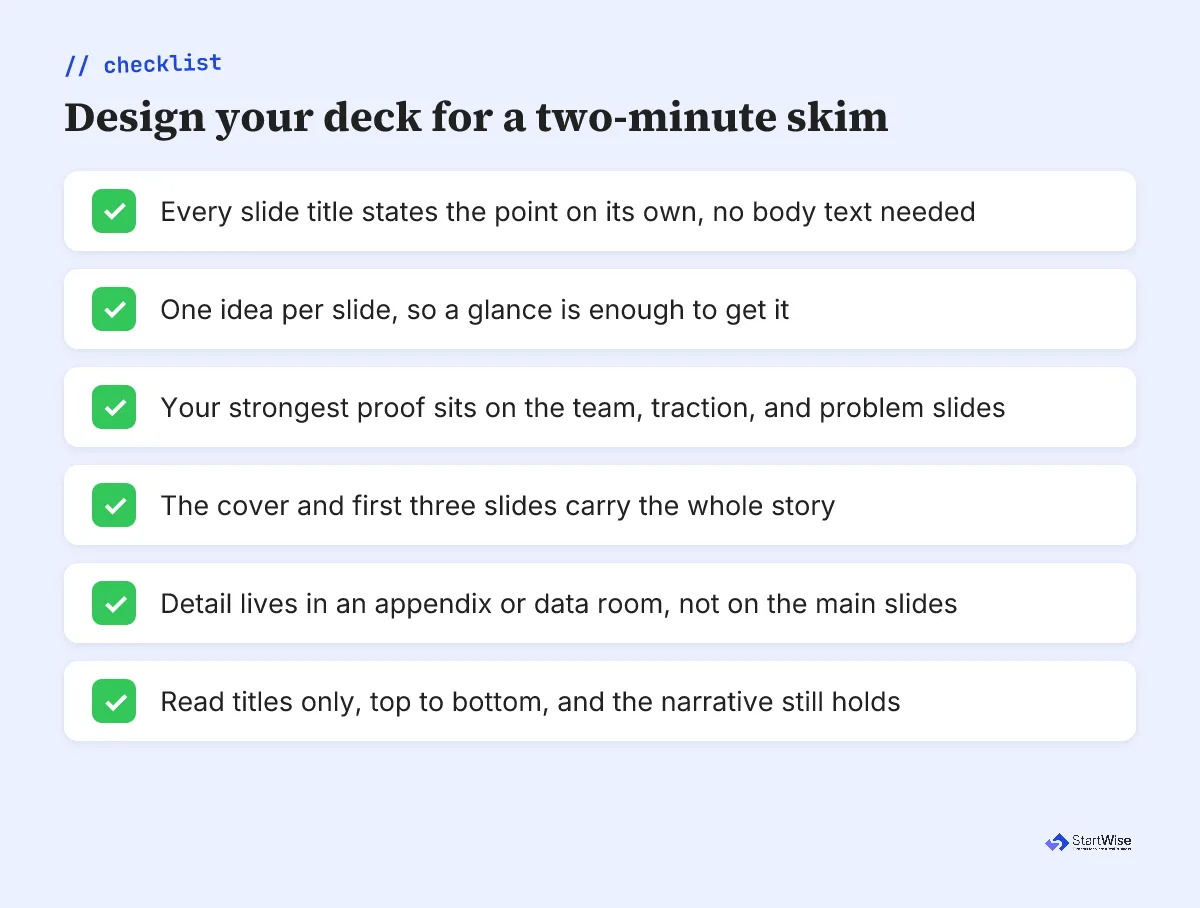
Design a deck for a two-minute skim by making every slide legible at a glance and putting your strongest signal where the eyes already go. The goal is simple to say and hard to do: a reader who only skims your titles should still get the story. I test this on every deck we review by reading nothing but the headlines, top to bottom.
Start with the titles. A slide titled “Traction” tells a skimming investor nothing; a title that reads “Revenue tripled in two quarters on zero paid spend” does the work even if they don’t read below it. Write each title as the claim, not the category.
Then cut each slide to one idea. When a slide argues two things, a 15-second look catches neither. Push the supporting detail into an appendix or your data room, where a genuinely interested investor will go looking, and keep the main flow clean enough to read in a hallway.
Front-load the proof. The how-many-slides math already says you don’t have room to waste, and the attention data says the room you do have sits early. Put your best evidence about the team, the problem, and any traction in the first half, before the reader’s patience runs out.
What to do this week
Run your current deck through the skim, then fix what fails it. It’s the same order I use when we review one, and it won’t take more than twenty minutes.
- Read only your slide titles, top to bottom. If the story doesn’t hold, rewrite the titles as claims.
- Time yourself skimming the deck. If you can’t get the point in two minutes, neither can an investor.
- Find your single best number and move it into the first three slides.
- Cut any slide arguing two things into one idea, and send the rest to an appendix.
- Hand it to someone cold for 90 seconds, then ask what they remember. That’s what an investor keeps.
The founders who win the read aren’t the ones with the longest decks. They just plan for two minutes.