
 By
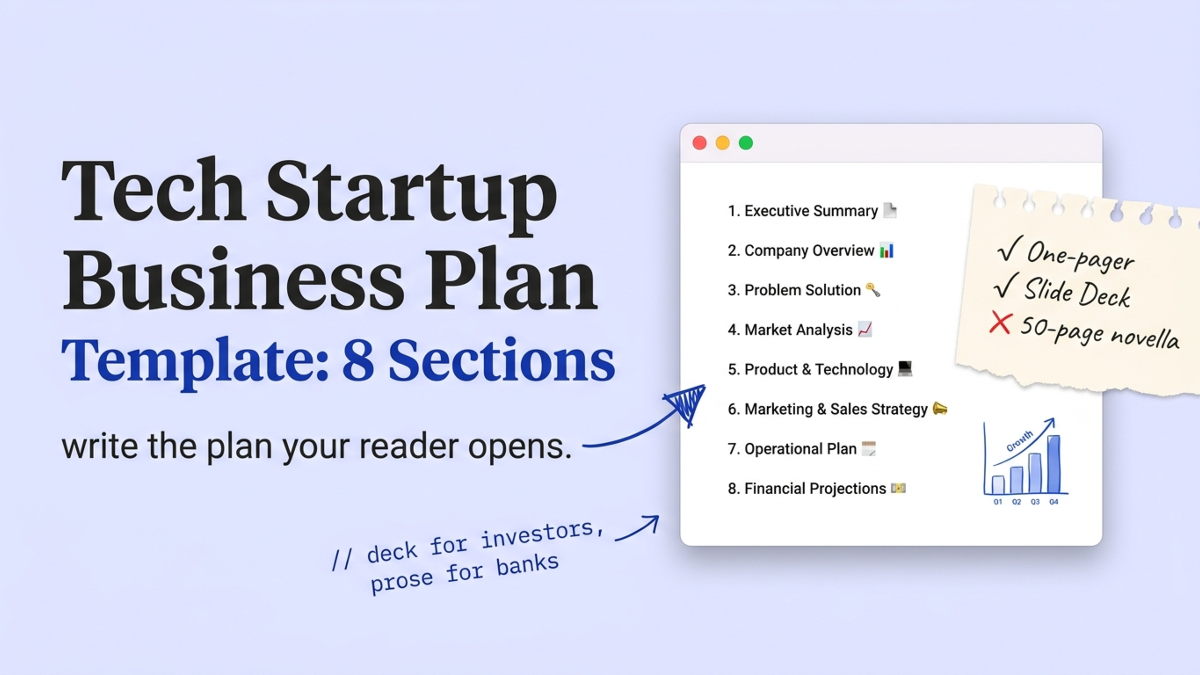
A tech startup business plan template is the reusable structure for the document that explains your company: the problem, the product, the market, the model, and the money. For a venture-backed startup, though, the template you grab online is usually built for a bank loan, not a seed round. We read founders’ fundraising materials before they go out, and the long written plan is almost never what gets someone funded. A deck is. So the first question isn’t which template. It’s which version you actually need.
Do you actually need a business plan for your tech startup?
Most tech founders raising from investors don’t need the 30-page written plan at all. What you need depends on who’s reading, and there are really three documents hiding under one phrase. Pick the wrong one and you’ll lose two weeks writing prose nobody opens.
The mix-up we see most weeks: a founder spends a month on a formal plan, then emails a VC who wanted a deck. Here’s the split.
| Version | Who reads it | What it is | When you need it |
|---|---|---|---|
| Investor plan | A VC or angel | A 10-to-12-slide deck, a one-page summary, a light model | Raising pre-seed or seed |
| Operating plan | You and your team | A lean one-pager of strategy, market, milestones | Always, as a living doc |
| Formal written plan | A bank, grant, or visa officer | A 30-to-40-page document with full projections | A loan, grant, or visa |
For a venture raise, you want the investor version. A deck carries the first read, a one-page summary travels in a cold email, and a light model backs up the numbers. If you want the full case for skipping the long document, we made it in what an investor-ready business plan actually is. The template below works for all three, because the thinking’s the same. Only the format and length change.
What goes in a tech startup business plan template?
A tech startup business plan template has eight sections, and each one answers a single question a reader is already asking. Keep the structure the same whether you’re writing a deck or a 30-page document.
The depth is what flexes.
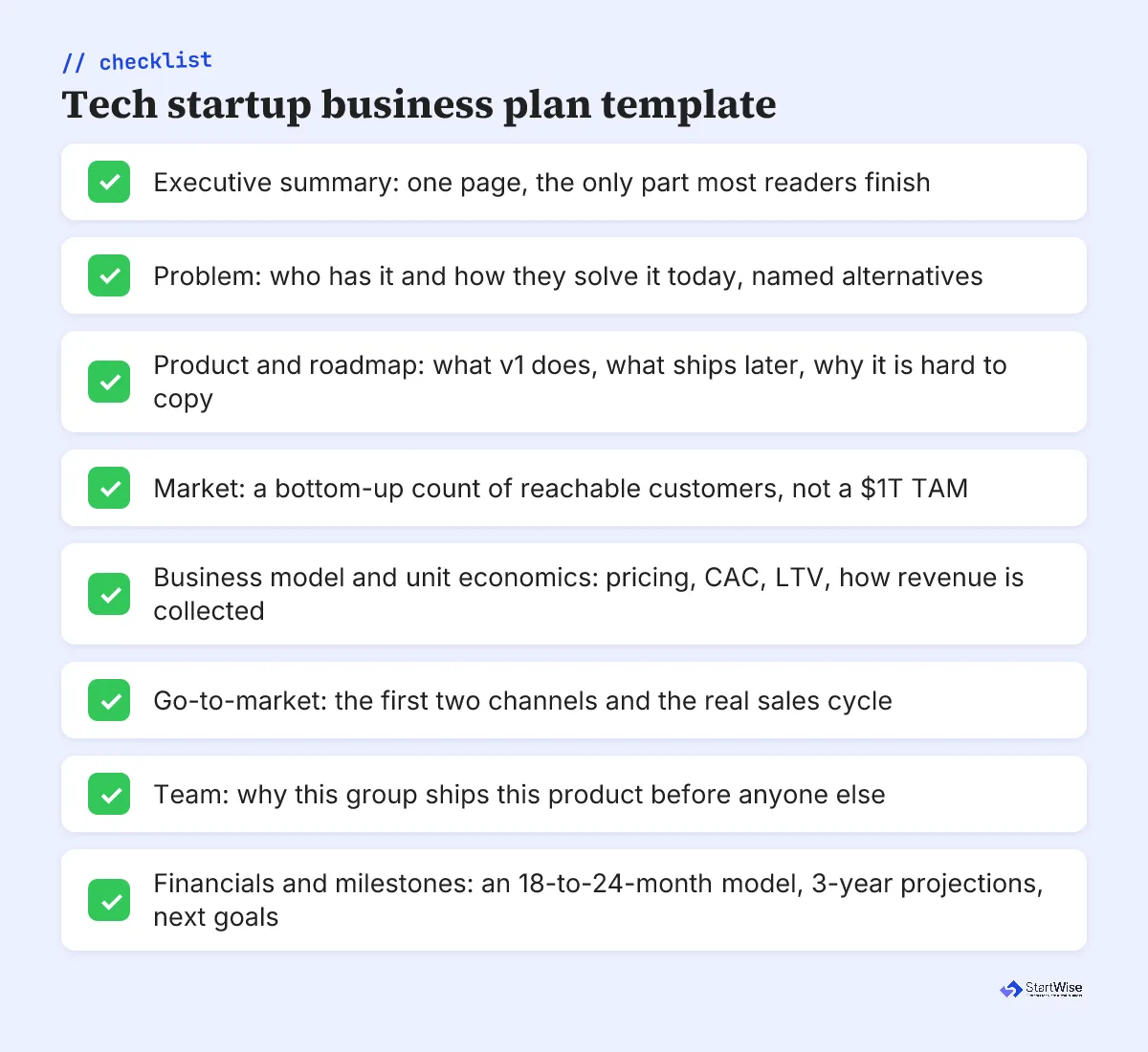
Sequoia Capital’s own plan outline runs a near-identical list that moves from company purpose through market and team to the financials. The firm is blunt about what wins: “it wasn’t really the slides we liked, it was their ideas, the clarity of their thinking, and the scope of their ambition.” I’d frame that as the whole job of the template. It forces clear thinking in a fixed order, so your reader doesn’t have to hunt for your logic.
Two sections are where tech founders either win or wobble: the product roadmap and the unit economics. We’ll take those next.
Which sections matter most to a tech investor?
Three sections carry a tech plan with investors: the product and roadmap, the market, and the unit economics. Nail those and the other five support them. Everyone writes an executive summary. Far fewer write a roadmap that separates what exists from what’s promised, which is exactly the line a technical investor checks first.
The product and roadmap section is the one we see generic templates get wrong. A tech investor wants to know what v1 does today, what ships in the next two quarters, and why the whole thing’s hard to copy once it works. “We use AI” is not a moat. A data advantage that compounds, a workflow customers won’t rip out, or a wedge into a market incumbents ignore, those are. Separate the built from the planned on the page, honestly, because the gap is the risk an investor is pricing.
The market section trips up more founders than any other. A $1 trillion TAM impresses nobody. A bottom-up count of the customers you can reach in year one, with a believable way to reach them, does the work. Investors have seen the top-down slide a thousand times, so a reachable number they can sanity-check earns more trust than a bigger one they can’t.
Unit economics is where a SaaS plan either proves it can make money or waves its hands. Show your pricing, your customer acquisition cost, your lifetime value, and how revenue is collected: monthly, annual, or usage-based. You don’t need five years of it. You need the two or three numbers your business actually runs on, and an honest read on which are measured versus still assumed.
Now the part that reframes all of it. Investors don’t read your plan the way you wrote it. They skim. A full pitch deck gets about 3.2 minutes of total attention, and the first page gets around 23 seconds, per Papermark’s 2024-2025 analysis of 3,000 decks and over 8 million data points. Every section has to make its point to someone moving fast.
A plan that only makes sense if someone reads all of it is a plan built for the wrong reader.
StartWise's position
After reviewing fundraising materials every week, we're convinced investors buy on the skim, not the deep read. The first page of a deck gets about 23 seconds (Papermark, 2024-2025). Your plan earns its keep as your operating doc and the raw material for a deck that survives that first look, not as a document a partner reads end to end.
Got the sections drafted? The problem, market, and ask are your deck now. Run it through the free Pitch Deck Doctor check and see what lands slide by slide.
How detailed should the financials be for a tech startup?
Your financials need an 18-to-24-month model you can defend and a three-year projection that shows the shape, not a five-year fantasy. Early-stage investors care far more about your assumptions than your final-year revenue number. So build year one from the bottom up, and let later years scale off drivers a reader can change and watch.
I keep seeing founders over-build the forecast and under-build the thinking behind it. A tidy spreadsheet that outputs $40M in year five, with no defensible path to the first $40K, reads as fiction. The model’s real job is to output one honest number: monthly burn, and the runway it buys. Match that number to the ask in your deck. For how far out to project and what detail to show by stage, we broke it down in how many years of financial projections investors want, and the full build sits in our startup financial model template.
43%
Poor product-market fit was a factor in 43% of recent startup failures (CB Insights, 2026, from 431 shutdowns). A model built on assumptions nobody tested is how a plan hides that risk instead of surfacing it.why the market and model sections have to be real
The fix is cheap, and it happens before the spreadsheet. A dozen customer problem interviews and a landing page tell you more about year one than a month in Excel, and we walk through the no-build version in how to validate a startup idea.
Test the demand first.
Save the full written plan for banks, grants, and visas
The full written plan is the right tool when your reader is a lender or a program, not a VC. That list is real, and we won’t pretend otherwise:
- SBA and bank loans, which underwrite cash flow and collateral
- SBIR and STTR grant programs, which score a full written proposal
- An E-2 or EB-5 visa petition, which needs a formal plan with projections
If that’s your road, write the long form, and the eight sections you built for investors carry straight over to it.
One nuance worth the ink. The market, product, and financial sections don’t change between versions. Only the packaging does. So do the investor version first even if a grant is coming, because the discipline of fitting your business on a deck makes the 30-page document faster and sharper when you finally need it.
What to do this week
Start by naming your reader, because that decides everything else.
- Decide which version you need: investor, operating, or formal. Most of you need the investor version.
- Draft the one-page summary first. If a line needs a paragraph to defend, the thinking isn’t finished yet.
- Turn those lines into a deck, one idea per slide, and size it against how many slides a pitch deck needs.
- Wire an 18-to-24-month model to two or three drivers, and make its burn number match the ask on your deck.
Then read the whole thing the way we coach founders to, and the way an investor will, at skim speed, and cut anything that doesn’t survive the first 23 seconds. Write the long plan the day a bank or a grant asks. Not before.