
 By
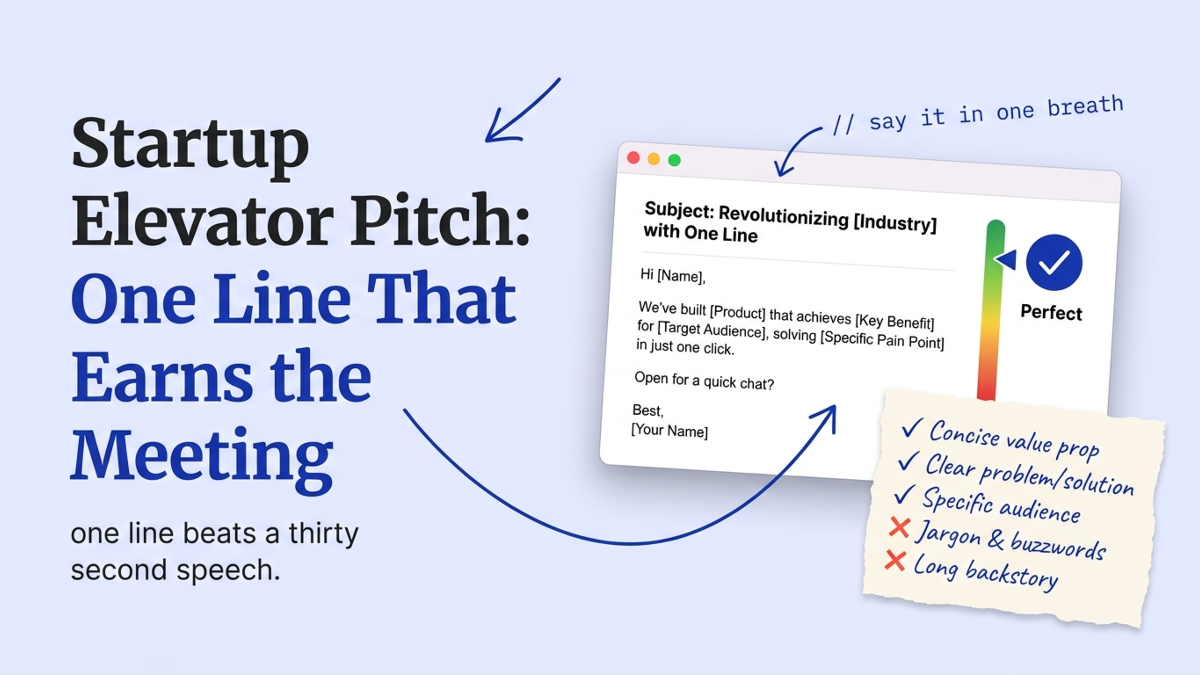
A startup elevator pitch is one or two plain sentences that tell someone what you do, who it helps, and why it matters right now. Think of it as the written line you’d give if an investor asked what you’re working on and you had one breath to answer. Most advice tells you to rehearse a 30-second speech. We read founder decks and cold emails every week, and the pitches that open doors are almost never performances. They’re sentences, skimmed off a screen by a tired investor who gives your first slide about 23 seconds (Papermark, 2024-2025).
What is a startup elevator pitch?
A startup elevator pitch is a one or two sentence summary of your company that a stranger understands on the first read. It names who you help, the problem you remove, and what you do about it. The pitch deck is the long version, 10 to 20 slides an investor reads later (Antler). The elevator pitch is the hook that makes them want the deck at all.
Here’s the part founders miss. The name is misleading. You’ll use this sentence far more in writing than out loud. The strongest version I see does three jobs at once: it titles your cover slide, opens your cold email, and answers the party question at a demo day. Same sentence, three places. If you need three different versions, none of them is sharp enough yet.
Why investors read your pitch before they hear it
Investors read your pitch before they ever hear it. Your first contact is almost always a cold email or a forwarded deck, not a face-to-face minute in a lift. So the sentence has to survive being skimmed on a phone, between two other meetings, by someone who didn’t ask for it. That’s a different job than a speech.
The numbers back this up. Investors give a deck’s first slide about 23 seconds and roughly 15 seconds on each slide after (Papermark, 2024-2025). A full deck gets about 3.2 minutes total. You don’t get a warm room and undivided attention. You get a glance.
StartWise's position
After reading founder decks and cold emails daily, our take is blunt: the elevator pitch is the skim-level sentence, so build it for the investor reading your cover slide in 23 seconds, not for a stage. A line that only lands when you perform it is a line that fails on a phone.
If your pitch only works out loud, it isn’t finished. The investor who funds you will read it before they ever hear you say it.
What goes into a one-line elevator pitch?
A one-line elevator pitch names four things: the audience, the problem, what you do, and why now. Leave one out and the reader fills the gap with a guess, usually the wrong one. You don’t need all four in a single clause. You need them present and plain.
- Audience: the specific person who has the problem, not “businesses” but “solo e-commerce founders”
- Problem: what it costs them in time, money, or risk, in concrete terms
- What you do: the solution in plain words, benefit first and mechanism second
- Why now: the reason this works today when it didn’t three years ago
Here’s the difference between a tagline and a pitch that does the work. A tagline sounds good and says nothing. A working one-line pitch could only ever describe your company.
| What you are writing | Tagline (sounds clever) | One-line pitch (does the work) |
|---|---|---|
| Fintech | ”Banking, reimagined for the bold" | "We give freelancers a business account that files their taxes automatically” |
| Dev tool | ”Ship faster, worry less" | "We let backend teams catch database errors before they reach production” |
| Marketplace | ”The future of local services" | "We match homeowners with vetted plumbers who can come the same day” |
Read the right-hand column again. Each one tells you the customer and the job in under 20 words. The decks we review almost always have the left column on the cover and the right column buried on slide four, which is backwards.
One more trap. The “we’re the Shopify for X” formula, known as the high-concept pitch, works only when both halves are obvious to the listener. Most founders reach for it to skip the harder work of naming the real problem. If your reference company isn’t a household name, the shortcut backfires and the reader is now guessing twice.
How long should an elevator pitch be?
An elevator pitch should fit in one breath, which usually means 20 to 30 words or about 30 seconds spoken. Antler calls 30 seconds the usual rule. Crestmont Capital’s investor guide stretches it to 30 to 90 seconds, with 60 as the target. Both are fine. The seconds aren’t the real constraint.
The better test is written, not timed. Can the sentence fit in an email subject line plus one short line underneath? Can a reader get it without rereading? We’ve watched founders memorize a polished 90-second version, then freeze when someone asks the question cold. If you’re padding to hit a time, you’re adding words an investor won’t read anyway.
Not sure your cover slide says what you do in one line? See how a reviewer reads it, the way an investor does.
How do you test an elevator pitch?
You test an elevator pitch by taking away everything except the sentence. Put it on your cover slide, show it to someone outside your industry for five seconds, then ask them to repeat what you do. If they can’t, the pitch isn’t done, no matter how good it sounds when you say it out loud.
The test I trust most is the phone test. Email the one line to a friend who doesn’t work in tech and wait for the reply. If they guess what you do, ship it. If they ask what you mean, you’ve got cutting to do. This sounds small, yet it catches the single most common problem we flag on a cover: a sentence the founder understands and a stranger doesn’t.
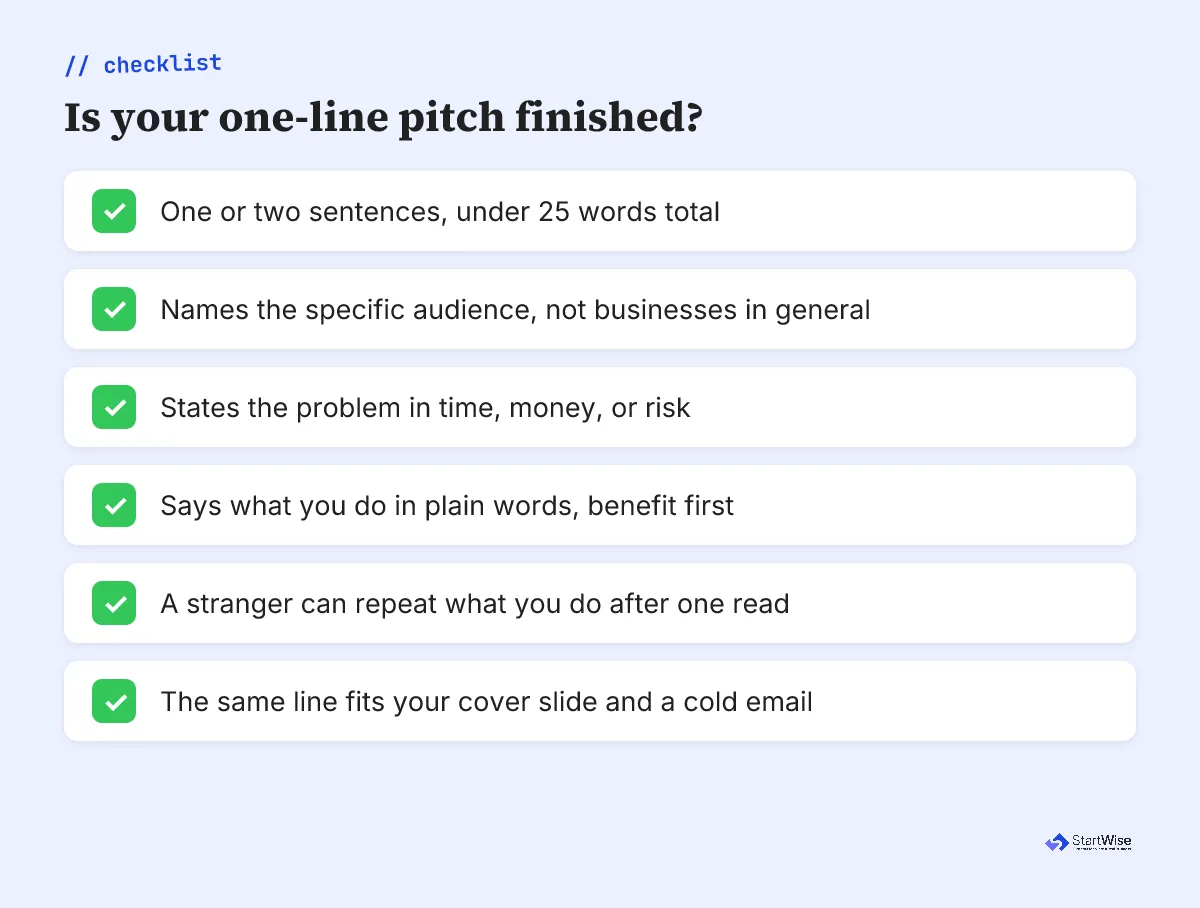
A pitch that passes the phone test also tends to pass what investors look for on the slides behind it, because the clarity carries through.
What to do this week
Here’s the work, in the order I give founders.
- Write one sentence that names your audience, their problem, and what you do. Aim for under 25 words.
- Paste it as the title of your cover slide and the first line of your next cold email. If it doesn’t fit both, keep cutting.
- Read only that slide to someone outside your field. Fix it until they can repeat what you do.
- Once the sentence holds, pressure-test the deck it opens, slide by slide.
Get the one line right and every other slide gets easier to write. Get it wrong and the best deck in the world opens on a shrug. You’ve got one sentence and one breath. Make them unmistakable.