
 By
By 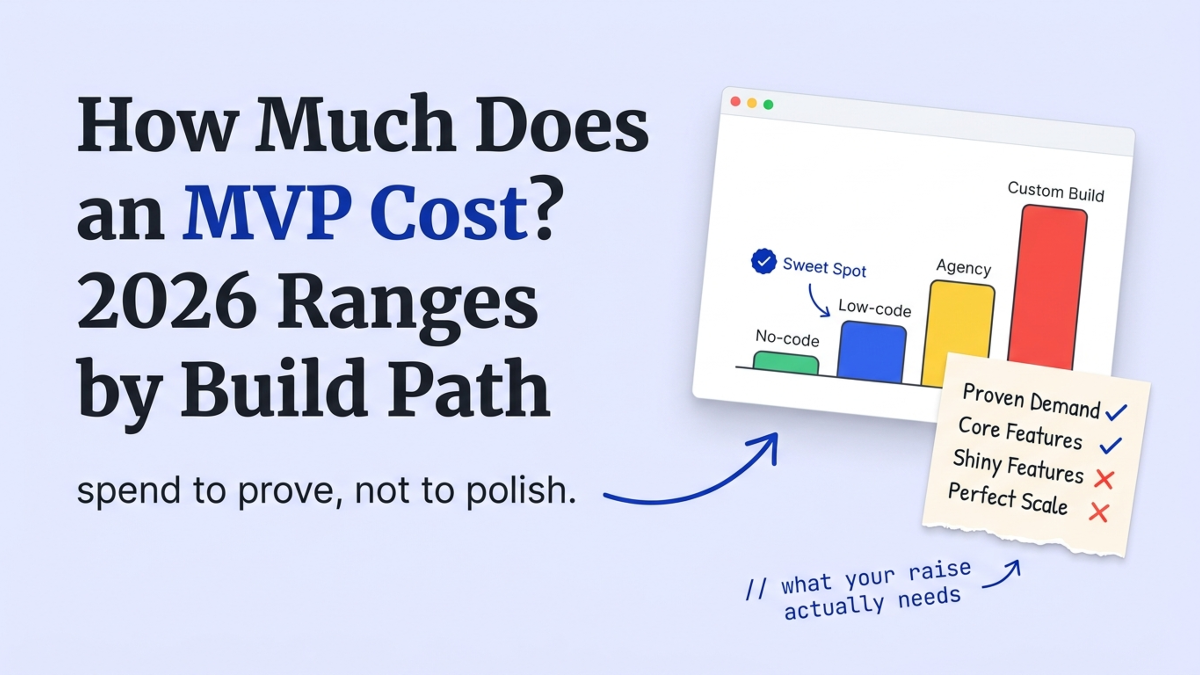
An MVP, or minimum viable product, is the smallest version of your product that tests whether people actually want it. In 2026 it costs anywhere from about $200 to build yourself with no-code tools to $150,000 for a custom-coded agency build (Forcoda). That spread isn’t random. It’s a stack of choices, and most get made before a single line of code. We review pre-seed decks most weeks, and the founders who spent the most building rarely have the strongest traction to show for it.
How much does an MVP cost in 2026?
The honest answer is a range, because “MVP” covers everything from a weekend no-code prototype to a funded, production-ready app. Here’s what each build path actually costs this year, based on current builder and agency pricing.
| Build path | Typical 2026 cost | Timeline |
|---|---|---|
| DIY no-code (Bubble, Glide, Lovable) | $200 to $3,000 | Days to weeks |
| AI-build / no-code agency | $10,000 to $50,000 | 2 to 8 weeks |
| Freelance developer | $10,000 to $40,000 | 1 to 3 months |
| Custom-coded agency | $50,000 to $150,000 | 3 to 9 months |
DIY, AI-build agency, and custom figures come from Forcoda; the freelance range is from Helpware, which puts freelance rates at $30 to $120 an hour. Simpler custom builds can start around $15,000 (Deliverable), but that’s the floor, not the norm.
The tiers buy different things. The $200 no-code build buys a working front door you assemble yourself. The $30,000 agency build buys someone else’s time and a polished result. The $100,000 custom build buys engineering you own outright, which matters once you have real users and real scale. What none of them buy is certainty that anyone wants the product, and that’s the part founders forget they still have to earn. I’ve reviewed plenty of expensive builds attached to empty pipelines, and the invoice never once impressed an investor.
Look at the top of that table. No-code isn’t a toy tier anymore. Gartner projects that 70% of new apps will use low-code or no-code platforms (via Ideas2IT), and the AI-build tools a non-technical founder can run now, Lovable and Bubble and Replit, produce MVPs that pass a first investor look. AI in the build loop can cut development cost 30% to 40% against traditional coding (Helpware), which is why the whole cost curve has bent down since 2023. So the real question isn’t which tier is best. It’s how little you can spend and still prove the one thing your raise needs proven.
MVP costs swing from $200 to $150,000 for one reason: scope
Scope sets the price, not the tooling. The same idea is $500 of no-code or $80,000 of custom engineering depending on how much you insist on building before you have a single user. Every feature you add is money spent, and at pre-seed most of it is spent on a guess.
Three things move the number most. Feature count is the obvious one. Where your builders sit is the quiet one: US and UK developers run $100 to $250 an hour, while Eastern European teams run $40 to $100 (Deliverable). And AI features are the sneaky one, adding 15% to 30% to a budget once you want a real model in the loop (Ideas2IT).
Here’s the reframe I give founders. Each of those line items is a bet you’re funding before the market has voted. A login system, three integrations, a mobile app and a web app: that’s four bets, and you’re paying full price for all of them on the theory that users will care. My honest take is that most pre-seed MVPs are two or three times bigger than they need to be, and the extra scope is anxiety, not strategy.
What does your raise actually require you to build?
Your raise sets your build, not the other way around. At pre-seed, investors are usually funding a team and an insight, not a finished product, so the MVP that earns a check is often much smaller than an agency will quote you. We wrote the longer version of this in do investors expect an MVP, and the short version is: usually not, if the insight is sharp enough.
Seed is where that changes. By then investors want a working product with real usage, so the build has to carry weight a slide can’t. The founders who get this order right spend almost nothing at pre-seed, use the round to build the thing seed investors will actually interrogate, and skip the expensive middle step entirely. The ones who get it backward spend $60,000 proving something a landing page could have told them.
Picture two founders with the same idea. The first spends $500 on a no-code prototype and a week of outreach, learns that buyers want a different feature, and adjusts before spending real money. The second commissions a $60,000 custom build, ships it four months later, and discovers the same thing about demand at ten times the cost, with a codebase now shaped around the wrong bet. Same idea, same market, wildly different burn. The difference wasn’t talent. It was the order they spent in.
The cheapest MVP is the one you never had to rebuild, because you validated the idea before you funded the polish.
This is where the money really leaks. In the decks we review, the emptiest traction slides tend to belong to founders who spent the most building before they tested demand. They confused a finished product with a proven one. Those are different things, and only one of them raises money.
StartWise's position
The most expensive MVP is the one you build for the wrong idea. CB Insights analyzed 431 failed startups in 2024 and found 43% died on poor product-market fit, not weak engineering. A cheaper first build you can throw away beats an expensive one you feel married to.
That 43% figure (CB Insights, via Preuve) is the whole argument for spending less early. The same analysis notes that 70% of failed startups ran out of capital, but calls that the final symptom, not the cause. Money spent building the wrong thing is how the runway disappears. If you’re not sure the idea holds, our guide to validating a startup idea without building anything is the cheaper first move.
Not sure the idea justifies a build yet? The free Idea Pressure Test scores it 0-100 across eleven dimensions, so you spend on what deserves spending.
Three hidden costs that blow past the sticker price
The quote you get is never the bill you pay. Three costs hide behind the sticker price, and they hit hardest on the paths that look cheapest up front.
- Your own time. A DIY no-code build carries a founder-time cost of $9,000 to $36,000 in hours you could have spent selling or raising (Forcoda).
- Security debt from AI code. About 45% of AI-generated code samples contain security flaws (Veracode, via Helpware), so a cheap AI build can turn into an expensive audit later.
- Maintenance. Hosting runs $50 to $500 a month and ongoing maintenance $500 to $5,000 a month (Deliverable), long after the build invoice is paid.
The one that surprises founders most is the rebuild. Forcoda modeled the 18-month total cost of each path, and a poorly executed DIY no-code build that needs rewriting lands at $68,000, or $87,000 if it puts you a year behind. A clean agency no-code build over the same period? $18,000. Cheapest today is not cheapest by the time you raise.
$68,000 to $87,000
is the 18-month cost of a botched DIY build that needs a rewrite, versus $18,000 for a clean agency no-code build. The sticker price and the real price are rarely the same number. (Forcoda, 2026)
So the trap isn’t spending too much. It’s spending twice. I’d rather a founder pay a little more for a build they won’t have to throw away than save $2,000 now and rebuild the whole thing the week before their raise.
Which build path should a founder choose?
Choose the cheapest path that produces the proof your next round needs. For most first-time founders raising pre-seed, that’s a no-code build under $3,000 or a validated waitlist, not a $50,000 custom app you can’t yet justify. Match the spend to the goal, and the goal is evidence.
Here’s the mapping I use with founders:
- Still testing whether anyone wants it: spend under $500 on a landing page and outreach before you build.
- Ready to test a real workflow: DIY no-code or an AI-build agency, $200 to $50,000 depending on polish.
- Raising seed on a working product: a freelance or custom build, once usage justifies the engineering.
Notice what’s missing. There’s no line that says “spend $80,000 to look funded.” Looking funded isn’t the same as being fundable, and investors can tell the difference in about a minute. If money is the constraint, work your cash runway math first, because your build budget is really a slice of your runway, and every dollar in code is a dollar not in the market.
Region is the other lever most first-time founders ignore. The same feature list built by a US team at $150 an hour and an Eastern European team at $60 an hour (Deliverable) can differ by half on the invoice, for work that reaches the same pre-seed bar. That doesn’t mean cheapest wins. It means the geography of your build is a budget decision you get to make on purpose, not a default you inherit from the first agency that answers your email.
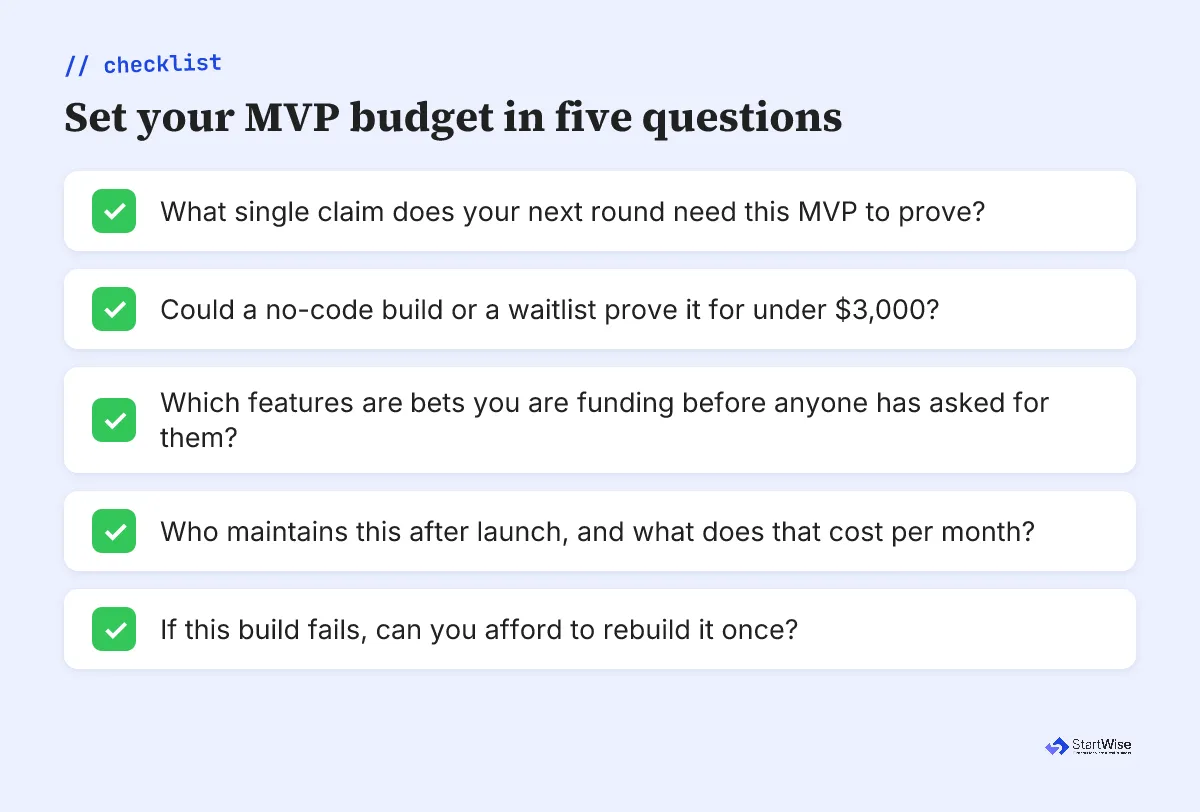
The checklist above is the version I run before a founder signs an agency contract. If you can’t answer the first question, the single claim your raise needs this MVP to prove, no build is cheap, because you don’t yet know what you’re paying to learn.
What to do this week
Set your build budget from your raise, not from an agency quote. Here’s the order I’d give any founder pricing an MVP before a pre-seed round.
- Write the one claim your next round needs proven, then ask whether a no-code build or a waitlist could prove it for under $3,000.
- Price two paths, not one. Get a no-code estimate next to the agency quote so you can see what the extra scope actually buys.
- Add the hidden costs, your time and maintenance, before you commit, so the sticker price isn’t a surprise.
- If the idea itself is still a guess, validate it before you fund it, and put the money you saved toward the raise.
The founders who spend well aren’t the ones with the biggest budget. They’re the ones who know exactly what they’re buying, which is proof, and who refuse to pay for anything else.