
 By
By 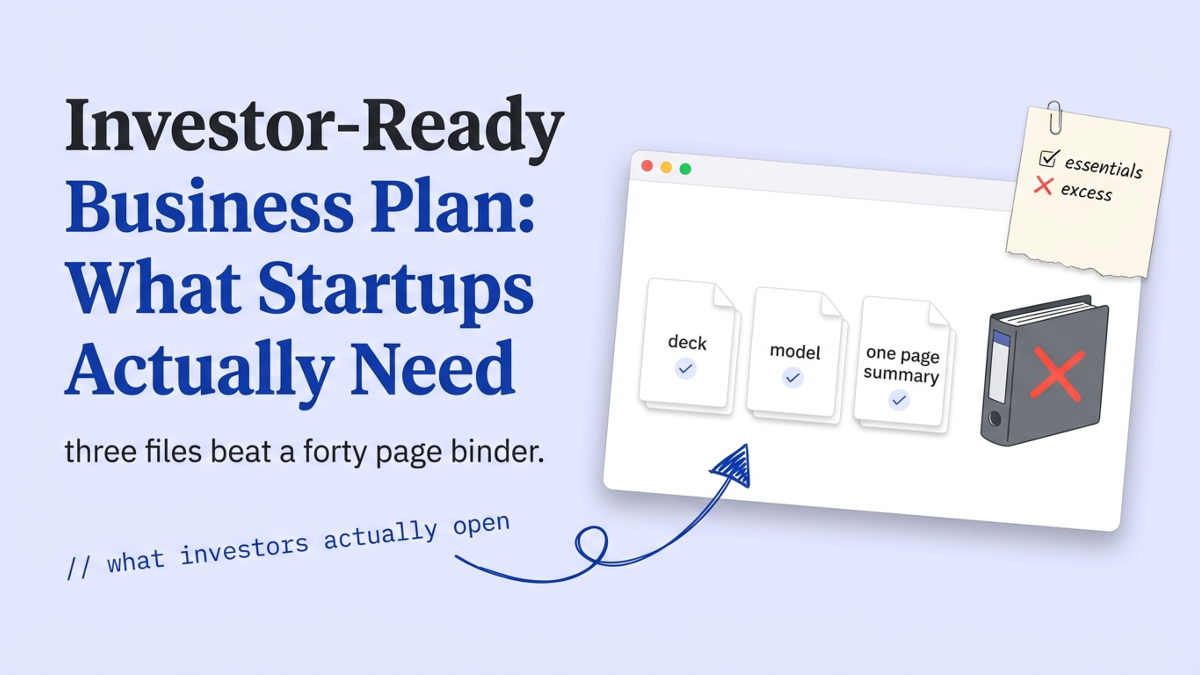
An investor-ready business plan is the set of documents a venture investor needs to decide whether to fund you. For a startup raising pre-seed or seed money, that set is not the 40-page written plan the phrase implies. We read founders’ fundraising materials before they send them, and almost nobody who lands a pre-seed check did it on a business plan. They did it on a deck and a model. The median pre-seed round closed near $500,000 in 2025, per CRV citing Carta, and it closes off a deck.
What does investor-ready actually mean for a startup?
Investor-ready means a venture investor can price the risk and say yes without asking for a document you don’t have. It doesn’t mean a polished written plan. It means three things exist and agree with each other: a pitch deck, a financial model, and a summary an investor can skim in a minute.
The written-plan tradition comes from bank lending. A loan officer reads 30 pages because they price collateral and cash flow, and the plan is the underwriting. Venture works the other way. CRV’s 2026 guide puts it plainly: pre-seed investors underwrite the founder, and they read qualitative signals like customer discovery interviews, waitlist signups, and letters of intent. Kruze Consulting’s pre-seed guide says the same thing in a sharper way, that investors are underwriting the founder rather than a spreadsheet. Neither one asks for a business plan.
Why does the myth persist? Templates. Search “business plan” and you land on tools built for small-business loans, so first-time founders dutifully write 30 pages of market analysis and hiring charts. Qubit Capital names the trap: founders confuse completeness with persuasion, and a data dump reads as exactly that. A venture partner doesn’t want completeness. They want the two or three reasons this could get very big, very fast.
So the two formats answer different questions. Here’s the split we see every week.
| Question | Bank or SBA plan | Venture investor-ready plan |
|---|---|---|
| Who reads it | A loan officer pricing risk | A partner betting on a founder |
| Main document | 30 to 40 page written plan | 10 to 12 slide pitch deck |
| Financials | 3 to 5 year P&L, break-even | 18 to 24 month driver model |
| The yes rests on | Collateral and cash flow | Team, market, early signal |
StartWise's position
If an investor has to open a 40-page plan to understand your business, the deck already failed. The plan is not the safety net for a weak deck. It's a different document for a different reader, and pre-seed rounds near $500,000 close without one.
The three documents investors actually read
The three documents are a pitch deck, a financial model, and a one-page executive summary. Get those three saying the same thing and you’re investor-ready. Miss the alignment and a partner spots it in the first five minutes.
Alignment is the quiet test. If the deck promises $50K MRR in 12 months and the model shows $20K, a partner stops reading your story and starts auditing your math. Same numbers, same milestones, same ask, across all three. That consistency is most of what “ready” actually means.
- The pitch deck is the document that gets read first, and often the only one read before a partner decides to take a call. Keep it to 10 to 12 slides: problem, solution, market, product, traction, model, team, and the ask. Qubit Capital ranks team quality as the top factor investors weigh in pre-seed and seed decisions, so the team slide earns real space.
- The financial model is not a five-year fantasy. It’s an 18-to-24-month model built on two or three drivers an investor can change and watch. It exists to show you understand what your business runs on, not to predict 2031.
- The one-page executive summary is the single written artifact that still matters. It’s what you paste into a cold email or hand to an analyst, and it links out to the deck and the model.
Behind those three sits a data room, the folder of incorporation docs, cap table, and contracts a partner opens during diligence. You don’t send it cold. You have it ready so a yes doesn’t stall.
One more reason the deck wins: it travels. A partner who likes it forwards it to the rest of the firm, and it has to make your case with you not in the room. A 40-page plan doesn’t get forwarded. It gets skimmed once and filed. Build the document that survives the hallway conversation you’ll never hear.
My honest take after enough reviews to lose count: founders spend weeks writing prose nobody reads and an afternoon on the deck everybody reads. Flip that ratio.
A partner reads your deck in five minutes and your written plan never. Build for the five minutes.
How much detail do pre-seed investors expect?
Pre-seed investors expect less written detail than founders think, and more evidence than a template asks for. The bar is set by stage, and in 2026 the two stages want different things. Pre-seed buys belief. Seed buys proof. We keep seeing founders over-build the forecast and under-build the story, which is backward for the stage they’re at.
What does buying belief look like in practice? An investor reads your problem, your background, and your why-now, then asks one quiet question: is this person likely to figure it out? Every document exists to make that answer obviously yes. That’s why a sharp founder story beats a polished five-year P&L this early.
At pre-seed, the round is small and the story carries it. CRV pegs the median pre-seed round near $500,000 at an $8.3 million pre-money valuation, with SAFEs making up roughly 90% of deals, and notes pre-seed deal sizes climbing 42.3% year over year in Q2 2025. Kruze puts the typical range at $250,000 to $2 million. At that stage, a working prototype, a waitlist, and three signed letters of intent tell an investor more than any forecast. Read the stage math in pre-seed versus seed funding.
The cap scales with the check. Kruze lists valuation caps stepping from $8 million under a $250K round to $15 million at a $1M to $2.4M round, and PitchBook clocked median pre-seed pre-money at $7.7 million in Q4 2025, close to CRV’s $8.3 million read. The exact figure drifts quarter to quarter. The point holds. These are small, fast rounds, and nobody is grading a five-year forecast to write one.
At seed, the questions harden. CRV says seed investors want a working product, paying customers, and the early shape of a repeatable acquisition motion: customer acquisition cost, lifetime value, burn rate, and CAC payback. Median seed dilution for software companies runs near 20%, per Carta’s Q1 2025 data via CRV. The model stops being a story and starts being a claim you can defend line by line.
For scale, VCs deployed roughly $300 billion globally in 2024, per Qubit Capital. That money moved on decks and data rooms. It didn’t move on 40-page written plans.
~20%
Median seed dilution for software companies, per Carta Q1 2025 (via CRV). The most common miss we flag: a beautiful 30-page plan next to a deck that contradicts it. Wasting a partner's first five minutes on the wrong document is expensive equity.from what we see in reviews before founders send
The deck is the plan investors read first. If yours isn't sharp, the model behind it never gets opened.
Write the one-page executive summary first
Write the summary before the deck, because it forces the decisions the deck then illustrates. One page, seven lines, no adjectives you can’t defend. If you can’t fit the business on a page, you haven’t found the business yet.
Here’s the shape we hand founders. Each line is one sentence.
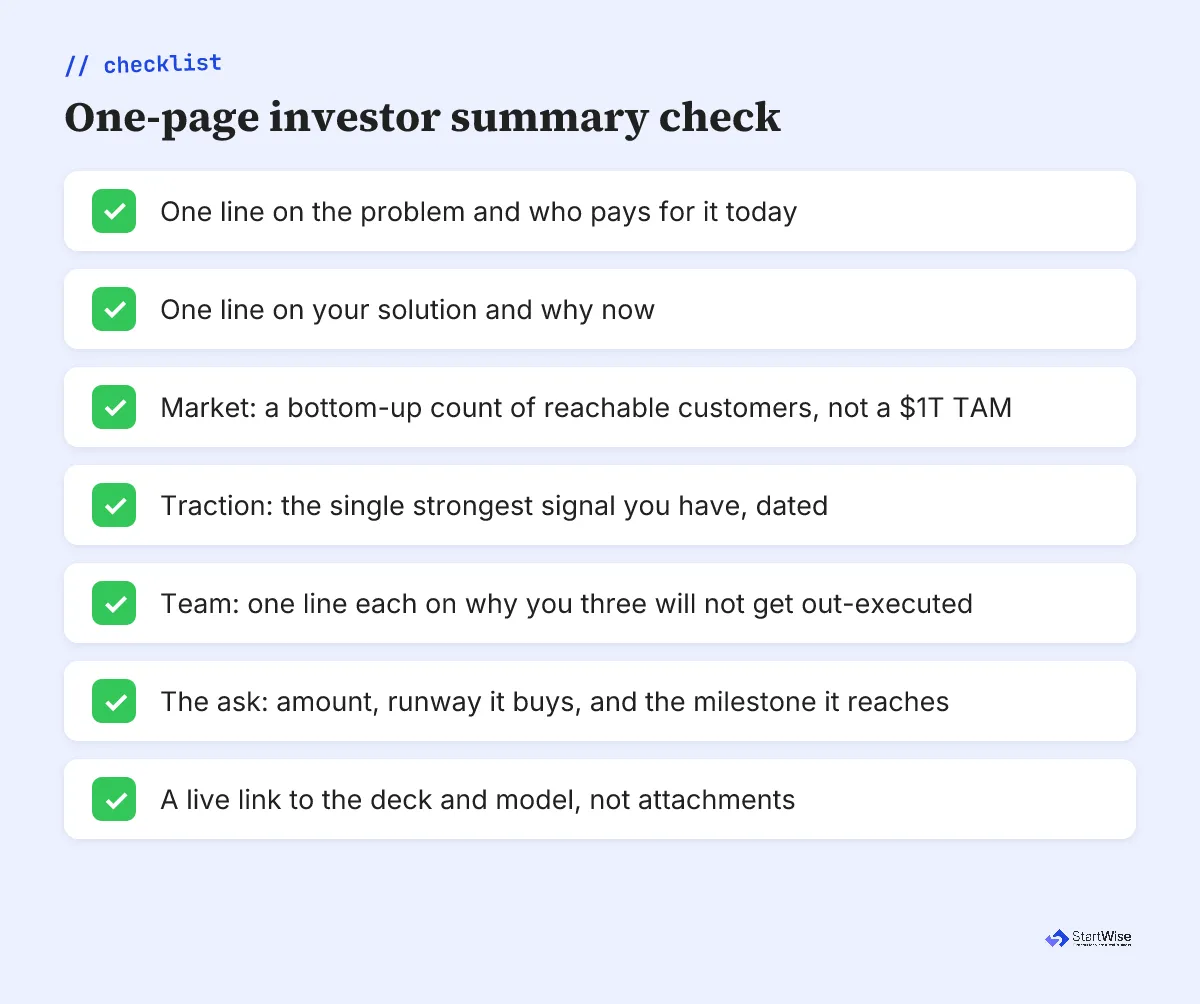
The traction line rewards honesty over volume. One dated, verifiable signal beats a wall of vanity metrics: a signed pilot, a 30% week-over-week waitlist climb, a design partner paying to try it. Pick the strongest true thing, date it, and an investor will trust the second-strongest without checking.
The market line trips up the most people. A $1 trillion TAM impresses nobody. A bottom-up count of the customers you can reach in year one, with a believable way to reach them, does the work. The ask line is the second-most-fumbled: “$500K to accelerate growth” is wallpaper, while “$500K for 18 months of runway to reach $50K MRR” is an actual ask tied to a milestone that de-risks your seed. Tie the money to the next round, every time.
Once the summary holds up, the deck writes itself and the model has a spine. That’s the order. Summary, then deck, then model, then data room. Work it backward from what an investor opens first.
When do you still need a written business plan?
You still need a written business plan when the reader is a lender or a program, not a venture investor. That’s a real list, and we won’t pretend otherwise. Bank and SBA loans require the traditional 30-to-40-page document. So do federal grant programs like SBIR, an E-2 or EB-5 visa petition, most franchise disclosures, and any traditional bank line of credit. If that’s your road, the long document is the right tool, and the market and financial sections you built for investors carry straight over to it.
There’s a sensible middle too. LivePlan argues for a “lean plan,” a short internal document that captures your strategy, market, and milestones without the 40-page bulk. As an operating tool for yourself, that’s fine, and it feeds straight into the deck and model. Just don’t confuse it with what a Series A partner requests during diligence, which is the model and the data room, not prose.
Most first-time founders raising from angels and pre-seed funds should skip the traditional business plan entirely. Write it the day a bank or a grant asks. Not before.
What to do this week
Start with the one-page summary, because it exposes every weak assumption in an afternoon.
- Draft the seven-line summary. If a line needs a paragraph, the thinking isn’t done.
- Build the deck from those seven lines, one slide per idea, and check it against the pre-seed fundraising checklist.
- Wire an 18-to-24-month model to two or three drivers, and make sure its numbers match the deck’s ask.
- Assemble a light data room so a yes never waits on paperwork.
Then run the whole thing the way we coach founders to, and the way an investor will, in the order laid out in how to raise a pre-seed round: skim the deck cold, open the model only if the deck earns it. If the deck can’t carry the first read on its own, no written plan is going to save it. That’s the honest test, and it’s cheaper to fail it at your desk than in a partner meeting.