
 By
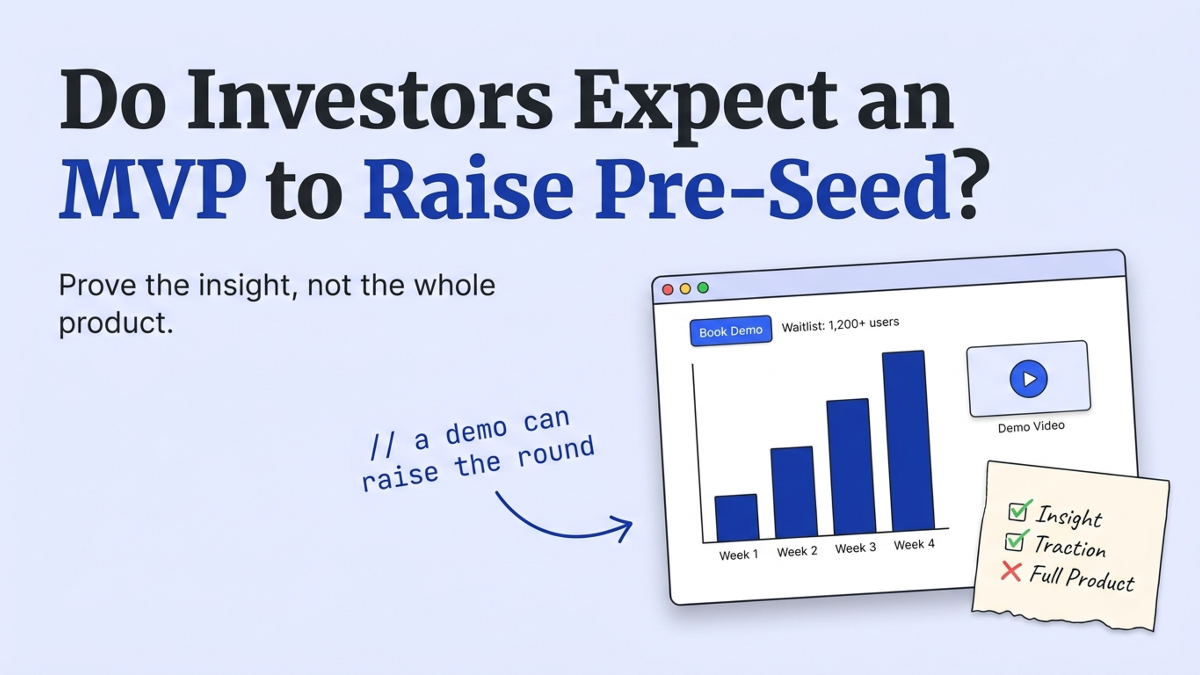
An MVP, a minimum viable product, is the simplest working version of your product that delivers its core value. The question we get asked most before a raise is whether investors expect one at pre-seed. Usually they don’t. We review pre-seed decks every week at StartWise, and the rounds that close are funded on a team and a sharp insight, not a finished app. The median US pre-seed closed at a $7.7 million pre-money valuation in late 2025 (PitchBook-NVCA, via Kruze). Here’s what actually moves an investor, and when a build earns your weeks.
Do investors expect an MVP at pre-seed?
Most pre-seed investors don’t expect a finished MVP, and plenty back founders with nothing built yet. A pre-seed round exists to buy you the time to build. That’s the whole point of the money.
Antler makes the case plainly: a growing number of startups raise pre-seed on a team, an idea, and a deck, then build the product with the round. Asana raised $10 million before it had an MVP, and Jet.com raised $140 million pre-MVP on founder track record and a market need that spoke for itself (Antler). The dollar amounts are outliers. The principle underneath them isn’t.
So the honest answer depends on what your build actually de-risks. The founders we review rarely ask that before they start coding. If the risky question is whether anyone wants this, a product doesn’t answer it. If it’s whether the thing can even be built, a prototype might.
Build to kill your riskiest assumption, not to look busy.
What do pre-seed investors actually fund?
Pre-seed investors fund three things: the team, the insight, and evidence the insight is real. Kruze Consulting’s 2026 pre-seed data lists a working product as one readiness signal, then notes some funds invest pre-revenue when top-tier operators are lined up to join (Kruze). The product is one lever among several. For first-time founders, it’s rarely the one that’s missing.
The evidence that moves a pre-seed check usually looks like one of these:
- Founder-market fit: you’ve lived this problem and it shows
- A demand slope: a waitlist or signups climbing week over week
- Commitment: signed letters of intent, deposits, or paying pilots
- A demo that makes the core insight click in seconds
In our review room, the gap that sinks a pre-seed deck is almost never a missing feature. It’s a problem slide that doesn’t prove the pain is real, or a team slide that reads like a resume instead of an answer to “why you.”
Who you pitch shifts the bar too. Angels often back a person and a problem they believe in, sometimes on the idea alone. Institutional pre-seed funds lean harder on evidence. The smaller and earlier the check, the more a sharp story can carry it. Read the investor before you decide what to build.
The bar is concrete. US founders raised $10.4 billion of pre-seed cash in 2025 across 50,316 SAFEs and notes, and about 45% of those rounds came in under $250K (Kruze). Money that size buys 12 to 18 months to find product-market fit. It isn’t a reward for having already found it. If you want the full sequence, our pre-seed fundraising playbook walks the timeline end to end.
That changes what you owe an investor.
What kind of MVP actually raises money?
The MVP that raises money is a different artifact from the MVP you build for users. One proves your specific insight to an investor skimming a deck. The other is a product real customers log into every day. Founders blur the two, and it costs them weeks and often tens of thousands of dollars.
The two optimize for opposite things. A product for users has to survive real load and messy edge cases without breaking. A proof for investors has to do one thing: make your core insight undeniable in a few seconds. Chasing reliability before you’ve raised is polishing a car nobody has agreed to buy.
An investor gives your deck about 3.2 minutes, roughly 15 seconds a slide, with more than twice that on the first page (Papermark, 2024-2025). Whatever you built has to land inside that skim. A working app they’ll never open during a three-minute read does nothing for you. A 30-second demo of the one thing that makes you different does everything.
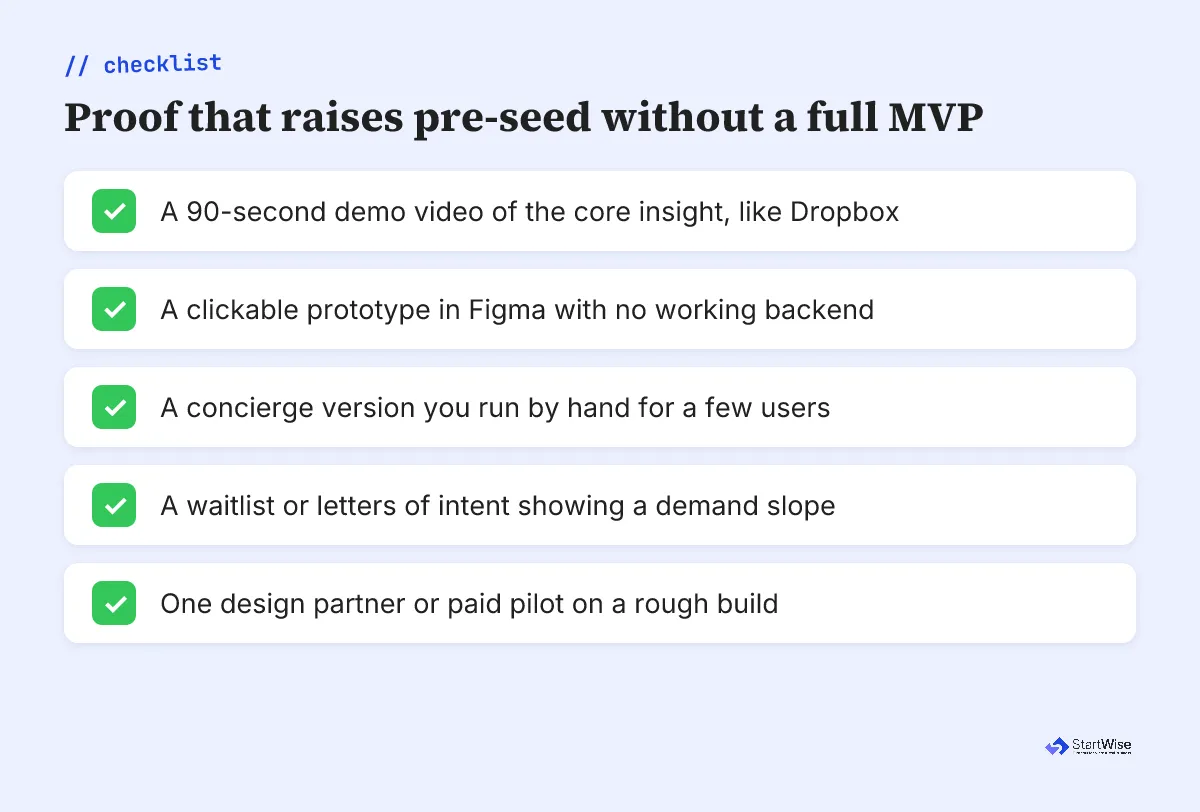
Dropbox is the cleanest example. Drew Houston didn’t ship a product to raise. He posted a demo video of how file sync would feel, and the waitlist jumped from 5,000 to 75,000 signups overnight, per CRV. The video was the MVP. It proved the insight, and the insight raised the round.
StartWise's position
At pre-seed your deck has one job: earn a 20-minute call. So the MVP you need is the sharpest possible proof of your insight, not a shippable product. Build the demo that survives a three-minute skim, and leave the roadmap for after the check clears.
This is why we tell founders to build for the deck first. A clickable prototype, a concierge version you run by hand, a short screen recording of the core flow: each can carry your insight into that skim. Your early signal belongs on the traction slide, read as a slope, not a total.
The concierge route is the most underused. DoorDash started by taking orders through a plain landing page and delivering by hand, long before it built any logistics software, per CRV. You can fake the backend, run the thing manually for ten users, and prove people want the outcome without a real product behind it. That evidence lands in a deck. A half-finished app usually doesn’t.
Building an MVP before you pitch? Make sure the deck proves your insight first. The free Pitch Deck Doctor check gives you slide-by-slide feedback in minutes.
When do you actually need a working product?
You need a working product when the build itself is the risk, or when you’ve moved past pre-seed. Deep tech, regulated markets, and hard technical bets are the clear cases: when “can this be built” is the open question, a prototype answers it (Antler). And by seed, the bar shifts.
Watch this exception, though. Plenty of founders use “our product is technically hard” to justify months of building when the real risk was demand all along. If a competent engineer would nod and say your feature is buildable in a sprint, feasibility isn’t your risk. Demand is.
CRV puts it directly: seed rounds now typically want meaningful ARR or strong usage before they close, while pre-seed can still open on a well-executed MVP and clear learning velocity (CRV). Emvigo, an MVP development shop, agrees from the other side of the table: pre-seed backs teams with qualitative validation, and seed needs quantitative proof. The two stages ask for different things.
| Pre-seed | Seed | |
|---|---|---|
| What gets funded | Team and insight | Working product and traction |
| Product bar | Demo or prototype, sometimes none | Live product with real users |
| Proof investors want | Demand signals, founder-market fit | Meaningful ARR or strong usage |
| Typical valuation | $7.7M pre-money median | Higher, revenue-driven |
So the timing question isn’t whether you need an MVP. It’s what your next round’s investor needs to see, and the cheapest thing that proves it. Once you have one, our MVP checklist before pitching investors scores whether its evidence is ready to send. For most pre-seed founders that’s a demo and a demand signal. For most seed founders it’s a live product with retention. The founders I watch get this wrong build a seed-grade product on a pre-seed timeline, then run out of runway before they can raise on it.
The runway trap: building before you pitch
The trap is spending your scarcest resource, the weeks before a raise, on the wrong artifact. A half-built app nobody outside your team has seen doesn’t retire the risk investors actually worry about, which is whether anyone wants the thing at all. We see this most in technical founders, who default to building because it’s the muscle they trust.
A working app your investors never open is the most expensive way to say nothing.
Every week you polish a product you can’t yet put in front of buyers, your runway shrinks and your options narrow. A $1M-to-$2.4M pre-seed round costs about 19 to 20% of your company in dilution (Kruze), and only about 30% of pre-seed startups reach Series A within two years. Those odds reward founders who spend pre-raise weeks proving demand and sharpening the pitch, not shipping features on a hunch. Runway is the one input you can’t raise more of.
If you haven’t proven anyone wants this yet, a build is the slowest, priciest validation there is. Prove demand without building first, then build only the minimum that carries your insight into the deck.
What to do this week
Before you write another line of code this week, decide what your build actually needs to prove. Then build only that.
- Name your riskiest assumption. Is it demand, or feasibility? Only feasibility bets need a working product now.
- If it’s demand, gather proof that fits a slide: a waitlist slope, three signed letters of intent, or a short demo of the core flow.
- Put that proof on your problem and traction slides, using our pre-seed deck examples as a model, then test the whole deck against a three-minute skim.
- Build the product after the round, or after real buyers commit money, whichever comes first.
The founders who raise fastest, in our experience, built the least and proved the most: one sharp signal, put where an investor could see it in three minutes.