
 By
By 
A pre-seed round is the first organized outside capital a startup raises: typically $750K-$1.5M on a SAFE, closed before there’s much product and usually before any revenue. Investors at this stage underwrite a team and a thesis, not a P&L, and most don’t expect a finished MVP to write a check.
Most advice on raising one is evergreen, and quietly dateless. The market underneath it moved through 2025. We review pre-seed materials every week at StartWise, and the founders who struggle aren’t short on advice; they’re running a 2021 playbook into a 2026 market. If you haven’t settled whether to raise at all, weigh it against bootstrapping first before you start.
Here’s the current playbook: real numbers, a 12-week process, and what the rejections mean.
What counts as a pre-seed round in 2026?
A pre-seed round in 2026 typically means $750K-$1.5M on a post-money SAFE at a $5-6M valuation cap, closed on team, thesis, and early demand signals rather than revenue. The median sits at roughly a $1M SAFE, per Trace Cohen’s May 2026 stage-by-stage breakdown at Value Add VC, built on Carta and PitchBook data.
Two terms carry the whole stage. A SAFE (simple agreement for future equity) is a short standard contract: the investor wires money now and receives shares when a later priced round sets the price. The post-money valuation cap is the ceiling that conversion price can reach. Raise $1M on a $5-6M cap and you’re selling roughly 15-20% of the company (Value Add VC, 2026).
Compare it with the seed round it leads to:
| What investors expect | Pre-seed (2026) | Seed (2026) |
|---|---|---|
| Typical round | $750K-$1.5M, median ~$1M | $2.5M-$3.5M, median $3.2M |
| Valuation | $5-6M post-money cap | $12-15M post-money |
| Dilution | 15-20% | 20-25% |
| Lead check | $250K-$750K | $500K-$2M |
| Proof required | Team, thesis, demand signals: waitlist, signed letters of intent (LOIs), pilots | Roughly $50K-$200K ARR or equivalent usage depth |
Every row comes from Value Add VC’s 2026 benchmarks.
What separates those columns is proof; the paperwork barely changes.
Everything investors forgive at pre-seed, they invoice for at seed. We keep seeing founders read that proof row as a formality, and it isn’t one.
The right pre-seed ask is the one that buys the seed-stage evidence.
The 2026 pre-seed market in five numbers
The market founders are raising into is standardized on SAFEs, stable in total size, and increasingly split between the very small and the very large. Five Carta-tracked numbers, summarized by the Flux team from Carta’s Q1 2026 data, tell the story:
- 93% of pre-seed rounds closed on SAFEs in Q1 2026. The priced pre-seed is now the exception that needs explaining.
- Convertible notes hit a record low: 7% of pre-seed rounds and 8% of the dollars. If someone hands you a note, ask why.
- The middle is hollowing out. The $1M-$2.5M band fell from 24% of rounds in Q1 2023 to 18% in Q1 2026, while sub-$1M rounds gained share.
- AI absorbs the capital. AI-focused companies took 50% of all pre-seed dollars in Q1 2026, up from roughly 30% a few years earlier.
- The market itself held: about $2.3 billion went into roughly 3,000 companies in Q1 2026, in line with recent quarters.
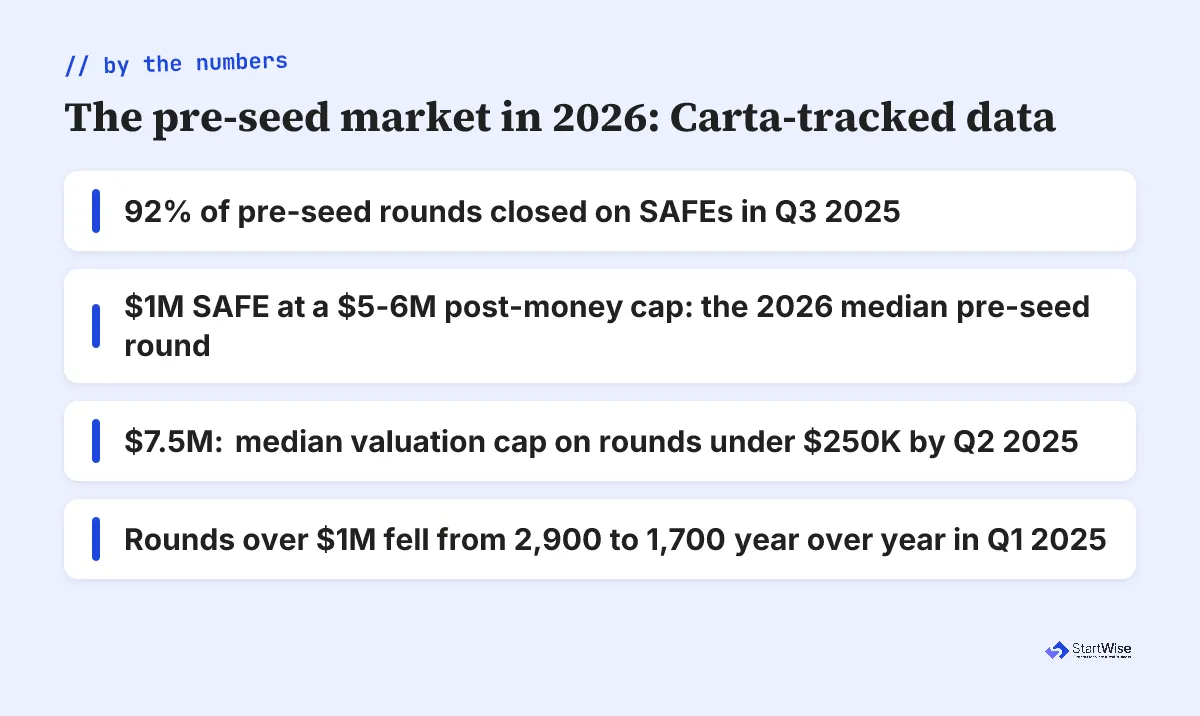
The shape that matters here is the barbell. Capital is pooling at the two ends and draining from the $1M-$2.5M middle, which is exactly the band a default $2M ask lands in.
The practical translation, as we read it: a tight sub-$1M angel round assembles fast, a clean $2.5M+ round with a real lead assembles slowly but holds, and the awkward $2M in between is the hardest number to close. A non-AI company should also budget more meetings per check, because half the money is going somewhere else.
There’s a quieter risk in a SAFE-standardized market, and we flag it more as rounds drag on:
Common mistake
Stacking SAFEs blind. Raising on a rolling series of SAFEs at different caps is normal now, but each one converts to equity at your next priced round. Founders who never model the combined conversion wake up to [far more dilution](/blog/startup-cap-table-mistakes/) than any single SAFE implied. Map the waterfall before you sign the second cap.
The cap-only post-money SAFE remains the default shape of the round. Flux’s blunt advice for 2026 founders, and ours, is to skip the discount and keep the math one number wide. Even then, model what the SAFE converts into before you sign a second cap.
How much should you raise at pre-seed?
Raise the amount that buys 12-24 months of runway plus one milestone that de-risks your seed. For most 2026 teams, that math lands inside the $750K-$1.5M band. Antler’s guide puts the floor at 12 months of runway and prefers 24-36 as the company matures, and its 15-20% equity guidance matches Value Add VC’s dilution numbers.
Don’t take older bands at face value. Zeni’s guide still tables pre-seed at $50K-$250K: real territory for a friends-and-family check, but well below where Carta-tracked rounds clustered through 2025.
The amount is the easy half. What the amount buys is the half investors interrogate:
StartWise's position
"Ask" slides fail by being shy. The single most common fixable flaw we flag: no concrete use of funds tied to a milestone that de-risks the next round. "18 months of runway to reach $50K MRR" is an ask; "$500K to accelerate growth" is wallpaper.
Work backwards from the seed column in the table above. If seed investors will want roughly $50K-$200K ARR (Value Add VC, 2026), your pre-seed amount is whatever credibly gets you there with a buffer, not a round number that sounded fundable.
Sell 20% at pre-seed and another 25% at seed, and simple multiplication says the founding team has parted with 40% of the company before Series A diligence starts.
Plan the raise as a 12-week process
A pre-seed raise runs on a calendar: warm-intro processes close in 2-6 weeks, mostly-cold processes take 8-12, and Antler budgets 90-120 days from first outreach to money in the bank. The week figures are Value Add VC’s 2026 timelines; the quarter-long budget is Antler’s.
Plan for the longer number and let the shorter one surprise you.
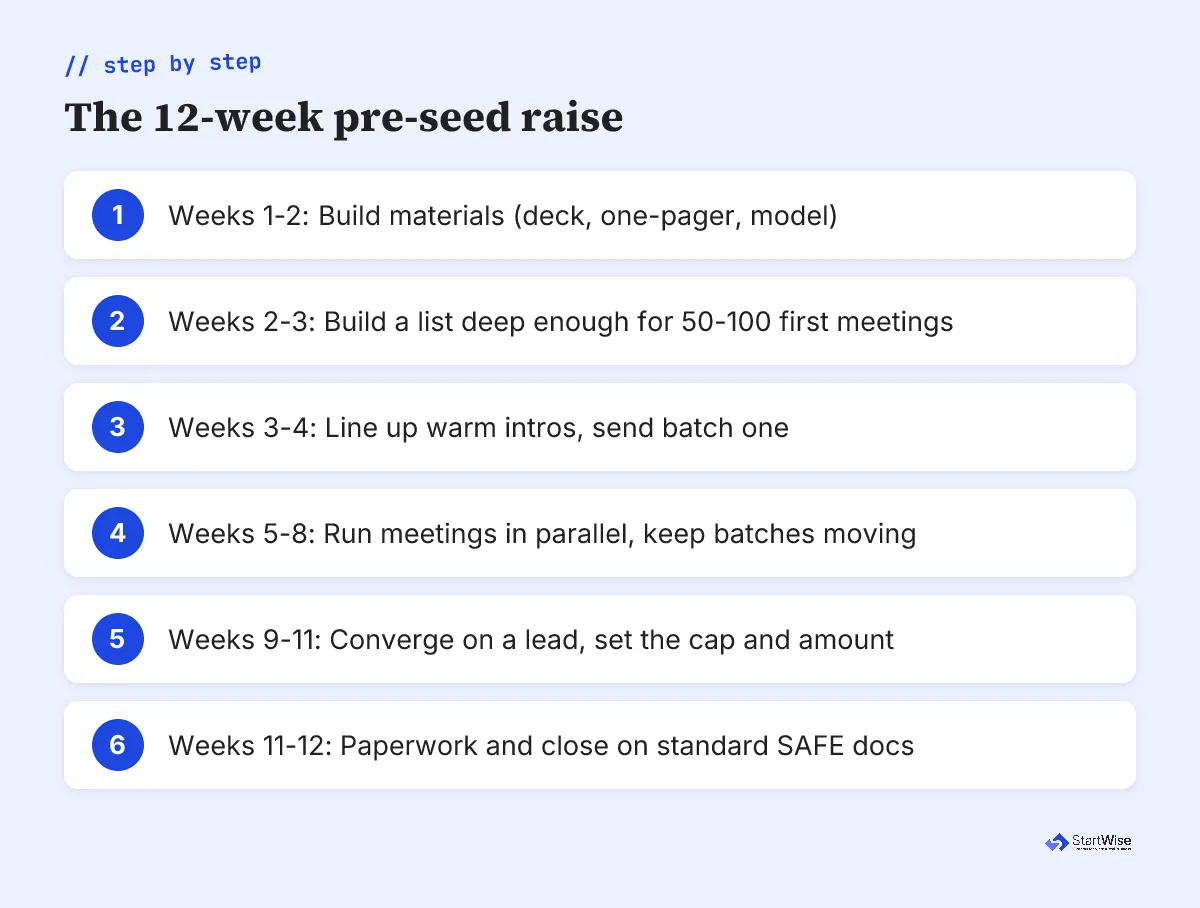
Week by week, here’s the process we’d tell most founders to run:
- Weeks 1-2: materials. Deck, one-pager, basic model. Finished before outreach starts, not during.
- Weeks 2-3: the list. Build a list deep enough to support the 50-100 first meetings Antler tells founders to line up, and load it into an investor pipeline tracker from day one. If you can’t say why a name is on it (stage, sector, check size), it shouldn’t be.
- Weeks 3-4: warm paths and batch one. Ask for introductions, send the first cold-email batch, book the first calls.
- Weeks 5-8: the meeting grind. Run conversations in parallel. Log every objection; the pattern is your edit list.
- Weeks 9-11: convergence. A lead or an anchor angel commits, the cap and amount firm up, and the rest of the round fills in around that commitment.
- Weeks 11-12: paperwork. The SAFE is a standard document (the same few pages across thousands of rounds), so you won’t spend these weeks negotiating; closing is mostly signatures and wiring instructions.
A raise compresses to the weeks you prepared for and expands to fill the ones you didn’t.
The calendar is also a defense. A process with a stated timeline reads as a founder with options; an open-ended raise reads as one that hasn’t found takers.
Where do you find pre-seed investors?
Pre-seed capital comes from four pools: angel investors, pre-seed VC funds, accelerators, and your own network. Each pool writes a different check for a different reason.
- Angels typically write $25K-$100K checks, per Zeni. They decide alone and fast, and many decide on the founder more than the deck.
- Pre-seed funds write the lead checks: $250K-$750K in Value Add VC’s 2026 numbers. Slower, more diligence, and they anchor the cap.
- Accelerators bundle a standard check (about $125K, give or take, in Zeni’s accounting) with mentorship and investor exposure. The check is the smallest part of the value.
- Friends and family money is real money with non-financial strings. Paper it on the same SAFE as everyone else.
On sourcing, two of the guides ranking for this query disagree productively: Zeni says target roughly 20 investors who have already funded your vertical, while Antler says build toward 50-100 first meetings.
Our read: Zeni is describing a warm-network raise, Antler a cold one. Count your warm paths first. Then pick your number.
Free investor directories (OpenVC, NFX’s Signal, and the open lists many funds publish) will get you names. They won’t get you a warm path or a current thesis, and stale entries are common. Verify that every name on your list has actually deployed at your stage recently before you spend an email on them.
A name on a list isn’t a prospect yet. A verified check-writer at your stage is.
Warm paths beat cold lists. Paste your LinkedIn into Atlas by StartWise and get your founder Second Brain and Network Map in about 15 seconds: who you already know, and what to do next. Free.
Which materials do investors expect before the first call?
Investors expect three documents before the first call: a deck, a one-pager, and a simple financial model. The discipline behind them matters more than the polish on them. They’re the core of the wider pre-seed fundraising checklist that decides whether you’re ready to start at all.
The checklist, item by item:
- The deck. Built for a cold skim, not a boardroom walkthrough. We tore down what to copy from the famous pitch deck examples, and what to skip, in a separate teardown; the short version is that slide titles should carry the story alone.
- The one-pager. Antler’s guide treats it as the deck’s key points on a single page. It’s the attachment that actually gets read on a phone.
- The model. Zeni is blunt about scope: full financial statements aren’t expected at the pitch stage, but projections are mandatory. A few connected tabs (hiring, spend, milestones) beat a fragile mega-spreadsheet.
- The memo (optional). Antler recommends a written investment memo alongside the deck. If you write better than you design, the memo is your unfair advantage.
- The founder story. Antler again: a deliberate origin story and vision story. Not biography: evidence you’ve lived the problem.
In the materials founders send us for review, the one-pager is the document founders most often haven’t written at all. That’s backwards: in cold outreach it does more work than the deck, because it’s the one thing a stranger reads in full.
These get you to the first call. What an investor asks for after it is a pre-seed data room: the lean folder of 8 to 12 documents that confirms the story before they wire.
Keep editing as the raise teaches you. The objection you hear three times is a slide, not a coincidence.
How should you run investor outreach?
Run outreach in parallel batches with a stated timeline, open with your weakest fits, and treat warm introductions as the main road. Those three mechanics separate organized raises from open-ended ones. When you do go after a referral, get the warm intro right: the person making it matters more than the fact that you got one.
Batch the outreach instead of trickling it. Sequential outreach kills momentum: by the time the last investor hears from you, the first has forgotten you. Batching keeps every conversation at roughly the same stage, which is what lets you look an investor in the eye and honestly say the round closes in three weeks.
Open with the weak fits: you’re rehearsing the questions investors ask in your first meetings whether you intend it or not. Spend them on investors you could survive losing, log the objections, fix the materials, then open the batch you actually care about.
Warm beats cold, but cold isn’t dead. Antler is unambiguous that introductions through the network are the best way in.
Going cold anyway? Keep the email to three sentences (what you do, your sharpest proof, the ask for a 20-minute call) with the one-pager attached. Most cold drafts we see fail on length, not on manners.
Follow up twice, then move on. Silence is the default response at pre-seed, and it isn’t an insult. After two follow-ups, the name goes back in the pool for your next milestone update.
Momentum is the only social proof a pre-seed company has.
Keep a simple pipeline log: who, stage, objection, next step.
The raise is a sales process; run it like one.
What do pre-seed rejections actually mean?
Most pre-seed rejections arrive as one of four templates, and each carries usable information once you translate it honestly.
Market context first, because it explains the tone. Seed-to-Series-A graduation sits near 38%, down from above 50% in the 2020-21 era, per Value Add VC’s 2026 review. Investors price that risk into every earlier check.
The bar didn’t move because of you.
The four templates you’ll actually get, translated:
- “Too early for us.” Often literal: the fund’s model needs a stage you haven’t reached. Check their recent deals before deciding it was about you.
- “Not a fit for our thesis.” A list problem, not a company problem. Tighten the targeting before the next batch.
- “Keep us posted.” A soft no today and a real door later, but the door doesn’t stay open unless your updates show movement. Send a short monthly note with the slope, not the saga.
- Silence. The most common answer and the least informative. Follow up twice; after that, the absence of a reply is the reply.
StartWise's position
Traction is a slope, not a number. Pre-revenue founders keep putting absolute counts in their decks and updates. At pre-seed, investors read direction and speed: week-over-week movement with a believable mechanism beats a vanity total every time.
My honest take: a pass is information about your list as often as it’s information about your company. If you’ve collected a run of “too early” replies, your targeting is one stage off; a run of thesis passes means the list was built by volume, not by filter.
What to do this week
Five jobs, in order. Each one moves the raise forward this week:
- Write the ask sentence: amount, months of runway, the milestone it buys. If you can’t fill all three blanks, fix the plan before touching the deck.
- Count your warm paths. List everyone who could introduce you to a check-writer. The count decides whether you run Zeni’s 20-investor targeted raise or build toward Antler’s 50-100 meetings.
- Draft the one-pager before re-polishing the deck. It’s the most-skipped document in the materials we review, and the hardest-working one in cold outreach.
- Right-size the round against the market. $750K-$1.5M on a post-money SAFE at a $5-6M cap is the 2026 center of gravity (Value Add VC, with Carta data via Flux). A bigger ask needs a named reason, or it reads as wallpaper.
- Pressure-test the deck against a cold skim. Slide titles alone should tell the story; the mechanics worth copying are in our pitch deck examples teardown.
When the round outgrows this stage, our seed round timeline walks through how long a priced seed takes and where it stalls, and Y Combinator’s seed fundraising guide is the canonical next read. The editorial rules this post follows (answer-first, every number from a named source, no email gates) live on the About page, and every post carries the same accountable author profile.
The market narrowed at the top. It didn’t close.
A right-sized ask, honest materials, and twelve organized weeks are still how first rounds happen.