
 By
By 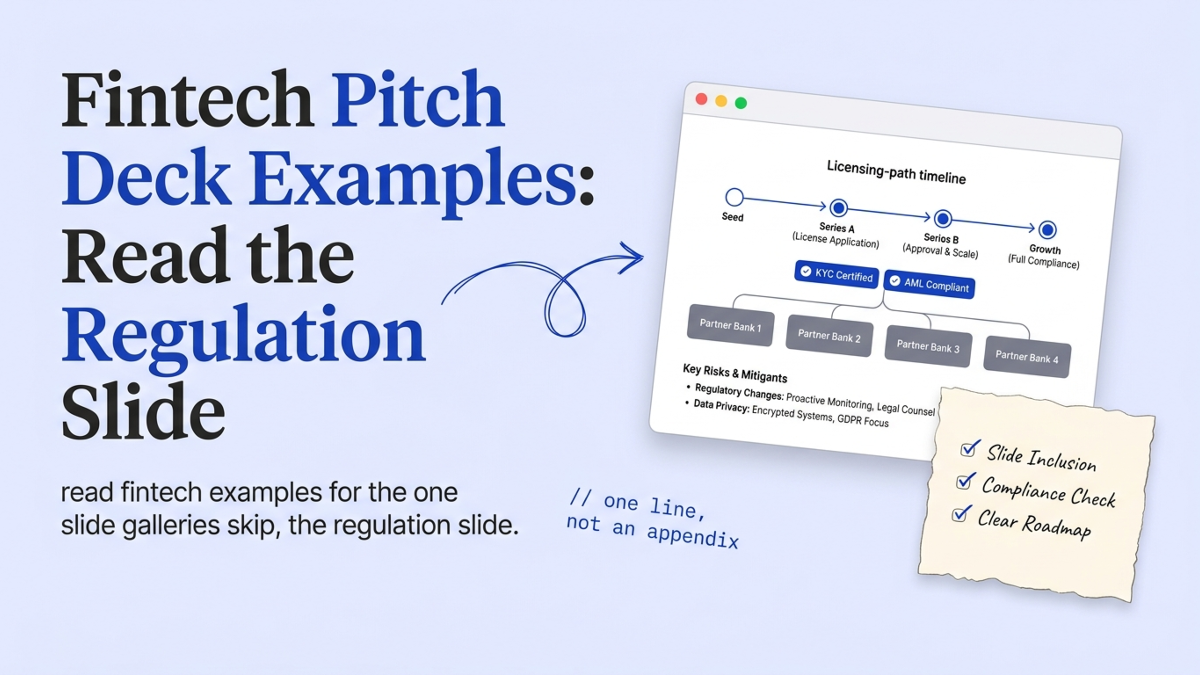
Fintech pitch deck examples fill the same galleries as every other deck, and they teach founders to copy the wrong thing. A fintech pitch deck is an investor presentation that has to clear one hurdle a generic deck doesn’t: regulation. At StartWise we review founder decks every day, and a fintech deck differs from any other on exactly one slide, the regulation and compliance slide. Global fintech funding fell to a seven-year low of $95.6 billion in 2024 (KPMG), so investors read that slide first. Here’s how to read the famous decks for it.
What makes a fintech pitch deck different from any other deck?
A fintech pitch deck differs from any other deck on one slide: the regulation and compliance slide. The cover, problem, solution, market, team, and ask are the same slides every founder builds, in roughly the same order. What changes is the regulatory exposure an investor expects you to address before they’ll trust the rest.
Skip it and a payments startup reads like a project waiting for a cease-and-desist. Over-build it and the story drowns.
We see the same split in review every week. The shared slides still matter, and we’ve written about how many slides a pitch deck needs and what each one does. But on those slides a fintech deck and a SaaS deck look nearly identical. Regulation is where the category actually shows, because a template can’t know that an investor reading a lending deck is hunting for your loss curve and your licensing path, not a longer feature list.
Build the regulation slide as a feature, not a footnote
The regulation slide works when it reads as a feature you’ve built, not a legal footnote you’ve bolted on. Decks that bury compliance in a footer get priced as compliance-risk plays. Decks that show a credible posture get priced as fintech.
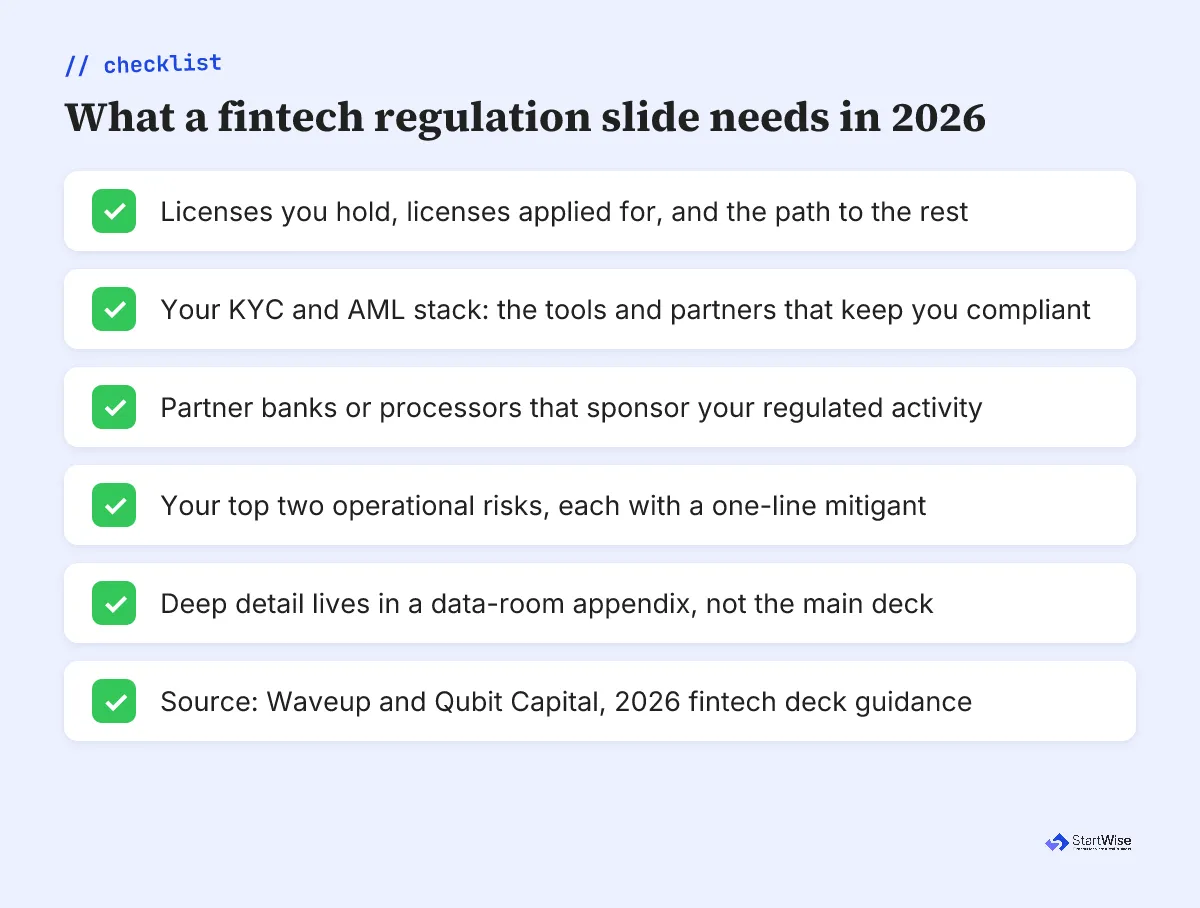
A strong version is one line of proof, not a five-slide appendix. Here’s what belongs on it:
- The licenses you hold, the ones you’ve applied for, and the path to the ones you still need.
- Your KYC and AML stack, meaning the know-your-customer and anti-money-laundering checks every regulated fintech runs, and the tools or partners you run them with.
- The partner banks or processors that sponsor your regulated activity.
- Your top two operational risks, each with a one-line mitigant.
The deep detail belongs in a data-room appendix, not the main deck. Push your full license documentation, your risk register, and any architecture diagrams there, then link to them. The main-deck slide earns its place by proving you know the terrain in the seconds an investor gives it.
The reg slide is the one we most often see founders get backwards. They treat it as the place to prove they’ve thought of everything, and they lose the reader by slide four of a compliance sub-deck.
StartWise's position
On a fintech deck, the compliance slide is where founders over-correct. The decks we review either bury regulation in a footer or drown the pitch in a five-slide licensing appendix that stalls every reader. At pre-seed, the winning move is one line showing you know the licensing path, not proof you've already cleared it. Regtech alone drew $7.4 billion of fintech funding in 2024 (KPMG), which tells you investors treat compliance as a market, not a chore. Show them you think the same way.
How do the required slides shift by fintech sub-vertical?
The required slides shift by sub-vertical, because a payments deck and a lending deck answer different questions. What an investor wants on slide one of a neobank deck would be noise on a crypto deck. The gap we flag most here is a founder who opens a lending pitch with a market-size slide instead of a loss curve.
| Sub-vertical | Lead with | The number investors check |
|---|---|---|
| Payments | Transaction volume | Take rate and gross processed volume |
| Neobank | Deposit growth | Primary-account share, net interest margin |
| Lending | Loan book | Loss ratio and vintage curve |
| Insurtech | Gross written premium | Combined ratio |
| Wealthtech | Assets under management | Net inflows, CAC payback |
| Crypto or Web3 | On-chain volume | Protocol revenue, regulatory position |
That mapping comes from Waveup’s 2026 sub-vertical guide, the one page in this search that treats fintech as six businesses instead of one. It’s the strongest thing the galleries can’t give you, because a static example can’t tell you which number your category is judged on.
Whatever the vertical, fintech unit economics get interrogated harder than SaaS. Interchange is thin, fraud is real, and compliance is expensive, so show customer acquisition cost, lifetime value, gross margin, and a loss ratio if you lend, at today’s scale and projected as you grow. If you’re not positive per unit yet, show the path. The financials slide is where those numbers live.
Not sure your fintech regulation slide reads as a feature, not a risk? Get a free, slide-by-slide review of your deck with a concrete fix list, in minutes.
What do the famous fintech deck examples actually show?
The famous fintech deck examples show a regulatory posture baked into the story, not stapled to the end. Waveup’s guide uses Wise, Revolut, Monzo, and N26 as neobank and payments archetypes: each led with the metric that proves its model, deposit growth or transaction volume, and treated its banking license as a selling point rather than a disclaimer.
The seed-stage examples matter more for a first raise. Qubit Capital’s teardown points to Robinhood’s early deck, which sold zero-commission trading as the wedge before it had scale, and to Super.com, which raised $60 million in 2023 on a deck built around one clear savings mechanism. Square’s early deck is still the reference for saying a regulated payments idea in plain words: one problem, one solution, minimal text.
A regulated business that hides its regulation reads as a risk; one that owns it reads as a fintech.
Here’s where the galleries mislead you. Most host decks from companies that already raised nine figures, with a compliance function you won’t have for years. Beautiful decks, useless models for a first raise, because their regulation slide describes a company three rounds ahead of you.
In review we read an example the same way every time. Open the regulation slide first, then the sub-vertical metric, and ask what actually earned the round. The cross-industry classics get the same disciplined read in what to copy and skip in pitch deck examples. If you’re in AI, AI startup pitch deck examples reads them for the moat slide, and healthcare pitch deck examples reads them for the reimbursement slide.
How much detail belongs in a fintech deck versus the data room?
A fintech pitch deck should run about 10 to 15 slides, with the regulatory detail pushed to a data-room appendix. The main deck earns the meeting; the appendix survives diligence. Trying to do both jobs on one slide is what sinks most of the decks we send back.
Investors give it less time than founders expect. DocSend’s 2024 data puts the average first read at 3 minutes 44 seconds. A cold deck gets 2 minutes 31 seconds and converts to a meeting only 3 to 5 percent of the time, versus 40 to 50 percent for a warm intro. Investors spend about 52 seconds on the financials slide and 38 on the problem.
So your regulation slide has to land in one glance, the same way the market-size slide does. If a reviewer needs more than 30 seconds to parse it, it’s too complex for the main deck, and it belongs in the appendix.
What to do this week
This week, rebuild your regulation slide before you touch the design on any other slide. It’s the slide we fix first in almost every fintech review, because it’s the one that separates a deck that looks regulated from one that reads as a real fintech.
- Write your regulation slide as four lines: licenses, KYC and AML stack, partner banks, top two risks with mitigants.
- Move every page of license documentation and your risk register into a data-room appendix, and link to it.
- Lead your deck with the number your sub-vertical is judged on, a loss ratio for lending, deposit growth for a neobank.
- Put real unit economics on the financials slide, or the honest path to them.
- Open two funded fintech decks, jump to their regulation slide, and copy the posture, never the numbers.
Then put it in front of someone who reads fintech decks the way investors do, before an investor does. On a fintech deck, the gap between polished and fundable is almost always this one slide.