
 By
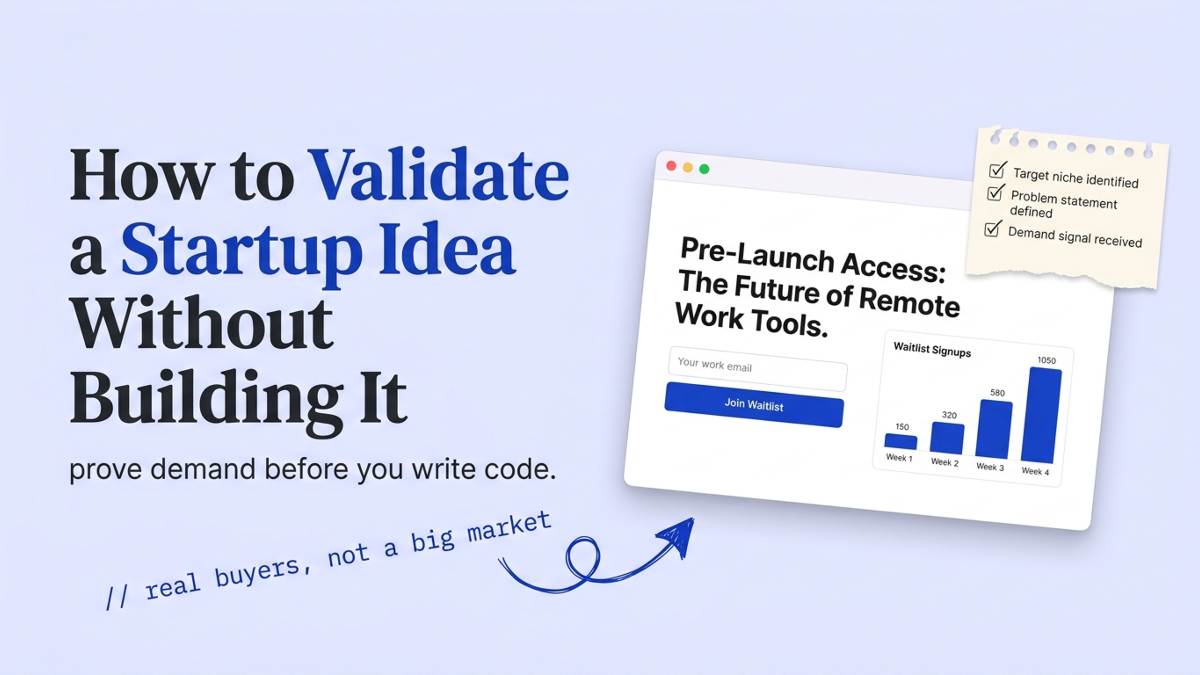
Validating a startup idea without building it means proving that specific people want the thing and will pay for it, before you write a line of code. It is demand research, not product work. We review founders’ materials every week at StartWise, and the same trap shows up: someone spends three months building, then goes looking for customers, and finds the demand was never there. The order is backwards. Prove demand first, cheaply, and the build becomes a much safer bet on a much shorter list of features people actually asked for.
What does it mean to validate an idea before building?
Validating before building means running cheap tests that answer one question: will real people pay for this? That question splits into two the internet constantly blurs. One is whether anyone wants it. The other is whether you can build it. Only the first is usually the risky one at the idea stage.
Most first-time founders validate the wrong thing, and we see it constantly. They open a code editor or a no-code builder and start assembling the product, which feels like progress and quietly tests feasibility. But feasibility is rarely what kills a company. The largest single category of startup failure is building something nobody needs. Analyses of CB Insights’ post-mortems put no market need at about 42% of failures, the top reason by a wide margin (CB Insights, via User Intuition). You can’t code your way out of that.
So validation isn’t something you do to your product. It is a set of experiments you run on the market, and the cheapest ones need no product at all.
Why “test before you build” advice still points you at building
Test before you build sounds right, until you read who gives the advice. A lot of it comes from tools that make money when you build, so their version of testing quietly assumes you build first, only faster and cheaper.
A no-code platform will tell you to spin up an app and see if people use it. That is genuinely faster than hand-coding, and no-code has a real place once demand is proven. But “launch a quick app and watch” is still a build. It’ll cost you weeks and real money, it anchors you to features you guessed at, and it answers can-I-build-it when the open question was does-anyone-want-it.
A no-code builder telling you to test before you build is still selling you the build.
| Validate first | Build an MVP first | |
|---|---|---|
| Time | Two to four weeks | Weeks to months |
| Cost | Under $500 | Dev time or a no-code subscription |
| What it proves | People will pay | The thing runs |
| Biggest risk | You stop too early | You built the wrong thing |
Neither column is wrong on its own. Building an MVP is the right move once you have buyers waiting, and there’s a lean way to build one without a technical co-founder, though investors rarely expect a finished one at pre-seed. The mistake is reaching for column two before column one has been run, which is where I watch the most founder time disappear.
Which pre-build tests actually prove demand?
The tests that prove demand share one trait: they ask someone to do something costly, not just say something nice. Talk is free. So “would you use this?” tells you almost nothing worth acting on. Here are the ones worth your two weeks, in rough order of how hard the signal is to fake.
- Problem interviews. Talk to ten people who have the problem now, and ask about the last time it bit them, not whether they like your idea. Past behavior predicts; opinions flatter.
- A smoke-test landing page. Put up one page with a single promise and a clear call to action, then point £100 to £300 of paid traffic at it and measure signups or buy-button clicks (wearefounders).
- A fake-door waitlist. Add a buy or get-access button that leads to a signup, and track the wait-list growth week over week as your slope.
- A pre-sale or deposit. Ask for money before the product exists; a pre-order, a deposit, or a signed letter of intent (an LOI, a written “we will buy this”) is the hardest signal to fake.
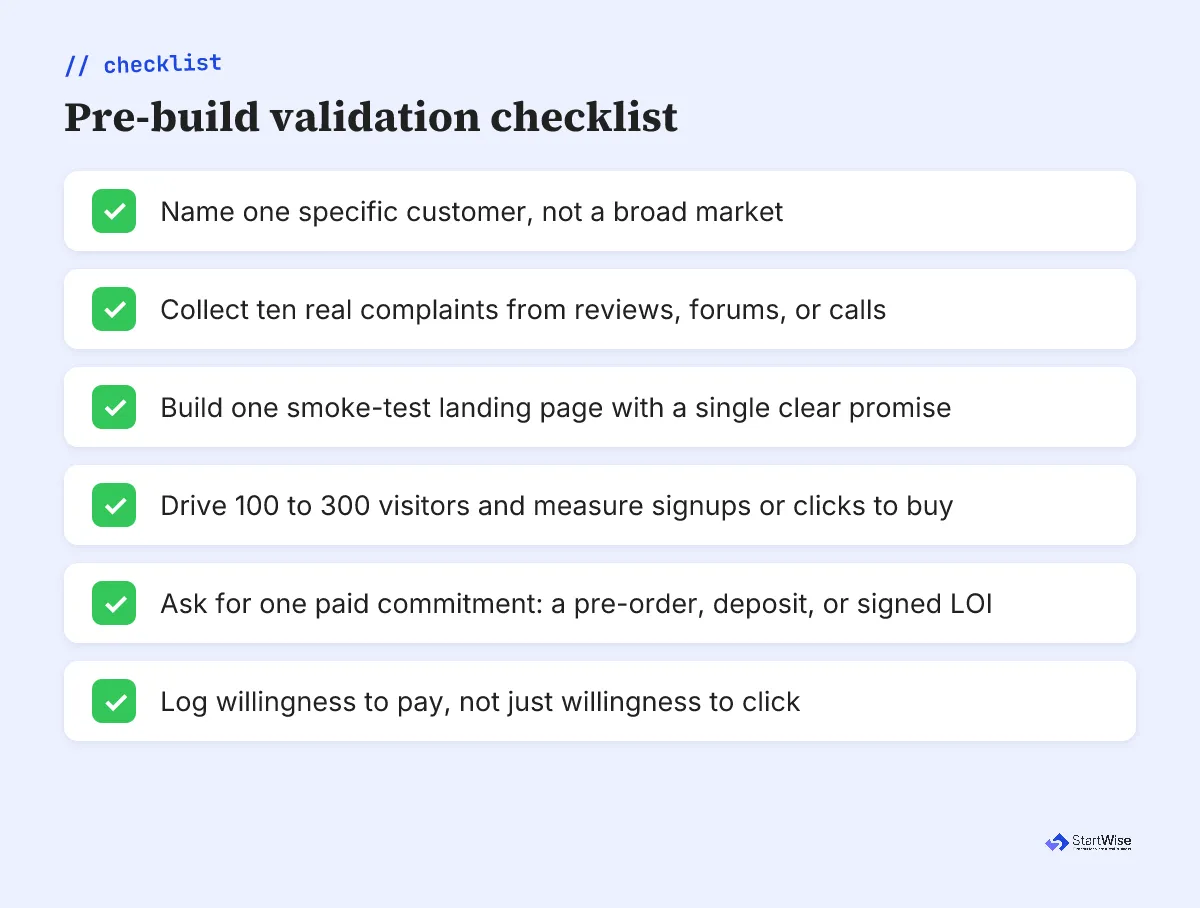
Notice the progression. Each step asks for more commitment than the last, and the whole sequence writes zero product code. A single narrow customer beats a broad market here: ten deep conversations with solo dietitians tell you more than a survey of “small businesses”. If you want to size that narrow market honestly, our TAM SAM SOM example works it from the bottom up instead of from a big top-down number.
One rule we’d stake a claim on: a signup is not validation. An email address costs nothing to give. Until someone has paid, pre-ordered, or signed something, you’ve got interest, and interest doesn’t fund a company.
Before you spend a weekend building, find out where your idea is weak. The free Idea Pressure Test scores it 0-100 across eleven dimensions.
What counts as validation to a pre-seed investor?
To a pre-seed investor, validation means evidence that specific people want this and will pay, shown as a slope they can believe rather than asserted in a survey or a big TAM. And the good news is that the tests above already produce it, so you’re only doing it once.
The tests double as your deck. Your interviews and collected complaints become the problem slide. Your pre-orders, LOIs, and waitlist curve become the traction slide, where investors read the slope, not the total. That is why we tell founders pre-build validation and fundraising prep are the same task: the artifacts you gather to decide whether to build are the artifacts a partner wants to see.
And the bar is real. The median pre-seed round in 2026 is about $1M at a $5M post-money cap (Carta State of Private Markets, Q4 2025). Investors spend about 3.2 minutes on a deck, roughly 15 seconds a slide, across 3,000 decks (Papermark, 2024). In that skim they’re hunting for proof, and “we think there’s a big market” is not proof.
StartWise's position
The validation that counts is a bottoms-up count of real people who said yes, not a $1T market number. If your demand proof can't survive a napkin check, no market-size slide will save it. Investors fund evidence of buyers, not the size of the ocean those buyers swim in.
This is also the honest test for whether to raise at all. If a few weeks of pre-build work can’t surface a handful of people who’ll pay, that’s not a fundraising problem. It’s an idea problem, and raising money won’t fix it.
How much should validation cost and how long?
Validation should cost under $500 and take two to four weeks, not months. wearefounders’ 2026 guide puts a full pre-build test in that band, and I think anything much longer is usually avoidance wearing a lab coat.
The opposite trap of building too soon is validating forever. Endless interviews and “more research” feel productive and risk nothing, which is exactly the problem. Set a commitment target before you start: a specific number of pre-orders, LOIs, or paid pilots by a specific date. wearefounders uses three pre-orders as its green light. Pick your own bar, but pick it up front.
When the deadline hits, you make a call: build, change the idea, or drop it. All three are wins, because each one saves the months you’d have spent building on a hunch. If the signal is strong, that’s your cue to check you’re ready to raise and turn the evidence into a deck.
What to do this week
This week, pick one narrow customer and run the cheapest test that asks for real commitment. Don’t open a builder yet. The founders who waste the least time, in our review room, aren’t the ones who build fastest.
- Name one specific customer, not a market. “Solo dietitians”, not “healthcare”.
- Find ten of them and ask about the last time the problem cost them time or money.
- Put up one landing page with a single promise and a buy or waitlist button.
- Ask for one paid commitment, and set a target and date before you start.
The founders who waste the least time aren’t the ones who ship first. They’re the ones who find out, in a fortnight and for a few hundred dollars, whether anyone was ever going to buy. Prove that first. The build, the deck, and the raise all get easier once you have.