
 By
By 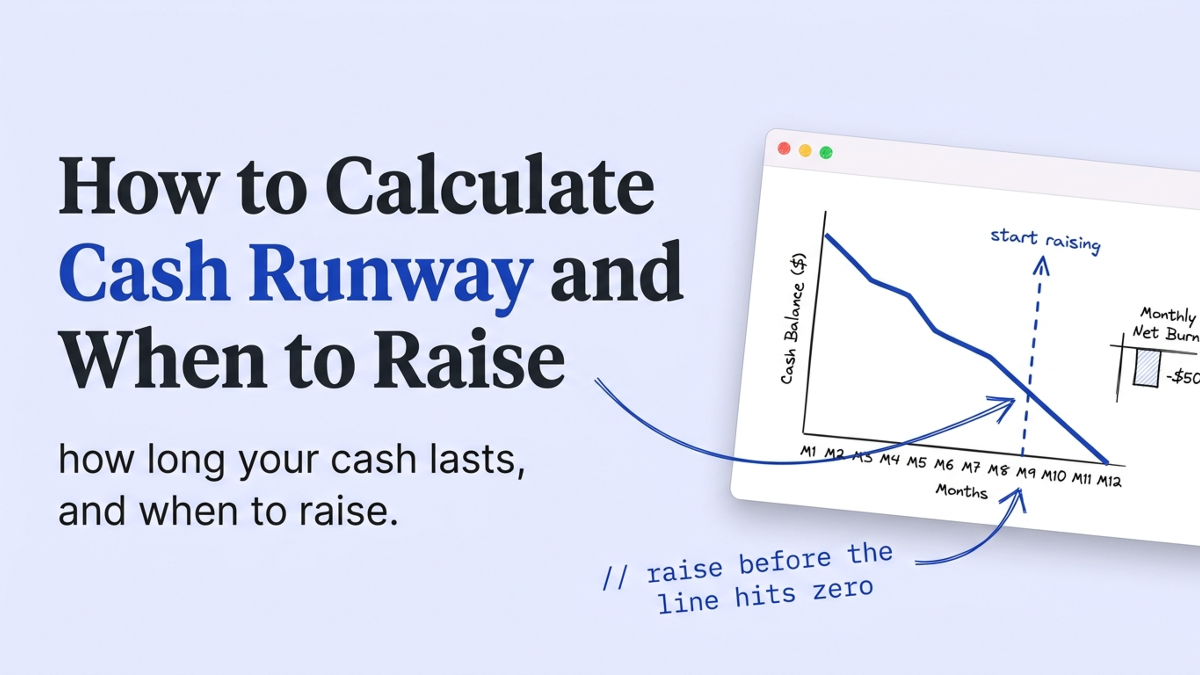
Cash runway is the number of months your startup can keep operating before the money runs out. You calculate it by dividing the cash in your bank by your monthly net burn, what you lose each month after revenue. A founder with $300,000 in the bank and a $50,000 net burn has six months. That number is a fundraising decision, not an accounting line. In the decks we review at StartWise, it’s often the vaguest figure on the page. Here’s how to calculate runway, read whether it says raise, and test whether you even have to.
What is cash runway, and how is it different from burn rate?
Cash runway and burn rate measure two halves of the same problem. Burn rate is how fast you spend. Runway is how long that spending can last before zero. Your burn comes in two forms, and mixing them up is the first mistake we see.
Gross burn is everything that leaves your account in a month: salaries, rent, software, ads. Net burn subtracts the cash coming in, and it falls straight out of your startup financial model if you built one. Mercury defines net burn as the figure that “reflects the actual rate at which your cash balance is declining,” and that’s the one runway depends on.
Use net burn for runway. Always.
I keep seeing founders quote gross burn when they mean net, which makes their runway look shorter and their fundraising panic worse than the math warrants. If you’re pre-revenue, the two numbers are the same. The moment a dollar of revenue lands, they split, and net is the honest one.
How do you calculate cash runway?
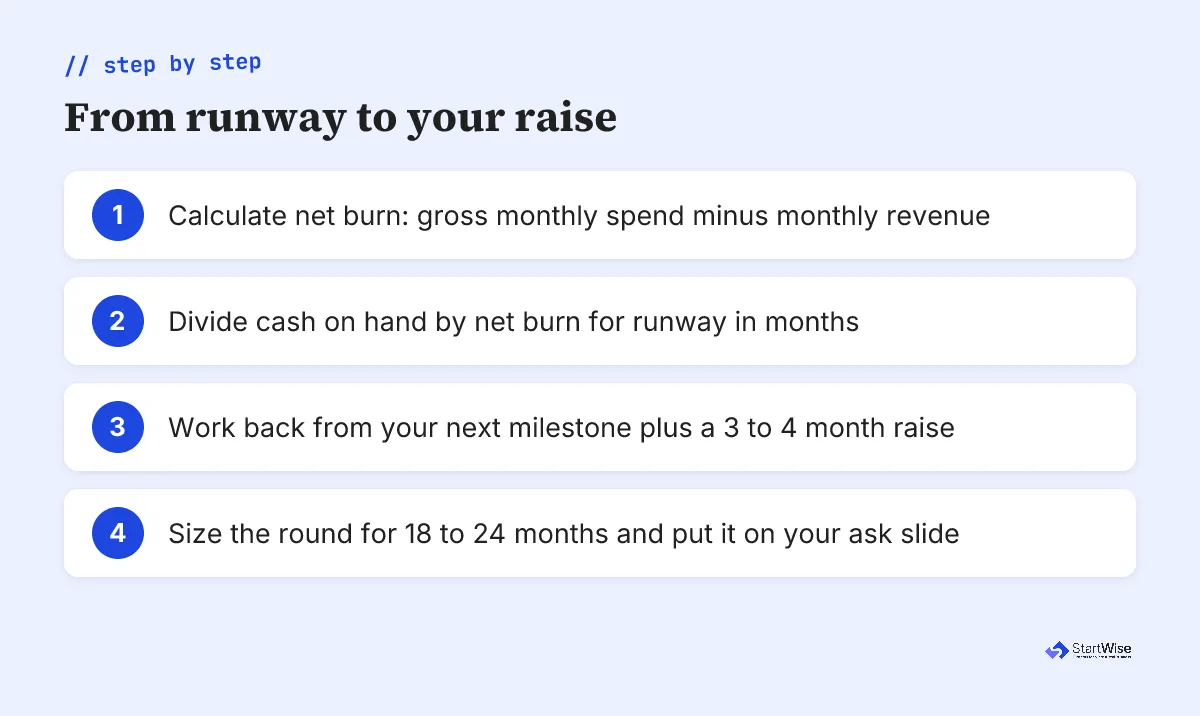
Cash runway is cash on hand divided by monthly net burn. Take that founder with $300,000 and a $50,000 net burn: $300,000 divided by $50,000 is six months. Both Mercury and Kruze Consulting use that exact formula, and both warn against trusting a single month of data.
One month can lie. Kruze recommends averaging your burn over three months for fast-growing startups, or six months for steadier ones, because a single lumpy month skews everything. A big annual software renewal or a one-off contractor invoice can make a healthy company look like it’s bleeding out.
So pull your last three bank statements, average the monthly drop, and divide. When we sanity-check a founder’s financials, that average is the first number we recompute, because last month’s snapshot almost never tells the truth.
How many months of runway should you have?
How much runway you should hold depends on your stage. A pre-revenue startup needs enough to build something and show progress. A company about to raise needs a buffer for the raise itself, which always runs longer than the plan. Upmetrics maps the targets by situation, and the pattern holds across the advice we give founders.
| Your situation | Target runway | Why this much |
|---|---|---|
| Pre-revenue startup | 12 to 18 months | Time to build and show real traction |
| Planning a seed or Series A raise | 18 to 24 months | A buffer for the raise itself |
| Funded, raising into a slow market | 24+ months | Cushion when capital is tight |
Notice the floor never drops below a year for a venture-backed startup. That’s deliberate. The months you hold aren’t just operating budget, they’re the time you get to build proof before you have to sell the next round.
When should you start raising, by your runway?
Start raising while you still have 9 to 12 months of runway, not when you’re down to your last three. Mercury tells founders to begin preparing “when your runway drops below 9 to 12 months.” Kruze puts the trigger near 10 months and calls six months the point where you “really need to start raising money.”
The reason comes down to negotiating position. A raise takes weeks to months to close, and a bank balance everyone can see is running dry becomes a weapon against you. Your valuation suffers. Your terms get worse. The cleaner your runway looks when you walk in, the better the round you walk out with.
We’ve watched founders wait until four months of runway and then take the first term sheet that lands, on whatever terms it carried. Don’t be that founder.
A raise negotiated at ten months of runway and one negotiated at three are not the same conversation.
Run the default-alive test before you raise
The default-alive test asks one thing before any raise: whether you need one at all. Paul Graham framed the question every founder should answer first, “assuming their expenses remain constant and their revenue growth is what it has been over the last several months, do they make it to profitability on the money they have left?” If yes, you’re default alive. If no, you’re default dead, leaning on a round you haven’t closed yet.
Most pre-seed founders are default dead at the start, and that’s normal. The real danger is not knowing which one you are. Graham’s warning is blunt: the fatal pinch is default dead plus slow growth plus not enough time to fix it. You hit it when the cash runs low, growth stalls, and the round drags past the runway you had left.
So run the test monthly. Project your current revenue growth against your net burn and check whether the lines cross before your balance hits zero. If they don’t, you have two honest levers: grow faster or spend less. I’d rather watch a founder pull one of those early than bet that the next round always shows up on time.
38%
of startup failures trace to running out of cash (CB Insights, via The VC Corner, 2026)
Why 12 months of runway is no longer enough
Twelve months of runway used to be a safe target. It isn’t anymore, because raising takes longer than it did. Capwave’s 2026 data shows pre-seed rounds now closing in 6 to 10 weeks instead of 4 to 6, and seed rounds stretching to 12 to 16 weeks from the old 8 to 12.
The whole cycle has slowed. The VC Corner puts the median gap between rounds at roughly 23 months in 2026, and reports that 61% of startups saw their runway shrink year over year. Some guidance now goes further than 18 to 24: Qubit Capital points to a JPMorgan review recommending 24 to 36 months as the conservative target.
Run the math on a 12-month raise. You hit the 9-month trigger at month three, start the process, and close a round with almost no buffer if anything slips. And something always slips. Raise 18 to 24 months instead and the picture changes: build for a year, open the raise at month 12, and close by month 18 with room to spare.
Raising only 12 months of runway in 2026 is planning to fundraise again before you have proof worth raising on.
The dollar figure follows from the burn. The typical 2026 pre-seed round runs $500K to $2.5M with a median near $1.2M, and pre-seed companies burn $40,000 to $120,000 a month, per Capwave. Multiply your real net burn by the months you need, then add the buffer. That burn and runway line lives inside the financial model investors want to see at your stage. We break down round sizing and dilution in our pre-seed fundraising playbook, and the model that holds this math is one of the files in your pre-seed data room.
Turning your runway into a raise plan? StartWise builds your financial model and investor outreach in one place.
How do you put runway on your Ask slide?
Your runway belongs on your ask slide, framed as the milestone it buys. Investors don’t fund a number. They fund the proof that number is supposed to produce. “Raising $1M for 18 months of runway to reach $50K MRR” tells an investor exactly what their money does and when they’ll see it work. A good ask slide shows how to size that number and phrase it.
StartWise's position
The single most common fixable flaw we flag is a shy ask. "18 months of runway to reach $50K MRR" is an ask. "$500K to accelerate growth" is wallpaper. Tie the raise to a milestone that de-risks your next round, and the runway number does the selling for you.
This is where the calculation pays off. A vague ask is the fastest way to make an investor stop reading. An AI pitch deck review flags one in seconds, and our breakdown of how many slides a deck needs shows where the ask sits in the story. Your runway number, tied to a milestone, is the difference between a slide that asks and a slide that hopes.
How do you extend your runway?
You extend runway two ways: spend less or earn more. Most founders we talk to reach for cost cuts first, because spending is the one thing they fully control. The biggest line usually hides in payroll or paid acquisition, not the $20 software subscriptions founders love to cancel for the feeling of progress.
- Cut your largest line first, where the real money sits
- Move annual contracts to monthly billing while you’re still small
- Delay any hire that doesn’t move your next milestone
- Raise prices before you raise money: revenue cuts net burn faster than anything
That last point matters most. Mercury flags a burn multiple, your net burn divided by net new ARR, under 2x as efficient. Qubit Capital cites 2025 CFO Advisors data putting the median Series A burn multiple at 1.6x, so under 2x is the bar investors now expect, not a stretch goal. If you’re burning far more than you’re adding, fix the engine before you ask investors to pour fuel into it.
What to do this week
Open your bank account and your last three months of statements. We walk founders through exactly this when their numbers feel fuzzy, and the whole exercise takes an afternoon.
- Average your net burn over the last three months
- Divide cash on hand by that number to get your runway in months
- If you’re under 12 months, start your raise plan now, not next quarter
- Size the round for 18 to 24 months and write the ask as a milestone
Your runway is a fundraising decision, not an accounting line. Treat it like one, and you’ll raise from strength instead of from the edge.