
 By
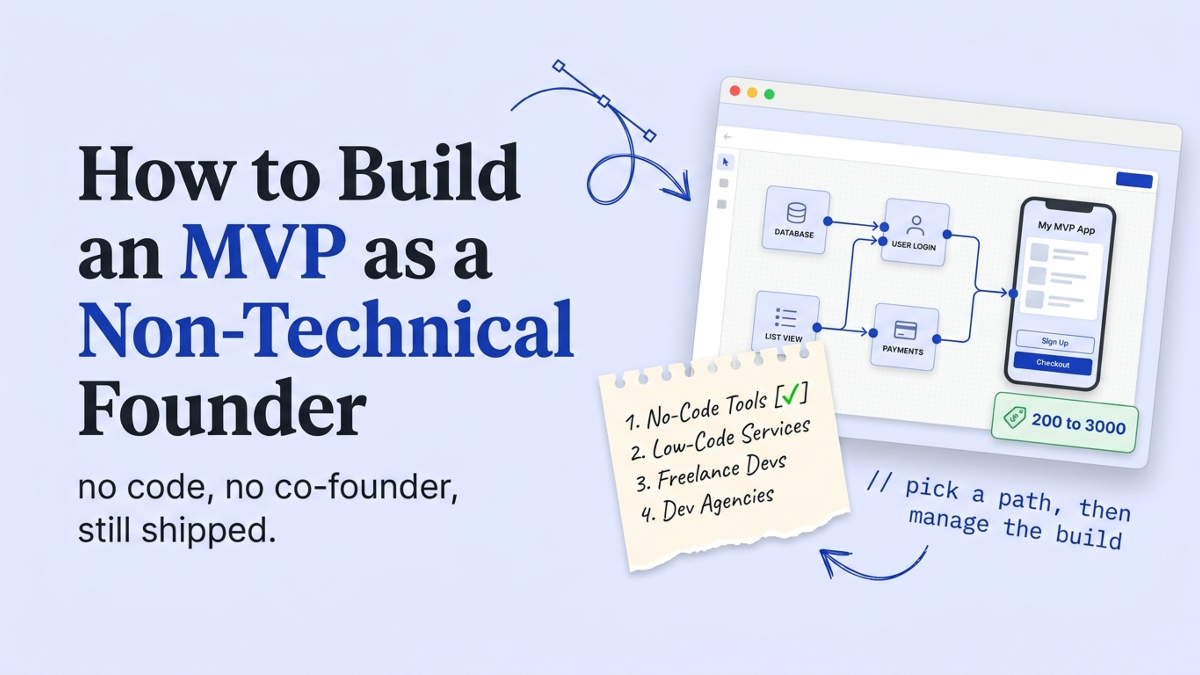
An MVP, or minimum viable product, is the smallest working version of your product that tests whether people want it. You can build one without knowing how to code.
A non-technical founder has two real jobs here: pick the right build path, and manage a build you can’t do yourself. Most agency pages ranking for this question answer it with hire us or go find a technical co-founder. We review founders’ materials most weeks at StartWise, and the ones who spent the most on a first build almost never had the strongest demand to show for it.
Do you need a technical co-founder to build an MVP?
No, you rarely need a technical co-founder to ship a first MVP. You need a way to get it built and a way to keep control of what gets built.
A co-founder who can code gives you deep commitment and a partner who owns the product with you. It also comes at a high cost in equity (Withum), and the right person is genuinely hard to find.
My honest take after seeing plenty of early teams: giving away a big slice of your company to solve a problem you could rent for a few months is a poor trade at the idea stage.
You can buy the technical judgment instead of marrying it. A fractional CTO gives you part-time oversight without the full equity cost, and an independent code audit checks quality and security before you commit real money (Withum). That’s a set of checks and balances, not a person you can’t unwind later.
What are the four ways to build an MVP without coding?
There are four realistic build paths for a non-technical founder: no-code tools, AI build tools, freelancers, and a development agency. They differ mostly in cost and speed, plus how much control you keep. Here’s the honest shape of each.
| Build path | Rough cost | Speed | Best for |
|---|---|---|---|
| No-code (Bubble, Glide, Webflow) | $200 to $3,000 | Days to weeks | Standard apps: marketplaces, directories, internal tools |
| AI build tools (Lovable, Replit, v0) | $200 to $3,000 | Days to weeks | A working first draft from a written description |
| Freelancer or small studio | $10,000 to $50,000 | Weeks to two months | A built-for-you result you don’t assemble |
| Custom-coded agency | $50,000 to $150,000 | Three to nine months | Novel, regulated, or compute-heavy products |
Those ranges track current 2026 builder and agency pricing (Forcoda): a no-code or AI-built MVP runs $200 to $3,000 out of pocket, while a US custom-coded build runs $50,000 to $150,000. A typical build still takes 3 to 6 months, though about 90 days is possible with focus (Solicy). We break the full cost math down in our guide to how much an MVP costs, so this piece stays on how to run the build.
Most non-technical founders should not pay a custom-code agency for a first MVP. At pre-seed, the cheap paths prove the same thing the expensive one does.
Which build path fits your idea?
Your build path depends on one split: are you building to validate, or building to scale? Those pull toward different tools.
No-code and AI builders fit a fairly standard app well, like a marketplace, a directory, a content site, or an internal tool with clear logic. Custom code earns its price when the product is novel, heavily regulated, or leans on serious computation.
We see the order get reversed all the time.
Founders open a builder and start assembling before they’ve checked that anyone wants the thing. The 34% of startups that fail from a lack of product-market fit (Failory, via Embroker) didn’t die from picking the wrong framework. They built something nobody needed.
So test demand before you spend real money on a build. You can prove demand without building anything first, then let what buyers actually ask for decide the smallest thing worth shipping.
StartWise's position
Build your first MVP to be thrown away. At pre-seed its only job is to prove you can ship and that someone wants what you shipped, not to be the codebase you scale on. The founders who treat the first build as permanent are the ones who overpay for it.
Before you sink weeks into building, pressure-test the idea: six questions, scored 0 to 100 across eleven dimensions.
How to manage a build you can’t do yourself
Managing a build you can’t do yourself comes down to three things: a spec, milestones, and control of the assets.
You don’t read the code. You govern the process. That distinction is the whole job, and it’s the part the agency pages skip because it doesn’t end with their invoice.
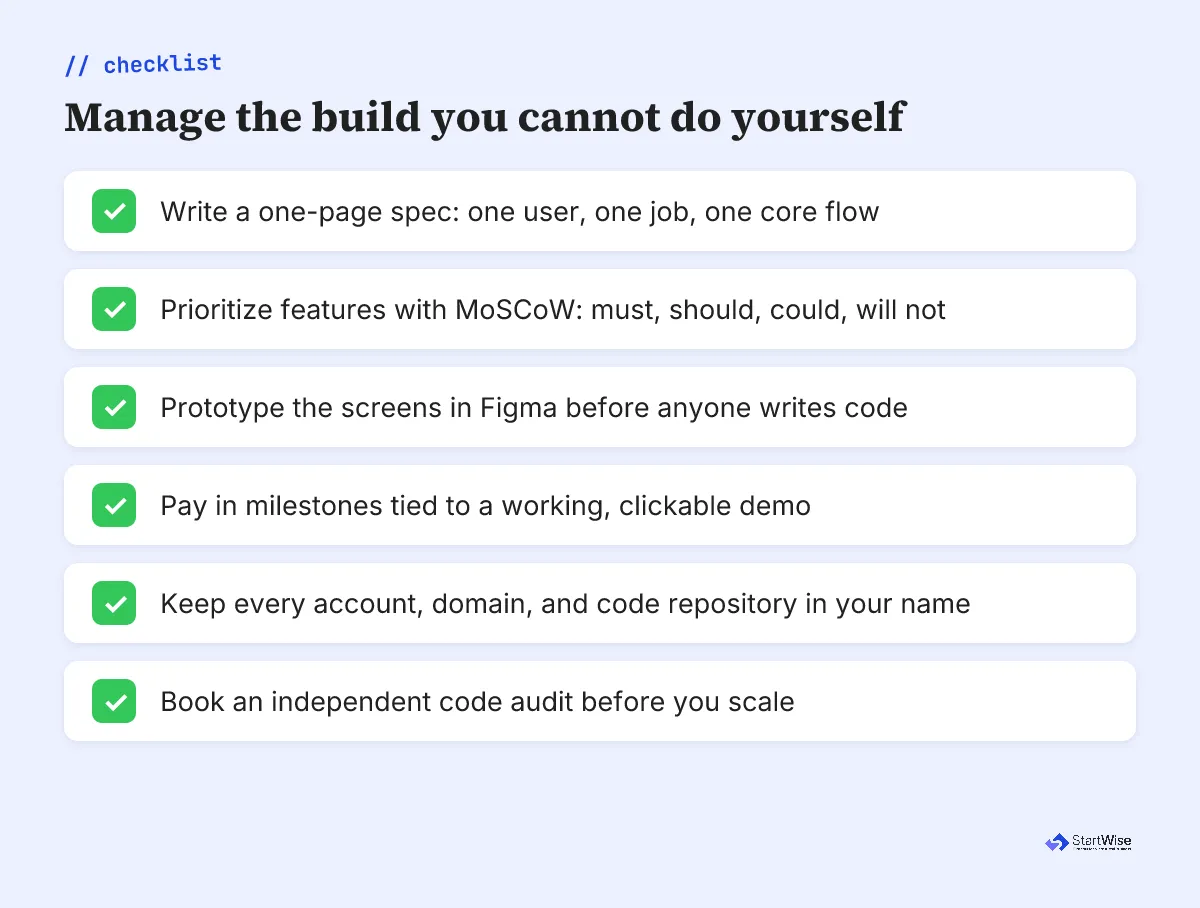
Start with a one-page Product Specification Document, your single source of truth (Withum). Name one user, the one job they hire your product to do, and the single flow that delivers it.
Then prioritize every feature with MoSCoW, a simple sort into must-have, should-have, could-have, and won’t-have, so the builder ships the must-haves before anything else. Prototype the screens in Figma before a line of code gets written, so you’re arguing over a picture instead of a bill.
Then protect yourself on the money and the assets:
- Pay in milestones tied to a working demo, never one lump sum up front.
- Run a weekly demo you can actually click, not a written status update.
- Keep every account, the domain, and the code repository in your name.
- Book an independent code audit before you scale, to catch spaghetti code early.
The founders we watch keep control ship faster and cheaper, because a tight spec kills the scope creep that eats no-code and custom budgets alike. If a freelancer holds your logins, you don’t own your company yet.
The non-technical founder’s job isn’t to write the code. It’s to make sure the right small thing gets built, and that you own it the day it’s done.
120 to 480 hours
is the founder time a DIY no-code build eats, worth roughly $9,000 to $36,000 of the attention that could have gone to customers. Cheap out of pocket is not the same as free. (Forcoda, 2026)
What do investors expect your MVP to prove?
Investors expect your MVP to prove two things: that you can ship, and that someone wants what you shipped. Polish isn’t on the list at pre-seed. A working no-code app that a few real users log into beats a beautiful slide about a product that doesn’t exist yet. If that app is consumer-facing, the deck still has to prove people come back, which is exactly what consumer app pitch deck examples teach best.
There’s an honest caveat. Some investors ask harder questions once they learn your product is a no-code build, because no-code has real limits at scale.
Early on that trade is fine. What a good investor is really checking is whether your technology is a liability and whether you can govern the build (Withum), the difference between a foundation and spaghetti code.
We dig into what investors actually expect from an MVP by stage, because the honest answer is that plenty of pre-seed rounds close with no MVP at all. Your job is to prove the one risk your raise turns on. Often that’s demand, not code.
What to do this week
Here’s the honest first week we’d give any non-technical founder, in order. None of it requires code.
- Write the one-page spec: one user, the one job they hire you for, the single flow that delivers it.
- Test demand before you build a thing. A landing page or ten real conversations will tell you more than another month of planning.
- Pick your path from the table above: no-code or an AI builder for a standard app, a freelancer if you want it built for you, the custom agency only once you have paying users.
- If you hire out, pay in milestones, book a weekly clickable demo, and keep every login in your name.
- Aim for a version you’d put in front of an investor, then stop adding features and go get users. Score it against our MVP checklist before pitching investors before you send it.
Build the smallest honest thing, keep control of it, and let real users tell you what to build next.