
 By
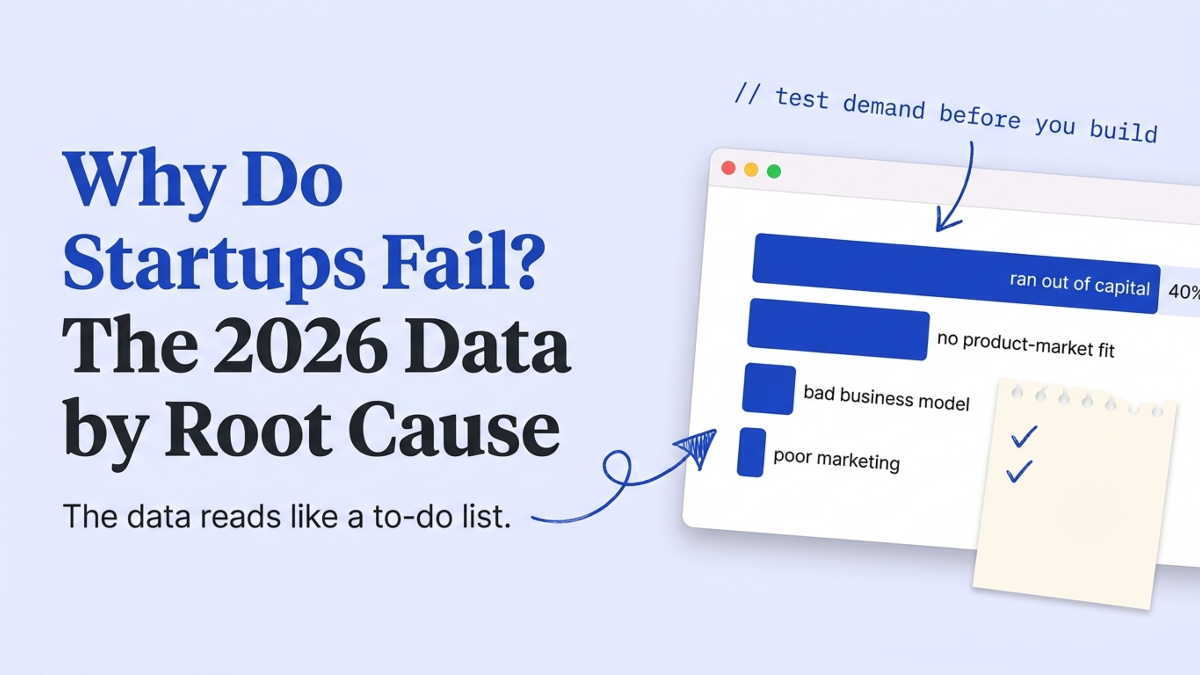
Startup failure is the moment a company stops operating, usually because it runs out of money or reasons to keep going. The data on why it happens is strikingly consistent, and most of it points at one thing: demand. In CB Insights’ March 2026 teardown of 431 venture-backed companies that shut down, 70% ran out of capital and 43% never found product-market fit (CB Insights, 2026). We read founder post-mortems the way we read decks at StartWise. The pattern rarely surprises us. The product was usually fine. Not enough people wanted it badly enough.
Why do most startups fail?
Most startups fail because customers won’t pay enough to keep the lights on, and the cash runs out while the team waits for that to change. CB Insights studied 431 venture-backed companies that shut down since 2023, identified the reasons behind 385 of them, and counted $17.5B in funding lost along the way. Four causes rose above the noise.
| Reason startups fail | Share of shutdowns | What it really signals |
|---|---|---|
| Ran out of capital | 70% | The final symptom, not the root cause |
| No product-market fit | 43% | Nobody wanted it badly enough |
| Bad timing or macro | 29% | Right idea, wrong year |
| Unsustainable unit economics | 19% | The math never worked at scale |
The shares add up to more than 100% because most failed startups named several causes at once (CB Insights, 2026). Read the table as a layered story, not a single verdict. Our read of the top two rows: they’re the same failure wearing two outfits. A company that runs out of money almost always ran out because demand never arrived to refill the account.
Is running out of cash the reason, or a symptom?
Running out of cash is the symptom, and weak demand is the disease underneath it. CB Insights says it plainly: capital is “the final cause of death, not the root problem” (CB Insights, 2026). Cash is just the thing you measure on the way down.
The base rates say failure is normal, not unlucky. US Bureau of Labor Statistics data, cited by Failory in its January 2026 analysis, shows about 20% of new businesses fail in year one, roughly 50% by year five, and near 70% by year ten (Failory, 2026). Venture-backed companies carry extra risk, because they spend ahead of revenue on the bet that demand will catch up.
Almost every “we ran out of money” story we hear started as a “nobody wanted it enough” problem that took eighteen months to show up on the bank statement.
So the runway math matters, but it’s downstream. A founder who can name ten people who’ll pay this month has a cash timing problem you can manage. A founder who can’t has a demand problem no bridge round will fix. If you’re unsure which you have, calculate your cash runway first, then be honest about what’s actually keeping it short.
What does “no market need” actually mean?
No market need means you built something people will admire but won’t buy, and it killed 43% of the startups in CB Insights’ 2026 set. Failory’s January 2026 review of more than 80 failed startups puts marketing and product-market-fit problems even higher, at 56%, the single largest bucket in its data (Failory, 2026). The headline is boring and true. Most dead startups made something nobody needed.
StartWise's position
A giant TAM number on a slide is theater, not demand. After reviewing decks daily, our view is blunt: a 40 billion dollar market you can't sell a single unit into this quarter is worth less than five people who'll pay you on Friday. That 43% product-market-fit failure rate is the gap between a big market and a paying one, cashing out.
This is why we push founders to size markets from the bottom up, counting reachable customers in year one, rather than starting from a trillion-dollar total. If you want the mechanics, our TAM SAM SOM example walks through a sizing that survives a napkin check. A market you can describe but can’t reach is the most expensive kind of optimism.
Not sure anyone wants your idea yet? Find the weak spots before you spend a quarter building. The free Idea Pressure Test scores your idea 0 to 100 across eleven dimensions.
Which failure modes can you test before you build?
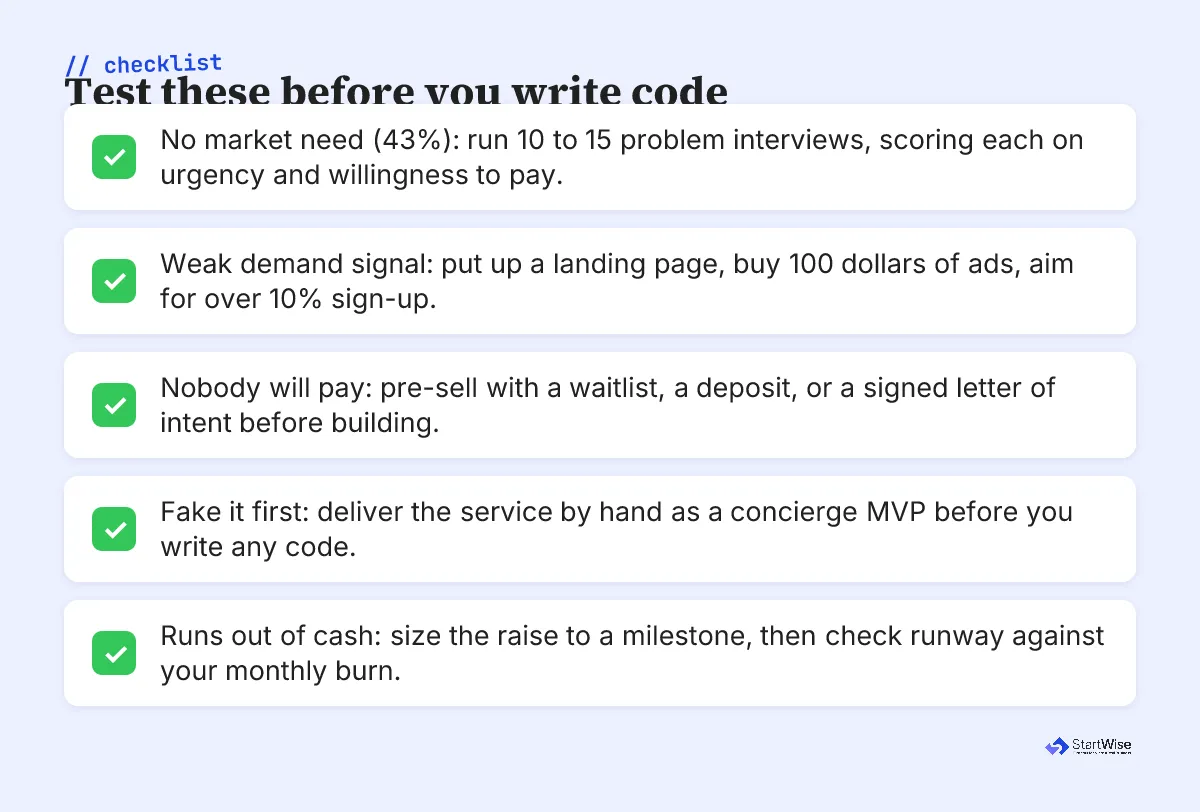
You can test the two biggest failure modes, weak demand and no willingness to pay, in under two weeks and for about 100 dollars. That failure data reads like a warning. Treat it as a to-do list instead. Thin Slices’ 2025 validation guide lays out the cheap tests, and I tell founders to run them in this order (Thin Slices, 2025):
- Problem interviews. Talk to 10 to 15 people in your target group, using the same script, and score each answer on urgency, existing workarounds, and willingness to pay.
- Landing-page test. Put up one page explaining the value, spend 100 dollars on ads, and watch the sign-up rate. Thin Slices suggests aiming above 10%.
- Concierge MVP. Deliver the service by hand first, over email or WhatsApp, before you build the platform that automates it.
- Pre-sale. Ask for a deposit, a pre-order, or a signed letter of intent. Money commitment is the only validation that never lies.
None of this needs code. That’s the point. Validating a startup idea without building it is faster, cheaper, and far more honest than shipping a polished product to silence. And when you do decide to build, knowing how much an MVP costs keeps the spend tied to what the tests already proved.
First-time founders fail more often than repeats
The success rate for first-time founders sits near 18% by one widely cited estimate, well below what repeat founders manage (Exploding Topics, via Failory, 2026). The gap isn’t talent. Repeat founders have simply watched demand kill a company once, so they test it first the second time around. We hear it in how they talk: customers before credentials, evidence before vision. You can borrow that scar tissue without paying for it. The fastest way is to decide, honestly, whether you should bootstrap or raise before you commit years to either path.
What to do this week
This week, before you write another line of code, pressure-test the demand behind your idea. Here’s the sequence I give founders, and none of it requires a product.
- Write down your single riskiest assumption. For most founders, it’s “people will pay for this.”
- Run ten problem interviews. Score each on urgency and willingness to pay, not politeness.
- Put up a landing page and spend 100 dollars driving traffic. Read the sign-up rate coldly.
- Ask for money. A deposit or a signed letter of intent beats a hundred compliments.
- Only once demand shows up, size your raise to a milestone and check it against your burn.
Startups rarely die because the founder built the wrong feature. They die because nobody wanted the thing badly enough to pay, and it took a year of runway to admit it. Find that out in two weeks instead.