
 By
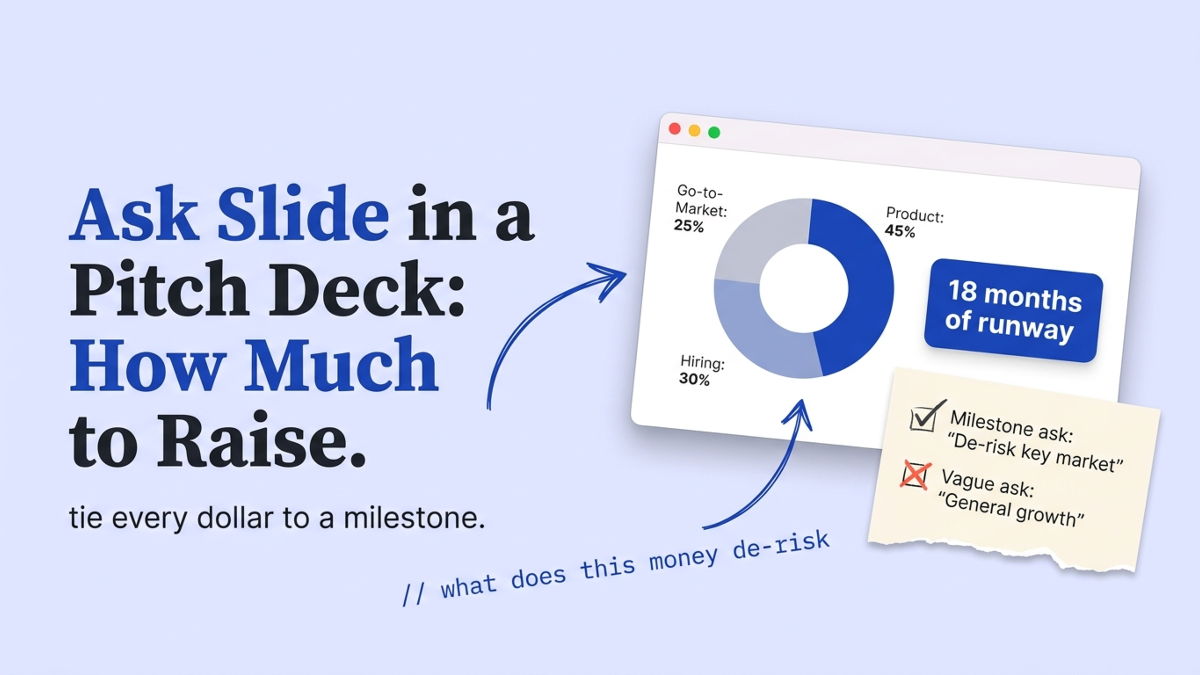
The ask slide is where you tell investors how much you’re raising and what the money will do. In most 2026 decks it merges with the old use-of-funds slide. One page now carries both the number and the plan. Here’s what most guides skip: investors read that slide in roughly 15 seconds, per Papermark’s 2024 study of 3,000 decks. We review founder decks before they raise, and the ask is the slide people write last and think about least. It deserves more.
What is the ask slide in a pitch deck?
The ask slide names the amount you want, breaks down where it goes, and ties that spend to what you’ll achieve. Three parts, one page. The amount tells an investor the size of the conversation. The allocation shows you’ve thought past the wire hitting your account. The milestone answers the only question that matters: what does this round buy that the last one couldn’t?
Older decks split the ask and the use of funds across two slides. Merging them is standard now, because it saves a slide and gives the number its context in a single read (Waveup). In the decks we review, the strongest asks read like a budget with a purpose, not a wish with a dollar sign.
It’s also the slide investors quote back to their partners. When a VC pitches your round internally, they repeat your ask and your milestone. If those two things don’t fit in a sentence, the internal pitch falls apart before you’re in the room.
How much should you raise?
How much you raise comes down to one rule: fund about 18 months of runway to your next real milestone. Under 12 months reads as a panic raise; over 24 signals you’re either underspending or over-raising (Waveup). Eighteen months is the number investors expect to sit behind your ask.
The 2026 stage numbers set your range. Pre-seed rounds run $750K to $1.5M with a median near $1M; seed rounds land around $3 to $3.2M, both diluting founders 15% to 20% (Carta State of Private Markets, via Value Add VC). Post-money caps sit around $4M to $6M at pre-seed, and the SAFE with a post-money cap is the default instrument. Those are the goalposts. Your number should fall inside them for a reason you can say out loud.
Here’s the math investors respect. Total your monthly operating costs, multiply by 18, add a 10% to 15% buffer for the things that always run over, then round to a clean figure (Waveup). A $2.46M result becomes $2.5M. Cash runway is the same calculation from the other direction, and if you can’t do it live in a meeting, the slide won’t save you. We flag asks every week where the number and the burn rate simply don’t reconcile.
How long do investors actually spend on the ask slide?
Investors spend about 15 seconds on the ask slide, the same rough budget they give any slide after the first, according to Papermark’s 2024 report on 3,000 decks. A whole deck gets about 3.2 minutes on a first read. The opening slide takes 23 seconds; every slide after it, roughly 15. About 30% of investors spend even longer on that first page (Papermark), so the attention curve is front-loaded and your ask lives on the thin end of it. It sits near the end, competing for a reader who’s already skimming fast.
That changes what the slide can be. Fifteen seconds is enough to read a number, a runway, and three budget lines. It is not enough to decode a ten-wedge pie chart or a paragraph about your hiring philosophy. If your ask needs a careful read, it won’t get one.
StartWise's position
The ask slide is a risk slide. Its real job is to answer one question: what does this money de-risk before your next round? A shy ask hides that answer behind a round number. "$500K to accelerate growth" is wallpaper; "$750K for 18 months of runway to $50K MRR" is an ask a lead can underwrite.
We watch this play out in reviews. The founders who treat the ask as a formality bury the strongest argument in the whole deck, which is proof they know exactly what the next 18 months cost and buy.
Make your ask read strong, not shy
A strong ask ties every dollar to a dated outcome; a shy one hides behind a round number and a verb like “scale.” That’s the whole difference. Waveup estimates around 95% of founders get the use-of-funds slide wrong, and the pattern is almost always the same. The money is there. The milestone isn’t.
Take a real rewrite. “Raising $500K to accelerate growth and hiring” is a sentence an investor has read a thousand times, and it says nothing. Now try this: “Raising $750K to fund 18 months of runway to $50K MRR and three enterprise design partners, the traction a seed lead underwrites.” Same round, different slide. One is a wish. The other is a plan with a finish line.
A round number with no milestone attached is wallpaper.
The fix is mechanical. For each chunk of the budget, name the milestone it drives (Waveup). “$1.8M to GTM” means nothing; “$1.8M to GTM to reach $1M ARR by Q4 2026” means you’ve done the arithmetic. Investors respond to the category of spend more than any other detail on the slide (Startups.com), so point each category at a result, the way your go-to-market slide points its one channel at customers.
| Element | Shy ask | Strong ask |
|---|---|---|
| Amount | ”$500K”, no basis given | ”$750K = 18 months to $50K MRR” |
| Use of funds | 10 vague wedges | 3 to 5 categories tied to the milestone |
| Milestone | ”accelerate growth" | "$50K MRR and 3 design partners by Q4” |
| Valuation | printed on the slide | left for the negotiation |
Milestones beat categories because they’re falsifiable. “Product” and “marketing” are buckets you can pour anything into. “$50K MRR by Q4” is a bet you’re making in public, and a bet is what earns the next check. Name the segment. Put a number on it. Give it a date, the same discipline the traction slide runs on. In our reviews, the shy ask is the single most common fixable flaw on the slide.
Not sure your ask reads as a plan instead of a wish? Get slide-by-slide feedback before you send.
Should you put valuation or use-of-funds detail on the slide?
Leave your valuation and cap off the ask slide, and hold the use of funds to three to five categories. Both rules come from one idea: the slide is a conversation starter, not a term sheet. Startups.com and Waveup agree in their 2026 guides. Don’t print a valuation on the deck you email, because you negotiate that separately, and naming it first only weakens your hand.
The use-of-funds breakdown has the opposite failure mode. Founders over-engineer it. A pie chart with ten wedges reads as someone who can’t prioritize, not someone who’s precise. Pick the three to five categories that actually move the milestone and give each a dollar figure and a one-line reason:
- Product: what you’ll ship, or the engineers you’ll hire to ship it
- Hiring: the two or three roles that unblock the milestone
- Go-to-market: the spend that turns product into the metric you promised
You’re aiming for a slide an investor can repeat to a partner from memory. If they can’t, it’s too busy. In reviews we cut the ask slide down far more often than we add to it, and the financials slide usually carries the detail this one is trying to hold.
Common mistake
Raising more than 24 months of runway to look ambitious. It reads as over-raising and hands away more of your company than the stage requires, at the 15% to 20% dilution you can't get back (Carta). Raise to the milestone, then raise again on better terms.
Where you are in the round matters too. The gap between a clean pre-seed and a seed raise shows up on this slide first, because a seed ask has to buy proof, not just runway.
What to do this week
Rewrite your ask slide in one sitting with this order, then test it on someone who has raised before. It’s the sequence I run when we review one.
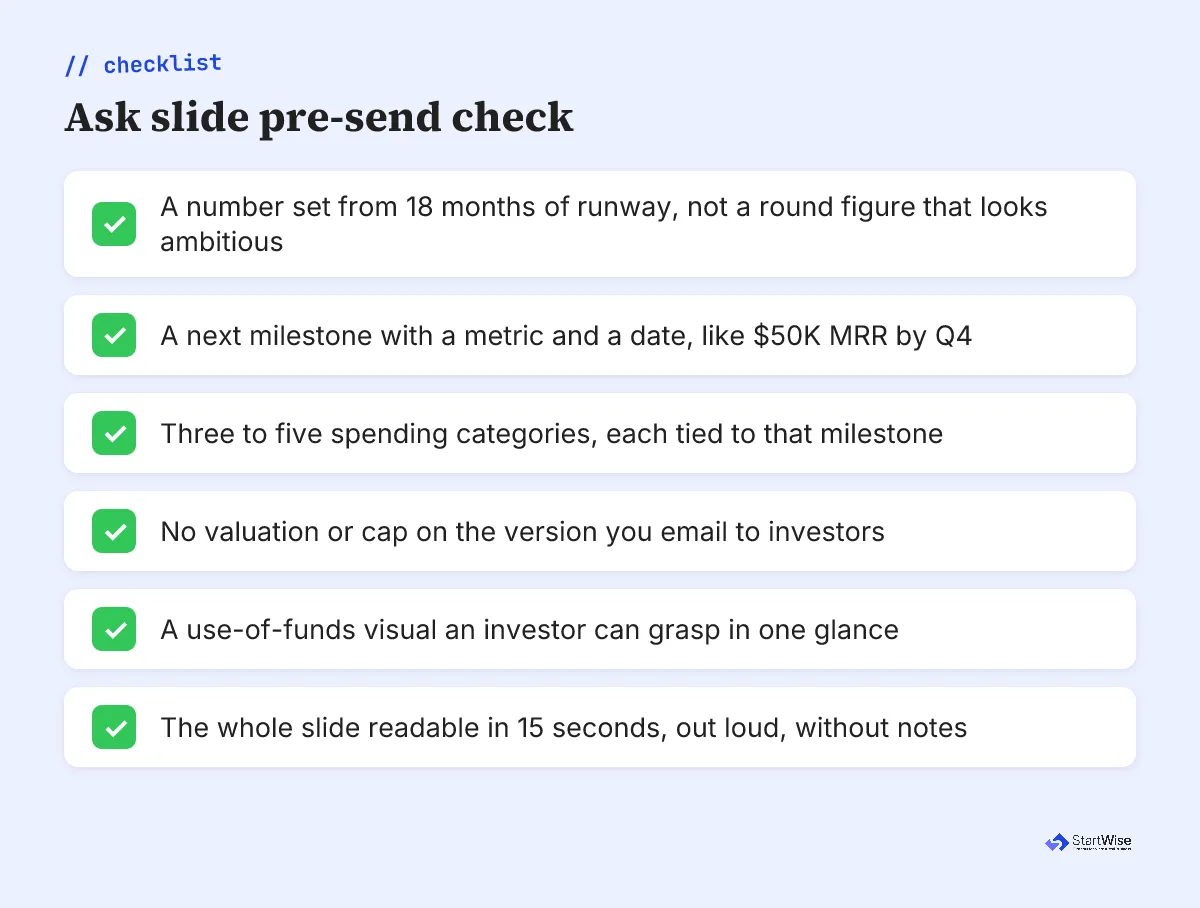
- Set the number from runway: 18 months of burn plus a 10% to 15% buffer, rounded clean.
- Name your next milestone with a metric and a date. Write “$50K MRR by Q4,” never “product-market fit.”
- Break the money into three to five categories, each tied to that milestone.
- Delete your valuation and cap from the version you email.
- Read the slide in 15 seconds. If you can’t, cut until you can.
Then say the ask out loud, once. If it names a number, a milestone, and a date without you reaching for the notes, it’s ready. If you stumble on it, the slide isn’t done, and neither is the plan behind it. The full deck math says you don’t have a slide to waste, so make this one land the way it should.