
 By
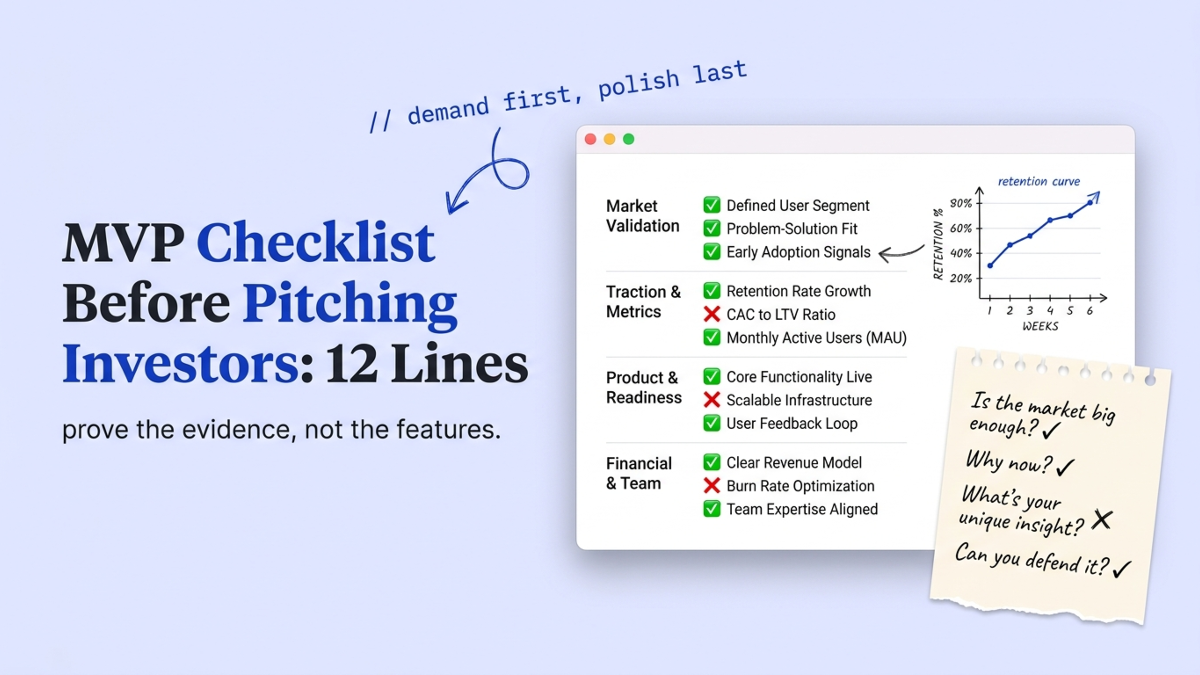
An MVP checklist before pitching investors lists the evidence your product must produce, not the features it must ship. The minimum viable product is the smallest working version that tests whether people want what you built.
We review founders’ materials most weeks at StartWise, and the pattern holds: the prettiest MVPs rarely carry the strongest demand data. Poor product-market fit is the root cause behind 43% of failed startups (CB Insights, 2025), so this checklist opens with proof that someone needs the thing.
What does an MVP need to prove before you pitch?
Before you pitch, an MVP has to answer four questions an investor’s money is quietly pricing: does anyone need this, will they use it and pay, can this team ship, and does the money reach a real milestone. Every line below hangs off one of those four.
Investors don’t buy the MVP. They buy the evidence it produced. A modern seed investor no longer expects a fully built product (VeryCreatives), so a working demo with a real usage curve beats a polished app nobody has opened.
Here’s the part founders skip. When CB Insights read 431 startups that shut down since 2023, running out of cash topped the list at 70%. That’s the cause of death, not the disease. Poor product-market fit sat underneath at 43%, and the median company had raised $11 million before it folded (CB Insights). Money didn’t save them. Demand would’ve.
In the review room we see the swap constantly: the deck leads with a product tour and buries the demand evidence three slides deep. So this checklist is ordered on purpose. Demand first, because that’s the risk that kills companies.
The 12-line MVP checklist to pass before you pitch
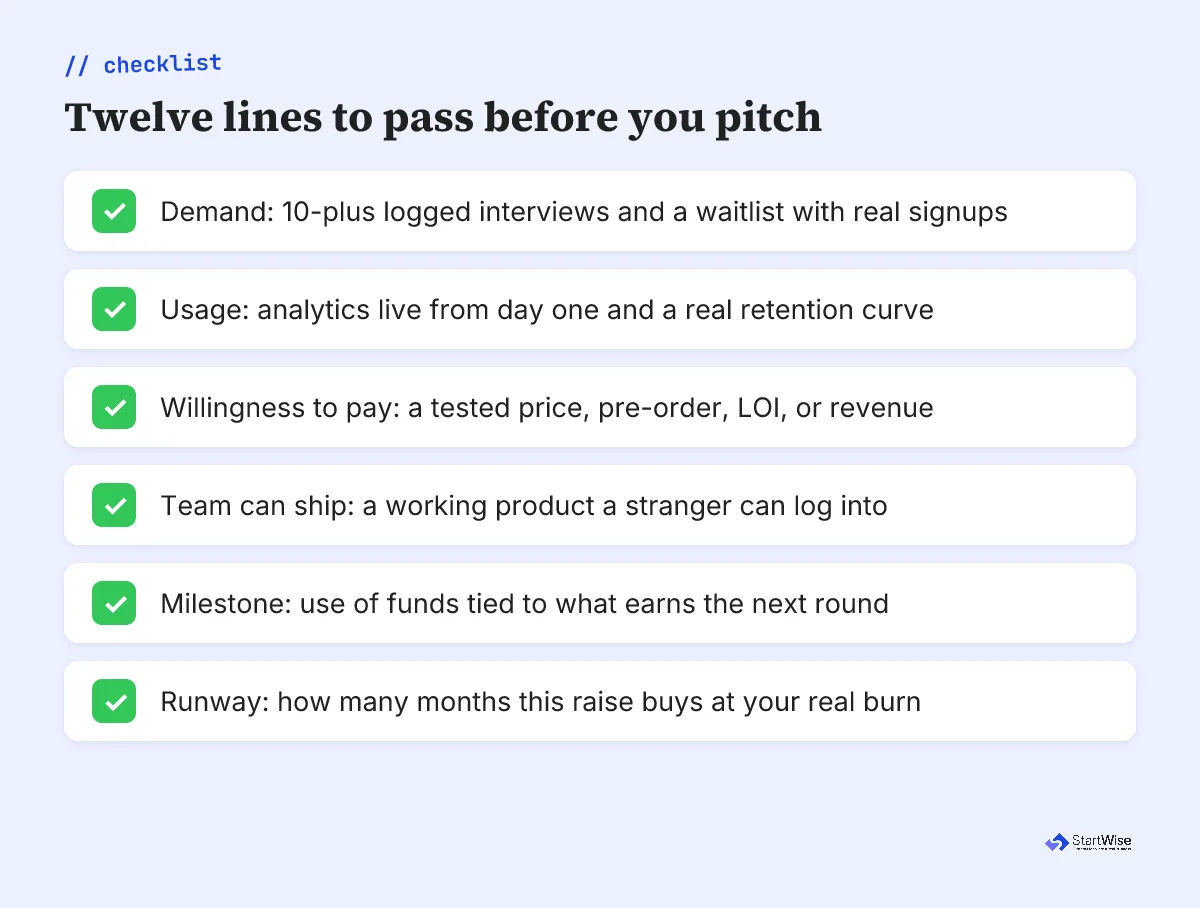
This is the full checklist, ungated: 12 lines grouped under the four investor questions. Score each one honestly as a pass or a fail before you send a single email, and treat a maybe as a fail.
Does anyone actually need this?
This group proves demand, the risk that sinks the most startups. My honest take: if these three don’t pass, nothing else on the list matters yet.
- Ten or more logged customer interviews, with the problem in the user’s words, not yours.
- A landing page or waitlist with real signups, so interest lives outside your own head. You can prove demand without building anything here.
- A one-sentence problem statement: specific user, specific pain, a cost you can measure.
Will they use it and pay for it?
This group proves the product actually does its job and that the value is real enough for someone to pay, which is the evidence a pre-seed deck almost never carries. Founders instrument it last. That’s exactly backwards.
- Analytics live from day one, through a tool like PostHog or Mixpanel, so you’re showing usage instead of asserting it.
- A retention or repeat-use curve, even a small one, from a real cohort of users.
- Willingness-to-pay evidence: a price you tested, a pre-order, a letter of intent, or early revenue.
Can this team actually ship it?
This group answers the execution question every investor asks quietly. Can you build? We keep seeing strong demand undercut by a product that plainly stalled somewhere between the demo and the third feature.
- A working product a stranger can log into, not a static mockup or a slide.
- A shipping cadence you can describe in one line: what you built in the last 30 days.
- A team line naming the relevant scar tissue: who has shipped or sold in this space before. If you haven’t built it yet, our guide to building an MVP as a non-technical founder covers the paths.
Where does the money actually go?
This group turns the ask into a plan. I’ve read a lot of decks where the product’s strong and the ask is wallpaper.
- A use of funds tied to one milestone that de-risks your next round, not a generic “growth.”
- Runway math: how many months this raise buys at your real monthly burn.
- The metric this round is meant to hit, stated in the numbers your next investor will check.
That’s the whole asset. For the broader raise beyond the product, our pre-seed fundraising checklist covers the deck, the list, and the data room.
Every line checked and ready to pitch? StartWise builds your plan, financial model, and investor outreach in one place, then matches you to investors for your stage.
How ready does your MVP need to be by stage?
How ready your MVP needs to be depends on the stage you’re raising. Pre-seed forgives a thin product; seed doesn’t. The bar climbs from proof of insight to proof of traction, and the checklist above stays the same while the pass mark rises.
| What to check | Pre-seed | Seed |
|---|---|---|
| What the MVP proves | You can ship and someone wants it | Real, repeatable usage and early revenue |
| Traction bar | A demo, a waitlist, first active users | $500K to $1.5M ARR for B2B SaaS (CRV, 2026) |
| Round and terms | About $0.75M to $1.5M, usually a SAFE (92% of pre-seed rounds, Carta) | $4.0M median cash, ~$20M post-money (Carta, 2025) |
| What sinks the pitch | No evidence anyone needs it | Revenue with no retention curve behind it |
CRV’s 2026 read on seed investors puts a strong B2B SaaS round at $500,000 to $1.5 million in ARR, growing 15% to 20% month over month (CRV). At pre-seed the bar drops, but the direction is identical: show movement, not a frozen screenshot.
The seed decks we review that stall usually have the revenue line and no cohort behind it. One number to internalize: raising a seed still takes most founders three to six months (CRV). The evidence you walk in with sets the whole pace.
At the earliest stage the product can be genuinely thin. We cover why in do investors expect an MVP, because plenty of pre-seed rounds close on a demo and an insight alone.
Why do founders fail this checklist?
The MVPs we see fail this checklist for one predictable reason: they’re over-built and under-instrumented. Founders arrive with a beautiful app and no usage data to defend it.
The fix is cheap. Turn on analytics before you build the next feature. A retention curve from 40 real users tells an investor more than a feature list of 40 screens ever will, because one is evidence and the other is a to-do list you happened to finish.
StartWise's position
An MVP with no analytics is worth less at pitch than a landing page with a waitlist. Investors fund the evidence a product generated, not the features it happens to have. The founders who spend the last of the budget on a fourth feature, instead of instrumenting the first three, walk in unable to answer the one question that matters: does anyone come back?
The subtler failure is treating the MVP as the thing you’re selling. It isn’t. Your MVP’s job is to generate evidence for the one risk your raise turns on, and often that risk is demand, not code.
$11M, 22 months
is what the median failed startup had raised and how long it lasted after its last round before shutting down. Cash bought time, not product-market fit. (CB Insights, 2025)
The MVP is not what you sell an investor. The evidence it produced is.
What to do this week
Here’s the honest order we’d give any founder sitting on an MVP and thinking about a raise. None of it needs a developer.
- Score the 12 lines above as pass or fail today. Be strict, and treat every maybe as a fail.
- Fix the demand lines first: log ten real customer conversations and stand up a waitlist if you don’t have one.
- Turn on analytics before you touch another feature, so next month you’ll have a retention curve to point at.
- Write your use of funds against one milestone that earns the next round, then sanity-check the runway math. Our note on what an MVP costs helps you size the burn.
- Only once the demand and usage lines pass, start lining up investors for your stage.
Build the smallest thing that proves demand, instrument it, and let the evidence do the pitching.