
 By
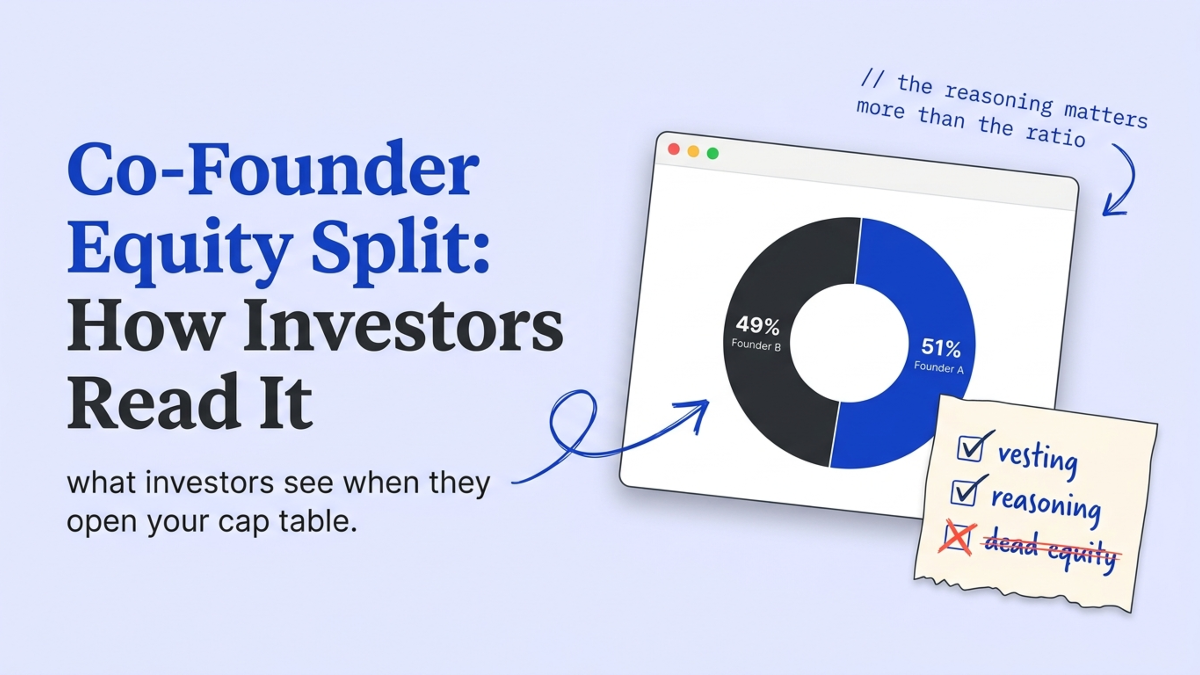
A co-founder equity split is how two or more founders divide ownership of the company they’re starting. It’s usually the first real money decision a founding team makes, and it lands on the cap table every investor reads before they wire a cent. About 42% of two-founder teams split 50/50, according to Carta data reported by Techstars in 2026. But when we read founders’ ownership docs, the ratio almost never raises an eyebrow. The reasoning behind it does.
How do most co-founders split their equity?
Most co-founder teams land near an even split. Carta’s data shows about 42% of two-founder companies go exactly 50/50 (via Techstars, 2026), and most of the rest sit close to it, nearer 51/49 than the lopsided splits most founders picture before we walk them through the numbers. Only a minority hand one person clear control.
Here’s how the common models actually look, and what each one tells an investor.
| Split | What it looks like | When it fits | What investors read |
|---|---|---|---|
| 50/50 | Equal shares | Equal commitment and risk | Fairness, or an avoided conversation |
| 51/49 | Near-equal, one tie-breaker | Peers who still want a casting vote | Decisiveness without drama |
| 60/40 or 55/45 | Weighted to one founder | Different time, capital, or experience | A judgment call they can probe |
| Junior co-founder | One founder on 5% to 20% | A later or part-time joiner | Clear hierarchy, if documented |
Initial co-founders usually hold 30% to 50% each before any outside money, with later joiners taking less (Stripe). The even split isn’t a mistake by default. Google’s founders went 50/50, and Microsoft’s Gates and Allen went 64/36 (First Citizens Bank). Both worked out. What a number can’t tell an investor is whether you got there by thinking hard or by dodging a hard talk.
What do investors actually look at in your split?
Investors look at the logic behind your split, not the split itself. During diligence, a VC asks who owns what percentage and wants clear reasoning and transparency about how you got there (First Citizens Bank). A 60/40 you can defend in one sentence beats a 50/50 you landed on because it felt polite.
Three things surface when an investor opens your cap table. The first is whether the split has a story. “She builds the product, I own sales, we both took the same pay cut” is a story. A round number with no explanation isn’t.
The second is vesting, and we’ll get to the mechanics below. The short version: founders who never put themselves on a schedule look like a team that hasn’t thought about what happens when someone leaves. The third is dead equity, a departed founder still sitting on a big stake, which is the single mess we flag most often when we read a founder’s ownership docs. It’s the same risk an investor already reads on your team slide, just in harder numbers.
Investors don’t grade the ratio. They grade whether you had the conversation.
StartWise's position
The team slide is a risk slide, and your cap table is the proof behind it. Investors read a co-founder split as a signal about whether the team survives its first hard year, not as a fairness exercise. A split with no documented reasoning and no vesting reads as two people who skipped the hardest early conversation.
Research backs the point. Noam Wasserman’s study of 6,000 founders in The Founder’s Dilemmas (2012) found teams that split equity evenly by default were three times more likely to end up with unhappy co-founders. The quick handshake is the expensive one.
The drift matters too. A split is a starting point, and dilution moves it from there: by Uber’s IPO, Travis Kalanick held 6.7% and Garrett Camp 4.6% (First Citizens Bank), both far below wherever they began. Investors know the number will shrink. What they’re testing is whether you two set it deliberately enough that it survives the pressure. Attorney Scott Dettmer, who has papered hundreds of these deals, puts even splits at just over half of all arrangements, so a 50/50 surprises nobody. A 50/50 you can’t explain will.
Does a 50/50 split hurt your raise?
A 50/50 split rarely hurts your raise on its own. The ratio isn’t the risk. Deadlock is. When two founders own exactly half each and disagree on something that matters, nothing breaks the tie, and we’ve watched that freeze companies at the worst possible moment.
My honest take: most two-founder teams should still take a 51/49 split. Not for the 1% of economics, but because someone needs a casting vote when you’re stuck. One extra share is cheap insurance against a stalemate.
The economics barely move. The decision rights do.
Plenty of great companies run 50/50 and never deadlock, because the founders built a way to break ties that doesn’t live on the cap table. If you go even, write down how you’ll settle a standoff before you’re in one. An investor who asks “what happens when you two disagree?” wants to hear that you already know.
Split settled and your cap table ready for a diligence read? The next step is getting in front of investors who back your stage.
Structure the split so it survives diligence
Structuring the split well matters more than picking the perfect ratio. Four moves turn a split from a liability into evidence that you think like an owner, and none of them take longer than a weekend.
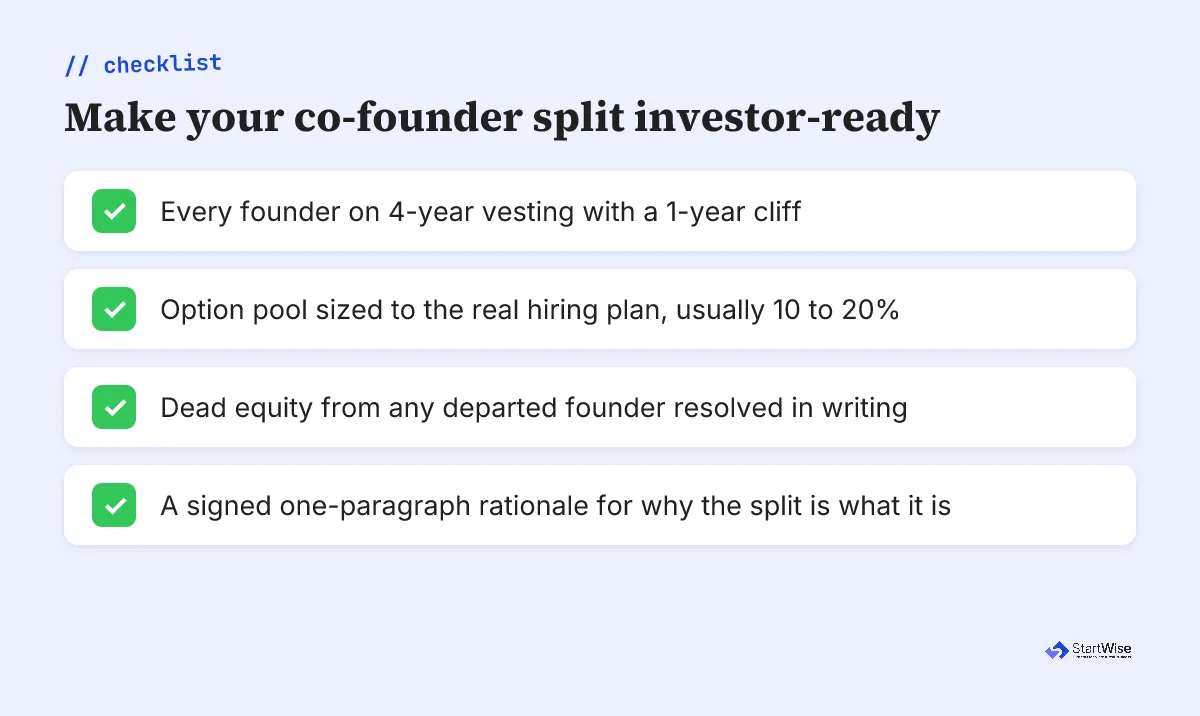
- Put every founder on 4-year vesting with a 1-year cliff. Stripe, LTSE, and Techstars all cite this as the standard, and its absence is the fastest flag an investor catches.
- Carve a realistic option pool. Early pools run 10% to 20% of equity (LTSE), and sizing it to your actual hiring plan keeps you from over-diluting before you need to.
- Resolve dead equity now. A co-founder who left owning 30% with no vesting is the mess we flag most, so clean it up in writing before an investor asks who that name is.
- Write the reasoning down. One signed paragraph on why the split is what it is answers the diligence question before anyone asks it.
Do those four and the split stops being a question an investor has to chase. It becomes a short, boring answer, which is exactly what you want a cap-table line to be.
What if you already split 50/50 and regret it?
If you already split 50/50 and regret it, you can still fix it, as long as you move before your first priced round locks the cap table. Equity you agreed to on a handshake isn’t final until it’s papered and vested, so the window is open longer than the founders we talk to assume.
The cleanest correction is vesting, not clawing back shares. Agree that from today each founder’s equity vests over four years, so ownership tracks who actually stays and does the work. That fixes the forward-looking risk without anyone feeling robbed of what they’ve already earned.
In practice that means re-papering the founder shares with a vesting schedule, and doing it the same way for both of you so neither reads it as a power grab. Let a lawyer handle the documents. The conversation is the hard part, and the sooner you have it, the less equity is already parked with someone who might not be here in a year.
Some teams go further with a dynamic split, the “slicing pie” idea popularized by Mike Moyer, where equity adjusts to logged contributions until you raise. It isn’t for everyone, but it beats carrying resentment into year two.
The worst option is silence.
Whatever you pick, your SAFEs make the clock real. Once they convert at a priced round, the split hardens, and the way a SAFE converts means the longer you wait, the more expensive the fix.
What to do this week
This week, have the equity conversation you’ve been avoiding, or re-open the one you rushed. Not the ratio first. The reasoning.
- Write one paragraph each on what you bring: the idea, the capital, the build, the hours, the risk. Trade them, then turn the gap into a number.
- Put every founder on 4-year vesting with a 1-year cliff, even if you’re solo today.
- Draft the split’s rationale in two sentences and have both founders sign it.
- Model where two rounds of dilution leave each of you, using the cap-table walkthrough, before you send a single deck.
Do that and the split stops being the thing an investor squints at. It becomes the first sign that you two can make a hard call together, which is the question we watch investors chase hardest, behind every line of your cap table.