
 By
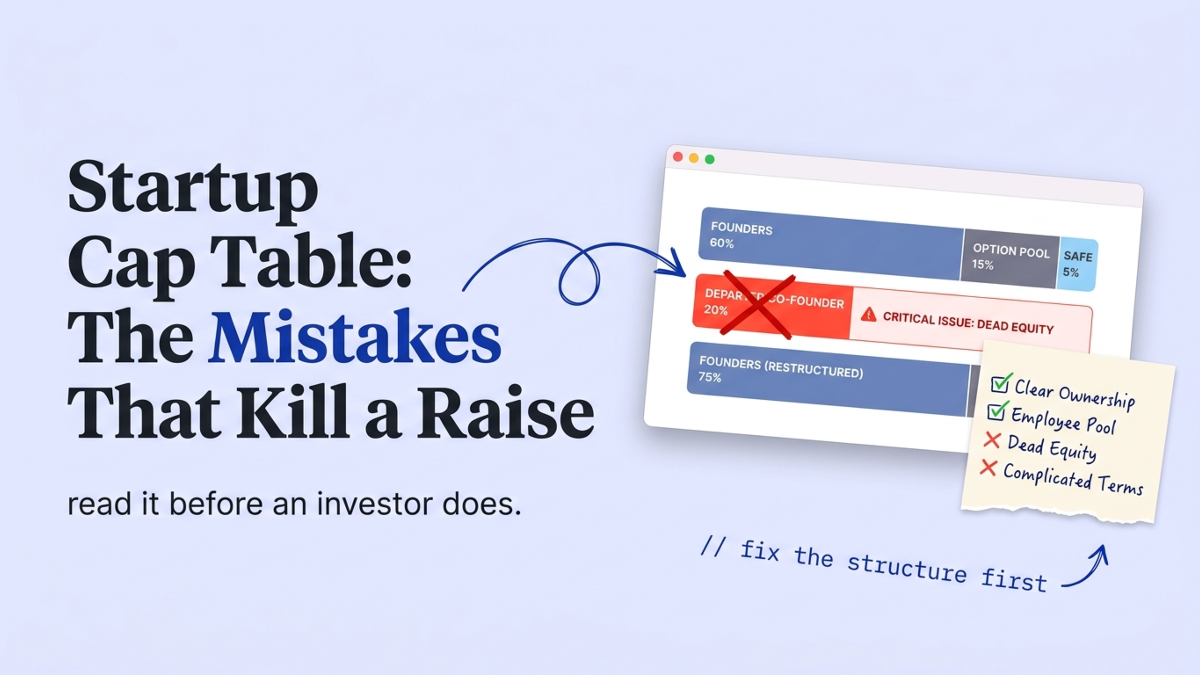
A cap table is the ledger of who owns what equity in your company: founders, investors, option holders, and any SAFEs waiting to convert. It’s also the first thing that tells an investor whether you’re organized. In the ownership docs we read at StartWise, the mess that stalls a raise is almost never the dilution math. It’s a co-founder who left owning a chunk, or an option grant nobody papered. By seed, founders keep about 56% on average (Carta data via CRV, 2026). Here’s how to read yours before an investor does.
What is a startup cap table?
A startup cap table lists every shareholder, how many shares each holds, and what percentage of the company that represents. At pre-seed it’s usually simple: two founders splitting common stock, maybe an advisor, and a few SAFEs (or a convertible note) from your first checks. The first line on it is your co-founder equity split, and how you set that split is the first thing an investor reads here.
The table has a few standard columns. Shareholder name, share class (common for founders, preferred for priced-round investors), share count, and ownership on a fully diluted basis. Fully diluted means you count every share that could exist, including the option pool and unconverted notes, not just the shares issued today.
Here’s the part that trips up first-time founders, and it’s the confusion we untangle most when founders send us their docs. SAFEs and convertible notes don’t show up as ownership the day you sign them. They sit off to the side as promises, and they convert into equity only when you raise a priced round. So your cap table can look clean and 90% founder-owned while you’ve actually sold 15% of the company to SAFE holders.
That gap is where most dilution surprises live.
How does dilution work across funding rounds?
Dilution happens when you issue new shares, which lowers everyone’s percentage even though your own share count doesn’t change. Each priced round mints new preferred shares for investors, so the founders’ slice shrinks at seed, again at Series A, and again after that.
The numbers are steadier than founder anxiety suggests. Median seed dilution ran about 20% in Q1 2024, and Series A about 17.9% in Q1 2025 (Carta data via CRV, 2026). Stacked up, that’s why the median founding team keeps roughly 56% after seed and about 36% after Series A.
Read your row and plan from it.
| Stage | Typical dilution | Founders retain (median) |
|---|---|---|
| Incorporation | none | ~100% |
| Seed | ~20% | ~56% |
| Series A | ~17.9% | ~36% |
| Series B | 15 to 20% | ~23% |
The mechanics are plain once you see them on paper. Say founders hold 8 million of 10 million shares, or 80%. The company issues 2 million new preferred shares to seed investors, taking the total to 12 million. The founders still hold 8 million shares, but now that’s 67% of a bigger pie. Nobody took shares away from you. The denominator grew.
Dilution compounds. The 20% at seed and the 18% at Series A don’t add to 38%; they multiply, and the founders’ half becomes a third. The founders we watch land in trouble aren’t the ones who gave up 20% raising a pre-seed round. They’re the ones who never modeled where two more rounds would leave them, and whether that trade beats not raising at all.
The option pool shuffle: who really pays for it
The option pool is equity you set aside to hire and reward employees, usually 10 to 15% of fully diluted shares at the early stages (CRV, 2026). How and when it gets created decides who eats the dilution, and the default answer is you.
Investors often require the pool to be created or expanded before their money goes in. That’s the shuffle. A pre-money pool comes out of the existing shareholders’ slice, so founders absorb it while the incoming investor doesn’t feel it. A 20% pool carved out this way is a bigger hit to your ownership than the round itself.
When an investor asks for a 20% pool, we tell founders to ask for the hiring plan that justifies it. Push back like this:
- Ask which specific roles the pool funds, and how much equity each one needs.
- If the plan needs 10%, propose 10% and hire more into a later pool.
- Ask to size part of the pool post-money, or split the difference.
A pool sized before the round is founder dilution wearing a planning costume.
Most of the time the roles on that plan need 10%, and the other 10% is pure founder dilution dressed up as prudence. You won’t win every point. You’ll win more than the founder who signs the term sheet without reading the pre-money line.
Why do SAFEs cause dilution surprises?
SAFEs cause surprises because they convert all at once. You raise $150K on a SAFE at pre-seed, another $300K six months later on a second SAFE with a different valuation cap, and neither touches your cap table until a priced round converts both into preferred shares.
By the time your seed round prices, three or four SAFEs can convert together and take a bigger bite than any single one suggested. Lucid describes this as how cap tables quietly change across rounds. We describe it as the reason a founder who thought they owned 80% wakes up at 62%.
The valuation cap on each SAFE makes it worse or better. A low cap means that SAFE converts into more shares, so an early check written at a $5 million cap can convert into a larger stake than a later check at a $10 million cap, even for the same dollars. Founders don’t track this until conversion, and by then the shares are already priced in. Walking through how a SAFE actually converts once is enough to stop the pattern from surprising you.
The fix is boring and it works.
Model every SAFE as if it converts today, before you sign the next one. If your number and your lawyer’s number disagree, you’ve found a problem worth fixing now, not during diligence when an investor is rebuilding the table anyway.
Cap table modeled and your dilution mapped? The next step is reaching the right investors for your stage.
What makes a cap table a red flag to investors?
A cap table becomes a red flag when it shows dead equity: shares held by people who no longer contribute. The classic case is a co-founder who left in year one still holding 30% with no vesting, so a third of the company sits with someone who’s gone. That’s the mess we flag most often when we read a founder’s ownership docs.
Investors don’t study any of this slowly. They spend about 3.2 minutes on the deck itself (Papermark, 2024, across 3,000 decks), and the cap-table glance is faster still. A red flag colors everything that follows in seconds.
Concentration is the second flag. If one angel holds 40% at seed, most venture funds walk, because the equity they’d need for future rounds is already spoken for. The third is a table full of handshake grants: an advisor you gave 5% verbally, a friend who “helped early.” Investors read these as judgment about how you make decisions. If you handed out equity casually, what else did you agree to without thinking it through?
StartWise's position
Your ownership is a slope, not a snapshot. Founders fixate on the percentage they give up in one round; investors read the whole trajectory and ask whether enough equity stays with the people building the company to keep them motivated to Series A. A founder diluted below half before seed is a motivation risk, and it shows.
So the median team holding 56% after seed (Carta via CRV, 2026) matters more as a direction than a target. An investor isn’t grading you against it. They’re checking that you’ll still own enough to care when the company gets hard, which it will.
Clean your cap table before you raise
Clean your cap table before you send a deck, not after a term sheet lands. The fixes below take a weekend, and they remove the surprises that stall a raise once an investor starts digging.
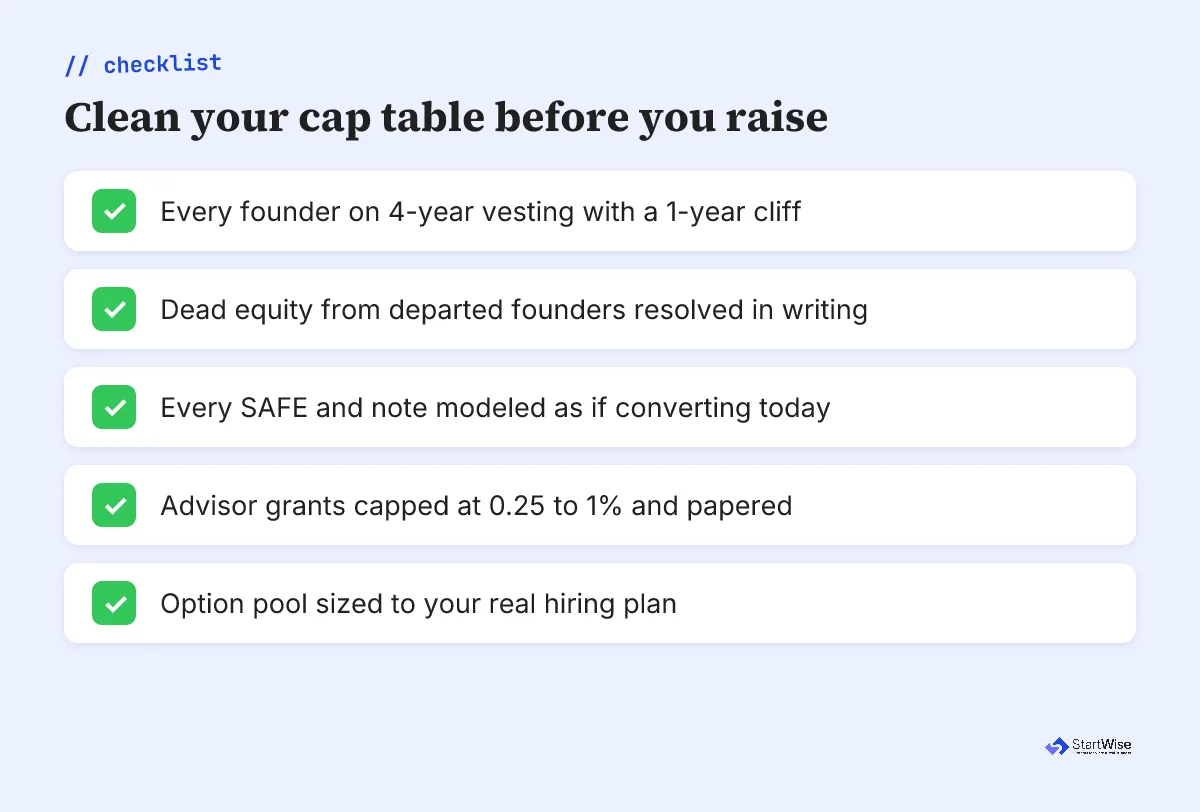
- Put every founder on 4-year vesting with a 1-year cliff. Even solo, even now. It protects the company if someone leaves, and it reads as adult judgment.
- Clear dead equity. A departed co-founder’s shares get resolved this month, in writing, before an investor asks who that name is.
- Model every SAFE and note as if converting today. Know your real fully diluted ownership before someone rebuilds the table for you.
- Cap advisor grants at 0.25 to 1% and paper them. Handshake equity is the flag that makes investors dig deeper.
- Right-size the option pool to your actual hiring plan, and push back on a pre-money pool you can’t justify.
Do those five and your cap table stops being a liability. It starts being evidence: that you understand ownership, that you plan two rounds ahead, and that you’ll still own enough of this company to fight for it. That’s what an investor is really reading when they open the table before they get into the checklist for the rest of your raise.