
 By
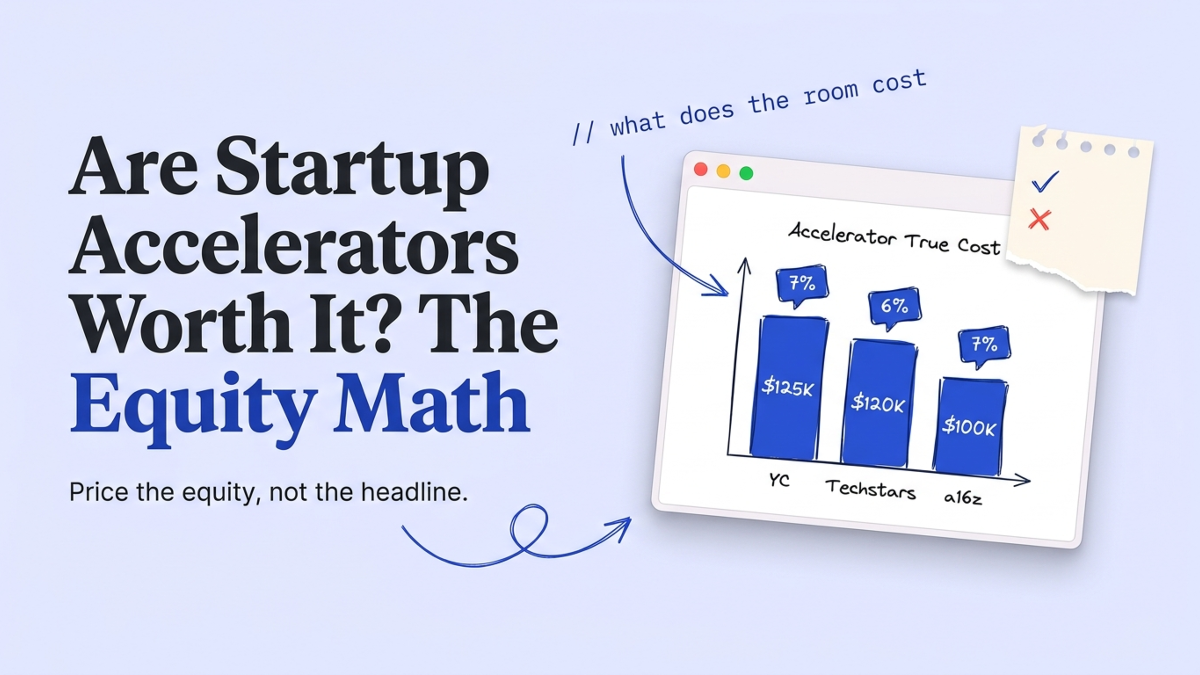
A startup accelerator is a fixed-length program, usually three months, that gives you a small check, mentorship, and a demo day in exchange for equity. The headline deal looks cheap. Y Combinator invests $500,000 for 7% plus an uncapped SAFE (YC, 2026). We review founder decks and fundraising materials every day at StartWise, and the question we hear most about accelerators is the wrong one. Founders ask which program is best. The better question is whether the equity buys something you can’t get on your own.
How much equity do startup accelerators actually take?
Most accelerators take 5% to 10% for a check between $100,000 and $500,000, but the headline percentage is only half the deal. The other half is an uncapped SAFE whose cost you won’t know until your next round. Here’s where the big programs stand in 2026.
| Program | Check | Headline equity | The catch |
|---|---|---|---|
| Y Combinator | $500,000 | 7% | Plus $375,000 on an uncapped MFN SAFE |
| Techstars | $220,000 | 5% common | Plus $200,000 on an uncapped MFN SAFE |
| a16z Speedrun | $500,000 | 10% | Plus $500,000 in your next round |
| Entrepreneur First | $125,000 | 8% | Plus an optional $125,000 MFN SAFE |
| MassChallenge | up to $100,000 | 0% | Equity-free, far smaller network |
Techstars restructured its deal to $220,000: $20,000 on a convertible agreement for 5% common stock, plus a $200,000 uncapped SAFE (Techstars, 2026). On paper that’s a lighter touch than YC. The number that actually decides your dilution isn’t in any of these columns, though. It’s the one we flag first when a founder shows us an accelerator offer, because nobody prints it.
What does 7% really cost at your next round?
The real cost is the uncapped SAFE, and it’s priced by your next round, not by the accelerator. An uncapped most-favored-nation SAFE is a floating promise: it converts at whatever terms your seed round sets, so a bigger raise means a bigger slice handed back. This is the math I run with founders before they sign anything. Startupik modeled it in 2026 and the gap is large.
At a median seed of $3M on a $24M post-money valuation, YC’s deal converts to about 8.6% of your company, and the equity it holds is worth roughly $1,555,000 after you subtract the $500,000 in cash (startupik, 2026). Techstars lands near 5.8% and about $1,180,000 net. a16z Speedrun, with its match in the next round, reaches 10% and roughly $1,900,000.
$1.18M to $1.9M
What a top accelerator's equity is worth at a median seed, after subtracting the cash they gave you (startupik, 2026)
So the “$500,000 for 7%” framing understates the bill by a wide margin. You’re not buying a $500,000 check. You’re spending well over a million dollars of future equity value, and the price floats up the better you do.
What are you actually buying for that equity?
You’re buying three things, and the check is the smallest of them. GrowthMentor puts it plainly: “The capital is the smallest part. The network and the deadline are what you’re paying for” (growthmentor, 2026).
- The network: warm access to hundreds of investors at demo day.
- The deadline: three months of forced focus with a batch watching.
- The signal: a brand on your deck that turns a cold founder into a meeting.
That signal is real and measurable. About 45% of YC companies raise a Series A, against 33% for non-accelerated startups, and roughly 4.5% reach unicorn status versus 2.5% at the seed stage generally (exnihilo, 2025). Those are the strongest numbers in the accelerator’s favor.
StartWise's position
Demo day is the ultimate skim. An accelerator buys you the room, not the deck. You get sixty seconds in front of three hundred investors, and if your story can't survive that skim, the 7% bought you a faster rejection, not a check. The program gets you in the door. It doesn't fix a weak idea or a deck that buries the lede.
This is the part the ranked lists skip, and the part we weigh most when founders ask. An accelerator is a lever, not an engine. It multiplies a founder who was already pushing, and it does very little for one who shows up hoping the batch will supply the missing conviction.
The accelerator's real product is a room full of investors. You can reach the right ones for your stage and industry directly, without handing over 7%.
When is an accelerator worth the equity?
An accelerator earns its equity when you need the network and signal more than the money, which is most true for the founders we see without a warm path to investors. If you’re a technical founder in a city with no venture scene, a repeat-outsider with no network, or an immigrant founder who needs a credible stamp, the brand does work you can’t buy any other way. For those founders, $1.5 million of future equity for a Series A rate that jumps from 33% to 45% is a fair trade.
The deadline matters too. Some founders genuinely move faster with a demo day on the calendar and a batch watching. If you’ve stalled for six months on a decision you keep deferring, three months of structure can be worth more than the dilution. Be honest about whether that’s you.
Raise directly if you can already get meetings
Founders who can already book warm investor meetings should skip the program, because its core product is access they already have. The network is its core product, and you don’t pay seven figures for a product you already own.
If you can already walk into the room, don’t hand over a tenth of your company for the door.
A founder with a handful of warm intros and a deck that earns the next call is better off running a tight process than giving up a tenth of the company for one.
The odds alone argue for a plan B. Top programs accept near 1% of applicants, and even regional accelerators run 5% to 15% (growthmentor, 2026). You cannot build a raise around a 1% event. Line up warm intros to investors and build a qualified pre-seed investor list in parallel, so a rejection from YC is a Tuesday, not a crisis. If the equity math bothers you, our walkthrough of how a SAFE converts shows exactly how that uncapped slice grows at your next round.
What to do this week
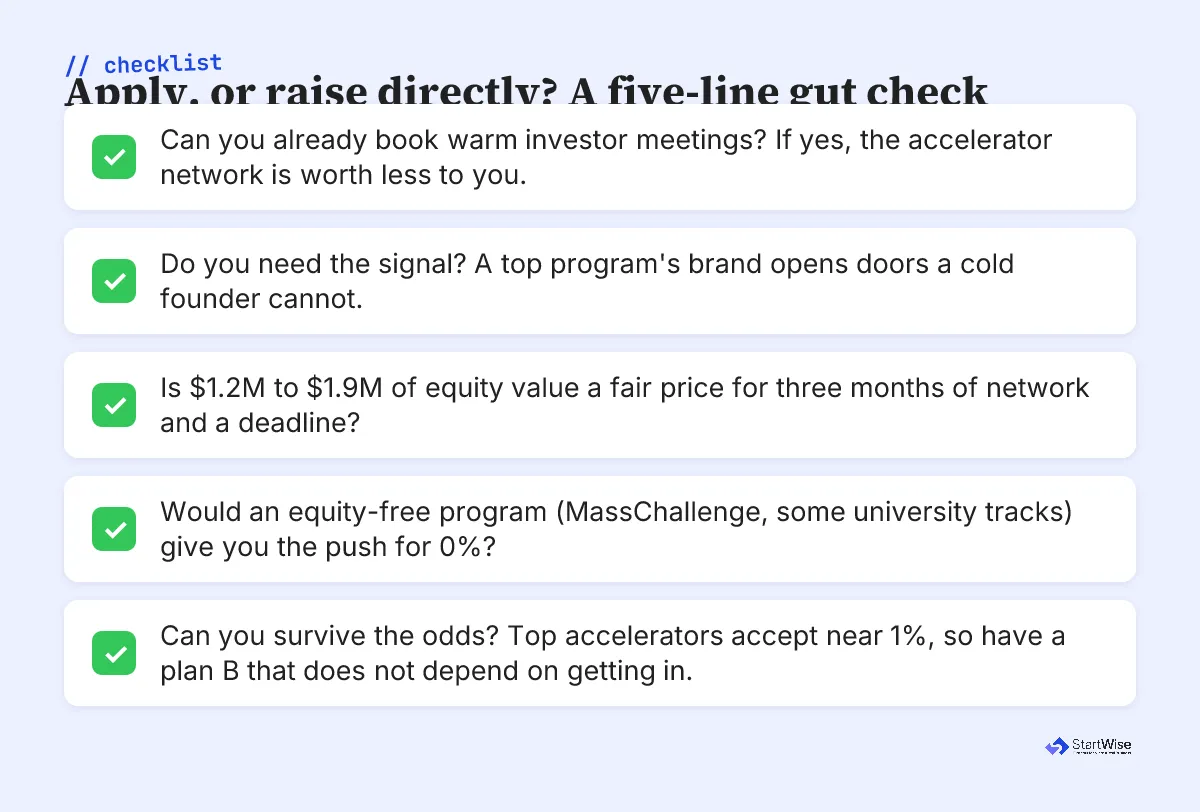
This week, decide whether you’re buying access or paying for access you already have. The gut check I give founders is short.
- List every investor you could get a warm intro to in the next month. More than five, and the network is worth less to you.
- Price the deal honestly. Run your target seed valuation through the uncapped-SAFE math, not the headline 7%.
- Pick one top program and one equity-free program to apply to, so you’re not betting everything on a 1% door.
- Start the direct raise in parallel. Read how to raise a pre-seed round and open a real pipeline this week.
- Whichever path you choose, make the deck survive the skim first. The room only helps if the story holds.
An accelerator isn’t a shortcut. It’s a lever on work you’ve already started. Decide what you’re actually buying, price it like the million-dollar deal it is, and raise directly if the room is one you can already walk into.