
 By
By 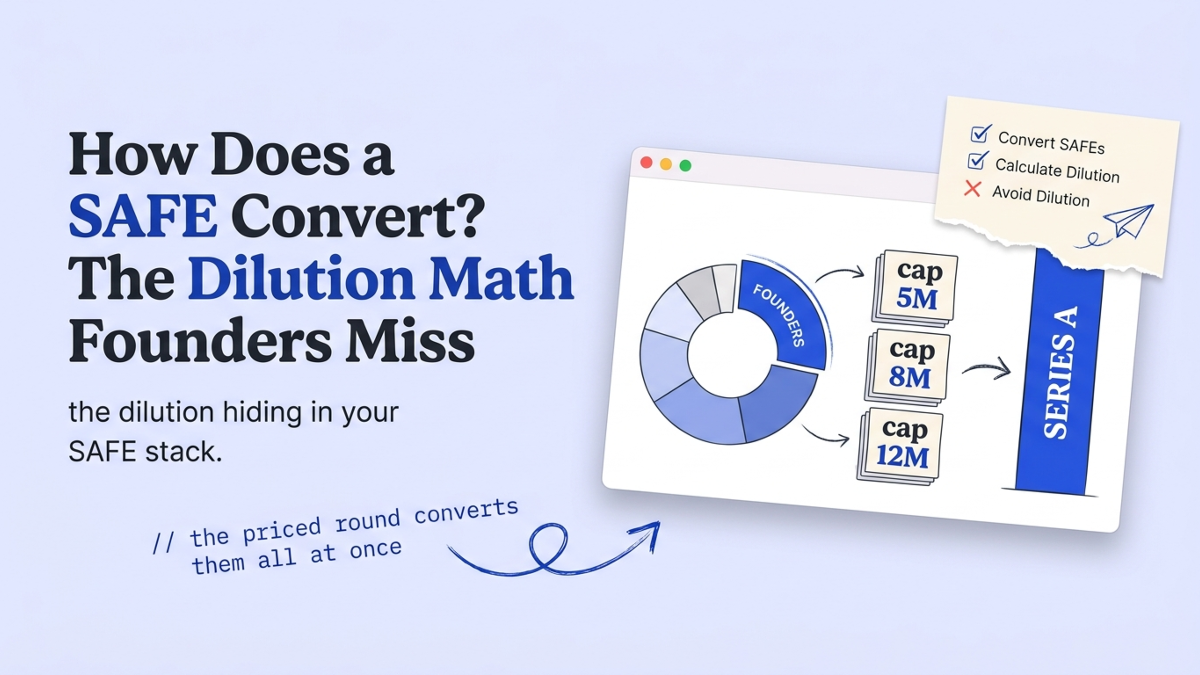
A SAFE (Simple Agreement for Future Equity) is a promise to hand an investor shares later, at your next priced round, in exchange for cash now. The catch lives in that word “later.” Most first-time founders sign two or three SAFEs, picture giving up a clean 20%, then watch their ownership drop further on closing day. We read fundraising materials every week, and the SAFE stack is where a cap table quietly gets away from founders who aren’t modeling it. Here’s exactly how conversion works, and where the surprise comes from.
What happens when a SAFE converts?
A SAFE, assuming you picked it over a convertible note, converts into shares the moment a priced round closes, one step ahead of the new investors’ money. It doesn’t sit on your cap table as equity until then. When a VC agrees to your Series A, every outstanding SAFE turns into preferred stock first, at a price set by whichever term treats the investor best.
Two numbers decide that price. The valuation cap and the discount rate. If a SAFE carries both, the investor converts at whichever produces the lower price per share, because a lower price buys more shares for the same dollars.
In the cap tables we review, founders can usually recite their cap and go blank on the conversion price it implies. That gap is the whole problem. We’ve priced enough of these to know the number is never the one founders guess. Your cap table is read by the next investor as a signal of judgment, so the shares a SAFE quietly creates matter long after the money lands.
How do the valuation cap and discount decide your dilution?
The valuation cap, not the headline size of your round, decides how many shares a SAFE buys. It sets a ceiling: the SAFE converts as if the company were worth the cap, even when the priced round values it far higher.
Cake Equity’s worked example makes it concrete. A $1M SAFE at a $5M cap, converting at a $12M Series A with 10 million fully diluted shares, converts at $0.50 a share and buys 2 million shares. The same $1M at the round price of $1.20 would buy only 833,333. That cap hands the investor 2.4x more stock for identical cash (Cake Equity).
A discount works differently. Instead of a ceiling, it shaves a fixed percentage off the round price, commonly 10% to 20%, with a median of 20% (Equidam, 2024). The version we keep seeing on pre-seed term sheets is a cap alone, no discount. About 30% of SAFEs carry both, and the investor still takes whichever price is cheaper (Equidam, 2024).
| Term | How it converts | Who it favors | Typical range |
|---|---|---|---|
| Valuation cap | At the cap price, cap divided by fully diluted shares | Investor when the round prices well above the cap | $10M to $15M post-money at pre-seed |
| Discount | A fixed percent off the round price | Investor in a modest step-up round | 10% to 20%, median 20% |
| Cap and discount | Investor takes whichever price is lower | Investor in every case | About 30% of SAFEs |
Why post-money SAFEs push dilution onto founders
Post-money SAFEs move the dilution from earlier investors onto you. Y Combinator rewrote its standard SAFE in 2018 so that each holder’s ownership is measured after all the SAFE money is counted, but before the new priced money converts it (Y Combinator).
Read that again. The percentage a post-money SAFE investor owns is fixed the day the round prices. So when you raise a second SAFE, or a third, that new money doesn’t dilute the first investor’s slice. It dilutes yours. The option pool a Series A lead demands works the same way: expand it before the round closes and, as Cake Equity notes, it dilutes founders further before the new investment is even issued.
The old pre-money SAFE spread that pain around. Everyone who hadn’t yet converted shared it. The post-money version, now the market standard, is cleaner for investors and quietly one-sided for founders, though it did give both sides the ability to calculate immediately and precisely how much of the company has been sold (Y Combinator).
A post-money SAFE fixes the investor’s slice and leaves the founder holding every later round of dilution.
Here’s our flat take. An uncapped or high-cap SAFE isn’t automatically founder-friendly. Stack enough post-money SAFEs and you can surrender more ownership than a single priced round would have cost you. If you can’t read the fully diluted result, you can’t price the favor. That’s why we push founders toward a real financial model before the second SAFE, not after.
What does a stacked SAFE round do to your cap table?
A stack of SAFEs at different caps converts into a bigger combined bite than any single one suggests, because each converts at its own price in the same round. We walk founders through this math constantly, and the total is always larger than the running tally they’re keeping in their head.
Forecastr walks through a common version: three SAFEs of $200K at a $5M cap, $300K at an $8M cap, and $500K at a $12M cap, all converting into a $20M pre-money Series A. The founders expected to keep about 80%. They kept roughly 71.5%. That missing 8.5% went to the SAFE holders, all at once, on closing day (Forecastr).
The order of events at the priced round is where the surprise hides:
- Every outstanding SAFE converts to shares at its own cap or discount price.
- The option pool is topped up out of the pre-money valuation.
- The new priced investors buy their shares at the round price.
- Founders absorb the gap between what they modeled and what actually converted.
The mistake we flag most
Founders read the valuation cap as their valuation. It's a ceiling on the investor's price, not a promise about your worth, and the wider the gap to your priced round, the more of you it converts.
Want to see what your SAFEs convert into before you sign the next one? StartWise builds your financial model and investor outreach in one place, free.
How much should you actually raise on SAFEs?
Raise to a milestone that de-risks your priced round, not to the friendliest cap an investor will accept. The amount you take on SAFEs is the amount you dilute, and pre-seed founders give up roughly 15% in a typical round already (Angel Investors Network, 2026).
With median pre-seed rounds landing between $750K and $1.5M, and caps clustering at $10M to $15M post-money, a second SAFE at a higher cap feels free (Angel Investors Network, 2026). It isn’t. You’ll feel it as a smaller founder row, never as a line item. Every dollar you raise before the priced round is a dollar of conversion that reads against your founder row. When we tell founders to size the raise to a milestone, this is why.
StartWise's position
An "ask" tied to a milestone that de-risks the next round beats a bigger check at a friendlier cap. "18 months of runway to reach $50K MRR" is a reason to raise a specific number. "As much as we can get" is how a cap table gets away from you before Series A.
If you’re still deciding whether to raise at all, our guide to raising a pre-seed round works through the milestone math before you pick a number.
What to do this week
Before you sign another SAFE, model the fully diluted cap table it creates. You don’t need a data room or a lawyer for the first pass, just a spreadsheet and the SAFEs you’ve already signed.
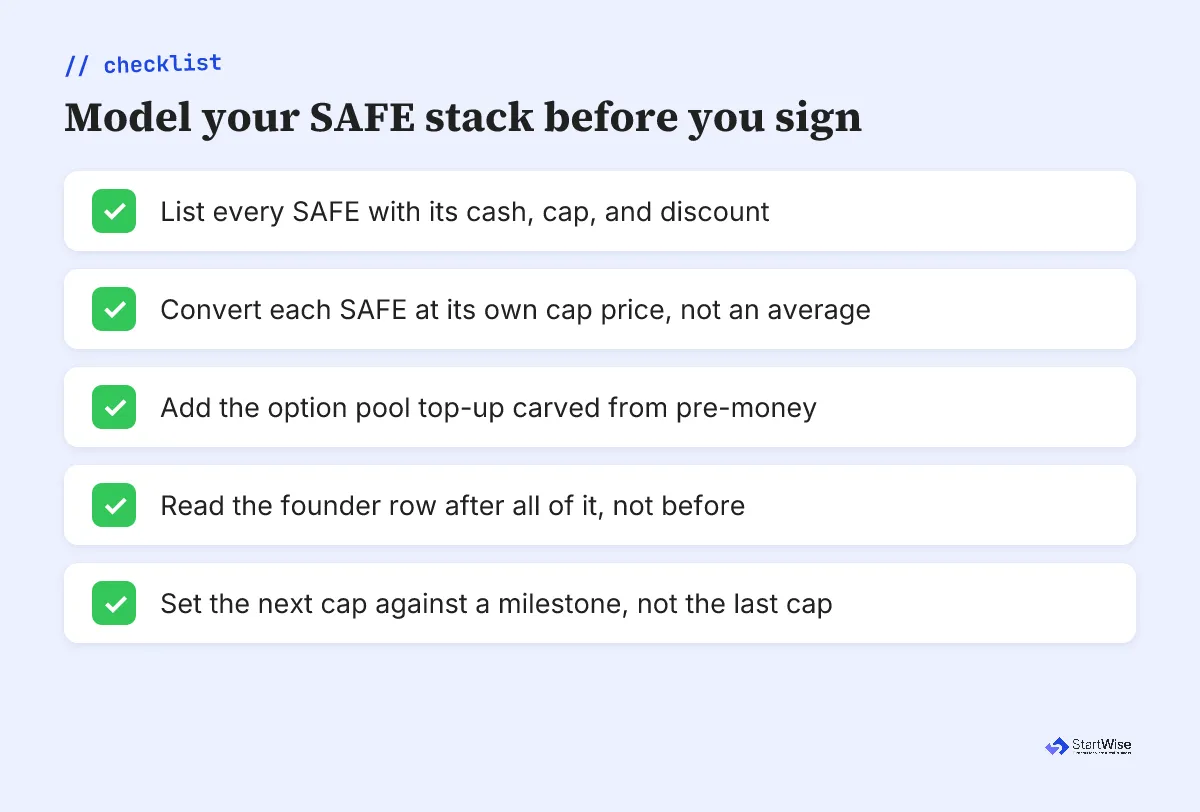
- List every SAFE with its cash amount, cap, and discount.
- Model each SAFE converting at its own cap price, not an average.
- Add the option pool top-up your lead will ask for, carved from pre-money.
- Read the founder row after all of it, not before.
- Set your next cap against a milestone, not against the last one.
Then sanity-check the whole raise against a pre-seed fundraising checklist so the SAFE terms match the rest of your plan. Every week we’ve watched the founders who model it first, and they’re never the ones surprised on closing day.