
 By
By 
A seed round is the first priced, institution-led financing most startups raise, usually after a pre-seed round done on a SAFE (a simple agreement that converts to equity in the next priced round). In 2026 it takes about 12 to 16 weeks from your first real investor meeting to money in the bank (Capwave). That headline number hides the part that decides your fate. The weeks aren’t the constraint. The gates are, and one gate holds up almost every raise we watch drag on.
How long does it take to raise a seed round in 2026?
Raising a seed round in 2026 takes most founders 12 to 16 weeks from the first real investor meeting to a closed wire (Capwave). Count the prep and the legal paperwork and it’s closer to three to six months end to end, per CRV’s founder data (via Causo’s H1 2026 seed report). US founders tend to land at the short end; international ones run longer.
That’s the median, and your raise is not the median. Some rounds close in eight weeks. Plenty take five months.
The spread is enormous, and it has almost nothing to do with how good your company is. A strong company with a disorganized raise loses to an average company that ran a tight one, and I’ve seen that happen more times than I’d like. So the useful question changes. Instead of asking how long it takes, ask what has to happen, in what order, for your raise to close. The weeks follow from the sequence. Get it right and 12 to 16 weeks is realistic; get it wrong and the same company drifts for two quarters.
The four gates a seed raise moves through
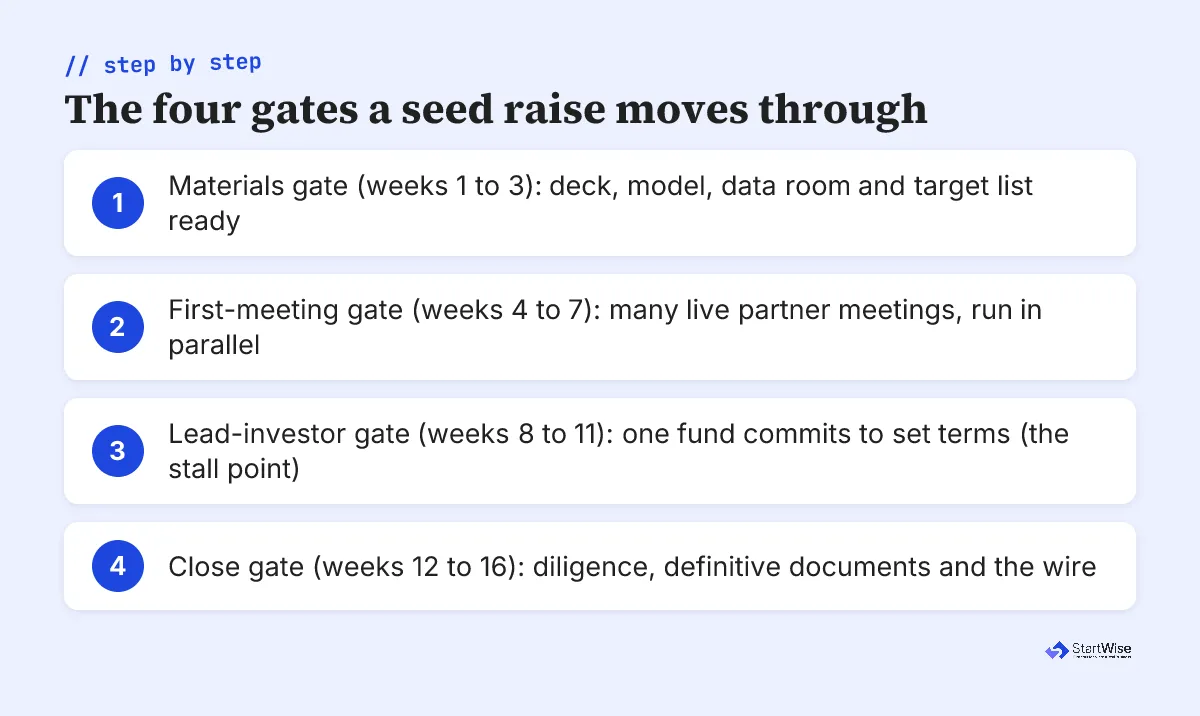
A seed raise moves through four gates, not four tidy blocks on a calendar: a materials gate, a first-meeting gate, a lead-investor gate, and a close gate. You advance by clearing each one, not by waiting for a week to tick over. Capwave’s 2026 breakdown maps them onto roughly this shape.
- Materials gate (about weeks 1 to 3): your deck, model and data room are ready, and your target list is built. Capwave found founders who spend at least 10 days here close 35% more often (Capwave).
- First-meeting gate (weeks 4 to 7): you’re in live partner conversations, running many at once instead of one at a time.
- Lead-investor gate (weeks 8 to 11): one fund commits to set the price and the terms. This is the gate that stalls.
- Close gate (weeks 12 to 16): confirmatory diligence, definitive documents and the wire.
In the raises we review, the founders who name these four gates out loud plan far better than the ones counting weeks. The trap is treating those week ranges as a schedule. They describe what a healthy raise looks like from the outside, after it worked. Inside, you don’t reach weeks 8 to 11 by reaching week 8. You get there by clearing the gate before it, and if a gate doesn’t clear, the calendar keeps moving while your raise doesn’t.
A seed raise doesn’t run on a calendar. It runs on gates, and you can’t schedule your way past a missing lead.
Why do so many seed raises stall on the lead investor?
Seed raises stall on the lead investor because a priced round can’t close until one fund agrees to lead it: to set the valuation, name the check size, and sign the term sheet everyone else follows. A lead investor is the one who anchors the round.
Until you have one, every “we’re interested” is just a maybe. The whole game becomes finding a lead investor who will actually set the price.
This is the part the tidy timelines hide. You can run 30 great meetings and still be nowhere, because 30 soft yeses without a lead is a pile of maybes, not a round. The money only starts moving when someone commits to go first. Capwave’s 2026 data puts a number on it: founders who land a lead in their first four weeks close about 2.4x faster than founders who don’t (Capwave).
StartWise's position
A stalled seed raise is almost never a deck problem. It's a lead problem. We watch founders re-cut slides in month three when the real blocker is that nobody has agreed to lead, and no design pass fixes that. The fix is pipeline math: more of the right conversations, aimed at the funds that actually write first checks.
So when a raise is dragging, I don’t start with the deck. I start with the pipeline: how many real lead candidates are live, and how many are genuine leads versus followers waiting for cover. A round full of angels and micro-funds that all want to follow has no engine. If your deck already got you the meetings, the deck isn’t your problem, and polishing it again is a way to feel busy while the clock runs.
Here’s one honest test. If an investor said yes today, could they lead? If most of your pipeline can only follow, no schedule will save you. Rebuild the target list toward funds that lead first, and you can fix that this week.
Stuck at the lead-investor gate? Atlas by StartWise maps your network in about 15 seconds and shows who can lead your round or make the warm intro to someone who will.
How does the seed timeline differ from pre-seed?
The seed timeline differs from pre-seed mostly in one requirement: the lead. A pre-seed round on a SAFE can close in 6 to 10 weeks with no lead and light legal work, because a SAFE skips the priced-round machinery (Capwave). A priced seed round needs a lead, a term sheet and confirmatory diligence, and each of those adds weeks.
That’s why the founder who wrapped pre-seed in a month is surprised when seed takes a quarter. The stage didn’t get harder to raise so much as heavier to close. Here’s how the two compare in 2026.
| Stage | Pre-seed | Seed |
|---|---|---|
| Typical time to close | 6 to 10 weeks | 12 to 16 weeks |
| Instrument | SAFE (88% to 92% of rounds) | Priced equity round |
| Lead investor needed | Usually no | Yes, this is the gate |
| Due diligence | Light | Formal, confirmatory |
| Median size (2026) | ~$1M | ~$3M |
| Median valuation | $4M to $6M post | ~$24M post |
Pre-seed figures come from Value Add VC and Future Sharks; the seed size and valuation are Carta Q4 2025 data (via Waveup) and CRV’s dilution range (via Causo). If you’re unsure which round you’re actually running, we drew the line between them in pre-seed vs seed funding, and walked through how a SAFE turns into equity in how a SAFE converts. The short version: pre-seed buys you speed, and seed buys you a priced anchor you have to work harder to close.
What makes a seed raise drag past 16 weeks?
Seed raises drag past 16 weeks for a short list of avoidable reasons, and most trace back to the lead gate rather than a weak company. Here’s what I watch slow founders down most, in the raises we review.
- No lead, only followers. A stack of soft commitments with nobody willing to set terms. The round has interest but no engine.
- A sequential drip. Pitching investors one at a time, so there’s never enough simultaneous interest to force a decision. Future Sharks recommends 20-plus first meetings inside a four to five week window, with 15 to 25 conversations in parallel (Future Sharks).
- Dead calendar zones. Late August and the last two weeks of December are where raises go quiet, because partners are out and investment committees don’t meet.
- Running out of targets. A list of 20 names burns out fast; a working seed list is 50 to 80 (Future Sharks), because most investors will pass.
- Diligence drift. Once you’re in diligence, missing data-room documents and slow replies add days that compound into weeks.
The one that quietly kills the most raises is the sequential drip. When you pitch investors one after another, no single fund ever feels the heat of competition, so everyone takes their time, and “taking their time” across ten funds in a row is how three weeks becomes three months.
2.1x
faster is how quickly founders close when their target list is built around investors active in the last 90 days, rather than a stale list of famous names who won't reply. A short or dated list is a self-inflicted delay. (Capwave, 2026)
Plan your seed raise backward from the close
Planning the raise backward from a target close date turns a vague “a few months” into a schedule you can run. Pick the week you want money in the bank, then count back through the four gates. Budget about four weeks to close from a signed term sheet, four more to land and negotiate that lead, four of concentrated meetings before it, and three to prepare. That puts your real start roughly 15 weeks out. When you reach that final gate, driving the close itself is its own playbook: land the lead, set a first close date, and bank checks on a rolling basis.
Prep is the cheapest lever you have. Capwave found that 10-plus days on materials before the first meeting correlates with closing 35% more often, and a target list built around funds active in the last 90 days with closing 2.1x faster (Capwave). Both are things you control before anyone says yes.
The other lever is warm paths to a lead. Cold outreach works, but the fastest route to a lead is usually a credible introduction, which is why we broke down how to get them in warm intros to investors. Build the target list first, using our pre-seed investors list as a model for qualifying each name by check size and stage, then map who can introduce you to the funds most likely to lead.
If you raised a pre-seed already, you know the rhythm. Seed is the same motion with a heavier close, and the pre-seed playbook still applies to the meetings phase, with a lead gate bolted onto the end.
What to do this week
Turn the timeline into a schedule you can start on Monday. Here’s the order I’d give any founder about to open a seed raise.
- Set a target close date, then count back 15 weeks. That date, not a vague “this fall”, is when your prep begins.
- Build a target list of 50 to 80 funds, and mark which ones can actually lead at your stage versus which can only follow.
- Line up warm paths to your top lead candidates before you send a single pitch, so your first meetings start with momentum.
- Book your first meetings in a tight four to five week block, running many in parallel, so no investor gets to take their time.
Do those four things and 12 to 16 weeks is a plan, not a hope. Skip them and you’ll be the founder re-cutting slides in month four, wondering why a good company can’t get a round closed. The weeks were never the problem. The lead was.