
 By
By 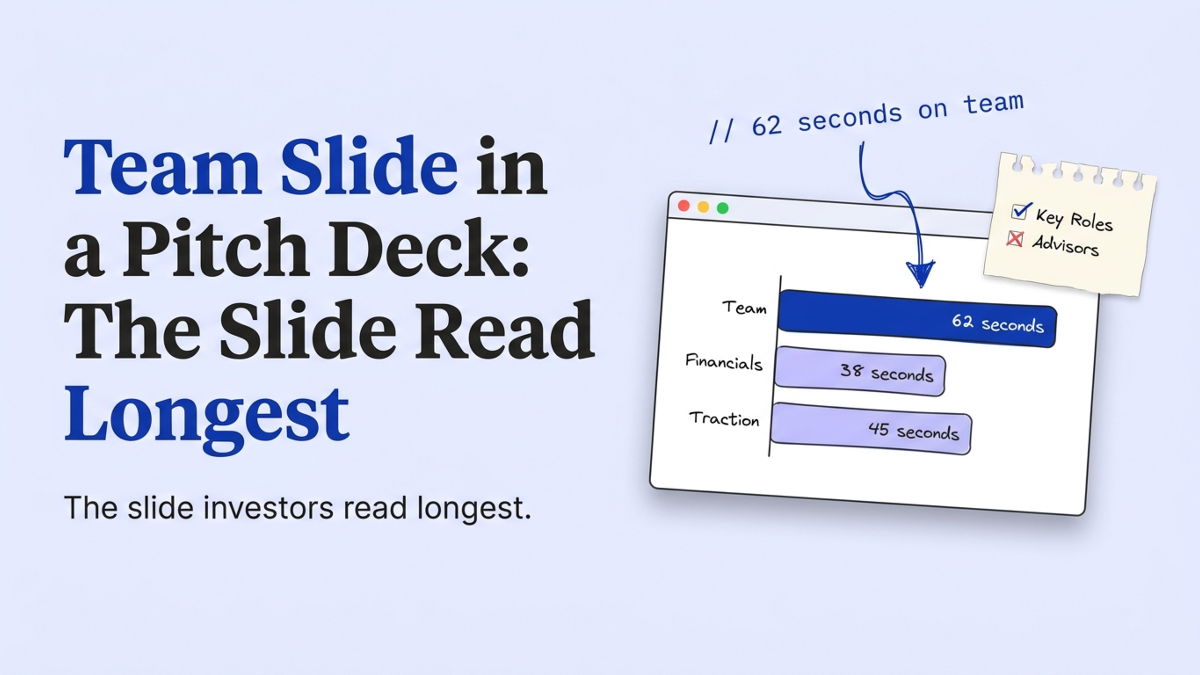
The team slide is the page in your pitch deck that tells investors who is building this and why they win. It sits early in most decks, often slide two or three. Here’s the part most guides skip: it gets more investor attention than any other slide. DocSend’s 2024 data, compiled by PitchGrade, clocks about 62 seconds on it, ahead of financials and traction. We review the decks founders send before they raise, and this is the slide they treat as an afterthought. That minute is where the bet gets priced.
Why do investors spend the most time on the team slide?
Investors linger on the team slide because at pre-seed, the team is most of what they are buying. That same DocSend data puts about 62 seconds on it, the single longest dwell of any slide, ahead of financials at 52 seconds and traction at 49. Waveup, which analyzed 800+ decks behind more than $3 billion raised, pegs the team at roughly 70% of an early-stage decision and the idea at 30%.
At pre-seed there’s no revenue trend to argue with, and the product is half-built. So the question shifts to the people. Can they build the thing, sell it, and still be standing at the next round?
In the decks we review, founders pour their design energy into the problem slide and paste the team in last. They have it backwards. The slide that earns the longest look deserves the most work.
What is the team slide actually answering?
The team slide answers one question, and it is not whether these people look impressive. It answers whether this team will fall apart or get out-executed before the next round. That’s a risk question, and credentials answer the wrong one.
Here’s our position after reviewing decks daily: the team slide is a risk slide, not a resume. A row of brand-name logos tells an investor you can get hired. It doesn’t tell them you’ll ship this product, in this market, when it gets hard. Relevant scars do. You shipped a payments feature to a million users. You sold into hospitals for three years. You lived the problem you’re now solving.
Credentials tell an investor you can get hired. Scars tell them you can finish.
That framing is not decoration. Waveup’s read that the team drives about 70% of an early-stage call is only true because investors treat those minutes as diligence on execution risk, not as a formality.
StartWise's position
The team slide is a risk slide, not a resume. Investors are pricing whether this team can out-execute rivals and stay together to the next round, and relevant scars answer that better than any title or logo.
What belongs on a team slide, and what to cut?
A strong team slide shows three to five core people, each with one line that proves founder-market fit, and nothing else fighting for the 62 seconds. Most weak ones fail by addition. They pad.
| Keep on the slide | Cut from the slide |
|---|---|
| Three to five core people, role plus one proof point | Ten faces, including part-timers and freelancers |
| The one scar that fits this market | A full work history for each person |
| Logos that explain your edge | Logos pasted to decorate |
| One or two active advisors who open doors | An advisor wall you talk to twice a year |
| A line on why this team, together | Adjectives: passionate, driven, serial |
The proof point is the whole game. “Led growth at Stripe” is a title. “Grew Stripe’s SMB signups 40% in a year” is a scar an investor can price. ThinkLions frames the four things a team slide must show as founder credibility, relevant experience, complementary skills, and proof of execution. One strong line per founder carries all four faster than a paragraph nobody finishes.
Four patterns we flag most in the review room:
- The credential dump: five logos and no line explaining why any of them matters here.
- The vanity solo slide: one founder, a headshot, the word “founder”, and no proof of anything.
- Advisor padding: three advisors listed to make a one-person company read as a team.
- The mismatch: a stellar background for a different problem than the one on the deck.
Not sure your team slide answers the risk question? Get a read before an investor does.
How do you write the team slide with no pedigree?
With no brand-name logos, you build the team slide out of evidence instead of pedigree. Most founders we see freeze here, assuming the slide needs a Google or a McKinsey on it. It doesn’t. It needs proof you can execute this specific thing.
Start with the scar you do have. You shipped a side project that pulled 5,000 users, or you spent four years inside the industry you’re now selling into, or you already built the v1 that’s sitting in your product slide. Any of those beats a logo with nothing to do with your market.
Solo and non-technical? Say so plainly and show the mitigation. Name the fractional engineer shipping your build, the advisor who ran the function you can’t, and the hire this round funds first. A reviewer’s fear is a single point of failure, so you answer it before they raise it.
First-time founder with a first-time team? Lead with domain proof and speed. “We shipped the beta in six weeks and have 30 users” says more about execution risk than any pedigree line. A relevant first-time founder with early traction beats a pedigreed team building in a market they’ve never touched, every time. Investors back first-timers constantly. They back the ones who show motion.
Place the team slide where it lands fastest
Put the team slide early if credibility is your strongest card, later if it’s your weakness. There’s no fixed slot. The attention data cuts both ways: if a reviewer will spend 62 seconds here regardless, you decide whether that happens while they’re forming a first impression or after you’ve earned it.
If you have deep domain expertise, a prior exit, or a name that opens the round, lead with the team, sometimes right after the problem. If the team is your soft spot, prove the problem and traction first, then bring the people in once the idea has earned attention. The decks we send back most often bury a strong founder behind six setup slides.
This matters more on cold outreach. A cold deck gets about 2 minutes 31 seconds of reading and converts to a meeting 3% to 5% of the time, versus 4 minutes 18 seconds and 40% to 50% for a warm intro, per DocSend. On a cold send you have half the time, so your strongest signal goes where it lands fast. That is also why founders track which slides investors actually open.
What to do this week
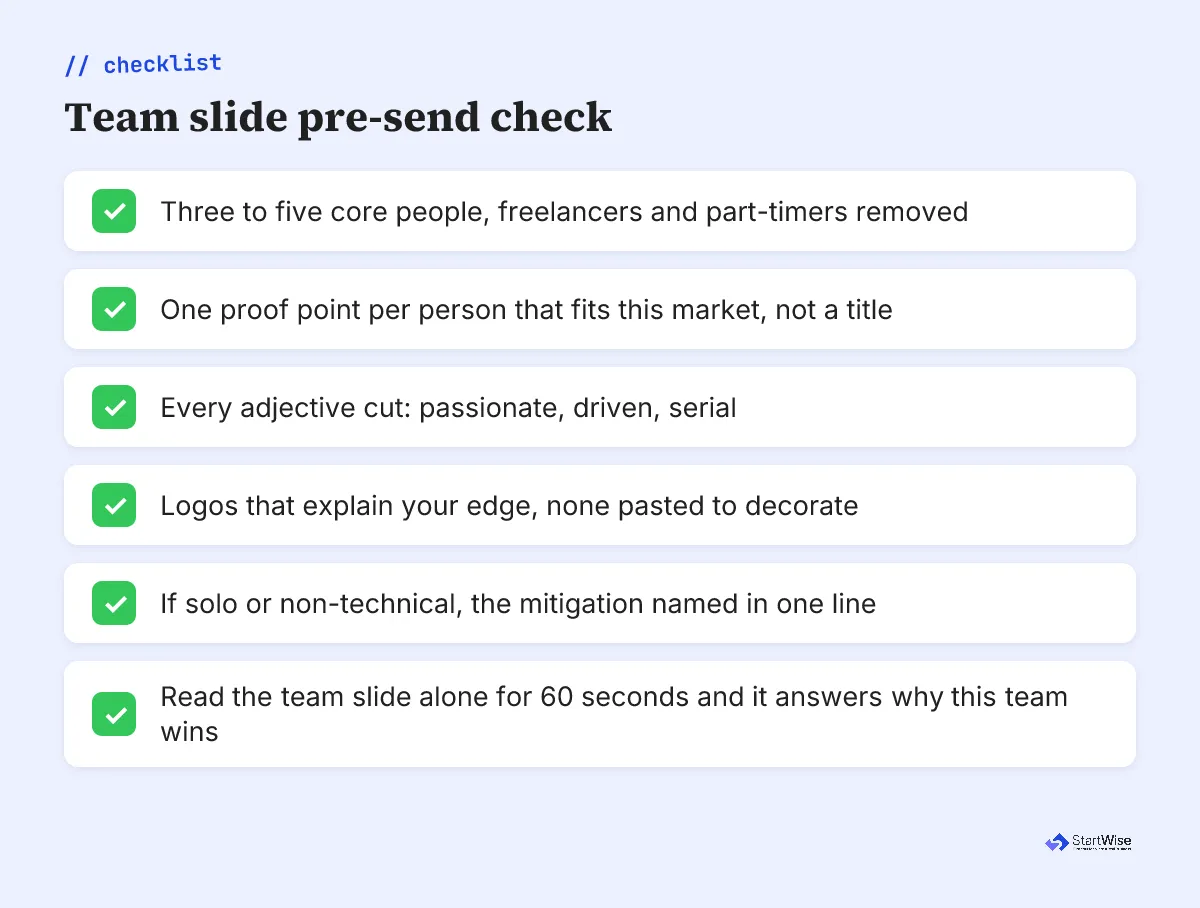
Rebuild your team slide around the risk question in one sitting. Here’s the order we’d run it:
- Cut to three to five core people. Freelancers and part-timers come off the slide.
- Give each person one proof point that fits this market. Replace every title with a scar.
- Kill the adjectives. “Passionate” and “serial entrepreneur” earn zero seconds.
- If you’re solo or non-technical, name the mitigation in one honest line.
- Read only your team slide for 60 seconds. If it doesn’t answer why this team wins, rewrite it.
That last step is the one founders skip and the one investors run every time. It pairs with the financials slide, the other place a 60-second read decides whether the number lands. Run the team slide through it before you send.