
 By
By 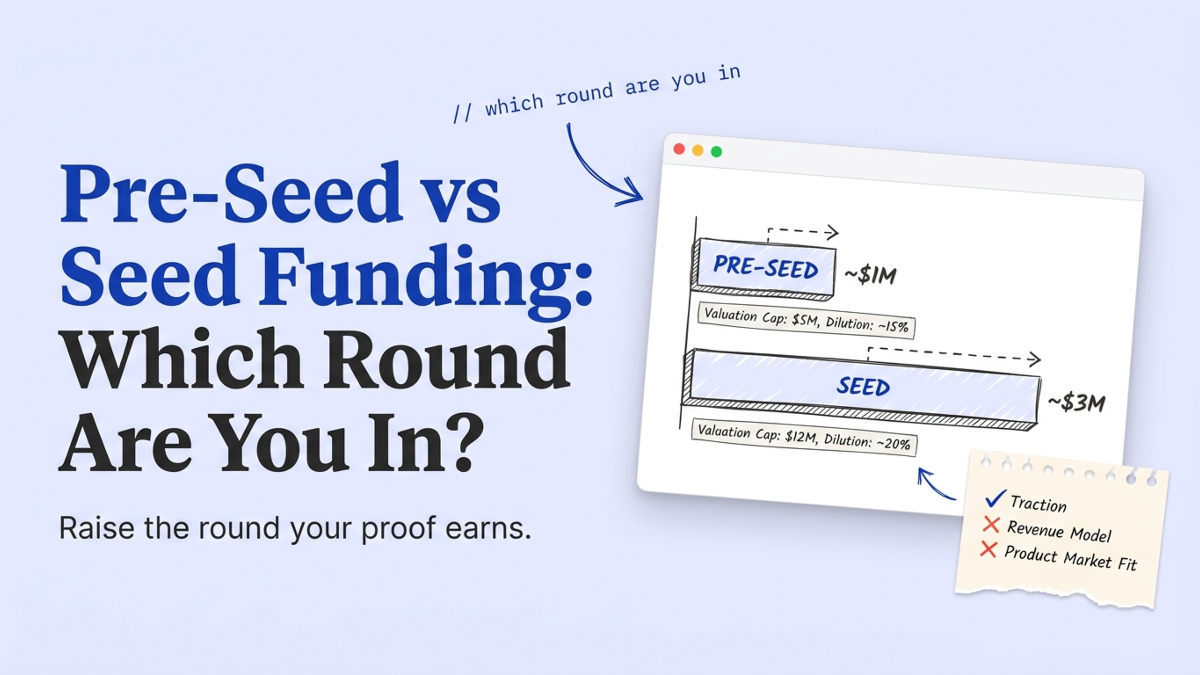
Pre-seed and seed funding are the two earliest rounds most startups raise, and founders mix them up constantly. Pre-seed backs a believable idea and team before the product has proven itself; seed backs early traction that hints at product-market fit. The gap used to be obvious. In 2026 it isn’t: the median pre-seed round is about $1 million and the median seed round is $3.2 million (Value Add VC), close enough that the dollar amount no longer tells you which round you’re in. We review raise plans most weeks, and a mislabeled round is one of the most common things we flag.
What is the difference between pre-seed and seed funding?
Pre-seed and seed funding differ most in what you’re selling investors. At pre-seed you’re selling a believable future. At seed you’re selling early proof. Everything else, the check size, the valuation, the type of investor, follows from that one shift from potential to evidence.
| Dimension | Pre-seed | Seed |
|---|---|---|
| Investors bet on | A believable idea and team | Early traction and signs of fit |
| Typical 2026 round | ~$1M ($750K to $1.5M) | ~$3.2M ($2.5M to $3.5M) |
| Valuation | $4M to $6M cap | $12M to $15M post-money |
| Dilution | 15% to 20% | 20% to 25% |
| What you show | An MVP, early users, a wedge | Revenue or strong engagement |
| Who writes checks | Angels, micro-funds, accelerators | Seed VCs, larger angels |
| Instrument | Usually a SAFE | A SAFE or a priced round |
Round and valuation figures are 2026 medians from Value Add VC; a SAFE is a simple agreement that converts to equity in your next priced round. Read the table top to bottom and the pattern is clear. Pre-seed is a bet on you. Seed is a bet on your numbers. In the decks we review, the tell is simple: a pre-seed slide describes what the product will do, while a seed slide shows a chart of people already doing it. So the honest question isn’t which round sounds better. It’s which bet your evidence actually supports today, and that’s the read investors will take whether or not you take it first.
How much do you raise at pre-seed vs seed in 2026?
In 2026, pre-seed rounds cluster around $1 million and seed rounds around $3.2 million, and both have moved since the 2021 peak. The median seed round is down from $4.1 million in 2022, with post-money valuations near $12M to $15M rather than the $18M to $22M of the last cycle (Value Add VC). The dollars matter less than what they cost you, though, and that cost is ownership.
Here’s what a typical round gives away. Plan for 15% to 20% dilution at pre-seed and 20% to 25% at seed, per the same 2026 data. Most of both rounds run on SAFEs now: Carta put SAFE usage at 88% of pre-seed deals in Q2 2024 and 89% by Q3 (via HubSpot). That has a sharp consequence founders miss. Every SAFE you stack, and every option pool you top up, dilutes you, and the dilution math on a SAFE is easy to get wrong until you see it modeled.
The investor on the other side is a signal too. Lead checks run $250K to $750K at pre-seed and $500K to $2M at seed (Value Add VC), and they come from different people: angels and micro-funds early, seed VCs once there’s traction to underwrite. The ground has shifted under both, which is why we keep having this conversation. The median seed deal grew 63.2% from 2019 to 2024 (PitchBook, via HubSpot), pulling rounds that once looked like pre-seed up into seed territory. That’s a big part of why the two blur now.
$3.2M
is the median seed round in 2026, down from $4.1M in 2022, with valuations off their peak too. Bigger is not the goal; right-sized for your stage is. (Value Add VC, 2026)
So the amount isn’t a trophy. Raising a seed-sized round on pre-seed evidence tends to mean a lower valuation and more dilution, not less, because you’re asking investors to pay for proof you don’t have yet. Size the round to the milestone it needs to buy.
Which round are you actually raising?
You’re raising the round your evidence supports, not the one your ambition wants. The cleanest test we use in reviews takes five minutes: write down everything a stranger could verify about your startup today, then match that proof to the stage it buys. Signups and a waitlist are a pre-seed story. Paying users who keep coming back are a seed story.
Forum Ventures draws the same line by readiness rather than dollars: pre-seed if you have a strong concept and team but no formed product, seed once you have a working product, initial traction, and early signs of product-market fit (Forum Ventures). Product-market fit here means real evidence customers want what you built, not a hunch that they might. That distinction is where most self-diagnoses go wrong.
The line founders blur most is engagement versus revenue. A thousand signups feels like traction, and it’s a fine pre-seed signal, but it isn’t the retained, paying use a seed investor reads as fit. When I flag a round as mislabeled, this is usually the reason. The metrics are real. They’re just pre-seed metrics wearing a seed label.
The round isn’t a label you pick. It’s a read investors take on your evidence, so take it first and raise the round you can actually defend.
The checklist below is the version I run against a founder’s deck before they send it. If most of it is true, you’re raising a seed. If it isn’t, you’re at pre-seed, and pricing yourself as a seed will cost you meetings.
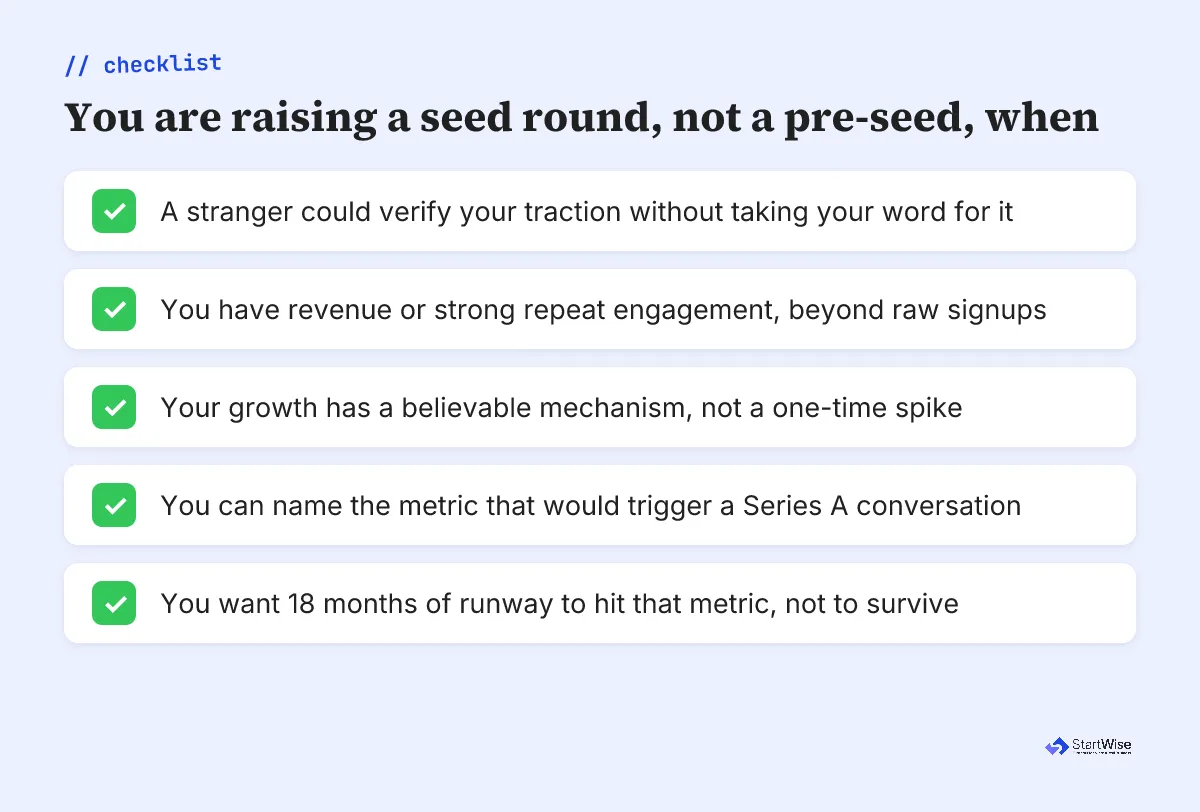
Be honest on the last line especially. Wanting 18 months of runway isn’t a reason to call your round a seed. Having a metric that 18 months of runway would let you hit, and that a Series A investor would recognize, is. If you can’t name that metric, you’re telling me you’re at pre-seed, whatever the deck says. Our pre-seed fundraising checklist walks the readiness signals in more depth.
Not sure which round your evidence actually supports? Atlas by StartWise maps where you stand and your next moves from your LinkedIn or website, so you raise the round you can defend.
Can you skip pre-seed and go straight to seed?
You can skip pre-seed and raise a seed round first, but only if you already carry seed-stage proof or an investor who bets earlier than most. It happens. Brex documents well-known startups that skipped a conventional pre-seed and raised a seed round as their first outside money (Brex). A repeat founder with a track record, or a thesis-driven fund with deep domain conviction, will sometimes write a seed check on less evidence than a generalist needs. Just know the priced seed process runs longer than a pre-seed once you start, which we map week by week in our seed round timeline.
Two situations make skipping realistic:
- You already carry seed-stage proof: revenue or strong retention a stranger could verify without taking your word.
- You have a thesis investor or a repeat-founder track record, so a fund bets on conviction instead of waiting for metrics.
The reason generalists hold back is math. A seed investor is underwriting your odds of reaching Series A, and only about 33% of seed-funded startups get there (Crunchbase, via HubSpot). A thesis fund takes that bet on conviction. Most funds want the evidence first, and Series A itself now expects roughly $1.5M in ARR growing threefold a year (HubSpot), so the seed you raise is really a down payment on proving you can get there.
For everyone else, skipping usually backfires. The typical outcome is a seed investor telling you to come back when you can show more traction, which costs you a warm intro you can’t easily reuse. If you’re a first-time, non-technical founder still deciding whether you even need a working product to raise, our take on what investors expect at pre-seed is the better starting point.
My honest take: most founders reaching for seed on pre-seed evidence are optimizing for the label, not the money. A clean pre-seed that hits its milestones beats a seed you talk your way into and then can’t grow into. The round you can defend is worth more than the round that sounds impressive at a dinner.
Mislabeling your round costs you real ownership
Mislabeling your round costs you in two currencies: wasted meetings and unnecessary dilution. Pitch a seed on pre-seed proof and you burn intros getting passed on. Raise a seed-sized round you don’t yet need, and you hand over 20% to 25% of your company (Value Add VC) when a $1 million pre-seed at 15% would have carried you to the milestone that earns a better-priced seed later.
The direction of the raise matters more than its size. Pre-seed money exists to buy the runway to earn seed-stage proof, so raise enough to reach the metric that starts a seed conversation and not a dollar more. If you don’t know how many months that is, work the cash runway math before you set the number. Over-raising early feels like winning. It’s the most expensive money you’ll ever take.
Here’s the sequence that protects ownership. A $1 million pre-seed at a $5 million cap costs you around 20%, buys the runway to hit a real metric, and lets you raise the seed at a $14 million valuation instead of an $8 million one. Skip that step, price yourself as a seed too early, and you sell the same company for less. That gap is dilution you never earn back.
StartWise's position
Founders pick their stage by how much they want to raise. Investors assign it by what you can prove. We keep seeing seed decks carrying pre-seed evidence, and that mismatch, not the market, is what stalls the raise. Fix the label to match the proof and the same numbers suddenly land.
There’s a reason we see this so often. It’s hard to spot from the inside. Your ambition is real, your progress feels bigger to you than to a stranger, and “seed” sounds like the round a serious company raises. None of that changes the evidence on the page. Match the round to the proof, and you stop losing meetings you should have won.
What to do this week
Diagnose your stage before you name your round, then raise the one you can defend. Here’s the order I’d give any founder unsure which round they’re in:
- List everything a stranger could verify today, then run it against the seed checklist above. Most-true means seed; mostly-false means pre-seed.
- Size the round to a milestone, not to a runway wish. Name the metric that would start a Series A talk and raise enough to reach it.
- Model the dilution at your target size before you commit, so 15% doesn’t quietly become 25%.
- Build the investor list that matches your real stage, since pre-seed and seed funds rarely overlap, then start the raise.
The founders who raise fastest aren’t the ones who reach for the bigger label. They’re the ones whose round matches their proof, because that’s the round an investor can say yes to today.