
 By
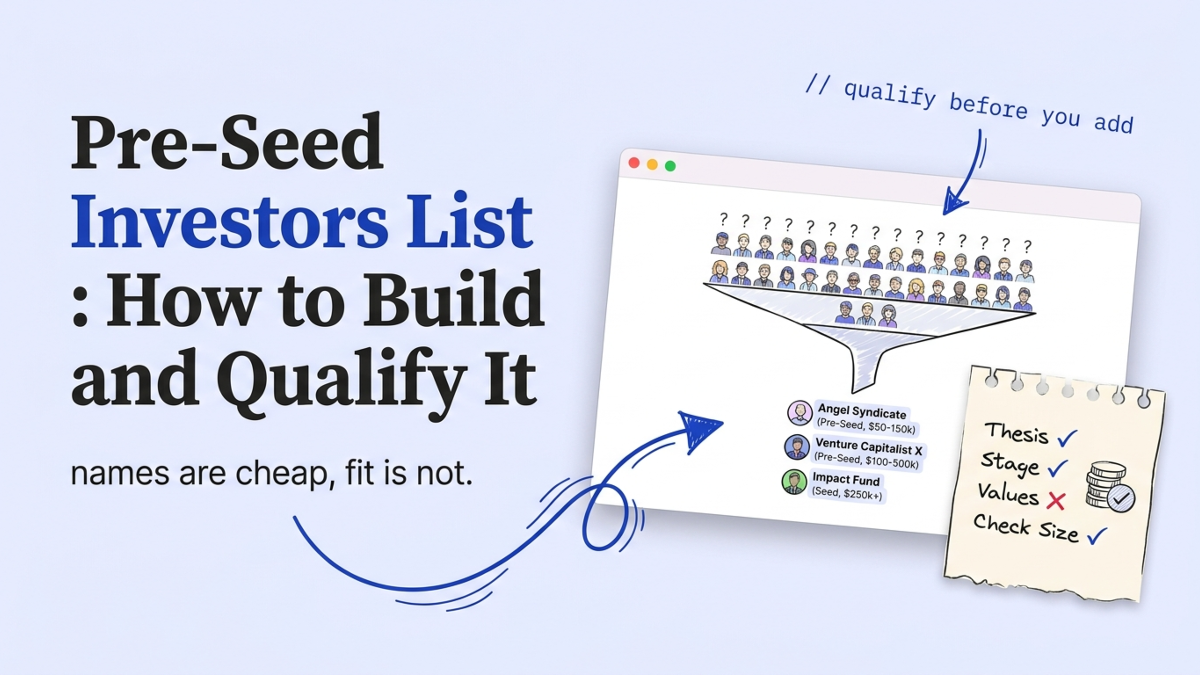
A pre-seed investors list is the set of investors you plan to approach for your first outside money: angels, micro-VCs, and accelerators who write the earliest checks. Most “lists” that rank on Google are directory exports of thousands of names, and a directory isn’t a plan. In the fundraises we see at StartWise, the founders who close fastest work a list of 100 to 150 qualified names, not 3,000 (SheetVenture, citing DocSend). Here’s how to build one that turns into meetings.
What is a pre-seed investors list, really?
A pre-seed investors list is a working target list: a ranked set of investors you’ve checked for fit, each with a next action attached. That’s a different object from the directories that rank on Google, which hand you raw names sorted by nothing that matters to your raise.
The distinction matters because a pre-seed round is assembled, not won in a single meeting. A typical pre-seed runs $50K to $1M (Beta Boom, 2026), and angels write individual checks anywhere from $10K to $500K (Rho, 2026). So a round pulls together 3 to 10 investors to reach $500K to $1.5M. Your list isn’t a lottery ticket. It’s the raw material for a dozen small yeses, and it feeds every other step of raising a pre-seed round.
Think of the directory as the quarry and your list as the building. You still have to cut the stone.
Most founders skip that step. They export a database, paste 2,000 rows into a spreadsheet, and email from the top down. We keep seeing the same result: dismal reply rates and a creeping sense that fundraising is a numbers game rigged against them. The numbers game is real. You just play it by narrowing, not by widening.
Where do you actually find pre-seed investors?
You find pre-seed investors in five reliable places, and each one has a catch. The databases give you volume, your network gives you conversion, and the gap between them is where most founders lose two weeks they didn’t have.
- OpenVC, AngelList, and Crunchbase let you filter by stage, sector, and geography. Great for volume, weak on whether the investor is active right now.
- Curated fund sheets like NFX Signal rank funds by how often they actually lead rounds versus only follow. Better signal, still no read on fit with your company.
- Accelerator alumni networks (YC, Techstars, On Deck) write early and fast. You usually need to be one degree from someone who went through them.
- Recent-round research: find companies like yours that raised pre-seed last year, then look up who wrote those checks. Highest fit of any source, and almost nobody does it.
- Your own network of former colleagues and founders who’ve already raised. Small, but these names convert far better than any cold list.
The fourth source deserves more attention than it gets. Pick five to ten startups that look like yours and raised pre-seed in the last year, then read their announcements and Crunchbase pages for the names of who funded them. Those investors have already said yes to your shape of company once. That’s a warmer signal than any “pre-seed” tag on a database, and it takes an afternoon.
Pre-seed capital mostly comes from angels and micro-funds in the $25M to $75M range, plus accelerators (Value Add VC, citing Carta Q4 2025). Institutional pre-seed funds exist, but individuals still write most first checks at this stage, so don’t build a list that’s all brand-name funds. If you’re raising for SaaS, weight the list toward angels who back SaaS specifically, because they read your metrics natively. I’d pull from all five sources, then qualify hard. That’s the step the directories skip, and it’s the one that decides your raise.
How many names should be on your list?
You want 100 to 150 qualified names, drawn from a top-of-funnel of 200 to 300 (SheetVenture, citing DocSend). That sounds like a lot until you watch the funnel collapse.
Here’s the shape of a normal pre-seed raise, step by step:
- Source 200 to 300 names across databases, fund sheets, and your network.
- Qualify down to 100 to 150 that fit your stage and sector.
- Contact 58 to 71 of them in a real outreach push, per DocSend’s pre-seed data.
- Secure 30 to 46 meetings, a meeting rate around 50 to 65%.
- Close 3 to 10 checks, since pitch-to-check runs roughly 5 to 6%.
The most useful thing in that data, in my experience, isn’t the count. DocSend found only a weak link between how many investors you contact and how much you raise. Emailing more people barely moves the outcome. Emailing the right people moves everything. That’s the entire case for qualifying before you send a single word.
How do you qualify a pre-seed investor before adding them?
You qualify a pre-seed investor on four filters, and a name earns a spot only when it clears all four. This is the step every directory skips, and it’s where I’d spend most of your list-building time. A name that fails any one filter is a polite rejection you scheduled in advance.
| Filter | What to check | Red flag |
|---|---|---|
| Stage-truth | Led or joined a pre-seed in the last 12 months | ”Pre-seed to Series A” on every profile |
| Check size | Typical check fits a $500K to $1.5M round | Writes $5M-plus checks only |
| Thesis fit | Your sector and model match recent deals | No deal like yours, ever |
| Recent activity | Actively deploying a current fund | Quiet 18 months, “between funds” |
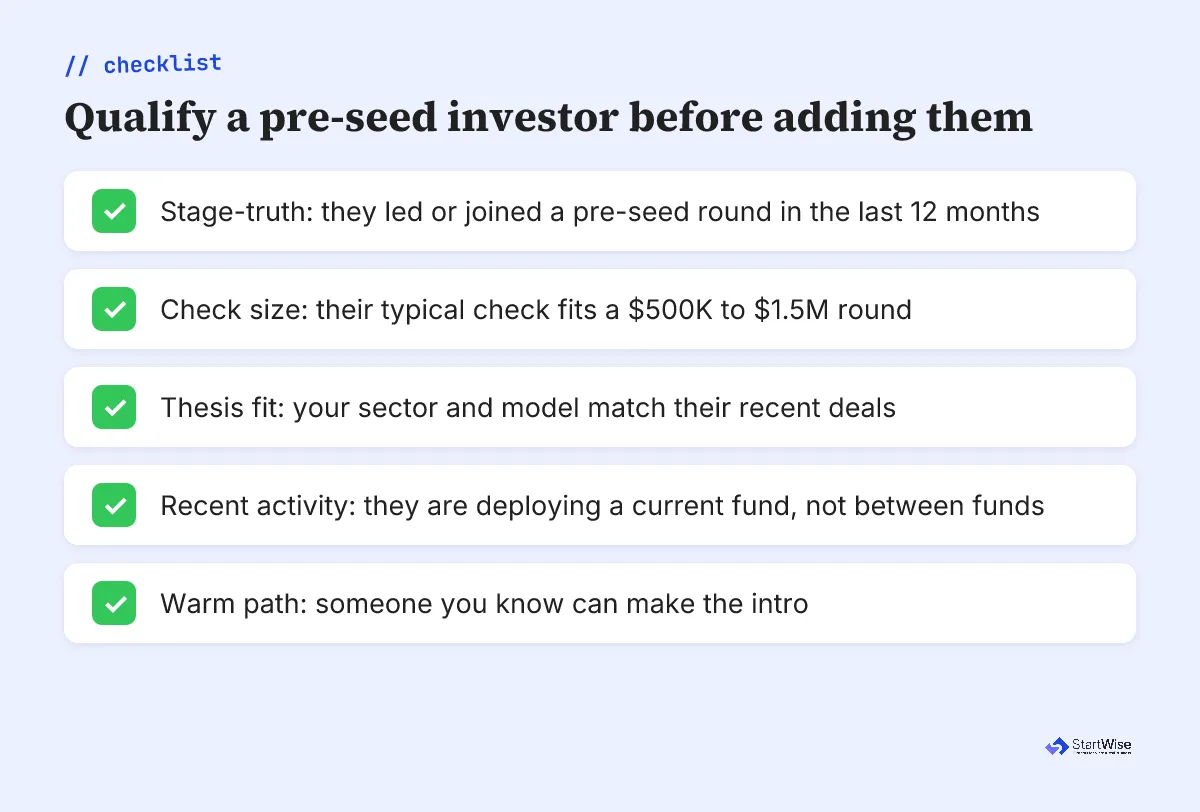
Stage-truth is the filter founders get wrong most. Plenty of investors say they do pre-seed and haven’t written a first check in two years. Read their last five deals, not their bio. If those five are all Series A, you’re a tourist attraction to them, not a prospect.
Check size is simple math. If a fund’s smallest check is $2M and your whole round is $750K, you’re too small to be worth their partner’s hour.
A list of 3,000 names is worse than a list of 80 you’ve actually qualified, because the long list feels like progress while it quietly burns your best weeks.
Thesis fit and recent activity you read from the same two pages: their portfolio and their public deal history. An investor who just closed a new fund is hungry and moving. One who hasn’t announced a deal since early last year is probably tapped out, whatever the website says. Cut them for now. You can add them back at seed.
The fastest names on your list are the ones you already have a path to. Atlas maps your network from your LinkedIn so you can see who can introduce you.
What should you send the investors on your list?
You send warm-path names an intro request first, and everyone else a short cold email built to earn one thing: a 20-minute call. Warm intros still convert at multiples of cold outreach, so rank the people you can reach through a mutual connection to the very top (how to get warm intros). For the rest, a tight cold email does the work, sent to the partner directly rather than a generic inbox.
We review the materials founders attach to these emails every week, and the same instinct hurts most of them: they send the full partner-meeting deck to a stranger skimming an inbox.
StartWise's position
The materials you attach to cold outreach have exactly one job: earn a 20-minute call. Closing the round happens later, in the meeting itself. That usually means a sharper, shorter deck than the templates push, because the reader is triaging an inbox, not sitting in your pitch.
The funnel math backs this up. Only about 50 to 65% of the investors you contact turn into a meeting, so your first touch is a filter, not a pitch. Get the call, then pitch. Before any of this, run your materials against a pre-seed fundraising checklist so a warm intro doesn’t get spent on a deck that isn’t ready.
What to do this week
Build the list before you write a single email. Here’s the sequence I’d run, in order, this week.
- Pull 200 to 300 names from two databases plus one curated fund sheet.
- Qualify each on the four filters and cut to 100 to 150 that actually fit.
- Flag every name you can reach through a warm path and rank those first.
- Drop the qualified list into an investor pipeline tracker with a next action on each, and skip the paid fundraising CRM until the sheet actually breaks.
- Send your first 15 outreach messages, warm paths first, and log every reply.
A qualified list of 120 names you’ve read carefully will out-raise a dump of 3,000 every time. Start cutting stone.