
 By
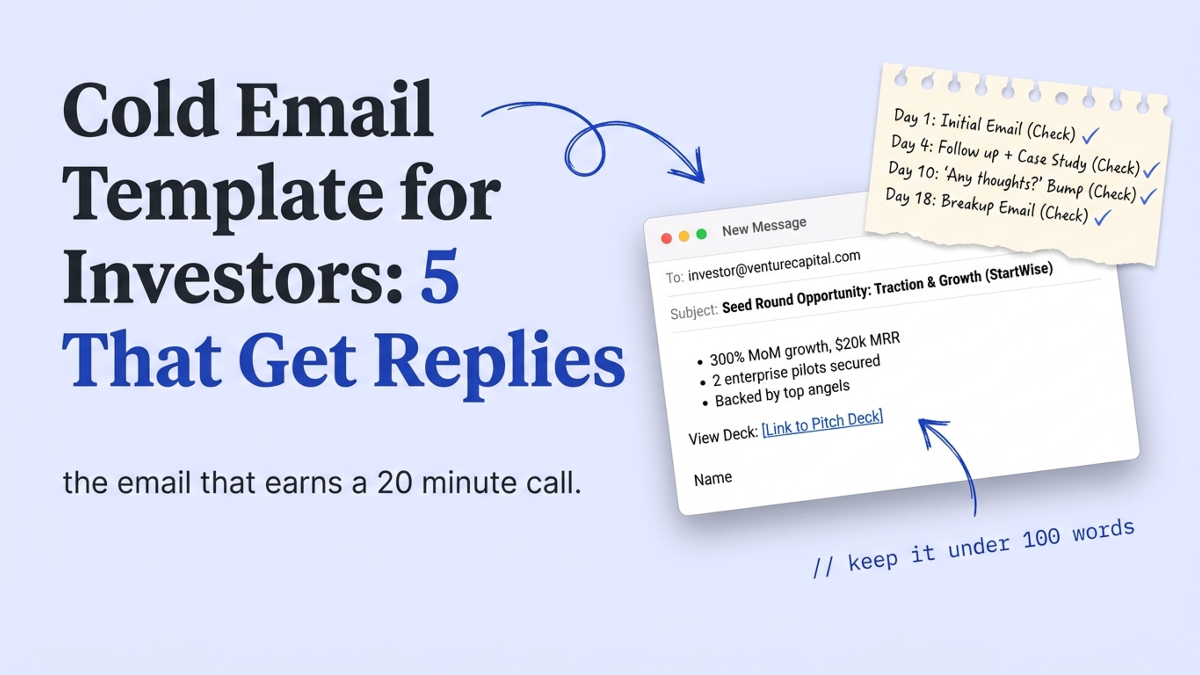
A cold email to investors is a short, unsolicited message asking someone who has never met you for a 20-minute call. It’s how a lot of first-time founders open a raise, because most don’t start with a warm intro to a partner at Sequoia. The math is humbling. Reply rates have fallen to 3.43% in 2026, down from 8.5% in 2019, according to Evalyze. We read a lot of first drafts, and the ones that get answered are shorter and sharper than founders expect.
Does cold emailing investors actually work?
Cold emailing investors works, but it’s a volume game with a low hit rate. Founders have closed real rounds this way. Per Streak, Dhruv Ghulati raised a $1M seed and Allie Janoch a $2.5M seed off cold emails. So the door is open.
The problem is the crowd on the other side of it. A venture capitalist gets around 40 pitches a day (VentureTrend, via Streak), and White Star Capital’s Christian Hernandez has said he receives over 1,000 sender emails a month (Business Insider). Even a single partner like Creandum’s Beata Klein reviews 10 to 20 cold emails a day, per Visible. Your message lands in a stack, and it gets triaged in seconds.
In the drafts we review, the biggest miss isn’t grammar or polish. It’s founders trying to close the entire raise in five paragraphs. A cold email can’t do that, and when it tries, it dies. Its job is narrower and easier: earn a reply, then a short call.
StartWise's position
A cold email has one job, and it's to earn a 20-minute call, not to close the round in the inbox. The founders who get replies write the shortest email with the sharpest single ask. The ones who get ignored try to pitch the whole thing before an investor has agreed to spend two minutes.
What makes an investor open and read a cold email?
An investor opens a cold email because of the subject line, then reads it because it’s short and specific. The subject does most of the work: nearly half of readers decide to open on the subject line alone (OptinMonster, via Streak). Per Evalyze, personalized subject lines hit 46% open rates against 35% for generic ones, so the line is where we tell founders to spend their first edit.
Pack it with the facts that qualify you: company name, a five-word one-liner, and your single strongest number or credential. “Acme: warehouse robots, $22K MRR up 30% MoM” beats “Investment opportunity” every time. If you’re in an accelerator, say so. Ash Rust tells founders to reference something like “YC S25” right in the subject, because a known badge earns the open.
Then keep the body brutally short. Visible puts the sweet spot near 100 words, and other outreach research lands at 50 to 125. Four beats carry it: the problem, one proof point, why this investor, and the ask. Everything else is cut. That short body is really an investor one-pager with a greeting on top, so the same rule holds: lead with your sharpest number, not the setup.
Common mistake
"I hope you're doing well" openers and a three-paragraph wall read as a template before an investor reaches your ask. Delete the throat-clearing. Open with the one thing about their portfolio or thesis that made you write to them specifically.
5 cold email templates for investors (copy-paste)
These are the five shapes we see earn replies, keyed to what you actually have at pre-seed, from real metrics to nothing but a sharp problem. Copy the one that fits, fill the brackets, and keep the whole thing under 100 words. Send from your own address, one investor at a time.
1. When you have real metrics
Subject: {Company}: {one-liner}, {key metric}
Hi {First name}, {Company} is {one-liner in five words}. Since {month}, we’ve grown to {$X MRR, up Y% month over month} with {second proof, e.g. 130% net revenue retention}. You backed {portfolio company}, so our {category} angle may fit your thesis. We’re raising a {round size} to {milestone}. Two-minute deck: {tracked link}. Open to a 20-minute call {day} or {day}?
2. When you’re pre-revenue
Subject: {Company}: {problem} for {who}
Hi {First name}, {who} still {problem, in one line}. {Company} fixes it with {approach}. We’re four weeks in and signups are growing {X% week over week}, with {N} on the waitlist and {qualitative signal, e.g. three design partners}. Traction is a slope here, not a number yet, but the slope is steep. Raising {round} to {milestone}. Deck: {tracked link}. Worth 20 minutes?
3. When something just changed
Subject: {Company} + your {new fund / recent post / new thesis}
Hi {First name}, saw you {just closed Fund III / wrote about {topic}}. {Company} is {one-liner}, and it maps directly to that: {one sentence on the fit}. We’re at {proof point} and raising {round}. Deck: {tracked link}. Ten-minute call this week, or should I send a short update instead?
4. When you have no metrics yet
Subject: Quick read on {Company}?
Hi {First name}, I’m building {Company}: {one-liner}. We’re pre-launch, so I’m not asking for money yet, just 15 minutes of your read on {specific question, e.g. whether {market} founders will pay for this}. You’ve seen more {category} pitches than almost anyone. Here’s the one-pager: {tracked link}. Any chance you have time {day}?
5. When you have a credential
Subject: {YC S25} founder, {Company}: {one-liner}
Hi {First name}, {Company} ({one-liner}) is a {batch/program} company. We {sharp proof point, e.g. hit $10K MRR in eight weeks} and are raising a {round} to {milestone}. Given your investments in {two portfolio companies}, I think we’re a fit. Deck: {tracked link}. Free for a 20-minute call {day} or {day}?
How many times should you follow up?
Follow up four times, not once. The first email captures about 58% of replies, and three to four follow-ups add the other 42%, according to Evalyze. Quit after one send and you leave most of your answers on the table. We watch founders email once, hear nothing, and read it as a no. Silence at day two isn’t a no. It’s day two.
Space the touches a few days apart and give each one a reason to exist. Evalyze’s cadence is a good default:
- Day 1: the original email.
- Day 4: a short nudge with one new fact (“closed our third design partner since I wrote”).
- Day 10: reframe around news relevant to them, like a market move or a competitor raise.
- Day 18: a one-line “no for now?” close that makes it easy to reply.
After the fourth, stop. More than five sends starts to read as desperation and can cost you the next round too. Your follow-up copy can be one sentence: “Circling back with a quick update, {Company} just {new proof}. Still worth 20 minutes?”
Running a dozen threads with different follow-up dates by hand gets messy fast. StartWise tracks every open and reply and routes you to investors for your stage.
How do you know who’s actually reading?
You know who’s reading by sending a tracked deck link instead of a PDF, then timing your follow-up to the opens. Angel and VC advice converges here: Ash Rust tells founders to drop a tracked deck link in the cold email precisely so you can see who engaged before you follow up.
The read is the useful part. If an investor opens your deck twice and lingers on the financials, that’s your same-day reply, and you can reference the exact section they sat on. A silent thread gets the standard nudge instead. We’ve written the full playbook on reading who viewed your deck, but the one habit that matters is a separate tracked link per investor, so a name attaches to every open.
A cold email isn’t a pitch. It’s a request for 20 minutes that happens to carry proof you’re worth them.
Then log it. Every send, open, and reply belongs in one place so a signal becomes a next action instead of a dopamine hit. That’s the entire point of an investor pipeline tracker: the follow-up you send on day four should be driven by data, not by whichever name you happen to remember.
Cold email or warm intro: which should you use?
A warm intro beats a cold email on every metric, so use one whenever you can get one. A referral from a founder an investor already backs lands near the top of the pile, while your cold note gets triaged with the other 40. The catch is simple: you can’t manufacture a warm intro you don’t have, and most first-time founders don’t have many. If you do have paths worth using, our guide to getting warm intros to investors covers how to find and ask for them.
| Approach | Reply odds | Best when | Effort |
|---|---|---|---|
| Warm intro | High | You share a real connection | Building the connection first |
| Cold email | ~3-4% base | No mutual contact exists | Writing plus 30-50 sends |
| Cold, personalized | 15-25% (top 10%) | You hook a specific signal | Real research per investor |
My honest take: run both. Spend your warm intros on your top-choice funds, and cold-email the long tail that fills your pipeline. Personalization is what moves cold email from the 3.43% base rate toward the 15-25% the best founders hit, so a smaller, researched list beats a blast to 300 addresses. In practice that research is one specific line per investor: a portfolio company they backed that rhymes with yours, a thesis they published, a hire they just made. It’s the whole difference between a mail merge and a note that reads like you wrote it for one person. Once an investor says yes, the relationship shifts from cold to ongoing, and your investor update emails take over from there.
What to send this week
Start with the list, because nothing else works without it. A tight, well-matched set of 30 to 50 investors is worth more than a scraped list of 300, so build and qualify your pre-seed investors list before you write a word.
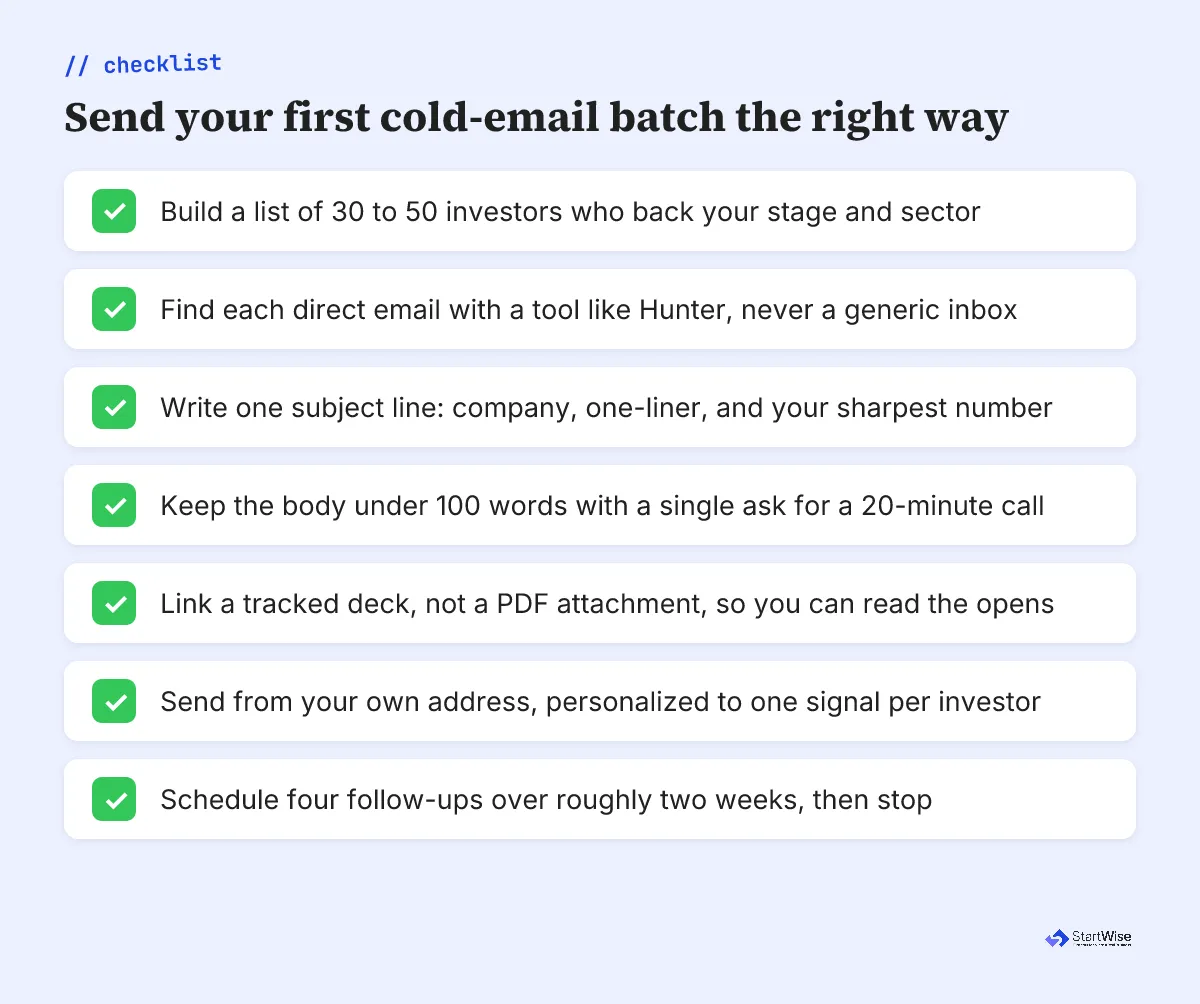
- Build the list: 30 to 50 investors who back your stage and sector, with a direct email for each.
- Pick the template above that matches what you actually have, and cut the body under 100 words.
- Write one subject line per investor, personalized to a real signal, not a mail-merge field.
- Swap your PDF for a tracked deck link so you can read the opens.
- Schedule four follow-ups over two weeks the moment you hit send, then stop.
Cold email won’t raise your round, and it won’t rescue a deck investors drop at slide three. What it does, in the raises we watch, is turn a blank pipeline into a handful of first calls. Fit it into a tight pre-seed process, send fewer and sharper, and the question stops being who replied. It becomes who’s next.