
 By
By 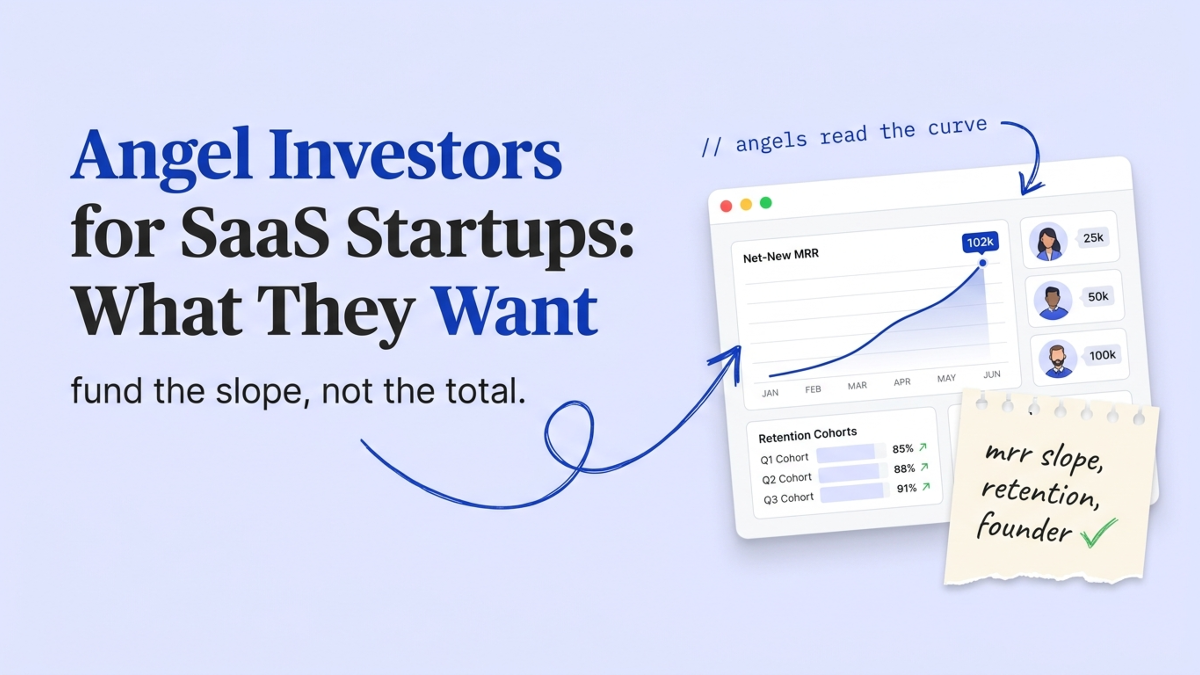
Angel investors for SaaS startups are individuals who write the first checks into your company, usually before a fund will. What they read is different from what a Series A partner reads. At pre-seed, they back the direction of your revenue and the retention behind it, not a big ARR total. In the SaaS raises we review at StartWise, the founders who stall lead with a five-year forecast, when the angel just wanted to know if last month’s customers stuck around. Angel checks run $15,000 to $250,000 (Bonfire Ventures, 2025). Here’s what SaaS angels actually check.
What do angel investors look for in a SaaS startup?
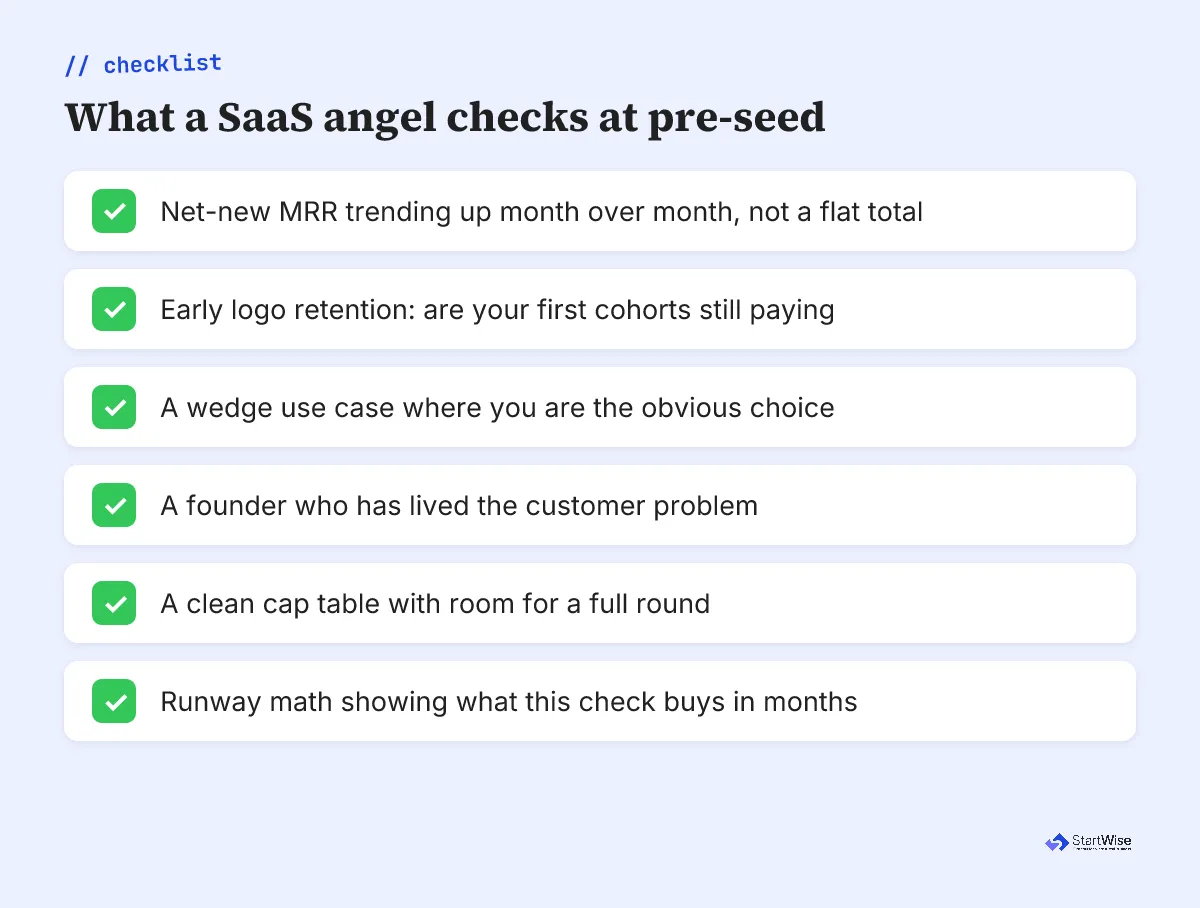
Angels look for the slope, not the total. A SaaS startup at pre-seed rarely has a number big enough to impress anyone, so the good angels read direction instead: is net-new MRR climbing month over month, and are the customers you won last quarter still paying this quarter. Those two lines tell them whether you’ve found something people keep, or just something people tried once.
The SaaS Benchmarks Report 2026 puts a healthy early slope at $5,000 to $10,000 of net-new MRR a month at pre-seed (averi, 2026). That’s small. It’s meant to be. An angel isn’t underwriting scale yet. They’re underwriting whether the curve bends up on its own.
The other thing they read is you. Operator-angels bet on the founder who has lived the customer’s problem, because at this stage the product will change and the market read might be wrong, but a founder who understands the buyer usually finds the next door. Credentials matter less than scars here.
StartWise's position
The best SaaS angels don't fund your ARR total. They fund your retention curve. A flat $30K MRR that churns 8% a month is a worse pitch than $12K MRR climbing with cohorts that stick, because retention is the only early proof that customers actually want the thing. Show the slope and the logo-retention direction before any five-year forecast.
We keep seeing founders bury the retention story under a market-size slide. Flip it. The retention line is your best evidence, so lead with it.
Which SaaS metrics should you skip at pre-seed?
Skip net revenue retention and LTV:CAC. Both are the metrics a Series A partner will grill you on, and both are close to meaningless at pre-seed. The SaaS Benchmarks Report 2026 says NRR is “too volatile to benchmark” below $500K ARR (averi, 2026), because with 40 customers a single upgrade or cancellation swings the number ten points. Quoting a precise NRR off a tiny base reads as false precision to anyone who’s seen it before.
LTV:CAC has the same problem in reverse. Lifetime value rests on a churn rate you can’t yet measure over a real lifetime, so any ratio you present is a guess dressed as a fact. The report’s own guidance is to use conservative estimates and not project improvements you haven’t earned (averi, 2026).
$500K ARR
the point below which net revenue retention is too volatile to benchmark, per the SaaS Benchmarks Report 2026. Leading a pre-seed pitch with NRR or LTV:CAC tells an angel you copied a Series A deck (averi, 2026)
So what do you show instead? Net-new MRR, plotted monthly. Gross logo retention, even as a simple “of our first 20 customers, 17 still pay.” And a wedge: the one use case where you’re the obvious pick. My honest take after reviewing a lot of these decks is that a founder who says “here’s what I’m not measuring yet, and here’s why” earns more trust than one who fabricates a clean cohort curve.
How much do SaaS angels write, and how does a round assemble?
Angels write small, so a SaaS pre-seed round is assembled, not won in one meeting. Individual checks run $15,000 to $250,000 (Bonfire Ventures, 2025). To reach a real pre-seed, you stack a handful of them, sometimes alongside one small fund. The 2026 median pre-seed is $1M at a $4M to $6M post-money cap, with a lead check landing between $250K and $750K (Value Add VC, citing Carta Q1 2026).
Do the arithmetic and a $1M round is usually 3 to 10 angels plus a possible anchor. That shapes how you run the raise. You’re not pitching one investor for the whole number. You’re building a qualified target list of people who each cover a slice.
Here’s the practical part we watch founders miss:
- A lead sets the cap, and the rest of the angels tend to follow that anchor.
- Most angels won’t wire until they see momentum, so bank the ready ones first.
- A SaaS-native angel adds distribution and hiring help, not just money.
- One angel who churned out of a bad SaaS deal will read your retention slide harder than any fund.
Most of these checks come in on a SAFE, which closes in days once the angel is ready, so the slow part is getting them ready rather than the paperwork.
Building your SaaS angel list? StartWise runs your plan, model, and outreach in one place and matches you to investors for your stage and industry.
Where do you find SaaS-focused angels?
You find them by starting narrow, with people who have built or sold SaaS, then widening out. Operator-angels are worth more than generalists to a SaaS founder because they read your metrics natively and they’ve felt your churn. A former SaaS founder knows what $8K of climbing net-new MRR means. A generalist angel needs it explained.
Free databases give you volume: OpenVC, AngelList, and Crunchbase all let you filter investors by stage and sector. Treat them as a starting point, not a finished list. The highest-fit names come from a simple move: look up who funded three or four SaaS companies one stage ahead of yours in the last year, and work backward to the angels on those cap tables.
Then qualify hard for SaaS fit before you email anyone, the same way you’d qualify any pre-seed investor. In the raises we review, the fast noes almost always trace to a founder who skipped this and pitched an angel who never touches SaaS. An angel who only backs consumer apps is a fast no dressed as a maybe.
How do you pitch a SaaS angel?
Lead with the retention curve, then the wedge, then the founder story. In the pitches we review, that order is what separates a warm meeting from a polite pass. The sequence isn’t cosmetic. The angel’s first silent question is whether customers actually stay, so answer it before they ask. Open with net-new MRR climbing and a plain retention stat, and you’ve cleared the bar the SERP’s generic advice never mentions.
Why does retention lead? Because churn is what kills SaaS companies, and angels know it. Across 431 failed startups, 70% ran out of capital and 43% never found product-market fit (CB Insights, 2026). A rising retention curve is the earliest signal you’re on the right side of that 43%. It’s the fact that lets an angel believe the check buys traction, not runway to nowhere.
A pre-seed SaaS deck that hides its retention line behind a TAM slide is answering a question the angel didn’t ask, and skipping the one they did.
Then make the ask concrete. “This $250K funds 12 months to reach $30K MRR” is an ask an angel can size. Vague growth language is wallpaper. When you send the deck, warm, specific outreach beats a mass blast every time, because angels wire to founders they believe understand the buyer.
What changes when you raise a SaaS seed round?
At seed, the metrics you skipped at pre-seed become the ones investors grill. By this stage we expect a real efficiency story behind the slope. The bar moves from “is there a slope” to “is the slope efficient and durable.” The SaaS Benchmarks Report 2026 puts a seed-stage target at 2 to 3x annual growth, net revenue retention of 100 to 110%, and monthly churn under 2% (averi, 2026). The round size jumps too: the 2026 median seed is $4.1M at a $24M post-money cap (Value Add VC, citing Carta Q1 2026).
That’s why the angel you land now matters beyond their check. A SaaS-native angel who joins at pre-seed helps you build the retention and efficiency story a seed fund will demand next year.
| Pre-seed SaaS | Seed SaaS | |
|---|---|---|
| What angels read | Net-new MRR slope, early retention | 2-3x growth, NRR 100-110% |
| Check size | $15K to $250K per angel | Lead writes $500K to $2M |
| Round size (2026 median) | $1M | $4.1M |
| Retention metric | Direction only | Monthly churn under 2% |
Raise your pre-seed to prove the curve exists. Raise your seed to prove it scales. A good angel bridges the two, which is why fit beats a marginally bigger check.
What to do this week
If you’re raising a SaaS pre-seed, stop polishing the market-size slide and build the retention story an angel will actually read. Here’s the week.
- Plot net-new MRR by month and gross logo retention on one slide, even if the numbers are small.
- Cut NRR and LTV:CAC from the deck if you’re under $500K ARR, and note what you’ll measure once you’re not.
- List 30 to 50 operator-angels who’ve built or sold SaaS, sourced from cap tables one stage ahead of you.
- Write one concrete ask tied to a milestone, like “$250K to reach $30K MRR in 12 months,” and drop the financial model behind it.
- Line up the full pre-seed raise so the angel conversations feed a real close, not a stack of soft yeses.
Do that and the angel meetings get shorter and warmer, because you’re answering the retention question before it’s asked. The founders we watch raise fastest aren’t the ones with the biggest number. They’re the ones whose slope points up and who can prove customers stay.