
 By
By 
A pre-seed fundraising checklist is the short list of things investors check before they take a first meeting: your deck, your model, your data room, your traction, your team, your ask, and your investor pipeline. Most lists tell you what to collect. The harder question is whether each line is firm or still aspirational. At StartWise we watch founders start outreach about three weeks early, with a deck that’s firm and a data room that’s a wish. This checklist assumes you’ve already decided to raise; if you’re still choosing between raising and bootstrapping, settle that first. Here’s the checklist, and the bar each line has to clear first.
What is a pre-seed fundraising checklist?
A pre-seed fundraising checklist is the set of materials and signals investors expect before they commit time to you: a deck, a light financial model, a data room, traction evidence, a team story, a funding ask, and a list of investors to approach. Think of it less as a packing list and more as a gate.
Each line has two states. Firm means it would survive an investor poking at it. Aspirational means you’re hoping they won’t. We keep seeing decks that are firm sitting next to data rooms that are empty, and that gap is what drags a raise out for months.
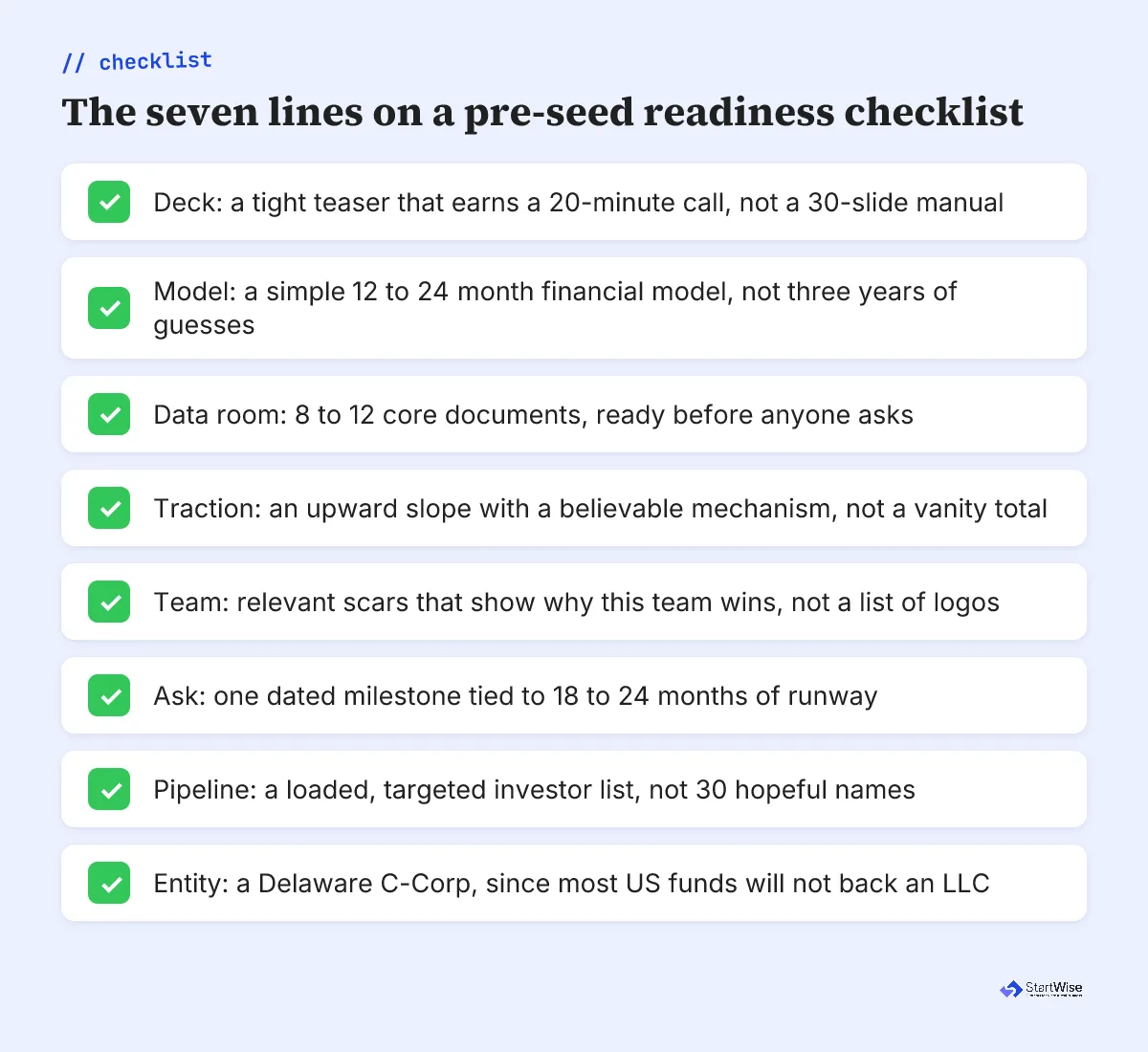
Here’s the full checklist. Every line below has to be firm before you send your first email:
- Deck: a tight teaser whose only job is to earn a 20-minute call.
- Model: a simple 12 to 24 month financial model, not three years of invented projections.
- Data room: 8 to 12 core documents, built before anyone asks.
- Traction: an upward slope with a mechanism behind it.
- Team: relevant scars that explain why this team wins.
- Ask: one dated milestone, sized off your runway.
- Pipeline: a long, targeted list of investors who fund your stage.
Notice what’s not on the list: a patent, a glossy website, an advisory board of famous names. Those are nice to have. None of them move a pre-seed decision on their own.
One more line sits underneath all seven: your entity. If you’re still an LLC, that’s the first fix, and the next section explains why.
Are you actually ready to raise?
Readiness is the line most founders cross too early. You’re ready when every checklist item is firm and you can defend it for ten minutes, not when the deck looks pretty. Jumping early has a real cost. You spend your best warm intros on a story that isn’t ready, and pre-seed investors talk to each other constantly.
The seven lines also stack in an order. You can’t write a firm ask before the model exists, and you can’t build a credible pipeline before the deck earns its first meetings. Founders who try to do all seven at once usually end up with five half-firm lines and a calendar full of premature calls.
The table below is the honest test. Read each line, then put yourself in one column.
| Checklist line | Aspirational (not ready) | Firm (ready) |
|---|---|---|
| Traction | ”Users love it” | A chart of weekly signups going up |
| Team | A list of past employers | Why this team wins this market |
| Ask | ”Raising to grow" | "18 months to $50K MRR” |
| Data room | ”I’ll pull it together” | A folder you can share today |
| Model | A blank spreadsheet | 18 months of real net burn |
You don’t email investors with an aspirational checklist. You email when every line is firm.
My honest take, after watching this play out: most first-time founders should delay outreach by a month and spend it turning two aspirational lines firm. The month costs you almost nothing. A blown intro costs you that investor for this round, and maybe the next one too.
Common mistake
Starting outreach before you're a Delaware C-Corp. Most US pre-seed and seed funds will not invest in an LLC (Kruze Consulting, 2026), so an unconverted entity isn't a paperwork detail. It's a hard no that quietly burns your first meetings.
What numbers should you know before you raise?
The numbers that frame a 2026 pre-seed round are smaller and more standardized than most founders expect. SAFEs have all but won, valuations have softened, and round sizes cluster lower than the headlines suggest. Walking into a meeting without these in your head reads as unprepared, and we see it cost founders credibility in the first five minutes.
| Pre-seed metric (2026) | Where it lands | Source |
|---|---|---|
| Median pre-money valuation | $7.7M, down 4% YoY | PitchBook-NVCA |
| Instrument | 92% SAFEs (Q3 2025) | Carta |
| Median SAFE cap, sub-$1M raise | $10M (up from $8M) | Carta |
| Median pre-seed SAFE raise | about $700K | Stripe |
| Rounds under $250K | about 45% | Carta |
| Founder dilution | 10 to 20% | Stripe |
So the median pre-seed founder sells 10 to 20% of the company (Stripe figures via Evalyze, 2025) for a round that’s frequently under $250,000 (Carta data via Kruze Consulting, 2025). That’s the whole trade. It’s also why investors interrogate the team and the thesis so hard at this stage, since there’s little financial history to underwrite.
A word on the SAFE itself, since the structure trips up first-timers. About 83% of pre-seed SAFEs are post-money (Carta, 2025), and a SAFE is a promise to convert into equity at a future priced round, capped at a set valuation. Define that term once and the mechanics stop being scary. The catch worth knowing: under a post-money SAFE, every extra dollar you raise dilutes you, the founder, not the investors who came before. So a higher cap helps you, and stacking SAFEs casually does not.
Two numbers do most of the work. Know your likely valuation cap, and know your monthly net burn. The rest is context.
Which materials do investors actually open?
Investors open three documents at pre-seed and skim the rest: your deck, a light financial model, and a lean data room. The instinct is to over-build all three. The reviewer’s reality is that they spend minutes, not hours, so depth in the wrong place is wasted effort.
Your deck’s only job here is to earn a 20-minute call. Keep it short and let the slide titles carry the story, the way the pitch decks that get read do. Your model should run 12 to 24 months on honest net burn, not three years of projections nobody believes; if you can’t yet, start by learning to calculate your cash runway. And your data room should hold 8 to 12 core documents, not 60, which is exactly what our pre-seed data room checklist lays out.
Excedr’s prep guide pegs a typical pre-seed at $250K to $2M (Excedr), and a model that can’t show how that money buys 18 months of runway isn’t firm yet. The model doesn’t need five tabs. It needs to answer one question: what does this round buy, and when does it run out?
The pattern we flag most here: founders over-build the model and under-build the data room. They’ll spend a weekend tuning a five-year forecast and then scramble to find their cap table when an investor opens due diligence. Flip that effort.
What does the team and traction line really test?
In the decks we review, the team and traction lines look like resume items. They’re really the risk assessment. At pre-seed, with no revenue to underwrite, investors are betting almost entirely on whether this team will out-execute and whether the early signal points up. Excedr’s pre-seed prep guide says it plainly: before you pitch, investors should already see a team that can execute and validation that customers see value (Excedr). If that signal is still thin, validate the idea before building so this line has real buyers behind it, not a wish.
Traction at this stage is about direction and speed. A believable upward slope with a real mechanism behind it beats a big one-time total every time, because investors are funding the next milestone, not the last screenshot.
StartWise's position
The team line is a risk line. Investors aren't grading your credentials. They're asking why this team won't fall apart or get out-executed. Relevant scars, like having shipped the thing or lived the problem, answer that question. A wall of brand-name logos usually answers a different one.
That’s why the team line carries so much weight. You’re handing over 10 to 20% of the company (Stripe, 2025) on little more than a team and a thesis, so “why us, why now” has to be firm, not a bio reel.
Checklist firm and ready to raise? StartWise builds your plan, model, and outreach in one place and routes you to investors for your stage.
How big should your ask and pipeline be?
Your ask and your pipeline are the two lines we watch founders get backwards. The ask should name a destination, and the pipeline should be wide enough to survive a brutal conversion rate. Most founders do the opposite, with a round-number ask and a 30-name list, and then wonder why the raise stalls.
Size the ask off runway. Raise enough to reach the milestone that gets you to a seed round, plus a buffer, which usually means planning for 18 to 24 months (Kruze Consulting, 2026). Then tie the number to one milestone, like “18 months to $50K MRR,” on your ask slide. A dated milestone is an ask. A round number is wallpaper.
Then load the pipeline. To land one or two term sheets you need a list far longer than feels reasonable, and the funnel math behind that is in our investor pipeline tracker guide. Build it before you send a single email, so your first week goes to outreach instead of list-building.
Plan for most of that list to say no or go quiet. That’s the normal shape of a pre-seed raise, not a referendum on your company, and it’s exactly why the list has to be long before you start working it.
What to do this week
Pick one aspirational line and make it firm. The founders we watch raise fastest don’t have more polish. They have fewer open lines before they start.
- Score all seven lines: firm or aspirational. Be honest, then ask a blunt friend to re-score them.
- Convert to a Delaware C-Corp if you haven’t. Most US funds won’t touch an LLC (Kruze Consulting, 2026).
- Fix your two weakest lines before you email anyone. Usually that’s the data room and the ask.
- Put the 2026 numbers in your head: $7.7M median pre-money, 92% SAFEs (Carta and PitchBook-NVCA, 2025).
- Once every line is firm, load your pipeline and start, using our 12-week pre-seed plan.
Firm beats early. Get every line firm, then go.