
 By
By 
An investor update email is the short, regular note you send the people who backed you, telling them how the company is doing and where you need help. Most first-time founders treat it as paperwork and let it slide by month three. That’s a mistake with a number on it: founders who send consistent updates are twice as likely to raise follow-on funding (Visible, 2026). At StartWise we read a lot of founder fundraising materials, and the update is the one most founders underuse. Here are the templates, the cadence, and the section you keep skipping.
What is an investor update email, and why bother?
An investor update email is a monthly progress note to everyone who has money or faith in your company: angels, funds, advisors, the friends who wrote your first checks. Its job is to keep them informed enough to help and warm enough to back you again. The payoff is concrete. Founders who update consistently raise follow-on rounds at roughly double the rate of those who go quiet (Visible, 2026).
Here’s why that holds. An investor who has watched you ship for eight months is a warm lead the day you open your next round. A founder who went dark is a cold pitch. We see this gap constantly in the raises we follow: the warm relationships were built months earlier, one update at a time.
An update nobody reads is a diary. An update with one clear ask is a fundraise you started early.
So the real reason to send updates is selfish in the best way. You’re quietly building the warmest pipeline you’ll have for the pre-seed or seed round that comes next.
How often should you send investor updates?
Send a monthly update for at least the first 24 to 36 months after you raise, says the Founder Institute, which has read thousands of them since 2009. Monthly is the standard cadence for early-stage companies because things change fast and investors forget fast. Kruze Consulting is blunter still: every startup should send a monthly update, whatever the stage. The shift to quarterly comes later, once you’ve grown enough that a board covers the detail (Visible).
Pick a fixed day and defend it. The Founder Institute found Wednesdays and Thursdays get the most reads, so the first Wednesday of the month is a fine default.
| Stage | Cadence | Why |
|---|---|---|
| Pre-seed | Monthly | Things change weekly and investors barely know you yet |
| Seed | Monthly | You’re building the relationship that funds your Series A |
| Series A+ | Quarterly | More to report, slower cycles, the board covers the rest |
My honest take after watching founders run this: the exact day matters less than the streak. An investor who gets your update on the same morning every month starts to trust the company runs on rails. Miss two in a row and they assume the worst, because the founders who stop sending updates are usually the ones in trouble.
What goes in an investor update email?
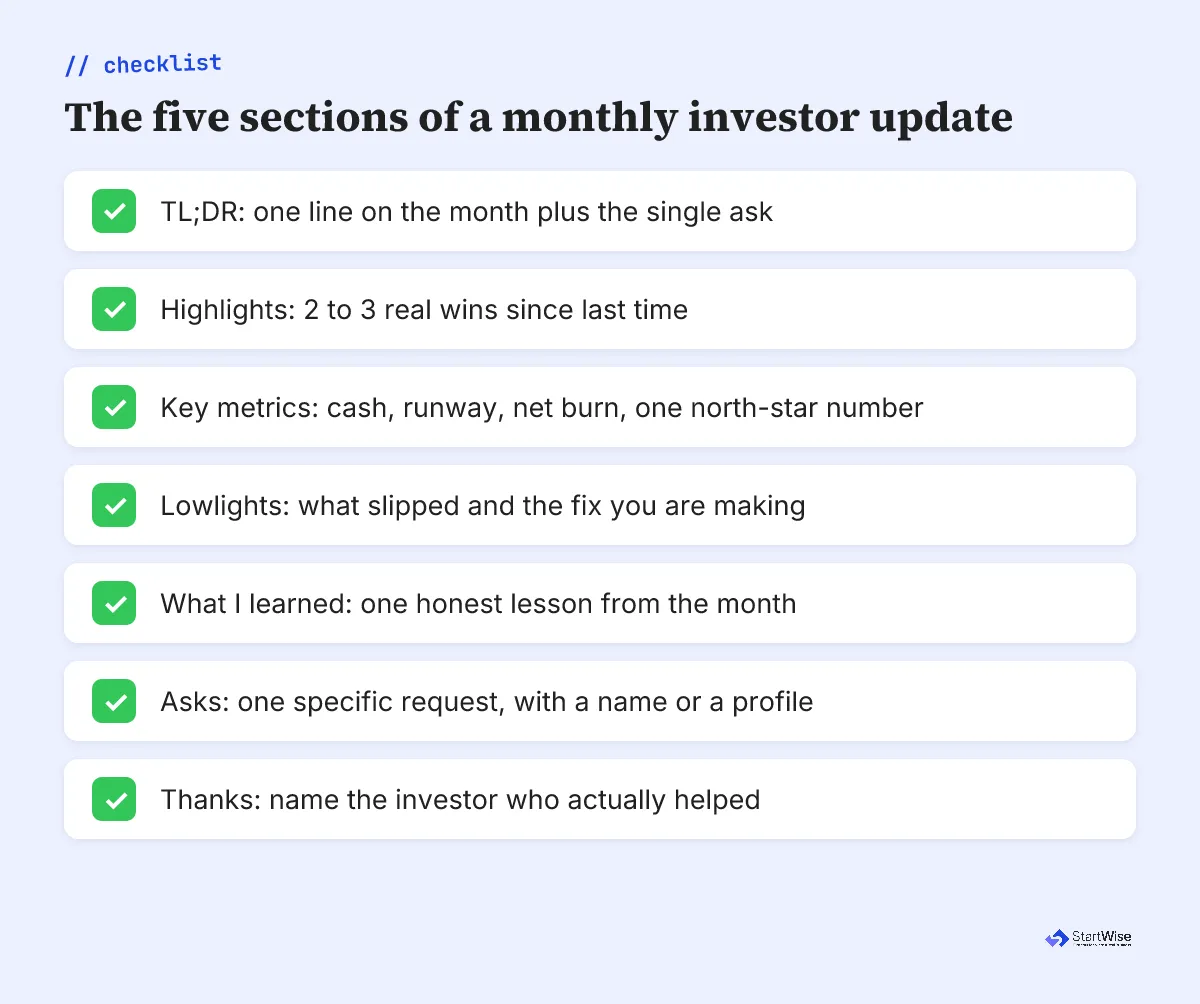
A good update has five parts: a one-line TL;DR, your highlights, key metrics, your lowlights, and one specific ask. The Founder Institute frames the same shape as overview, performance, economics, and needs. Keep the whole thing to something an investor reads on a phone in two minutes.
The metrics block is where you prove you know your own business, and in the updates we read it’s the first place an investor’s eye lands. Put cash in the bank, runway, net burn, and your one north-star number up top, every month, in the same order, so a reader can scan the trend in seconds. Only 42% of updates include a KPIs section at all (Visible), so real numbers up top already put you ahead of most founders.
| Section | What to write | Keep it to |
|---|---|---|
| TL;DR | One line: up, down, or flat, plus the single ask | 2 sentences |
| Highlights | 2 to 3 real wins since last update | 3 bullets |
| Key metrics | Cash, runway, net burn, one north-star number | A short block |
| Lowlights | What went wrong and what you’re doing about it | 2 bullets |
| Asks | One request: an intro, a hire, or advice | 1 to 2 lines |
Now the part founders fumble.
In Visible’s breakdown of what updates actually contain, 81% include a highlights section but only 39% include a fundraising or ask section (Visible). So most founders write a press release and forget to ask for anything. That’s backwards. The whole reason an investor opens your email is to feel useful, and you’re the one who decides whether they can be.
StartWise's position
Asks fail by being shy. The shyest line in any founder's update is the request for help, and it's the line that pays. After reviewing fundraising materials daily, our position is blunt: an update with no specific ask, a named intro, a role you're hiring, a customer you want reached, is a wasted send. Only 39% of updates even include an ask (Visible). Be in that minority.
The monthly investor update template
Here’s the core template, copy-paste and ungated. Swap the brackets for your numbers and send it. In my experience it takes about five minutes once you’ve sent two of them, and the second one is always faster than you expect.
Subject: [Company] investor update, [Month Year]

Hi all,

TL;DR: [One line on the month.] The one thing I need: [specific ask].

Highlights
- [Win 1]
- [Win 2]

Metrics
- Revenue / MRR: [$X] ([+Y% MoM])
- Cash: [$X]  |  Runway: [N months]  |  Net burn: [$X/mo]
- [North-star metric]: [X]

Lowlights
- [What slipped, and the fix]

What I learned
- [One honest lesson]

Asks
- [One specific request, with a name or a profile]

Thanks to [name] for [specific help].

[Your name]
Two rules make this work. Send it from your own email, not a no-reply address, because replies are where intros and advice happen. And keep the metrics in the same order every month so a returning investor reads the trend, not the layout.
How long should an investor update email be?
Keep a monthly update under 400 words outside the metrics block (Deckbrief), short enough that a busy angel finishes it on a phone between meetings. The updates we watch get read are the tight ones. Long updates don’t get read. They get archived unopened, and an archived update does none of the warming you sent it to do.
Put your metrics where an investor sees them before a word of narrative. That order matters more than founders think: the reader wants the score before the story, and burying the numbers under two paragraphs of context is how you lose the skim on the one email meant to build trust between rounds.
Your subject line carries more weight than any sentence in the body. Use the same format every month with the month and one number in it, so a returning investor reads the trend straight from the inbox. “Acme update, September 2026: MRR $18K, up 22%” beats a bare “Monthly Update” every time, because it earns the open before it happens.
Write for the skim first, the read second.
What if you have no real metrics yet?
At pre-seed with no revenue, you report direction instead of totals. The mistake we flag most often is a founder staying silent because the numbers feel too small to share. They aren’t. Investors at this stage backed a slope, not a snapshot, so show them the slope: weekly active users climbing, interviews done, a waitlist growing, a pipeline forming.
Subject: [Company] update, [Month Year]

Hi all,

TL;DR: Still pre-revenue, but [the signal that matters]. Ask below.

Traction signals
- Weekly active users: [X] ([+Y] WoW)
- Customer interviews this month: [N]
- Pipeline / waitlist: [X]

Product
- Shipped: [one thing]
- Next: [one thing]

Cash
- Runway: [N months] at [$X/mo]

Ask
- [Intro to one named profile, or one key hire]

[Your name]
A waitlist that grew from 40 to 220 in a month tells an investor more than a revenue line of zero ever could. Movement is the metric before money is. Pair this with your investor pipeline tracker so the people you’re updating are the same ones you’re warming for the raise.
Updates keep this round warm. When you're ready for the next one, StartWise matches you to investors for your stage and builds the outreach.
How do you write the update when the month was bad?
Lead with the bad news, then the plan. When a month goes sideways, the worst move is to skip the update, because silence after a rough patch is exactly what makes investors nervous. The founders we trust most are the ones who send the hard update on time, name the problem in the first line, and show they’re already moving on it.
Subject: [Company] update, [Month Year] (a hard one)

Hi all,

TL;DR: Tough month. [What happened] in one sentence. Here's the plan.

What went wrong
- [The honest version, no spin]

What we're doing about it
- [Decision 1]
- [Decision 2]

What I need
- [The specific help that would matter most right now]

Still here, still building.

[Your name]
Investors expect bad months. What they punish is finding out late, from someone else, or at the moment you come back asking for a bridge. A candid bad-month update is worth more than three glossy ones, because it’s proof they can trust your good news too.
How should you send and track investor updates?
For most pre-seed and seed founders, a plain email sent to a BCC list or a single group alias is enough to start. Don’t over-engineer it. We watch founders agonize over tooling before they’ve sent a single update, and the discipline of sending beats any tool you won’t open. A Gmail draft you reuse each month works fine for your first year.
The friction shows up once your list grows. BCC means you can’t see who opened the update, who clicked, or who quietly stopped reading, and that signal is useful: an investor who reads every update is your warmest lead, and one who’s gone cold is worth a direct check-in. Dedicated investor-update tools like Visible add open and click tracking for exactly this reason. The Silicon Valley Bank team treats the update as one of the two emails every founder must master, alongside the cold intro, because both are relationship tools, not announcements.
That’s the mindset shift. Treat every send as relationship maintenance, so that eight months from now the next round opens with people who already believe you. The tool you pick matters far less than whether the right names keep opening the email.
Whatever you send from, keep the data room behind it current. An investor who reads a strong update often clicks through to your data room next, and a stale folder undoes a good email.
What to do this week
Set up your update before your next investor call, not the night before you need money. It takes one evening. The founders we see raise fastest already had a clean update streak running, so their next round opened warm instead of cold.
- Copy the monthly template above into a reusable draft and fill in this month’s brackets.
- Pick a fixed send day, the first Wednesday is a good default, and put it on your calendar as recurring.
- Write one real ask. A named intro, a specific hire, or a customer you want reached. No ask, no send.
- BCC your investors, or move to a tracking tool once your list passes 15 people.
- Next month, change the numbers and the ask, keep the shape, and don’t break the streak.
Do that, and the update stops being a chore you dread on the last day of the month. It becomes the cheapest fundraising you’ll ever do, sent one email at a time, months before you actually ask for the check.