
 By
By 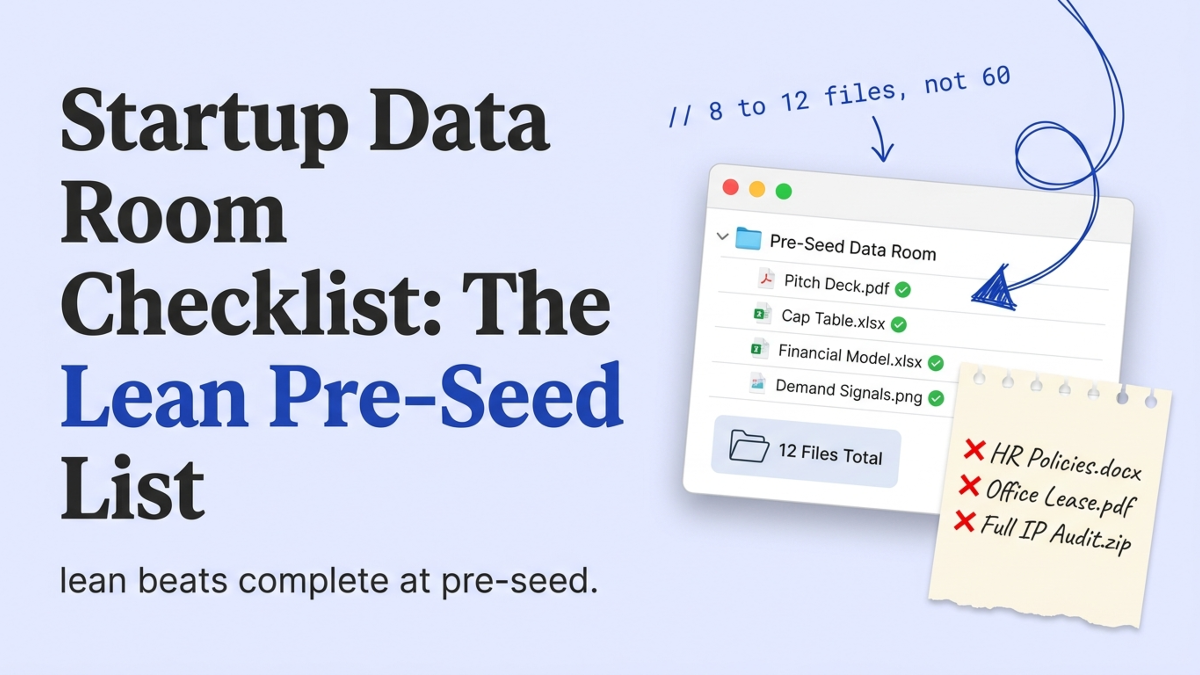
A startup data room is the secure online folder where you keep the documents investors ask for during due diligence: your deck, cap table, incorporation papers, and a financial model. At pre-seed it should hold 8 to 12 documents (Visible, 2026), not the 60 that most checklists publish. In the rooms we review at StartWise, the error runs the other way. Founders over-build, uploading Series A diligence files before a single investor has asked for one. Here’s the lean list, what to cut, and when to send it.
What is a startup data room?
A startup data room is a secure, shareable folder of company documents that investors review before they wire money. People also call it a virtual data room, or VDR. Older founders remember physical rooms full of binders. Yours is a link.
At pre-seed the room has one job: let an interested investor confirm you are real and move to a yes. It is not a sales tool. The deck sells; the room verifies. We keep seeing founders confuse the two and pack the room with narrative slides nobody asked for.
Most teams run it on DocSend, Visible, or a shared Google Drive folder with permissions locked down. The tool matters less than the contents and the timing, which is where this checklist starts.
Do pre-seed investors expect a data room in 2026?
Pre-seed investors do expect a data room, but they expect access, not volume. 89% of investors now require secure digital access to diligence materials through a virtual data room (Papermark, 2026). That statistic gets misread. It means an organized, shareable room is table stakes. It does not mean you should fill it with 60 files.
That misreading drives the over-building we flag. Founders see “investors require a data room” and assume the room’s job is completeness, so they upload every legal file, HR doc, and old model they can find before a single partner has asked for access. At pre-seed the room’s job is speed and trust. What investors underwrite here is the founder and an early signal of demand (Value Add VC, 2026), not three years of financials. With the SAFE now the default pre-seed instrument, there’s no priced round to diligence in depth anyway.
The money math backs it. A typical 2026 pre-seed runs $500K to $2.5M with a median of $1.2M (Capwave). Nobody writing a $250K check is auditing a 60-tab model. They’re deciding whether they believe you.
What goes in a pre-seed data room?
A pre-seed data room holds 8 to 12 documents that prove three things: the company is real, the team can build, and someone wants what you’re making. Here is the full list, in the rough order an investor opens it.
- Pitch deck. The same one you sent, not a special edition.
- Cap table. Who owns what today, on one page.
- Incorporation documents and founder IP assignment. Proof you own the company and the code.
- A 12 to 24 month financial model. A simple one, tied to your use of funds.
- Demand signals. Waitlist numbers, letters of intent (LOIs), pilot agreements, anything that shows pull.
- One-page team summary. Roles, relevant scars, why this team wins.
- Product demo. A link, a sandbox login, or a short walkthrough video.
- Past investor updates, if you’ve sent any.
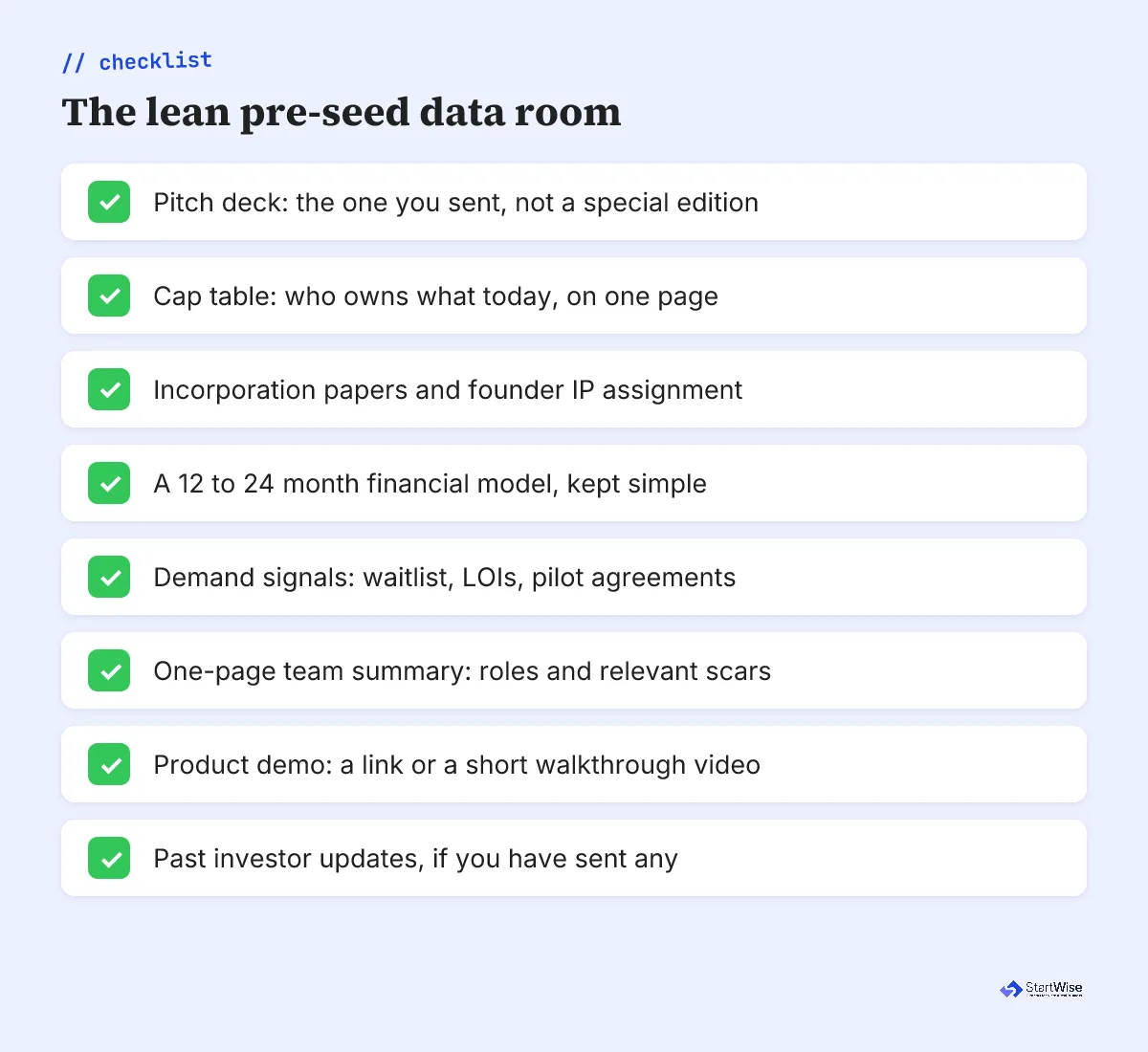
That’s the whole room. Notice the model spans 12 to 24 months, not three years. Pre-seed investors underwrite team, thesis, and a demand signal, not audited projections (Value Add VC, 2026). A glossy five-year forecast at this stage reads as theater, and they know it.
How deep the room goes scales with the round you’re raising:
| Stage | Documents | Financials | What investors check |
|---|---|---|---|
| Pre-seed | 8 to 12 | 12 to 24 month model | Team, thesis, demand signal |
| Seed | 15 to 25 | Model plus early actuals | Traction slope, retention |
| Series A | 30 to 60+ | Three years plus cohorts | Repeatable, scalable growth |
Copy the Series A column at pre-seed and you’ve built the wrong room. A pre-seed founder linking three years of fabricated financials and signed enterprise contracts they don’t have isn’t impressing anyone. They’re advertising that they can’t tell the stages apart.
Two of those files do most of the work: the cap table and the model. Investors open them first and read them hardest, so get them right. The slips we catch most are a cap table that’s months out of date and a model whose headline raise doesn’t match the number on your deck’s ask slide. When those two disagree, an investor trusts neither.
What to leave out of a pre-seed data room
What you leave out of a pre-seed data room matters as much as what you put in. The cuts are specific. Drop the three-year audited financials, the exhaustive HR files, the 40-tab model, the signed customer contracts you haven’t earned, and any NDA gating the room itself. Pre-seed investors won’t sign one to look at a seed-stage company, and asking reads as naive.
At pre-seed, the data room is a credibility test you pass by subtraction.
In the rooms we review, the instinct to add more comes from anxiety, not strategy. More documents feel safer. They aren’t. Each extra file is one more thing an investor has to wade through to find the four that matter, and one more place for an inconsistency to surface.
Common mistake
The error we flag most: a founder uploads 40 documents before one investor has asked for access. A bloated room doesn't read as thorough. It reads as someone who can't tell a pre-seed raise from a Series A.
How investors actually read your data room
Investors read a data room the way they read your deck: fast, and hunting for a reason to stop. Papermark’s 2024 analysis of 3,000 pitch decks found they spend about 3.2 minutes on a deck, 23 seconds on the first page, and roughly 15 seconds on each page after. They don’t slow down for your data room either. They scan the folder names, open two or three files, and decide whether to keep going.
They open the deck first, then the cap table and the model, and rarely reach the legal or product files unless those three hold up. Optimize for that order. Survive the first three and you’ve earned the deep read.
So the room has to read in a glance. Name files plainly (01_Pitch_Deck.pdf, Cap_Table_2026-06.xlsx), put the four documents that matter at the top, and make the model open without a tutorial.
StartWise's position
A pre-seed data room should pass the same skim test we apply to decks. If an investor can grasp your company from the folder names and the top of each file in a few minutes, the room works. Build it for the skim, not for completeness.
When should you share your data room?
Share your data room after an investor shows real interest, not before. The sequence matters. In cold outreach you send the deck, ideally as a tracked link so you can see who opened it. A short teaser version of it, maybe, and nothing else. When someone replies or takes a call, you share the room for the diligence conversation that follows.
In the raises we watch, pasting a full data room link into a first cold email is a tell. It says you don’t know what to lead with, so you led with everything. The same discipline that keeps your ask slide to one milestone keeps your outreach to one asset: the deck earns the meeting, the room confirms the story.
This also protects you. You control who sees the cap table and the model, and you see who opened what before you walk into the next conversation. Note each viewer in your investor pipeline tracker so you always know who’s actually in diligence.
Data room built? The next step is getting it in front of investors who fund your stage.
How a ready data room speeds up your raise
A ready data room shortens the gap between an investor’s interest and the wire. That gap is getting longer on its own: pre-seed rounds now take 6 to 10 weeks to close in 2026, up from 4 to 6 (Capwave). Every day you spend assembling documents mid-process is a day the round stays open and momentum leaks.
When an investor asks for diligence materials and you send a clean, current link the same afternoon, you keep the round moving. When you go quiet for a week to build the room from scratch, you hand them time to second-guess, and you compete with every other deal that landed in their inbox that week. Keep the model fresh while you’re at it, because the runway math behind it is the number they check first.
Speed compounds. An investor who gets clean answers in a day moves faster precisely because nothing in the room makes them nervous, and a quick yes from one fund is the strongest signal you can send the next one.
This is the case we make to founders for building the room early and lean. The room is one line on a wider pre-seed fundraising checklist, and being ready is a speed advantage in a market where raising already takes longer than it did two years ago. The fortress of files was never the point.
Where should you host your data room?
Host your pre-seed data room wherever you can control access and see who opened what. You don’t need a paid platform to start. A locked Google Drive folder with view-only, per-person permissions does the job for most pre-seed raises, and you can upgrade the day a round turns competitive.
The common options, cheapest first:
- Shared cloud folder (Google Drive, Dropbox). Free and familiar, fine for pre-seed if you set permissions per person and switch off downloads.
- DocSend. The founder standard for sharing decks and rooms, with page-by-page analytics that show you exactly what an investor read.
- Visible, Papermark, or a dedicated VDR. More structure and tracking, worth it once you’re juggling several investors at once.
We’ve watched founders lose a day to permissions settings in the middle of a raise, which is exactly the friction a folder set up in advance removes. Whatever you pick, one rule holds: never use a public link with no access control. A data room is private by definition. A link anyone can forward isn’t a data room. It’s a leak.
What to do this week
Build the lean version now, before you need it. The founders we see raise fastest already have this folder built before the first investor call. It takes an afternoon, and it removes one excuse for going slow when an investor finally leans in.
- Make one folder and add the 8 to 12 documents above. Skip anything not on the list.
- Rename every file with a plain, dated convention so the room reads top to bottom.
- Open your financial model and confirm the runway math matches your deck’s ask.
- Set permissions to view-only and keep the share link unsent until someone asks.
- Diary a monthly reminder to refresh the model and your demand-signal numbers.
Do that, and the day an investor says “send me your data room,” your answer is a link, not a week of scrambling.