
 By
By 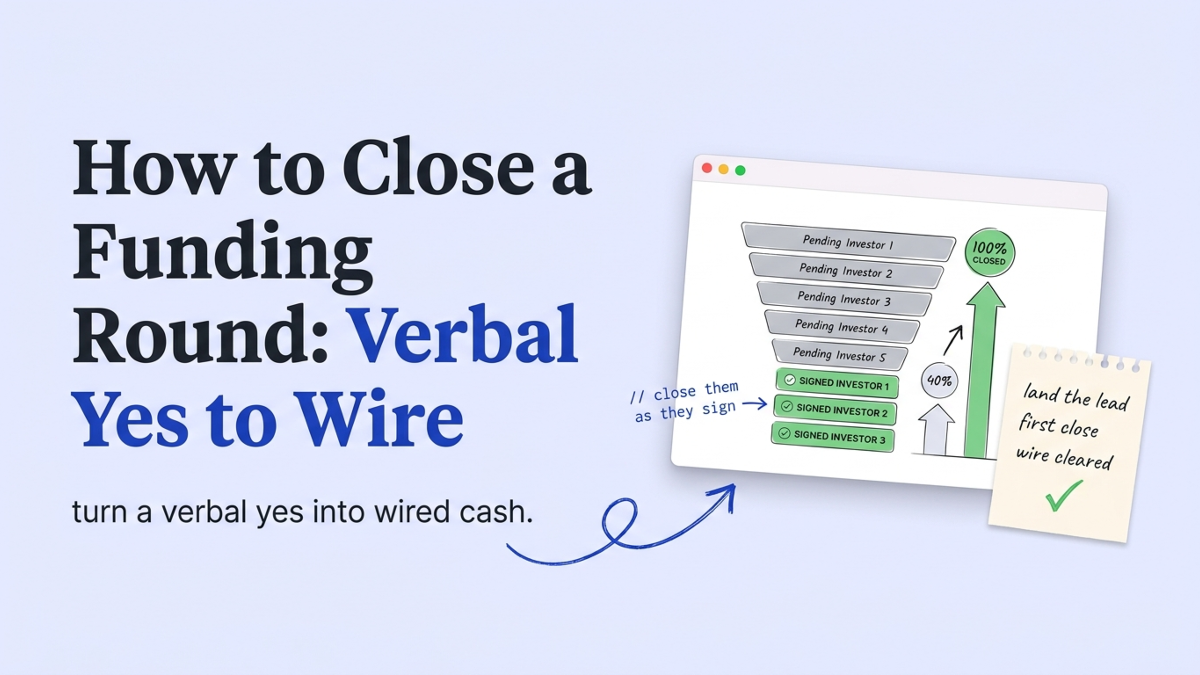
Closing a funding round is the moment verbal interest becomes signed paper and cash in your account. It’s the step where the most raises we watch at StartWise stall, because founders hear a yes and stop selling. A soft commit isn’t money. At pre-seed, 91% of the instruments founders close are post-money SAFEs (Carta, Q2 2026), which is good news: the paperwork moves fast once investors are ready. Getting them ready is the hard part. Here’s how to drive a round from soft yeses to a wire.
What does closing a funding round actually mean?
Closing means every committed investor has signed their paperwork and the money has landed in your bank account. Three things feel like a close and aren’t one:
- A verbal or emailed yes.
- A soft commit waiting on a lead.
- A signed term sheet with no wire behind it.
At pre-seed that paperwork is usually a post-money SAFE, the instrument behind 91% of the deals Carta tracked in Q2 2026 (Carta via Kruze Consulting, 2026).
A SAFE is a simple agreement for future equity: the investor wires now and converts to shares at your next priced round. Because it runs on standard Y Combinator terms, there’s no valuation to negotiate line by line and no term sheet to redline.
We watch founders celebrate a soft-circled round, go quiet, then wonder three weeks later why nobody wired. A verbal yes is a maybe with better manners.
Why do soft commits stall before they wire?
Soft commits stall because most investors, especially angels, won’t wire until someone credible leads the round. Alex Iskold of 2048 Ventures puts it plainly: angels “weren’t willing to invest and wire the money without a lead” (2048 Ventures, 2026).
Early in a raise there’s no momentum, and for the first checks it isn’t even clear the round will come together (2048 Ventures, 2026). That’s the trap. Everyone waits for everyone, and the round that felt 80% done drifts for a month.
Once a lead is in, the picture clears. As roughly half to three-quarters of the round commits, the founder and investors settle on the cap, and the rest follow the anchor (2048 Ventures, 2026).
My honest take: at pre-seed, chasing twenty angels before you have a lead is backwards. Land one credible lead, and the other nineteen conversations get easier.
Close investors one at a time with a rolling close
You don’t have to wait for the whole round to close anyone. A rolling close lets you sign and bank each investor as they commit, then top up later at the same or a higher cap. On SeedLegals, 70% of funding rounds now include a rolling close (SeedLegals, 2026).
This is the mechanic we watch first-time founders miss most. A priced round closes once, all at once, after a term sheet and weeks of legal. A SAFE round doesn’t. Each SAFE is its own bilateral contract, so the investor who’s ready today can wire today while you keep working the ones who aren’t.
Banking early checks builds the momentum a stalled round lacks. “Three investors wired this week” is a truer signal than any deadline you invent.
70%
of SeedLegals funding rounds now enable a rolling close, so you bank each check as it signs instead of waiting for the full round to assemble (SeedLegals, 2026)
How do you create urgency without a fake deadline?
Real urgency comes from momentum you can point to, not a deadline you made up. Investors have seen the “round closes Friday” email a hundred times. What moves them is evidence the train is leaving:
- A lead is committed at a set cap.
- A chunk of the round is already circled or wired.
- Named investors they respect are in.
- The allocation left is smaller than the check they wanted to write.
Notice what’s missing from that list: a threat. “This is your last chance” from a founder with no lead reads as desperation, and investors price desperation into their answer.
The founders we watch close fastest never manufacture scarcity. They report it. Momentum is a fact you earn, and by the time three-quarters of the round is circled, the cap is set and the last checks chase the ones already in (2048 Ventures, 2026).
Chasing verbal yeses across your inbox? StartWise runs your raise from one place, tracks who reopened your deck and who is ready to wire, and helps you drive to a first close.
What documents do you sign to close a SAFE round?
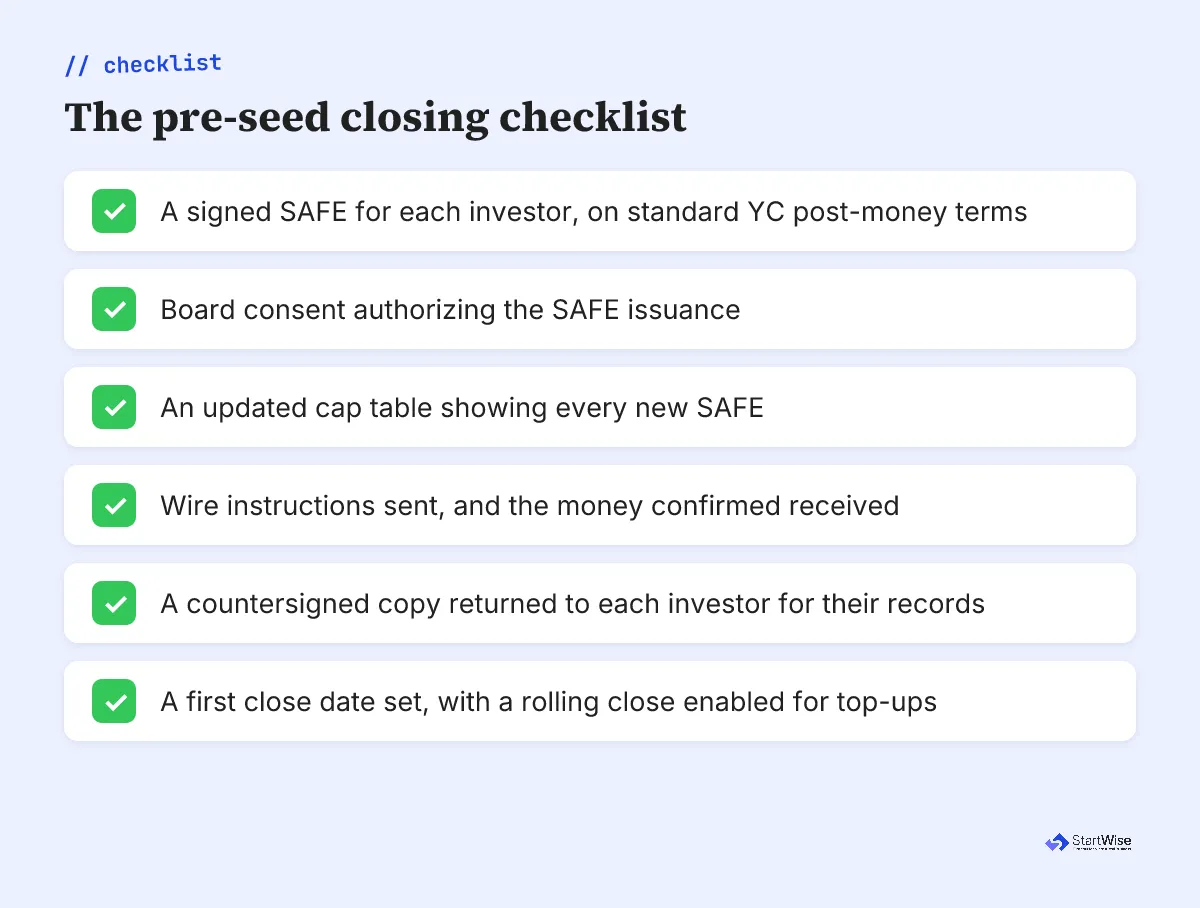
To close a SAFE, you sign the SAFE itself, get board consent to issue it, update your cap table, and send wire instructions. That’s the whole list at pre-seed. A SAFE “does not require legal review to be valid” (CRV, 2026), though plenty still have counsel glance at anything nonstandard.
Use the standard YC post-money SAFE without modification. Post-money SAFEs have been the market standard since the 2018 form (CRV, 2026), and 91% of pre-seed instruments now use them (Carta, Q2 2026). Redlining a standard SAFE is how a two-day close turns into a two-week one.
In the closings we review, the SAFE round and the priced round barely resemble each other at the finish line.
| Step | SAFE round (pre-seed) | Priced round (seed and up) |
|---|---|---|
| Core document | Standard YC post-money SAFE | Term sheet, then full legal docs |
| Negotiation | Cap and discount only | Valuation, board seats, protective terms |
| Legal time | Days | Two to six weeks |
| Close style | Rolling, one investor at a time | One simultaneous close |
Why do rounds fizzle at the finish line?
Rounds fizzle when the founder stops driving after the soft commits land. The money feels basically in, so daily outreach slows, no first close date gets set, and the half-committed investors drift back to their day jobs.
It’s the same deadlock we see every time. Angels wait for the lead, the founder waits for the angels, and nobody signs. Breaking it is your job, not theirs. Set a first close date, get one investor to wire against a rolling close, and use that as the proof that pulls the rest in.
Every week a soft-circled round sits unsigned is a week of runway you burn against a wall. A slow close is how a fundable company still runs out of money.
A round isn’t closed when investors say yes. It’s closed when the wire clears.
StartWise's position
Treat a round as unclosed until the cash clears, and force a first close early instead of waiting for the whole round to assemble. A verbal yes costs an investor nothing. A signed SAFE and a wire cost them real money, and only the second one is a close. With 70% of rounds now offering a rolling close (SeedLegals, 2026), there's no reason to let money you've already won wait on a straggler.
That’s the shift, and it’s the whole point of this post. Stop treating the yes as the finish line. The wire is the finish line, and it’s yours to drive.
What to do this week
If your round is soft-circled but unsigned, stop selling the vision and start closing the paper. Here’s the week.
- List every soft commit with a dollar amount and a flag for signed, or only nodded, and run it like a pipeline.
- Name your gap. If you have no lead, landing one is the only job that matters this week.
- Set a first close date, then tell every committed investor you’re banking the first close on that day.
- Enable a rolling close so you can sign each investor as they’re ready and top up later at the same or a higher cap.
- Send the standard YC SAFE and wire instructions to everyone who’s verbally in, with a signing deadline that’s real because the first close is real.
Do that, and the round that’s been almost there for a month starts landing as cash. The founders we watch don’t close because they’re better storytellers. They close because they treat the wire, not the yes, as the finish line. Line up the full pre-seed raise behind that one habit and the finish stops moving away from you.