
 By
By 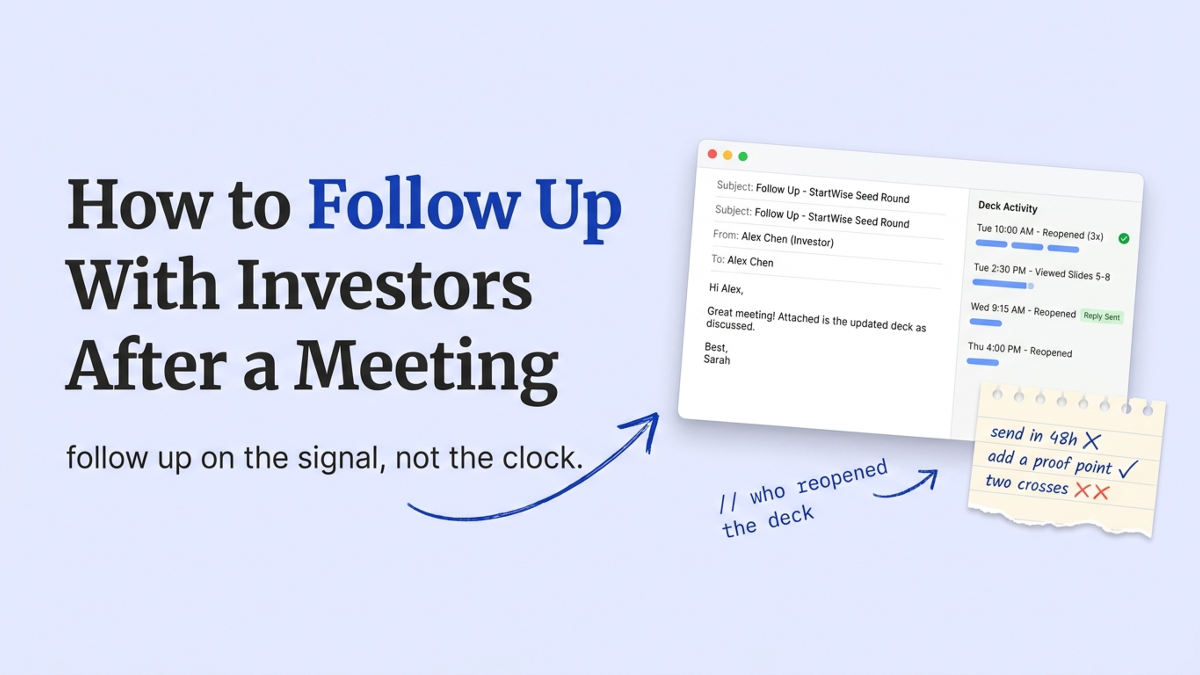
The investor follow-up is the email you send after a meeting to keep the conversation moving toward a check. Most founders treat it as a thank-you note, so it reads like one and gets ignored. In the raises we watch at StartWise, the follow-up is where a promising meeting either turns into diligence or quietly dies. It’s a read on where you stand, and most founders misread it. Here’s how to send it, when, and how to tell a live deal from a dead one.
When should you follow up after an investor meeting?
Send your first follow-up within 24 to 48 hours of the meeting (Allied Venture Partners, 2026). That window matters. Any faster and you look anxious. Any slower and the meeting has already blurred into the ten others that partner took this week.
Speed is itself a signal. The way you follow up is a preview of how you’ll operate once their money is in your company. A same-day recap that answers the hard question from the room tells an investor you execute. A vague note four days later tells them the opposite.
We keep seeing founders sit on the follow-up because they want it perfect. Don’t. A fast, specific, slightly imperfect email beats a polished one that arrives after the investor has moved on.
What should your first follow-up email include?
Your first follow-up should answer the open questions from the meeting, add one new piece of proof, and hand over your data room. Skip the long thank-you. One line of gratitude, then straight to substance.
The single rule that separates a follow-up that works from one that doesn’t: every send carries one new proof point, something dated and true since you last spoke. In the notes we review, the ones that get replies almost always open with one:
- A customer signed or a pilot converted.
- A senior hire said yes.
- Weekly usage or revenue moved in the right direction.
- You closed the gap on the exact objection they raised in the room.
Investors read a full deck in about 3.2 minutes and give the first slide 23 seconds (Papermark, 2024), and your follow-up gets the same fast skim. If it says nothing new, it earns nothing back.
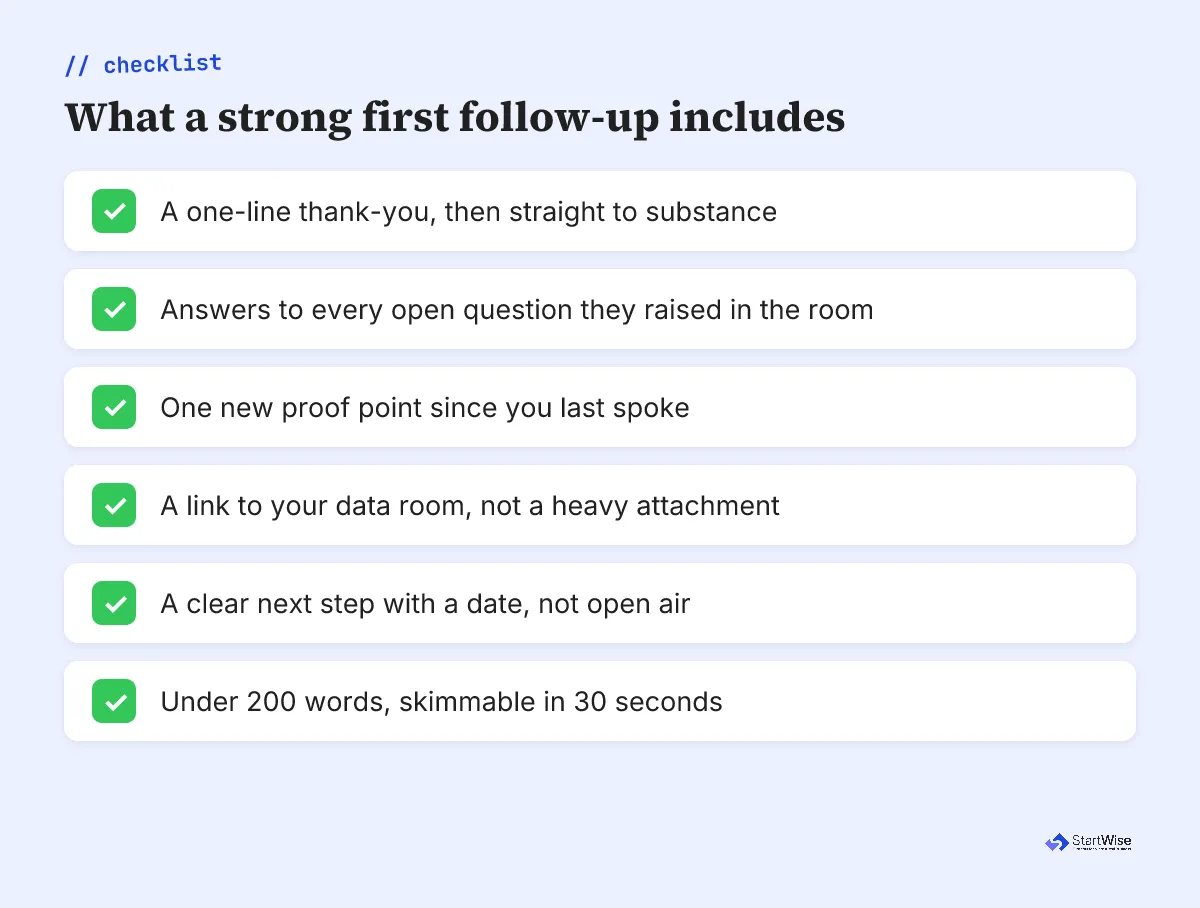
Link the data room instead of attaching a 15MB file. A link lets you update materials without resending, and it shows you who reopened your deck and when. That last part changes how you follow up, and we’ll come back to it.
Investor follow-up email templates you can copy
These four templates cover the situations you’ll actually hit after a meeting. They’re the shapes we see earn replies in the raises we watch, stripped to the essentials. Copy them, swap in your specifics, and cut anything generic. Every one gets a skim, not a read.
1. The first follow-up (within 48 hours)
Subject: Great meeting [Firm] + the [metric] you asked about

Hi [Name],

Thanks for the time yesterday. You asked how we're thinking
about [the objection or question]. Short answer: [one or two
sentences that actually answer it].

One update since we spoke: [new customer / hire / usage number].

Full numbers and docs are in our data room here: [link].

Happy to loop in [co-founder] on [topic] if useful. Would a
15-minute call next week make sense to go deeper on [the thing
they cared about]?

[Your name]
2. The proof-point nudge (7 to 10 days, no reply)
Subject: Quick update: [the milestone]

Hi [Name],

Wanted to share one thing since we last talked: [specific,
dated proof point, e.g. "we closed our third design-partner
this week, now at $6K MRR"].

No ask here, just keeping you in the loop as we move. The data
room is live if you want the detail: [link].

[Your name]
3. The milestone update (for a warm maybe)
Subject: [Company] update: [headline number]

Hi [Name],

Since our conversation last month: [2 to 3 bullets of dated
progress]. We're [X]% toward the milestone I mentioned we'd hit
before close.

We're aiming to wrap the round by [date] with [$ amount] left in
the allocation. Let me know if it's worth another conversation.

[Your name]
Keep that last one on the same investor update email rhythm you’ll use once they’re on your cap table. Investors fund founders they’ve watched execute.
4. The polite close (after 3 to 4 touches, no response)
Subject: Closing the loop

Hi [Name],

I know timing has to be right on both sides, so I'll stop
filling your inbox. If [our stage / sector / traction] fits
later, I'd love to reconnect. I'll keep you on our monthly
update so you can watch us build.

Thanks again for the time.

[Your name]
Running follow-ups from a messy inbox? StartWise sends your notes and data room from one place and tracks who reopens, so you follow up on the signal.
How often should you follow up with investors?
Space follow-ups about a week apart on a live deal, and tighten to every 7 to 10 days if you’re racing a close date (Allied Venture Partners, 2026). Persistence is real: roughly 80% of closed deals need five or more follow-ups, and founders who track opens see response rates climb by around 50% (Allied Venture Partners, 2026). So don’t quit after one email.
But that cadence assumes a pulse. This is where the timing rule flips from the calendar to the signal. When your data room shows an investor reopened the deck last night, that’s your moment, not next Tuesday. A re-open on a tracked link is a live buying signal, and a follow-up sent within hours of it lands on a warm desk instead of a cold one.
Run this across every open conversation at once. You’re managing a pipeline, not a pen pal, and the founders we watch close fastest work it like a board. The follow-up is how you triage it: push the warm ones, close the cold ones, and buy back the hours the dead ones would eat.
| When | What to send | What their reply tells you |
|---|---|---|
| Day 1 to 2 | Recap plus one proof point plus data room | Fast, specific reply means real interest |
| Day 7 to 10 | A dated milestone, no ask | A reopen or a question means it’s live |
| Day 14 to 21 | Milestone update plus a close date | Silence twice means it’s a soft no |
| After a reopen | Same-day note on the signal | Engagement without a reply means keep nurturing |
What does it mean when an investor goes silent?
Silence after a first meeting is a soft no far more often than founders want to admit. Interested investors move fast, because the round is competitive: the median 2026 seed is $4.1M at a $24M post-money valuation, and the seed-to-Series-A gap has stretched to 18 to 24 months (Value Add VC, 2026). An investor who wants in doesn’t want to lose the allocation. So they reply.
Here’s the hard part, and it’s the whole point of this post. The follow-up is a diagnostic. The investor’s response, or lack of one, is data about where the deal really sits, and your job is to read it honestly and spend your time where it pays. My honest take, after watching dozens of founders grind on ghosts: the scarce resource in a raise isn’t investor patience. It’s your time.
Silence after a first meeting is a soft no wearing a calendar invite.
StartWise's position
A follow-up is a diagnostic, not a thank-you note. After a first meeting, silence is usually a soft no, so make every follow-up carry one new proof point and treat two unanswered notes as your answer. Yes, 80% of closed deals take five-plus follow-ups (Allied Venture Partners, 2026), but those are follow-ups to interest. Chasing a ghost past two tries spends the hours a live lead needed.
That’s why the diagnostic matters so much at pre-seed. Running out of money is the recorded cause of death for 70% of failed startups (CB Insights, 2026), and a slow raise is how you get there. Every week you pour into a dead lead is a week your runway shrinks against a wall you can’t move.
Common mistake
Sending a fifth, sixth, and seventh follow-up to an investor who never replied to the first two. It feels like hustle. It's the opposite. You're spending your closing energy on the one person who already decided, while a warmer investor waits on the reply you never sent.
So set a rule and hold it. Two unanswered follow-ups on a first meeting, and that investor moves to nurture: your monthly update, nothing more. If they come back when you post a real milestone, the interest was always going to live there anyway.
What to do this week
Set up the follow-up system before your next meeting, not after it goes quiet. The founders we watch close fastest treat every meeting as the start of a tracked thread, not a one-off pitch. Their follow-ups go out in hours because the machinery already exists.
- Save the four templates above and rewrite each in your own voice today.
- Put your deck and data room behind a tracked link so a re-open pings you.
- After each meeting, send the first follow-up within 48 hours with one proof point.
- Log every open conversation with a next-action date, the way you’d run a cold outreach pipeline.
- When a deck reopens, follow up that day. When two follow-ups go unanswered, move the name to nurture and reclaim the time.
Do that, and follow-up stops being the anxious guessing game most founders play. It becomes a read you can act on, meeting by meeting, so you pour your best hours into the deals that are actually alive. The questions they asked in the room told you what to prove. The follow-up is where you prove it.