
 By
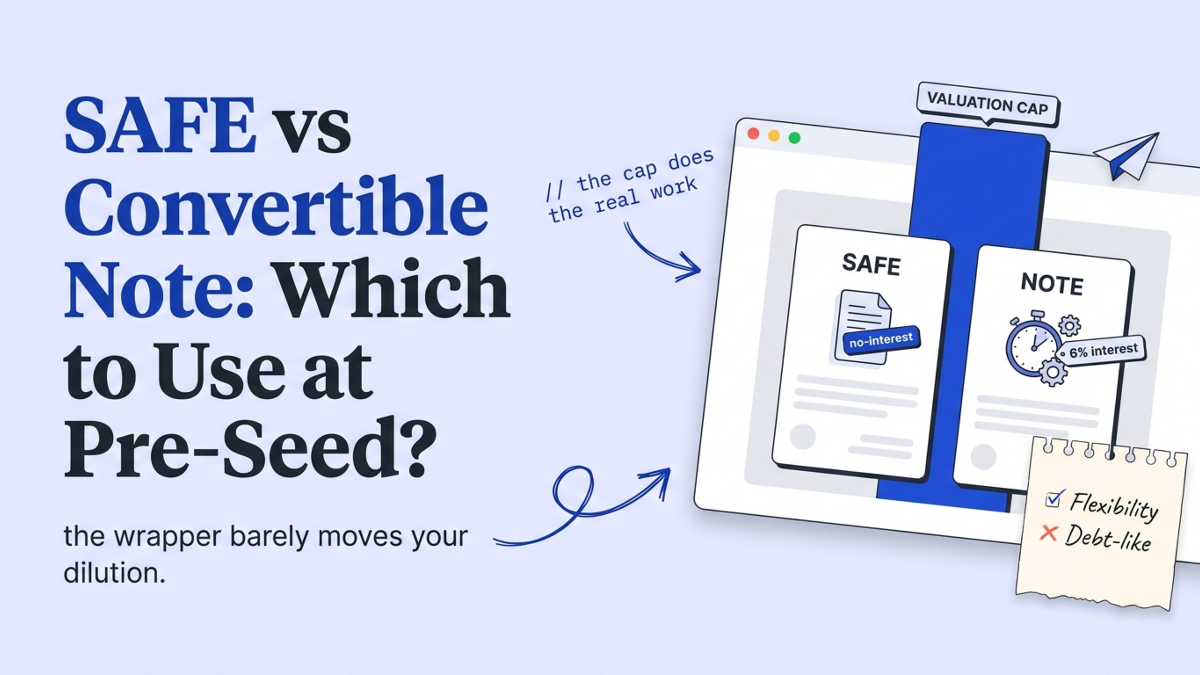
A SAFE and a convertible note are the two ways founders take money before setting a valuation. A SAFE (Simple Agreement for Future Equity) is a promise to hand over shares at your next priced round; a convertible note is a short-term loan that converts into those shares instead of being repaid. In the pre-seed rounds we help founders prepare, this gets treated as a heavy legal fork. It mostly isn’t. About 90% of pre-seed deals already run on SAFEs, and the number that decides your dilution is the cap, not the wrapper.
SAFE vs convertible note: what’s the real difference?
The real difference between a SAFE and a convertible note is debt. A SAFE isn’t a loan: Y Combinator’s post-money SAFE, the standard since 2018, has no interest and no maturity date, and it converts into preferred shares automatically at your priced round (Y Combinator). A convertible note is a promissory note. It accrues interest, usually 4% to 8% a year, and it carries a maturity date, usually 18 to 24 months out, when the balance is legally due (Papermark, 2026).
Everything else the two share. Both let you skip the valuation fight until a lead investor prices the round. Both convert using a valuation cap, a ceiling on the price your money converts at, or a discount, or both. That discount usually runs 10% to 20% off the priced-round price (Y Combinator). In the raises we help prepare, the SAFE template is the one everyone in the room already recognizes. That familiarity matters.
| Term | Post-money SAFE | Convertible note |
|---|---|---|
| Legal nature | Not debt, no repayment | Debt, a promissory note |
| Interest | None | ~4% to 8% a year |
| Maturity date | None | ~18 to 24 months |
| Converts at | Priced round, automatically | Priced round or maturity |
| Cost to issue | Free standard template | Lawyer-drafted, higher |
| Pre-seed usage | ~90% of rounds | ~10% of rounds |
Which one should most pre-seed founders use?
Most pre-seed founders should use a post-money SAFE, and the market has already made the call for you. About 90% of pre-seed deals now close on SAFEs, with convertible notes making up roughly the other 10% (CRV, 2025). When we prep a first raise, a SAFE is the default, because it’s free to issue, every angel and early fund has signed dozens, and it converts without a maturity clock hanging over you.
One thing the standard SAFE leaves out: pro-rata rights, the investor’s option to keep their percentage in your next round, live in a separate side letter, not the SAFE itself (Papermark, 2026). Read any side letter as closely as the cap.
So the decision most founders agonize over is mostly settled before they start. The argument worth having isn’t SAFE-versus-note. It’s what cap you sign.
StartWise's position
The instrument almost never decides your raise. The valuation cap does. We keep seeing founders spend a week debating SAFE-versus-note wording, then sign a cap that quietly costs them more ownership than the wrapper ever could. Pick the standard instrument in an afternoon and spend the real energy on the cap: the median pre-seed cap on rounds under $250K was $7.5M in Q2 2025 (CRV), and where you land against that number is what you feel at the priced round.
When is a convertible note actually the right call?
A convertible note is the right call in a few specific situations, and they’re worth knowing so you’ll recognize them when they show up. The debt structure that makes a note riskier for founders is exactly what some investors want. That’s the tell. CRV’s 2026 guide points to the cases where a note still wins (CRV):
- Bridge financing between priced rounds, where a short, defined conversion window is the whole point.
- Investors who want creditor protection, so their money sits ahead of equity if things go sideways.
- Regions and backgrounds where notes are the norm. In New York, Boston, and among debt-oriented investors, a note can feel more familiar.
- A deal you expect to convert on a clear timeline, where the maturity date is a feature.
At seed the mix shifts anyway. About 64% of seed rounds use SAFEs, 27% price the round, and 10% still use convertible notes (CRV, 2025). Deal size drives it: rounds under $500K lean SAFE, and once you’re over $5M, roughly 70% are priced. My honest take is that if none of the cases above describe your raise, reaching for a note just buys you legal fees and a deadline.
The maturity date is the trap founders miss
The maturity date is the one part of a convertible note that quietly turns against you. A SAFE waits as long as it takes. A note doesn’t: on its maturity date, usually 18 to 24 months after signing, the principal plus accrued interest is legally due (Papermark, 2026). Put a $250,000 note at 6% interest on an 18-month clock and about $272,500 converts, not the $250,000 you banked. The rate stays modest by design, because it has to clear the IRS Applicable Federal Rate (CRV, 2025).
Now line that clock up against how long a raise actually takes. Pre-seed to seed rarely runs on schedule, and if your priced round slips past the note’s maturity, the balance comes due while you’re still pre-revenue. That’s the seam we watch founders walk into. The note that felt identical to a SAFE on signing day is suddenly a creditor with a repayment date, right when cash is tightest.
70%
of failed startups had run out of capital CB Insights, 2026, from 385 venture-backed shutdowns
A matured note doesn’t usually get called in cash. Most founders and investors renegotiate. But you renegotiate from the weak seat, with a legal deadline behind you, and that’s a worse table than the one a SAFE leaves you at. When we map out a founder’s raise and there’s a note in the stack, the maturity date is the first thing we circle. If you sign one, make the maturity longer than your realistic gap to the next round. A seed round takes about 12 to 16 weeks to close once it starts, and the months of pipeline-building before that are what eat the runway.
Picked your instrument? The paperwork is the easy part. Getting the round filled is the work, and StartWise runs your plan, model, and investor outreach in one place, free.
Does the instrument change how much you get diluted?
The instrument barely changes your dilution. The cap, the discount, and how many rounds of paper you stack do almost all of it. A SAFE and a note with the same cap and discount convert to nearly the same ownership; the note just adds a little interest to the total. What actually moves the number is the cap you agree to, plus the fact that post-money instruments stack additively rather than as a blended average.
This is where founders get surprised. Three SAFEs at a $6M, $10M, and $15M cap don’t average out to something comfortable. Each one takes its own slice, and the founder row shrinks by the sum. Notes behave the same way. We break down the exact conversion math in how a SAFE converts, and the cap-table mistakes that stall raises almost always trace back to stacked caps, not to whether the paper said SAFE or note.
Whether the paper says SAFE or note barely moves your dilution. The valuation cap does almost all of it.
If you’ve been treating the SAFE-versus-note question as the big fundraising decision, you’ve been guarding the wrong door. Get the wrapper standard, then negotiate the cap like it’s the only term that matters. For your ownership, it nearly is.
What to do this week
Don’t spend another day stuck on the instrument. Here’s the order we’d work it, from the paperwork to the number that actually matters.
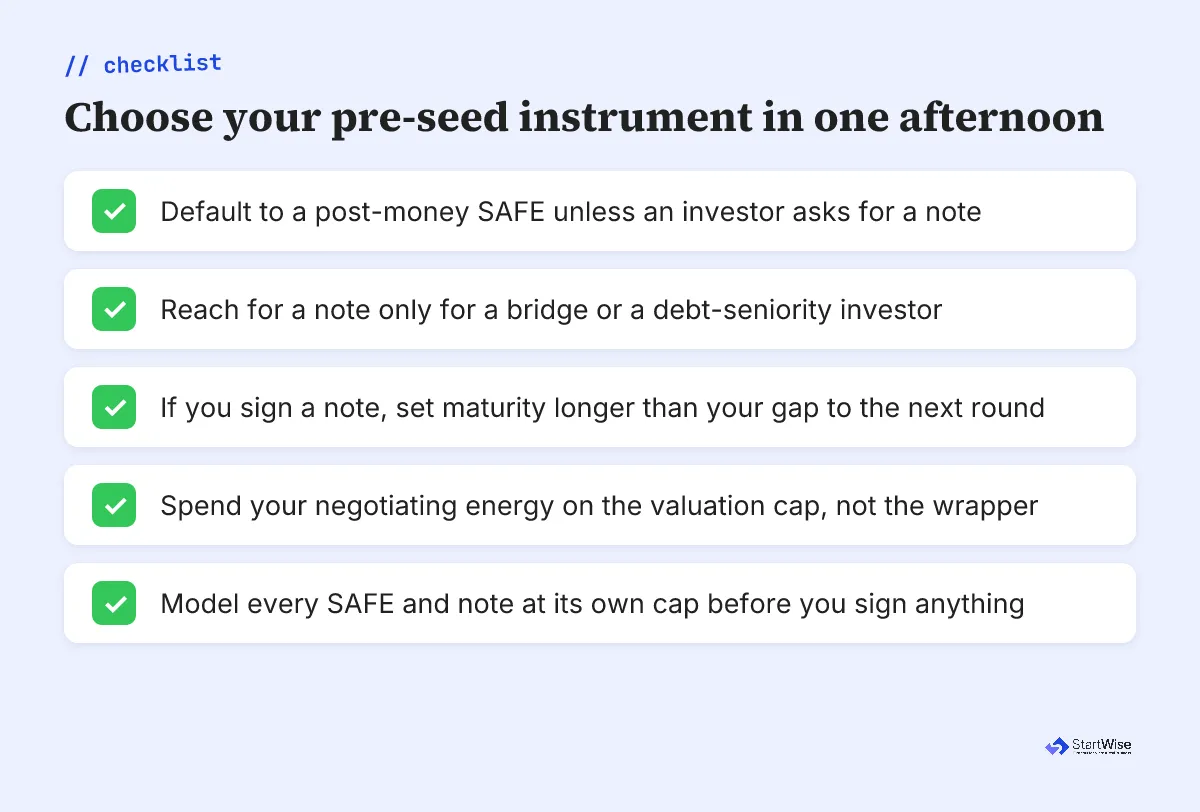
- Default to a post-money SAFE. It’s free, standard, and what about 90% of pre-seed rounds use.
- Reach for a convertible note only if you have a specific reason: a bridge, an investor who wants debt seniority, or a defined conversion window.
- If you sign a note, set the maturity longer than your realistic gap to the next round, and check the interest rate.
- Spend your negotiating energy on the valuation cap, and set it against a milestone you can actually hit.
- Model every SAFE and note at its own cap before you sign anything, so you read the founder row after all of it, not before.
Pick the wrapper in an afternoon. Then go win the cap. That’s the whole game at pre-seed, and it’s a lot less paperwork than the internet makes it look.