
 By
By 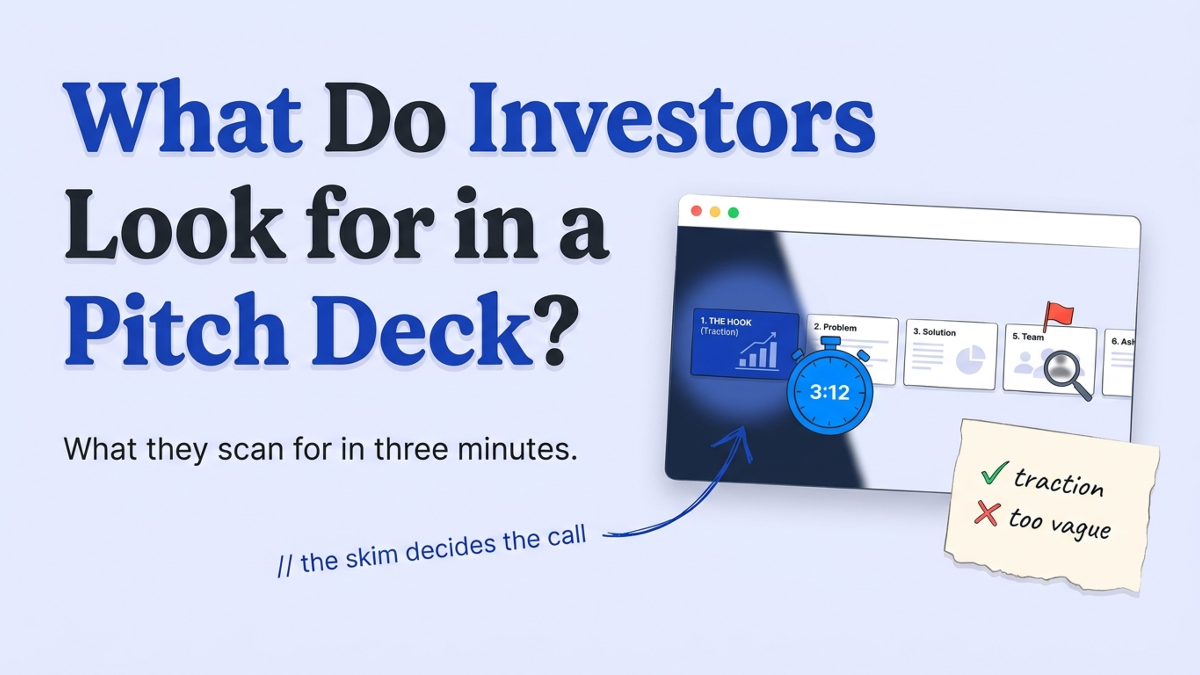
What investors look for in a pitch deck is signal, not polish: fast evidence that your startup could return a fund. And they hunt for it quickly. Papermark tracked 3,000 decks and found investors spend about 3.2 minutes on one, with 23 seconds on the first slide. In the decks we review, the ones that stall aren’t ugly. They’re complete, and buried, so the signal an investor needs never surfaces in the skim.
What do investors look for in a pitch deck?
Investors look for a few signals that a bet could pay off: a real and large problem, a team with an unfair right to solve it, proof the market is responding, and a clear use of funds. Everything else on the slide is context. GrowthX and DECKO, two guides ranking for this question, both land on roughly that list. They’re right about the ingredients.
What their lists skip is how the deck actually gets read. An investor isn’t grading completeness. They’re scanning for the one signal that’s missing, because a missing signal is a risk, and risk is what kills the check. CB Insights studied 431 venture-backed startups that shut down since 2023 and found 70% ran out of capital, 43% never found product-market fit, and 19% had unit economics that never worked (CB Insights, 2026). Those are the failures your deck argues against, slide by slide.
So here’s the reframe we’d offer after reading decks all day. Investors don’t look for what’s on your deck. They look for what’s absent, and whether the gap is the kind that ends a fund.
What is the first thing investors look at?
The first thing investors look at is your opening slide, and they give it about 23 seconds. Papermark’s analysis of 3,000 decks and more than 8 million data points clocked the pace. Investors spend roughly 3.2 minutes on a full deck, 23 seconds on the first slide, and about 15 seconds on each one after, with 30% lingering longest on page one (Papermark, 2024). The VC Corner puts DocSend’s number at about 4 minutes total. Either way, you get a skim, not a study.
StartWise's position
After reviewing decks daily, our take: a deck dies in the first 90 seconds of a skim, so build for the skim before the deep read. If an investor reads only your slide titles and still gets the story, you pass. Papermark clocks 23 seconds on that first slide, and a buried headline wastes all of it.
This is the mismatch we flag most. A founder pours hours into slide 8, the detailed roadmap, and leaves the title of slide 1 as one vague noun. The investor never reaches slide 8 at full attention. Front-load the signal, and put it in the headline where a skim can catch it.
The signals investors scan for, slide by slide
The signals investors scan for map onto specific slides, and each slide either closes a risk or opens one. Read your deck in that order and you start to see it the way a reviewer does: fast, and looking for the crack.
| What investors want to see | What a weak version looks like | The slide |
|---|---|---|
| A problem that is real and specific | A trend statement nobody is bleeding over | Problem |
| A team with an unfair right to win | A wall of logos and job titles | Team |
| Traction with a slope and a mechanism | A big absolute number with no direction | Traction |
| A market sized bottoms-up | 1% of a $50B TAM | Market |
| An ask tied to a milestone | ”$500K to accelerate growth” | Ask |
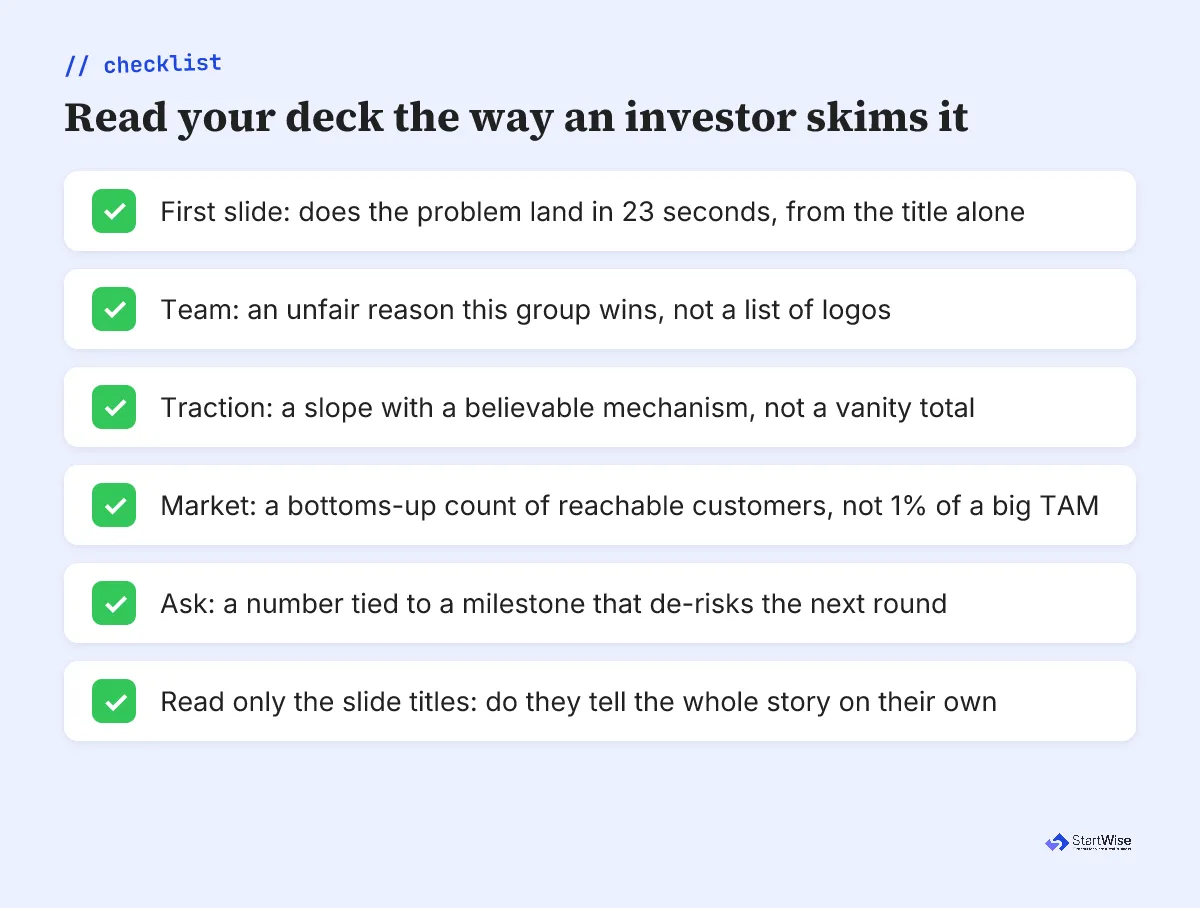
Two of these carry most of the weight at the skim stage. Why those two? The problem slide, because a reviewer decides in the first 23 seconds whether the pain is real. And the traction slide: it’s the fastest proof the rest of the deck isn’t a hypothesis. We keep seeing strong teams bury a genuine problem under a market-trend headline. The trend gets a polite nod. The problem gets the meeting.
Investors don’t reject the ugliest deck. They reject the one where the signal is missing and the risk is left standing.
On the page, this read is quiet and quick. In the room, the same signals come back as the questions investors ask, one per risk, and the slide you skimped on is usually the one you fumble out loud.
Not sure which slide is leaking the wrong signal? Get a free, slide-by-slide read of your deck in minutes.
What do investors look for by stage: pre-seed vs seed?
What investors look for shifts hard between pre-seed and seed, even when the slides stay the same. At pre-seed, they’re buying conviction: a problem worth a decade, a team with an unfair insight, and a believable why-now. There’s rarely traction to grade, so the problem and team slides do the work.
The price sets the bar. The median 2026 seed round is about $4M at a $20M post-money valuation (The VC Corner, 2026, citing Carta), and that money buys the right to demand evidence: a traction slope, early retention, unit economics that could work. By the time you’re pitching Series A investors watching for a median $1M to $2M in ARR growing 2-3x, the deck is mostly proof.
The most common stage error we flag is a seed deck that answers the traction question with a plan. At pre-seed, a plan is fine. At seed, it tells the room you’re raising the wrong round. If you’re unsure which bar you’re held to, settle which round you’re actually in first.
What founders think investors look for vs. what gets flagged
Founders and investors quietly disagree about what a pitch deck is even for, and the gap shows up on every slide. Founders optimize for completeness and design, so nothing is missing and everything is on-brand. Investors optimize for speed, so they want the signal to surface in one skim and survive one follow-up. That gap is where good startups lose meetings.
In the decks we review, the three most common own-goals aren’t missing slides. They’re a problem slide written as a market trend, a traction slide showing a vanity total instead of a slope, and a fat appendix that dilutes the five slides that matter. None of it reads as sloppy. It reads as a founder who built for themselves, not the reader.
Design is not the bar. Among 431 failed startups, 43% died on poor product-market fit and 19% on broken unit economics (CB Insights, 2026). Those are the exact signals a pretty deck hides best.
My honest take: obsessing over template and font is the safe work founders do to avoid the hard work of deciding what their one clear claim is. The skim doesn’t reward the safe work.
What to do this week
You don’t need a redesign. It’s the read we run on every deck: go through your own the way an investor skims it, then fix the slide that leaks the weakest signal.
- Read only your slide titles, top to bottom. If they don’t tell the story alone, rewrite the titles first.
- Time it: can a stranger get your problem in 23 seconds from slide one? If not, that’s the fix.
- Mark the one slide with the weakest signal, usually problem or traction, and rebuild it before touching anything else.
- Cut every slide that isn’t answering a signal. Five sharp slides beat twelve complete ones.
- Hand the deck to someone cold, give them three minutes, and ask what they remember. That list is what investors will see too.
Do that, and your deck stops being a document you present. It starts being the argument that survives a skim.