
 By
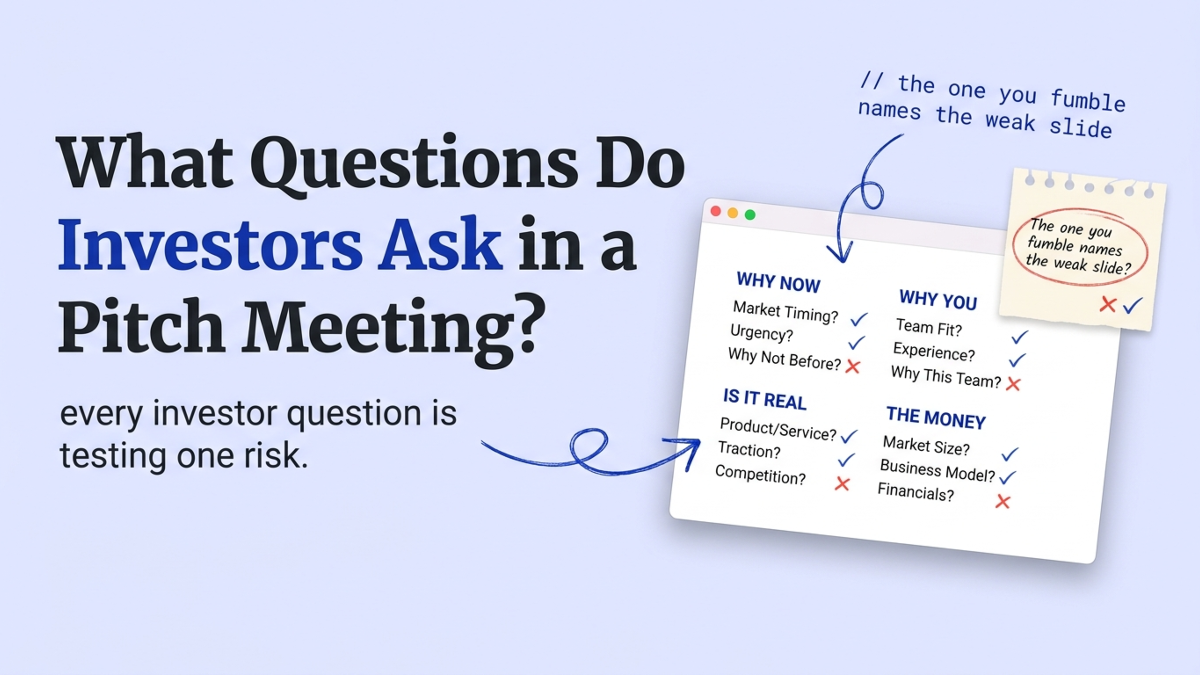
Investor questions in a pitch meeting are the follow-ups you get after the deck, and they aren’t random. Each one tests a specific risk: whether anyone wants this, whether your team can build it, whether the traction is real, and whether the money ever comes back. In the meetings founders replay to us afterward, the freeze lands on the same kind of question. Not a curveball. A basic one they’d written a slide about but never actually decided. That gap is exactly what a sharp investor is hunting for.
What questions do investors ask in a pitch meeting?
Investors ask about ten questions in a pitch meeting, and they circle the same themes every time: your team, your market, your product, your traction, your model, and what you’ll do with the cash. SeedLegals pulled a representative set straight from active early-stage investors, and it reads less like an interview and more like a stress test:
- Why do you want to create this company?
- What makes your team the best people to build it?
- What’s your biggest weakness?
- What risks does your business face?
- How do you explain your product to a customer?
- What core assumptions will you test next?
- Where is this business in five to seven years?
- Are your documents in order?
None of these are trivia, and we watch founders freeze on the plainest ones. Concept Ventures principal Oliver Kicks told SeedLegals he asks about weakness because he’s “looking for a founder to demonstrate self-awareness.” Pretiosum Ventures’ Yana Abramova frames the same question as one about “honesty, integrity, and authenticity.” The words change from investor to investor. The thing being measured barely does.
Why do investors ask what they ask?
Investors ask what they ask because they’re pricing risk, not making conversation. Every question maps to a way startups die. CB Insights studied 431 venture-backed companies that shut down since 2023 and found 70% ran out of capital, 43% died on poor product-market fit, 29% on bad timing, and 19% on unit economics that never worked (CB Insights, 2026).
Read that list again and the questions rearrange themselves around those failure modes. The question “who actually wants this?” is the product-market-fit risk wearing a friendly face. “Why you?” is the team risk. “What’s changed?” is timing, and the money questions test whether a dollar in can ever become many out. We keep seeing founders prep for the questions as a memory exercise, when the investor is really running a four-part risk audit and watching which part you flinch on.
The questions, sorted by the four risks they test
The ten questions collapse into four risks, and once you see the grouping the way we do in the review room, you can stop guessing what’s coming. Every follow-up is a probe into one of them, and each risk has a home slide in your deck.
| The risk | What they’re really asking | A question that tests it | The slide it lives on |
|---|---|---|---|
| Why now | Is the world ready, and are you early or late? | ”What makes now the moment?” | Problem / market |
| Why you | Will this team out-execute and stay together? | ”What makes you the ones to build this?” | Team |
| Is it real | Does anyone actually want this yet? | ”What have you tested, and what happened?” | Traction |
| Where the money goes | Can a dollar in become many out? | ”How much, and for what milestone?” | Ask / business model |
The team question has gotten sharper in 2026. Capwave audited more than 500 rounds in the last 90 days. Founders who could name their own option-pool RIF clause on a first call advanced to the next meeting 1.7x more often than those who deferred to their lawyer (Capwave, 2026). An RIF clause just governs what happens to unvested equity if someone leaves. The point isn’t the trivia. It’s that “why you” now includes “do you know how your own cap table is built.”
The question you fumble names the slide to fix
Here’s the move no listicle hands you: the question you can’t answer in one clean sentence is pointing straight at a slide you never finished deciding. So don’t rehearse answers. Go hunting for the fumble instead, because that’s the cheaper thing to fix and the thing that actually loses meetings.
The pattern is boringly consistent in the review room. A founder cruises through nine questions, then hits “what’s your wedge versus the incumbent?” and starts stacking qualifiers. That stall isn’t a speaking problem. It’s a competition slide they wrote to sound broad instead of picking a lane. The mouth hesitates because the slide never committed.
The question you can’t answer in one clean sentence is a slide you haven’t finished thinking about.
StartWise's position
After reviewing decks daily, our blunt take: a fumble in an investor meeting is almost never a nerves problem. It's a slide written to impress rather than to be true, and the follow-up question just found the seam. Poor product-market fit sinks 43% of failed startups (CB Insights, 2026), and it hides in the exact answers founders most want to blur past.
So run the drill before the meeting. Have a friend ask you the four risk questions cold, and mark every answer that took more than a sentence. Those are your weak slides, in priority order. Rewrite each one until the answer falls out of it, then the meeting mostly runs itself.
About to sit across from an investor? See your startup the way they will, so you know which answers hold and which slide needs work.
How do pre-seed and seed questions differ?
The questions barely change from pre-seed to seed. The evidence behind your answers has to change completely. At pre-seed, “is it real?” is answered with conviction and a why-now story, because investors are betting on people and an opening, not metrics. At seed, the same question demands proof: usage data, letters of intent, a waitlist that’s moving.
The price tag explains the shift. The median 2026 seed round is about $4M at a $20M post-money valuation, and 92% of pre-seed rounds still close on post-money SAFEs (The VC Corner, 2026, citing Carta). More money buys the right to demand more evidence. So a pre-seed founder who answers the traction question with a plan is fine, and a seed founder who does the same just told the room they’re raising the wrong round. It’s the mismatch we flag most often on stage-confused decks. If you’re unsure which bar you’re being held to, sort out which round you’re actually in before you walk in.
What should you ask the investor back?
A pitch meeting runs two ways, and the founders who treat it that way read as people an investor wants on the cap table. The questions you ask are also diligence. They tell you whether this investor can actually help, and they tell the investor you’ve done this thinking.
- What’s your typical check size, and can you lead?
- Do you reserve capital for follow-on rounds?
- How do you make a decision, and who else is involved?
- Any portfolio companies that might conflict?
- What’s your timeline, and how fast do you say no?
That last one matters more than it looks. A fast, clear no keeps your outreach process moving, while a soft maybe quietly stalls your whole raise. We watch founders chase warm-sounding investors for weeks who were never going to lead. Ask early, and you spend your energy on the names that can close.
What to do this week
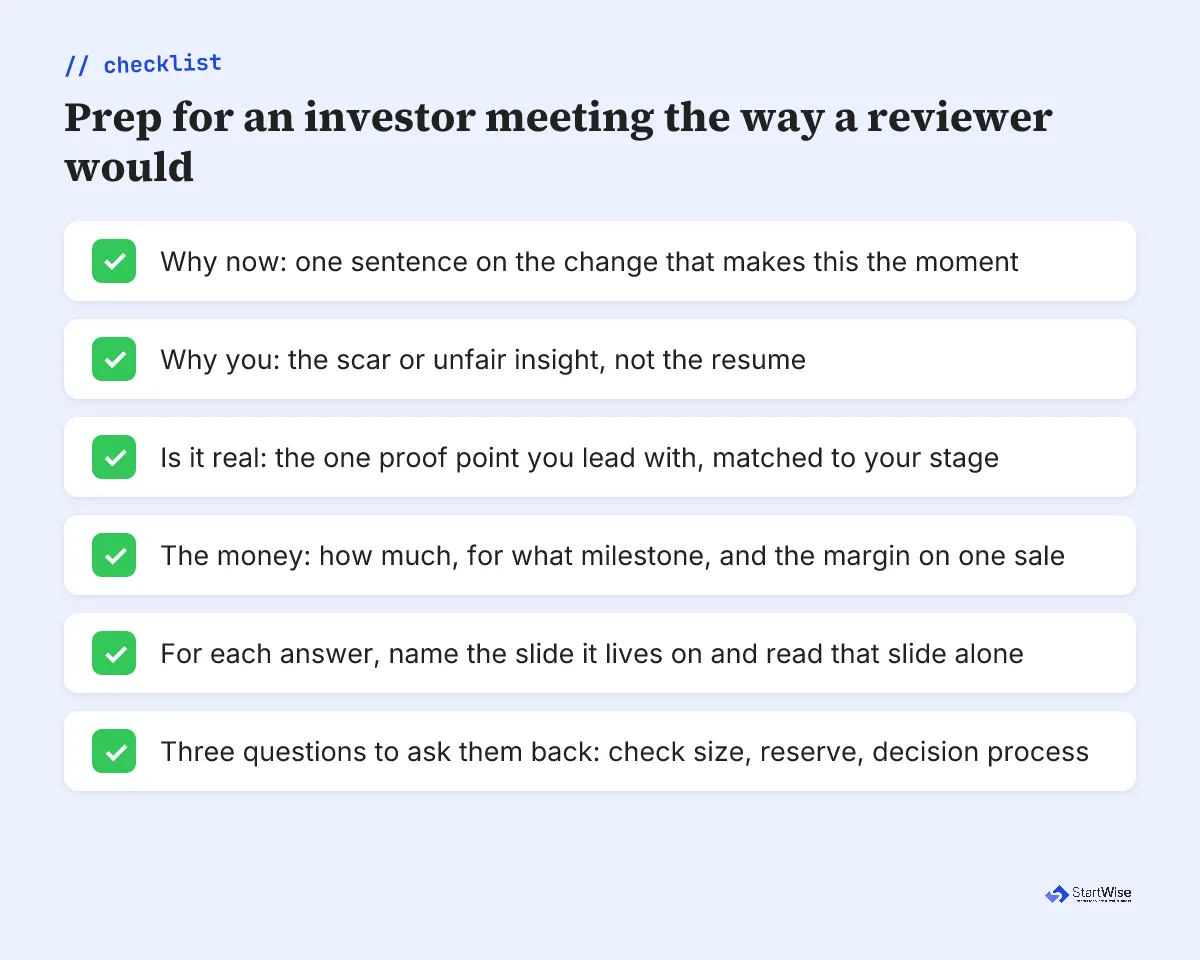
Prep isn’t rehearsing a script. It’s the drill we run on every deck: find the four answers that fall apart under one follow-up, then fix the slide underneath each one.
- Write one-sentence answers to the four risks: why now, why you, is it real, where the money goes.
- Have someone ask them cold, and mark every question you answered in more than a sentence.
- Open the slide behind each fumble and rewrite it until the answer is obvious.
- Draft three questions to ask them back, so the meeting runs two ways.
- After the meeting, log the next action in your investor pipeline tracker and send your follow-up within two days.
Do that, and the meeting stops feeling like an exam. It starts feeling like the conversation you already had with yourself, out loud.