
 By
An AI pitch deck generator turns a prompt or a questionnaire into a full slide deck in minutes. By 2026 there are dozens, and most are genuinely good at the part they promise: a clean draft, fast. We review founder decks every week, and here’s the pattern the roundups miss. The tool that made a deck almost never predicts whether it raises. Papermark’s 2024 study of 3,000 decks found investors spend about 3.2 minutes on one, and no generator is built for that read.
Which AI pitch deck generator is best in 2026?
The best AI pitch deck generator in 2026 depends on the bottleneck you’re actually stuck on. Gamma wins for a fast first draft, Beautiful.ai and Canva for design, Slidebean for investor-template structure, and Plus AI if you live inside PowerPoint. Here’s how the main tools stack up for a fundraising deck, not a sales one.
| Tool | Best for | Price | The catch |
|---|---|---|---|
| StartWise | Getting a deck investor-ready before you send it | Free deck check. Check your deck free → | Reviews and routes your deck; not a from-scratch slide designer |
| Gamma | A fast first draft from a prompt | Free tier; from about $8/mo | Output reads generic until you rewrite it |
| Beautiful.ai | Enforced, consistent design | From about $12/mo | Less control over custom layouts |
| Canva | The biggest free template library | Free; Pro from about $15/mo | You do the fundraising thinking yourself |
| Slidebean | Investor-template structure | From about $19/mo | Rigid styling, and it upsells consulting |
| Plus AI | Decks inside PowerPoint or Google Slides | From about $15/mo | Design comes second; it lives in your existing tool |
Prices are from the 2026 roundups by Alai and Prezent, checked today, and they move with billing and plan. The link in the StartWise row is a free slide-by-slide review of a deck you’ve already built, in any of these tools. If you’re specifically leaving PitchBob, our six-tool PitchBob alternatives comparison covers that case, and the StartWise vs PitchBob head-to-head goes deeper on the whole-stack option. If Slidebean is the tool you’re weighing, our Slidebean alternatives roundup ranks the field by job.
How we ranked them: the investor-readiness test
We ranked these on investor-readiness, not design polish, because a beautiful deck that says nothing still gets skipped. Every listicle we read scores the same things: speed to a draft, template count, collaboration features. None of them ask the question a fundraising founder actually cares about. Will this help me raise?
So here’s the four-part test we run instead.
- Does it force focus, or pad you out to a twelve-slide template a cold-outreach deck doesn’t need?
- Does anything check the argument, not the design? Does the problem slide earn the next 15 seconds?
- Do you own the export? A deck locked inside one viewer vanishes the day that tool changes its plan, exactly what happened to Tome AI when it deleted user decks in 2025.
- Is it built for fundraising, or for any presentation at all? A sales deck and an investor deck fail for different reasons.
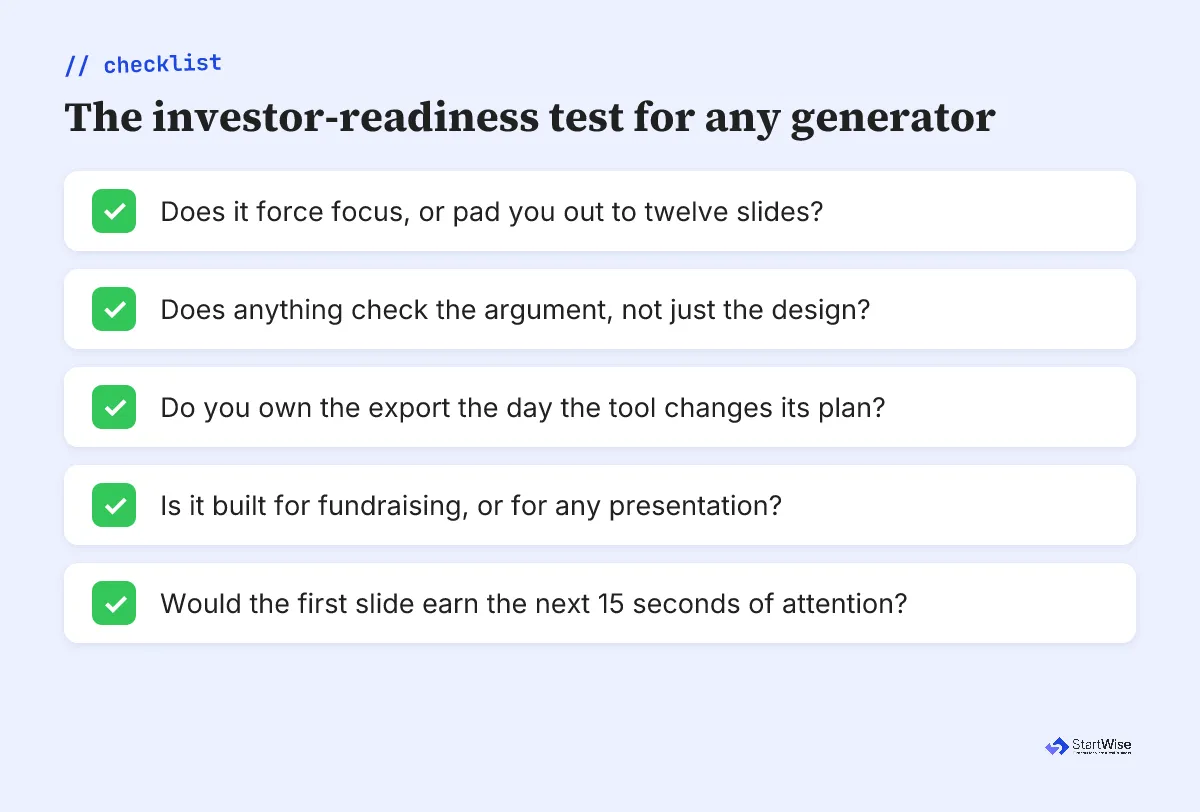
Rank the tools on those four and they bunch up fast. Most nail design and export. Almost none force focus. And on the criterion that decides the round, every generator on the market scores the same: zero. Not one of them reads your deck the way an investor will.
Which generator fits your bottleneck?
The right generator fixes the one thing slowing you down, so name that first before you compare feature lists. If your problem is the blank page, use Gamma. It drafts a full deck from a prompt and lets you refine by chatting (“make slide 4 punchier”), starting free and running about $8 per month on Plus. That’s the fastest path from nothing to something you can edit.
If your problem is design, two tools split the job. Beautiful.ai auto-formats every slide to consistent rules for about $12 a month, so nothing looks lopsided. Canva hands you the largest template library and a genuinely usable free tier, with Pro around $15 a month. Both make an ugly deck look clean.
Neither makes a thin deck say more.
If your problem is fundraising structure, Slidebean is built around investor-deck templates from about $19 a month, though the styling is rigid and it’ll nudge you toward paid consulting. If you already live in PowerPoint or Google Slides, Plus AI generates decks right inside them for about $15 a month, so you skip the export dance. And if raw design quality is the thing you care about most, Alai trained its model on 1,000-plus pitch decks and prices from about $16 a month.
The generator decides how fast you get a draft. It never decides whether you raise.
Here’s the honest part. None of these picks changes your odds much. They change how quickly you reach a decent-looking draft, which matters far less than founders shopping for tools want it to. In the decks we review, a second generator has never fixed a weak story. Read the slide-count test instead, then stop shopping.
What does no pitch deck generator check?
No AI pitch deck generator checks whether your deck survives how investors actually read it, and that’s the gap every tool on this list shares. Papermark analyzed 3,000 decks across 2024, more than 8 million data points, and found investors spend about 3.2 minutes on a full deck: 23 seconds on the first slide, then roughly 15 seconds on each one after. Thirty percent of them spend more time on that first page than anywhere else.
A generator can’t see that skim. It fills your slides to a template’s length and calls the job done.
StartWise's position
The tool you pick barely moves your odds. From the decks we review every week, the ones that raise aren't the best-designed; they're the ones where a founder cut a template deck down to one clear claim per slide. Filling twelve slides is the easy 20%. The judgment about what to cut is the 80% no generator makes for you.
So you end up with a clean, generic deck that reads fine at your desk and dies in 23 seconds on a partner’s laptop. This is the work no tool on the market does, and it’s a different job from generating slides. An AI deck review checks the content against how investors skim; a generator checks nothing. If you want the underlying numbers, we broke down how long investors spend on a pitch deck slide by slide.
Built your deck in Gamma, Canva, or Slidebean? See what an investor sees before you hit send.
Is a free AI pitch deck generator good enough?
A free AI pitch deck generator is good enough to ship a first draft, and for most pre-seed founders that’s the right call. Gamma, Canva, and Pitch all run real free tiers, per the 2026 roundups, and Google Slides is free outright. Free gets you a complete deck you can edit. That’s the whole job at this stage.
Paying for a prettier generator, on the other hand, is close to waste when the content is the problem. Less than 1% of businesses raise venture capital (Forbes data, 2025), and about 34% of failed startups die from poor product-market fit, not poor design.
Spend the money where the round is decided.
My honest take: upgrade a generator only when the free tier blocks something specific, like brand fonts or team editing. Otherwise the paid plan buys polish you don’t need yet.
What to do this week
Stop comparing generators and fix the deck you’ve got. Here’s the order that works:
- Pick one tool for your real bottleneck: Gamma for a fast draft, Canva or Beautiful.ai for design, Slidebean for structure. Don’t run three.
- Export a copy you own as PDF or PPTX, and strip any leftover vendor branding and placeholder text.
- Cut the deck to the slides your story needs, then read only the titles. If they tell the story alone, you’ve done the hard part.
- Get the content reviewed against the investor skim before you send it, not after the rejections arrive.
Every founder I talk to wants to know which tool is best. The honest answer: the one you’ll stop fiddling with, so you can go fix the ten seconds an investor is guaranteed to read first.