
 By
By 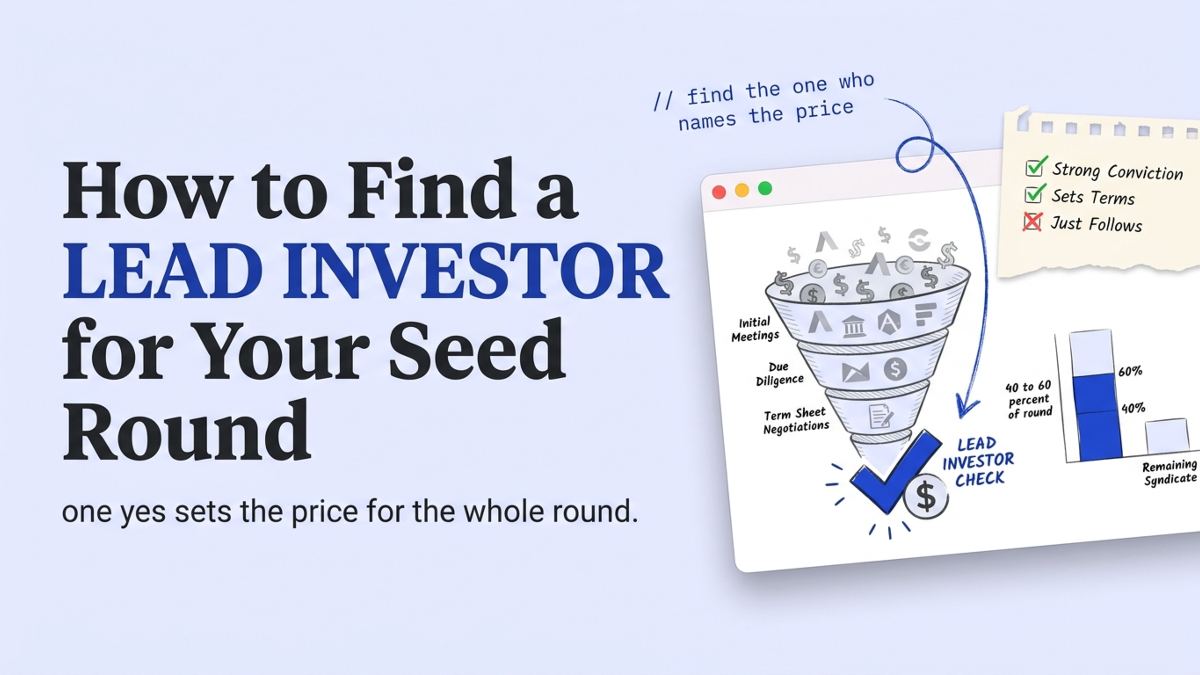
A lead investor is the fund or angel who sets your round’s price and terms, then writes the biggest single check. Everyone else waits to see who that is. In the raises founders bring to us, the round rarely stalls on a weak slide. It stalls because a dozen investors each said a version of “we’re in once you find a lead,” and nobody wanted to move first. That’s a lead problem, not a deck problem, and it’s the quietest way a promising raise dies.
What is a lead investor, and why does the round wait on one?
A lead investor does the work every other investor would rather skip. They negotiate your valuation, set the terms, and run the real diligence. Usually they take a board seat too. Follow-on investors read those terms, write a smaller check, and commit faster once someone else has taken on the pricing. CRV puts a lead’s share at 40 to 60 percent of the round and follow-on checks at $50,000 to $500,000 (CRV, 2025).
That split explains the waiting. Mercury describes it plainly: the lead is usually the first to commit, and other interested investors hold off until they see who is leading (Mercury). Without a lead, every angel would have to price the round themselves, and almost none want that job.
So the first yes is worth far more than its dollars. It gives everyone else permission. We watch founders treat all ten names on their list as interchangeable, and they aren’t. One has to go first. The rest are built to go second.
Why is your raise stalling without a lead?
Your raise stalls without a lead because commitments that depend on someone else committing aren’t commitments. This is the soft-circle trap, and it’s the most common stall we see in the review room.
A founder collects $200,000 of “yes, once you have a lead” from angels, polishes the deck twice more, and waits. The deck was never the thing holding it up. The round has no one willing to name a price, so it just sits there while the founder rewrites the traction slide for the fourth time.
StartWise's position
After reviewing decks daily, our blunt take: a stalled raise is almost never a deck problem. It's a lead problem. Founders keep rewriting slides when what's missing is a single investor willing to set the price, and since that investor carries 40 to 60 percent of the round (CRV, 2025), nothing closes until they show up.
Soft commitments that wait on a lead aren’t commitments. They’re a queue with no front.
The fix isn’t a better deck.
It’s finding the one investor who’ll price the round, because the queue behind them can’t move until they do.
Which investors can actually lead, and which only follow?
Most funds that take seed meetings never lead, and knowing which is which before you pitch saves you weeks. Plenty of funds with “seed” in their thesis only write follow-on checks. They wait for a term sheet, then fill allocation behind whoever set it. A partner can be genuinely excited about your company and still be structurally unable to give you the one thing you need.
| Lead investor | Follow-on investor | |
|---|---|---|
| Job | Sets valuation and terms, runs diligence | Accepts the terms, fills allocation |
| Check | 40 to 60% of the round | $50,000 to $500,000 |
| Timing | First to commit | Waits for the lead |
| Board seat | Often takes one | Rarely |
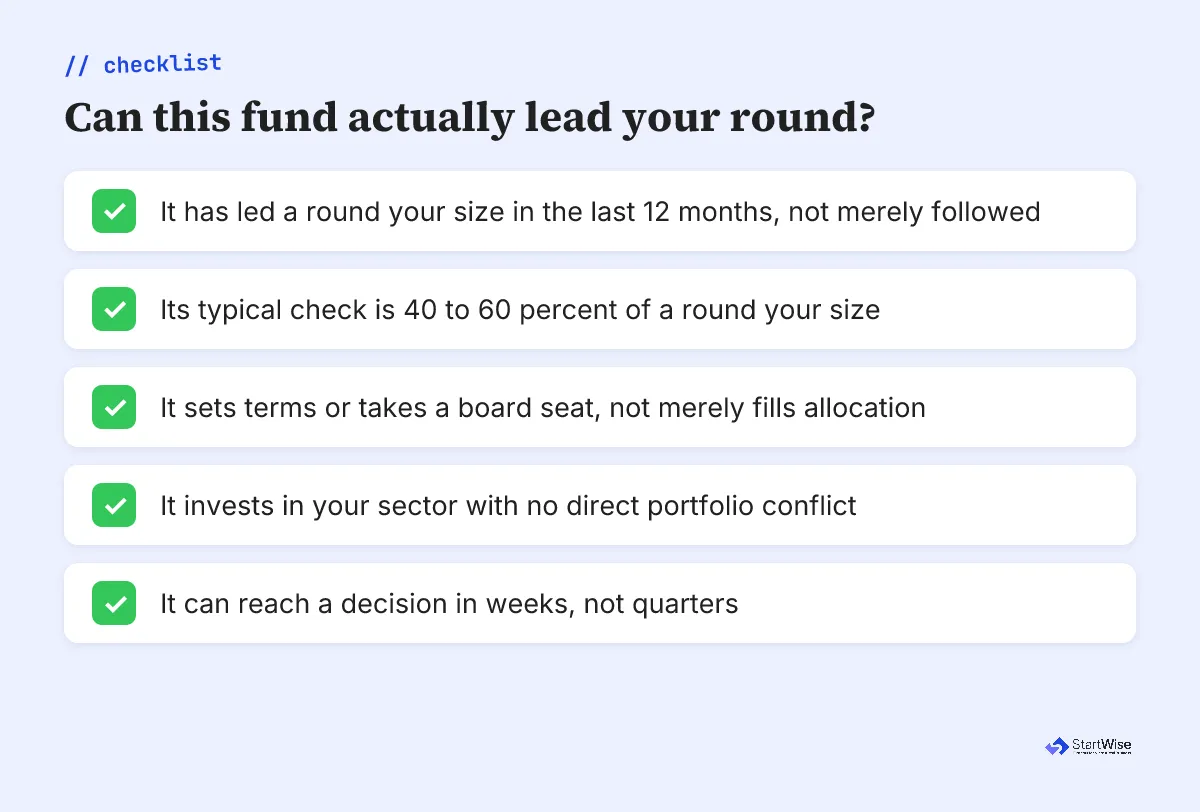
So qualify before you spend a meeting. On the first call, ask whether they’ve led a round your size in the last year, and listen for a real answer instead of a warm one. I’ve watched founders chase a friendly partner for a month who was never going to set terms.
That month is the round’s momentum, spent on the wrong person.
Not sure who in your network can reach a fund that leads? Map it free and see who to ask for the intro.
How do you find and land a lead investor?
Finding a lead is a targeting problem before it’s a pitching problem. You want a short list of funds that actually lead at your stage and sector, reached through people the partners already trust. CRV recommends building a target list of 50 to 100 investors against specific criteria (CRV, 2025); the mistake we see is founders working that list one name at a time.
- Build the list of 50 to 100 stage-fit funds, then research each one so you qualify the list before you pitch it.
- Cut every fund that has only followed in the last year. A pretty logo that never leads is dead weight.
- Rank what’s left by the strength of your warm path to the partner, not by brand.
- Open your top five leads inside the same two-week window, in parallel.
- Track every thread so nothing goes cold.
The concentration matters more than the count. A raise that drags reads as a negative signal, and each week a lead sits in your inbox weakens your position. You want your best five hearing from you at once, not strung across three months, so the process feels like momentum rather than a slow no. Keep it all in one investor pipeline tracker so you can see which lead is closest and push there. This is the same sequencing that decides how long the whole raise takes.
Do you even need a lead at pre-seed?
At pre-seed, you often need no lead at all, and chasing one can cost you months you don’t have. The 2026 median pre-seed is a $1M SAFE at a $5 to $6M post-money cap (Value Add VC, 2026), and a group of angels can fill that without anyone drafting a term sheet.
A post-money SAFE already fixes the cap, so there’s nothing left for a lead to negotiate. That’s why the SAFE is the default pre-seed instrument in 2026. The lead question really bites at seed, where the median round is $4.1M at a $24M post-money valuation (Value Add VC) and someone has to price a priced round.
My honest take: most pre-seed founders spend too long hunting a lead they don’t need. Set a fair cap, open the SAFE, and let the round fill from your angels. Save the lead hunt for the round that genuinely requires one, and make sure you know which round you’re actually raising before you start.
What to do this week
The lead is the bottleneck, so point this week’s work straight at it instead of at your slides. It’s the sequence we walk founders through when a raise stalls out.
- List every soft commitment you have, and mark which ones are waiting on a lead. That number is your real gap.
- Build a list of 50 to 100 funds that lead at your stage, then cut every one that only follows.
- For your top five, find a warm path to the partner and open all five in the same two weeks.
- If you’re at pre-seed on a SAFE, set a fair cap and stop waiting for a term sheet nobody needs.
- Log every thread in a tracker so no lead quietly goes cold.
Chase the one yes that sets the price.
The rest of the round has been waiting on it the whole time.