
 By
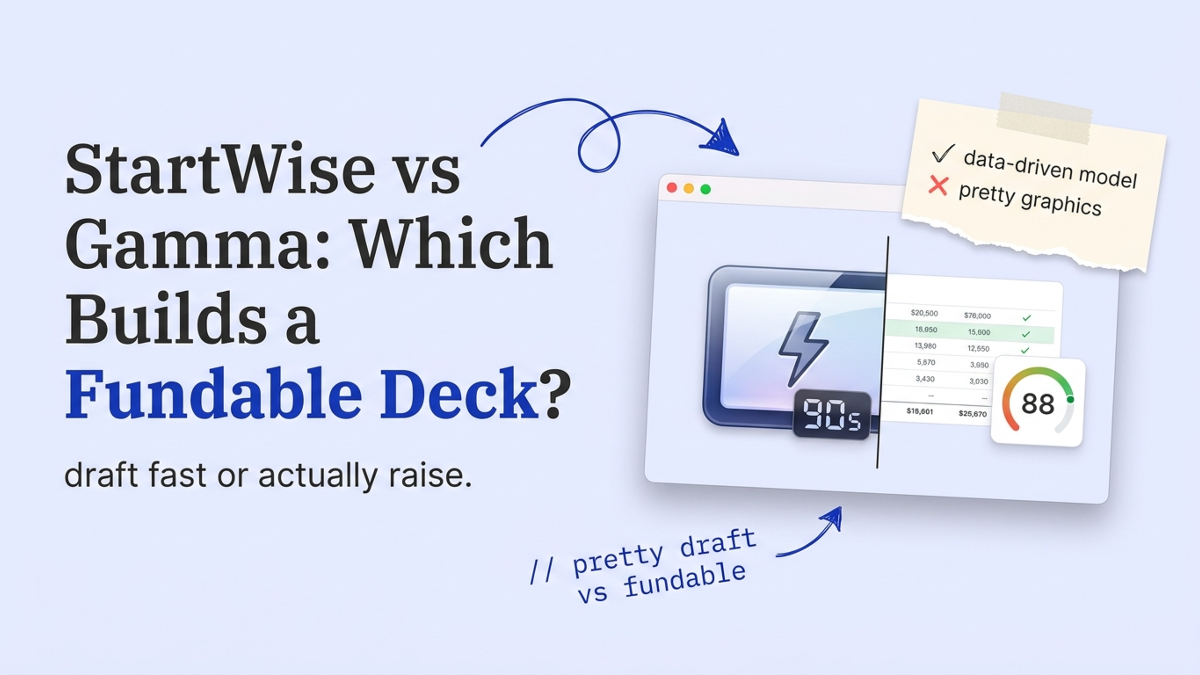
StartWise and Gamma both touch your pitch deck, but they answer different questions. Gamma is an AI generator that drafts a polished deck from a prompt in under a minute. Our side reviews the deck and the fundraising story behind it, then builds the model and matches you to investors. We read founder decks every week, and the ones built fast in a generator share one gap: the slides look done, but the argument isn’t. A clean draft is the easy part of a raise. The 3.2 minutes an investor spends reading it (Papermark, 2024) decide the rest.
StartWise vs Gamma: what does each tool do?
StartWise and Gamma do two different jobs. Gamma turns a prompt into a designed deck; StartWise checks whether that deck can raise, then builds the model and the investor list around it. Here is the split in one view.
| Tool | Best at | Doesn’t do | Price (2026) |
|---|---|---|---|
| StartWise | Reviewing your deck and story slide by slide, then building the model and investor list. Check your deck free | Auto-design or draft the slides for you | Free deck review |
| Gamma | Drafting a polished 10 to 12 slide deck from a prompt in under a minute | Financial modeling, deck review, investor matching | Free (400 credits); Pro $20/mo |
In the decks we review, these two tools show up at opposite ends of the same problem. Gamma made the slides. Nobody checked the argument. Both steps matter, and they are not the same step, which is the whole reason this comparison exists instead of a winner.
Is Gamma good for pitch decks?
Gamma is good for pitch decks in one specific way: getting a clean first draft on screen fast. Paste a description and it returns a full 10 to 12 slide deck in under a minute, with the standard frameworks already laid out, problem through ask (AIStackPicks, 2026). One review clocked it at 4 to 6 hours saved versus starting from a blank file.
It starts free. The free tier gives you 400 AI credits with no card, and since a presentation costs about 40 credits, that is room for a few decks before you pay (Deckary, 2026). Pro runs $20 a month. We’ve watched founders go from nothing to a shareable link in an afternoon, and that speed is real when you’re still iterating on the story.
The exports aren’t clean, though. Testing found font substitutions and layout shifts when moving a Gamma deck into PowerPoint (Deckary, 2026). So if an investor wants a file instead of a link, budget cleanup time. For a tracked link, Gamma holds up fine, and it’s a reasonable pick if a blank page is the thing stopping you. That is a narrow job done well. It is also the easy 10% of a raise.
What Gamma can’t do before you send the deck
Gamma can’t tell you whether the deck it drew is fundable. It generates structure and design. It doesn’t check the argument, the numbers, or who should receive the thing. Its own reviewers are blunt about this: “you can’t send the raw output to investors,” and it “won’t capture the specific credibility signals investors look for” on the team slide (AIStackPicks, 2026).
Three gaps matter most for a raise. Gamma has no financial modeling, no unit-economics or cash-flow work of any kind (AIStackPicks, 2026), and we flag that absence in nearly every generated draft we open. It runs no review step that reads the deck the way an investor does. And with no investor matching, a finished deck just sits on your drive.
The market slide is where this bites hardest.
StartWise's position
Most market-size slides are theater. A generator fills your market slide with a $1T number because the template has a box for it. Investors trust a bottoms-up count of the customers you can reach in year one. If your SAM math can't survive a napkin check, a prettier slide makes it worse, not better.
This isn’t a design problem you can polish away. Startups fail on product-market fit (43%) and running out of capital (70%), not on slide aesthetics (CB Insights, 2026). A generator will draft every one of those slides for you. It just can’t tell you when the box is empty.
A generator fills every box on the slide. It can’t tell you the box is empty.
Drafted your deck in Gamma? See what an investor sees before you send it, slide by slide.
How does StartWise check the deck Gamma draws?
StartWise checks the deck against what investors actually read, slide by slide. It reviews each slide for the specific things that lose meetings, builds the financial model Gamma skips, and matches you to investors once the deck holds up. The review is free.
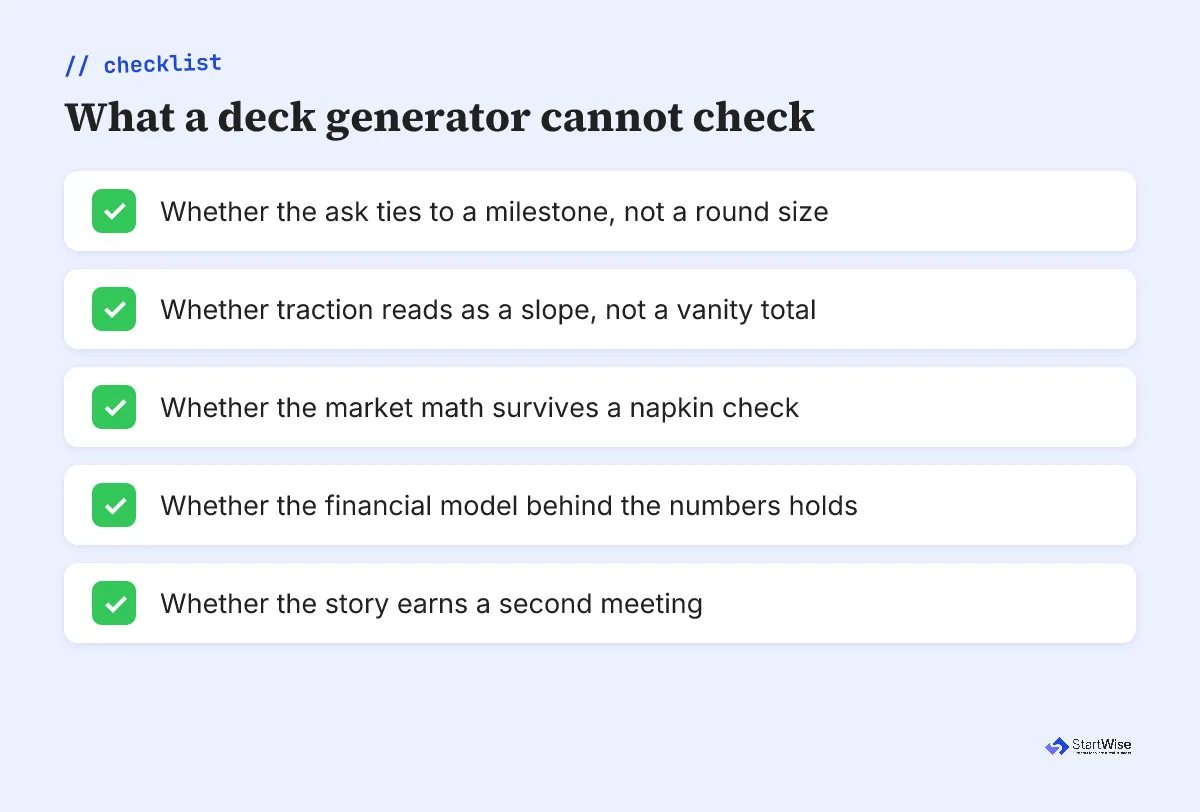
When we review a generated draft, the fixes cluster in the same three places every time:
- The ask names a round size instead of a milestone that de-risks the next raise.
- The traction slide shows a vanity total instead of a week-over-week slope.
- The market math is the theater from the last section, a big number with no bottoms-up floor.
None of those are design fixes, and none of them show up in an export check.
The model is the other half. Investors push on the numbers, and a financial model that reads as three hopeful lines fails the first question. Gamma won’t build it, and it won’t flag that it’s missing. A review that reads the whole package, deck plus model, catches both before an investor does.
Which should you use to raise pre-seed?
For a pre-seed raise, use Gamma to draft and StartWise to decide whether the draft can raise. The two aren’t competing for the same slot in your week. One gets you past the blank page; the other tells you if the page is any good.
Design is rarely the thing between you and a term sheet. Of the startups CB Insights studied, 70% ran out of capital and 43% never found product-market fit (CB Insights, 2026); none failed because the font was wrong. Our honest take, after reviewing decks daily: a first-time founder gets more from a slide-by-slide review than from a $20 design subscription, unless slow, ugly slides are genuinely your blocker.
So draft in Gamma if that helps. Then get it read before it goes out, because the 23 seconds an investor gives your first slide (Papermark, 2024) won’t forgive a vague ask, however clean the layout. If you’re also weighing design-first tools, our StartWise vs Beautiful.ai piece and the Slidebean alternatives roundup cover the same split.
What to do this week
Here is the order we’d run it this week, start to finish.
- Draft the deck in Gamma, or any tool you like, to get past the blank page.
- Rewrite each slide title so it carries the point alone, then read titles-only top to bottom. If the story survives, the skim does too (Papermark, 2024).
- Pressure-test the market slide with a bottoms-up count, not a $1T TAM.
- Build the one-page financial model Gamma won’t, before any investor asks.
- Get the full deck reviewed slide by slide before you send it.
The draft is the hour you’ll remember. The review is the hour that changes the answer. The slides can look done long before the argument is, and investors read the argument.