
 By
By 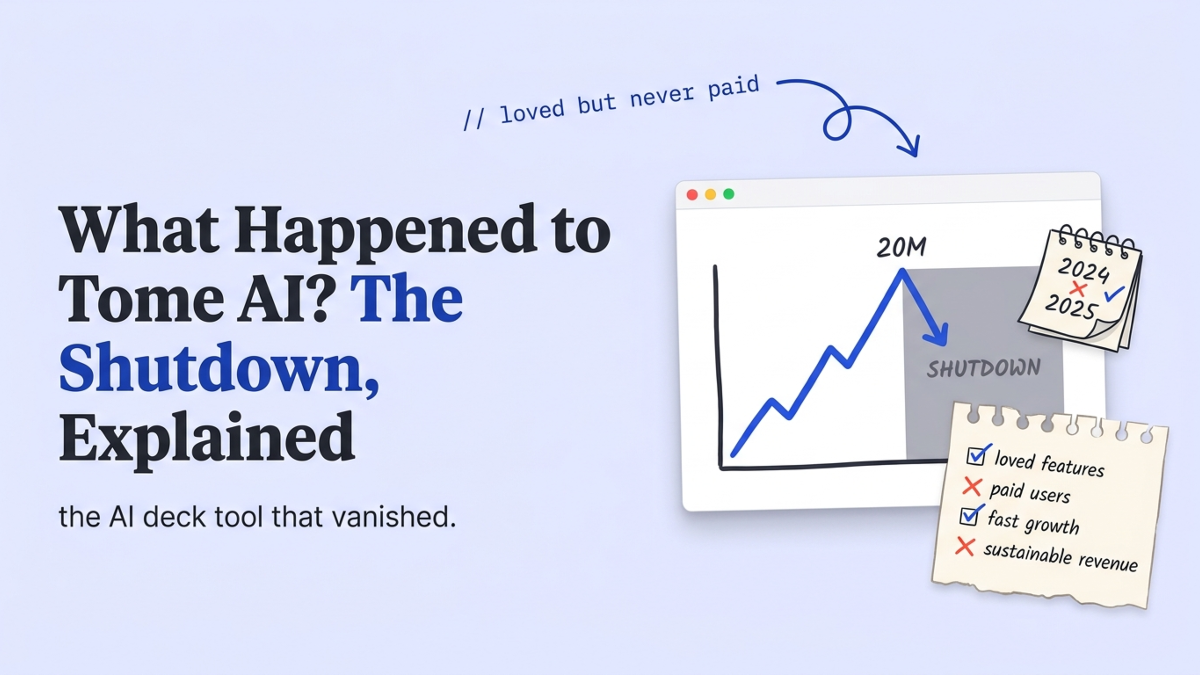
Tome was an AI presentation tool that turned a prompt into a full slide deck, and for a stretch it was the fastest one founders reached for. It’s gone. Tome shut its presentation product down in April 2025, and the team behind it now builds Lightfield, an AI CRM. The tell was in the numbers. Contrary Research reported Tome grew past 20 million users while annual revenue sat near $2 million. People loved the free tool. Almost nobody paid.
What happened to Tome AI?
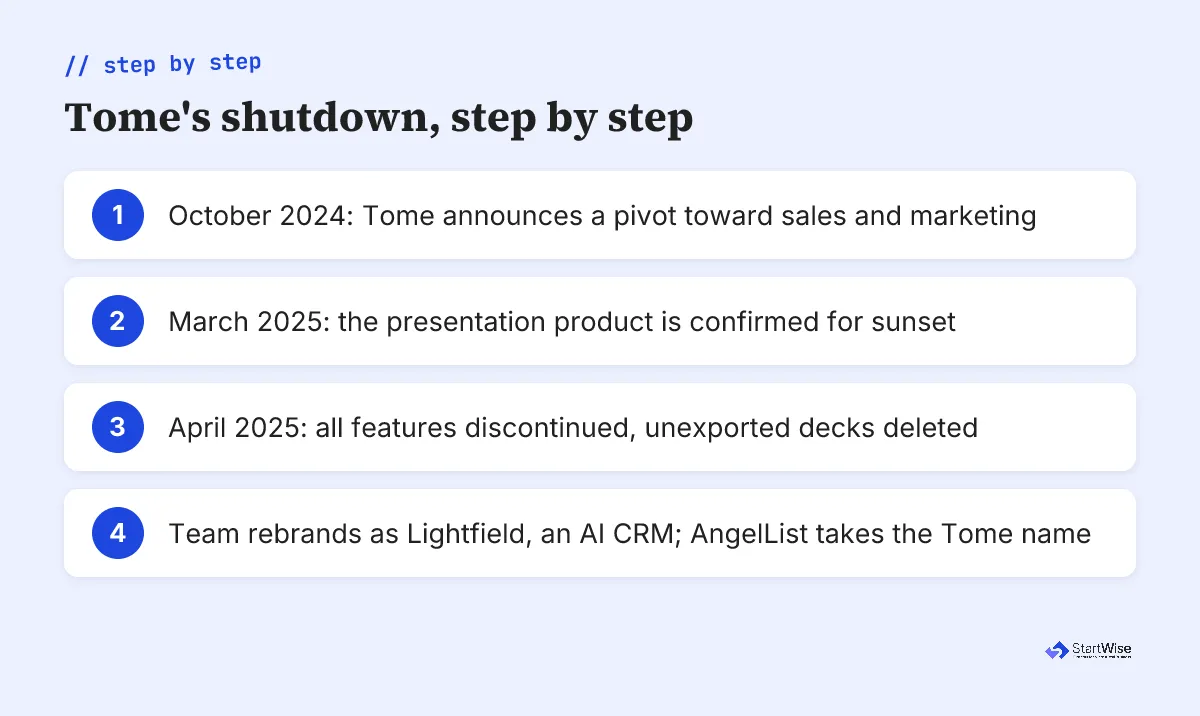
Tome shut down its AI presentation product in stages across 2024 and 2025, and the wind-down was deliberate rather than a sudden collapse. Deckary’s shutdown breakdown dates the sequence: the company announced a pivot toward sales and marketing in October 2024, confirmed the presentation product would sunset in March 2025, then discontinued every feature in April 2025. Decks users hadn’t exported were deleted.
The company itself didn’t die. It changed shape. Founders Keith Peiris and Henri Liriani, both former Meta product managers, rebranded the business as Lightfield and pointed it at a different problem. AngelList picked up the Tome name for its own document tooling.
We still get founders asking us where their old Tome decks went. The answer is the uncomfortable part of this story, and it’s below.
So the brand you remember is split in two now. The product is off, and the people build something unrelated to slides.
Why did Tome shut down with 20 million users?
Tome shut down because adoption never became revenue, and that gap is the whole story. Contrary Research put Tome’s annual recurring revenue near $2 million by mid-2023, against more than 20 million users and $81 million raised at a $300 million valuation in its February 2023 Series B. An earlier $26 million Series A in September 2021 had valued it at $175 million. The money and the users were real.
The business under them wasn’t.
Here’s my blunt read after watching a lot of tools chase the same curve. A product that 20 million people use for free and almost none will pay for isn’t a business. It’s a very expensive demo.
Peiris has been candid about the deeper reason. He found that a general presentation tool couldn’t serve everyone, because every persona needed its own data and context to make the output useful. Content generation alone wasn’t the pain worth paying for. The team cut headcount from about 70 to 7, then rebuilt around sales data instead of slides.
A tool that 20 million people love for free and almost none will pay for isn’t a business. It’s a very expensive demo.
That pivot is paying off so far. Lightfield, the CRM they built next, raised a $47 million Series A led by a16z in September 2026 and signed more than 5,000 companies since launching in November 2025. The founders were right that the money was in the data, not the deck.
Can you still use Tome, and where are your decks?
You can’t still use Tome, and any deck you didn’t export is gone. The product was fully discontinued in April 2025, and Deckary confirms unexported files were permanently deleted. There’s no login that pulls an old deck back now.
If you kept a local export or a PDF, that copy is all you have. I’d treat this as the practical lesson before the strategic one: whatever tool builds your next deck, keep your own editable file somewhere you control.
What should founders use instead of Tome?
The right replacement depends on which job you’re actually hiring a tool for. Most “best Tome alternatives” lists rank options by design polish and PowerPoint export quality. That’s the wrong axis for a raise. A fundraising deck has two separate jobs, and different tools own each:
- Build the slides: AI or template design tools like Gamma, Beautiful.ai, or Canva
- Make the story fundable: a slide-by-slide review of the deck before it reaches an investor
| Tool | Best for | The honest catch |
|---|---|---|
| Gamma | General-purpose AI slide design, the closest Tome successor | Optimizes how the deck looks, not whether the story is fundable |
| Beautiful.ai | Auto-formatted, on-brand design | Same design-first focus; a polished weak story is still a weak story |
| Canva | Templates and quick edits for any deck | Broad, not built for investor logic or the pre-seed narrative |
| Pitch | Team decks with light collaboration | Sales and internal decks, less a fundraising-specific tool |
| Pitch Deck Doctor | A slide-by-slide review of a deck you already have | It reviews and fixes, it doesn’t design the slides for you |
Pick a designer from the top rows if you like, then run the result past a review layer before it reaches an investor. For a deeper ranked list built for founders, our Tome alternatives guide walks through each option, and the wider field is covered in our roundup of the best AI pitch deck generators.
StartWise's position
The tool that designs your deck is the cheap, replaceable part. Investors skim for the missing signal, not the animation, and the decks we review fail on the story long before the styling. Tome is the proof at scale: 20 million users loved the design and left annual revenue near $2 million (Contrary Research, 2025). Beautiful slides that don't say anything fundable still don't raise.
That’s why chasing the prettiest Tome replacement usually misses the point. The slide that’s killing most raises isn’t badly designed. It’s saying the wrong thing, or nothing.
Rebuilding your deck after Tome? Find out what a reviewer flags before an investor does.
What Tome’s shutdown teaches founders about deck tools
Tome’s shutdown carries a lesson beyond “export your files,” and it’s about how you choose the tool in the first place. Two things founders should take from it. Both change what you reach for next.
First, a venture-backed general design tool can be turned off from under you. Tome was well funded and widely loved. It still went dark with decks inside it. When your fundraising materials live only in someone else’s app, their pivot becomes your problem. Keep an editable master file you own, and treat the tool as a renter, not a landlord.
Second, and this is the bigger one, your deck’s bottleneck was almost never the design tool. Founders churn off a dead app and immediately start shopping for the next AI designer, as if a slicker builder is what stood between them and a term sheet.
It usually wasn’t.
What investors actually look for in a deck is a clear problem, a believable wedge, and traction they can trust, and none of that comes from the styling engine. It comes from what you put on the slide.
Investors give a whole deck only a couple of minutes on average, so the styling buys you attention and the substance converts it. Get the substance wrong and no tool saves you. This is the same trap behind the most common pitch deck mistakes we see: founders polishing the wrapper while the argument underneath stays thin.
So the honest takeaway is a little deflating. The tool was never the moat, and the next tool won’t be either.
What to do this week
If Tome was your deck tool, or you were about to try it, spend an hour resetting the way we’d run it in a review, not tool-shopping.
- Find your last Tome export or PDF. If none exists, rebuild from your latest local copy, not from memory.
- Move the deck into a tool you can export and own. Gamma or Canva are fine for the design pass.
- Keep an editable master file in storage you control, so the next shutdown or pivot never costs you your deck.
- Ignore the design for one full read. Check the problem, wedge, and traction an investor scans for first.
- Get a second read on the story, slide by slide, before you send it. That’s the part a design tool was never going to fix.
Tome proved a free tool millions love can still fail. Your deck can be beautiful and still not raise. Fix the story first, then pick whatever tool makes it look good.