
 By
By 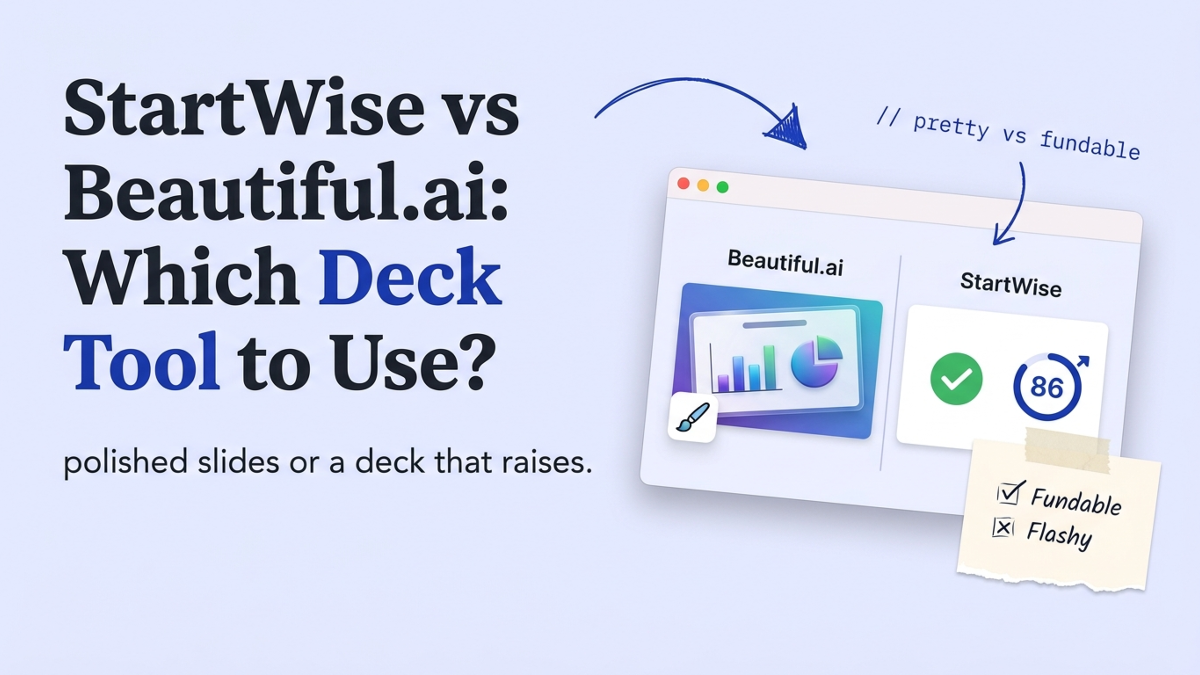
StartWise and Beautiful.ai both touch your pitch deck, but they solve different problems. Beautiful.ai is an AI presentation tool that auto-designs polished slides. StartWise reviews the deck and the fundraising story behind it, then matches you to investors. We read founder decks every week. The gap matters. A gorgeous deck can still lose the room. Investors give a deck about 3.2 minutes of total attention and 23 seconds on the first page (Papermark, 2024), so design buys you a glance, not a yes.
StartWise vs Beautiful.ai: which should you use?
Use Beautiful.ai if your bottleneck is design and time. Use StartWise if the deck itself has to hold up to an investor. One tool makes slides look professional. The other checks whether the story raises.
| Tool | Primary job | Fundraising fit | Price |
|---|---|---|---|
| StartWise | Make the deck and story investor-ready | Reviews your deck slide by slide, builds the model, matches investors. Check your deck free → | Free deck review |
| Beautiful.ai | Auto-design polished slides fast | Makes slides look professional; the content is yours to get right | $14.50/mo (annual) |
When a founder asks us which to pick, that’s the line I draw. Beautiful.ai controls how the deck looks. StartWise pressure-tests what’s on it. Pick the one that matches the problem you actually have, not the one with the prettier feature page. This is the same split we drew in StartWise vs Storydoc: a design tool and a readiness tool aren’t the same purchase.
What is Beautiful.ai, and who is it for?
Beautiful.ai is an AI presentation tool built around Smart Slides, layouts that automatically resize and realign your content as you type. You add a bullet, the slide re-balances itself. No manual nudging. It ships more than 300 Smart Slide layouts, custom brand controls that lock your logo, fonts and colors, animated charts, and PowerPoint import and export, per its startups page. There are pitch deck templates modeled on Slack, Uber, Airbnb and Netflix.
Who’s it for? Non-designers who need slides that look professional without hiring a designer. That’s a real job, and Beautiful.ai is genuinely good at it. We review plenty of decks built in it, and the design almost never looks amateur. One 2026 roundup ranked it the number two tool overall and “the top alternative for non-designers,” valuing its output at “less than one hour of freelance design work” (Value Add VC, 2026).
If polished slides are what stand between you and sending your deck, it earns its price.
What is StartWise, and who is it for?
StartWise takes first-time founders from idea to investor-ready: business plan, pitch deck review, financial model, then investor outreach. Its deck tool, Pitch Deck Doctor, reads your deck the way investors do and tells you what to fix slide by slide. It isn’t a blank design canvas. It critiques the deck you have and connects it to the model and investor list a raise needs.
The reader we build for is six weeks from their first investor email. That founder rarely needs another design tool. They need to know the ask slide is wallpaper, the traction slide plots the wrong number, and the market math won’t survive a napkin check. StartWise is for the founder unsure whether the story holds, not the one unsure whether the font pairs.
The founder who needs another design tool is rare. The one who needs a second opinion on the argument is in front of us every week.
Does design polish or fundraising substance get you funded?
Substance gets you funded. Design gets you past the filter that says “this looks amateur,” and no further. The evidence is in why companies actually die. CB Insights studied 431 startups that shut down. The top reasons were running out of capital (70%), poor product-market fit (43%), bad timing (29%) and unsustainable unit economics (19%) (CB Insights, 2026). Slide design isn’t on the list.
StartWise's position
Our position after reviewing decks daily: a deck dies in the first 90 seconds of a skim, and it dies on the slide titles, not the styling. Build for the skim first, so reading only your titles tells the story. A design tool can auto-align every slide and still leave you with titles that say nothing. It can't write the argument for you.
We watch the polish-first instinct backfire. A founder spends a weekend making slides beautiful and never notices the deck answers the wrong question. Investors read for the missing signal fast. They spend about 23 seconds on your first page and roughly 15 seconds on each one after (Papermark, 2024). Pretty formatting doesn’t slow that skim down. A sharper argument does.
A beautiful deck raises the floor, not the ceiling. It gets you taken seriously, then the story has to do the rest.
Designed your deck in Beautiful.ai, Gamma, or Canva? See what an investor sees before you send it, slide by slide.
Can Beautiful.ai review your deck or build your model?
No, and it doesn’t claim to. Beautiful.ai designs slides and shows viewer analytics, and that’s where its job ends. Its own startups page lists no review of your plan’s logic, no financial modeling, and no investor feedback. That’s not a knock. It’s a different category. The tool tells you a slide looks clean. It can’t tell you the ask is vague or the financials slide is three hopeful lines instead of a model.
Viewer analytics is the feature we watch founders most often mistake for feedback. Knowing an investor quit on slide 3 tells you where you lost them, but not why, and it won’t rewrite the slide that lost them. That’s the difference. A structured review tells you what to change before you send.
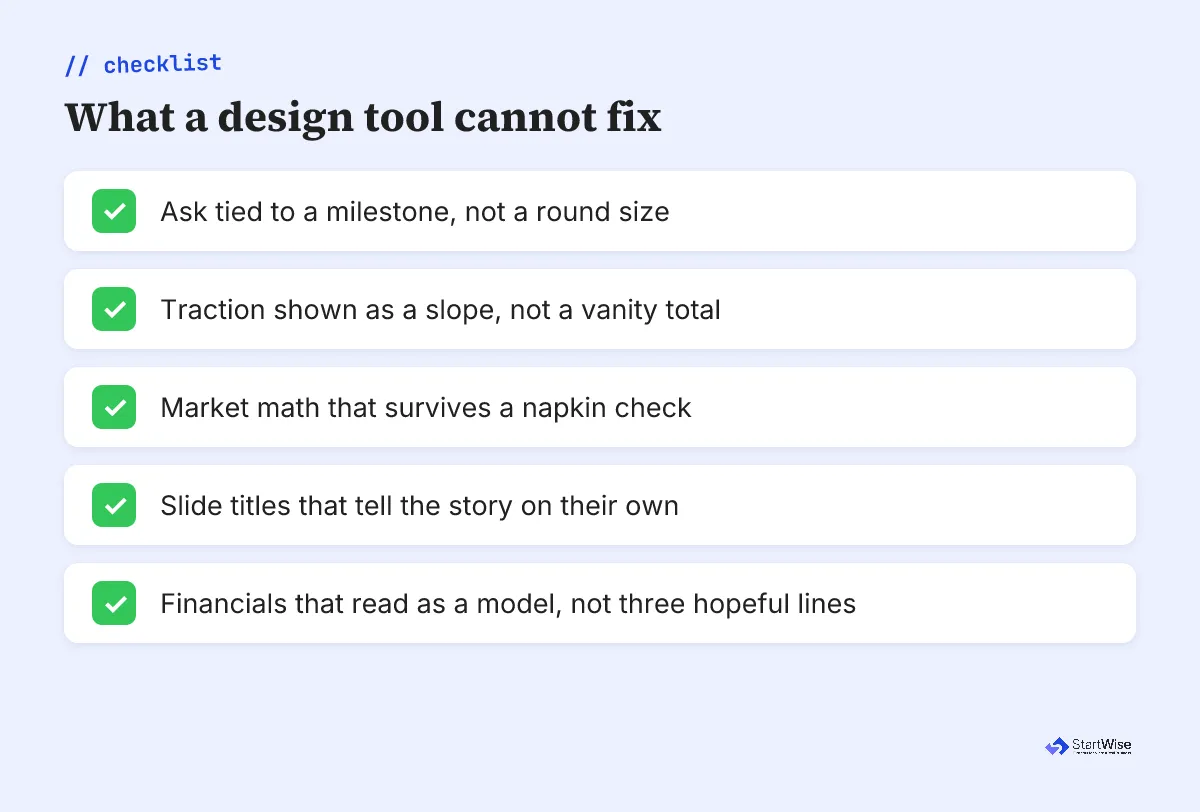
Here’s the honest test. Run down that list. If your gaps are on it, a prettier template moves none of them.
Match the tool to your stage and budget
Match the tool to your stage. Beautiful.ai runs $14.50 a month on Pro for one user and $40 per user a month on Team for 2 to 20 seats, both billed annually (Beautiful.ai, 2026). Every plan opens with a 14-day trial that requires a card. For a solo pre-seed founder, that’s a modest, fair price for fast design.
But budget follows the bottleneck. At pre-seed the deck and financial model decide most meetings, not the slide theme.
43%
of failed startups cite poor product-market fit and 19% cite weak unit economics. Design never appears in the reasons companies die. (CB Insights, 2026)
So spend by what’s weak. Pick a design tool when slow, amateur-looking slides are the real blocker:
- You can build a clean deck yourself but it takes days
- Your story is tight and you just need it to look the part
- You’re sending to many investors and want consistent branding
Pick a review-and-readiness tool when the argument is the risk. That’s where a first-time founder usually is, and it’s the more common gap we see. We compared the design-tool trade-off the same way in StartWise vs Slidebean, and the answer rhymes: buy the thing that fixes your actual weakness.
What to do this week
Figure out your bottleneck before you buy anything. Be honest about whether the problem is how the deck looks or what it says.
- Read only your slide titles, top to bottom. If they don’t tell the story alone, that’s a substance gap no template fixes.
- Check the ask and the numbers. A vague ask and a three-line financial model are the two things we flag most, and neither is a design problem.
- If the deck looks amateur and the story is solid, a tool like Beautiful.ai is a fast, cheap fix. Use it.
- If you’re not sure the story holds, get the deck reviewed first, then design. Fixing the argument on ugly slides beats polishing the wrong ones.
Design last. Get the argument right, and any decent tool can make it look the part.