
 By
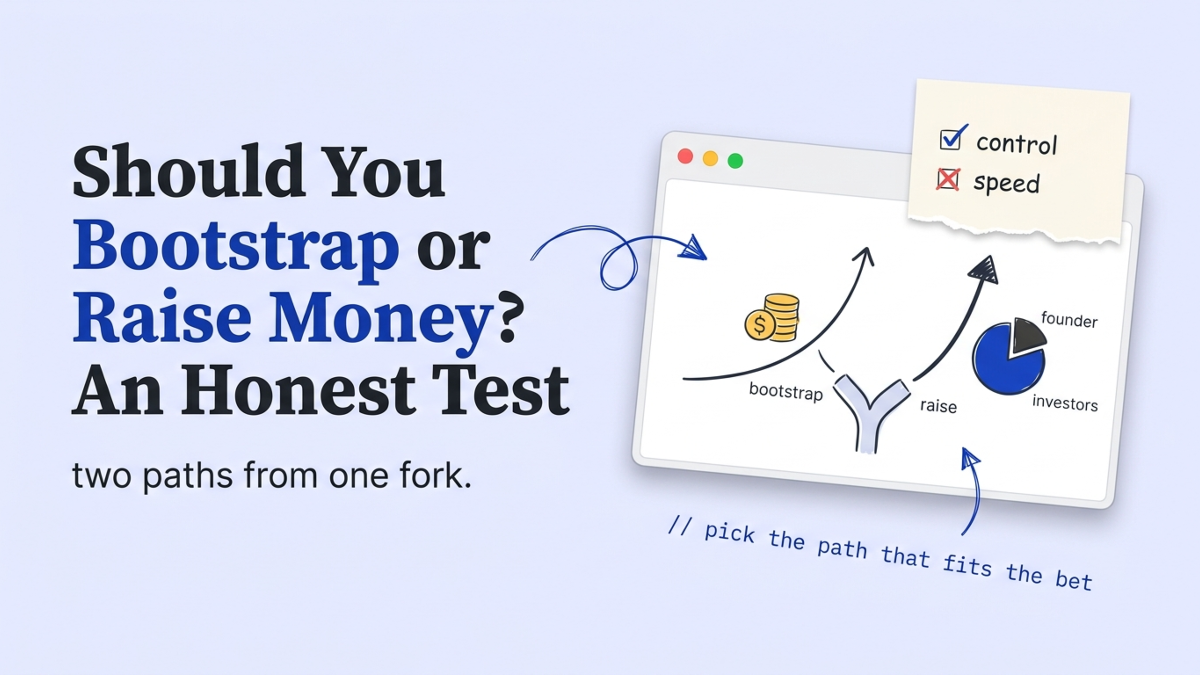
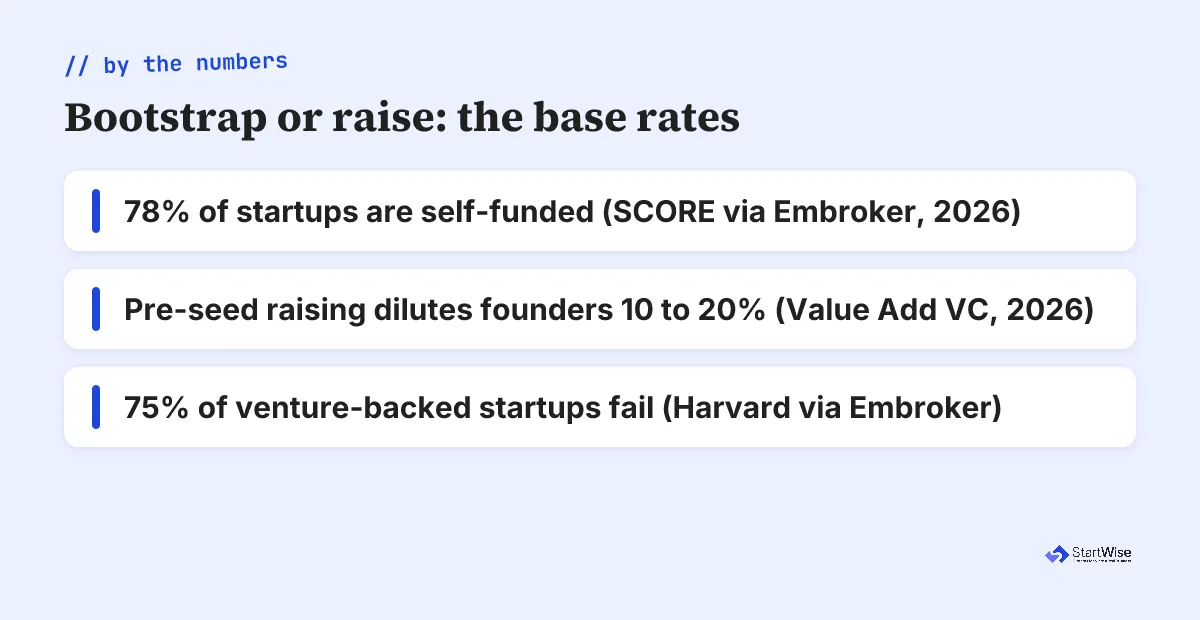
Bootstrapping means funding your startup from revenue and savings. Raising means selling equity to investors, usually on a SAFE at pre-seed, to buy the speed you can’t fund on your own. Most founders treat raising as the obvious next step. It rarely is. The numbers point the other way: 78% of startups are self-funded, according to SCORE figures compiled by Embroker in 2026. We review founders’ plans and decks at StartWise every week, and the same pattern keeps repeating, with people asking us how to raise long before they ask whether they should.
What do bootstrapping and raising actually mean in 2026?
Bootstrapping and raising are two different bets on the same company, not two rungs on one ladder. Bootstrapping grows the business on revenue, personal savings, and sometimes a small friends-and-family check. Raising trades equity for outside money. At pre-seed in 2026, that almost always means a SAFE, a simple agreement for future equity that converts to shares at your next priced round.
The mix is more lopsided than founder Twitter suggests. SAFEs made up 93% of pre-seed rounds in the first quarter of 2026, with convertible notes at a record-low 7%, according to Carta data summarized by Flux. And venture money is concentrating: AI startups now take 50% of all pre-seed dollars, while the $1M to $2.5M middle of the market shrank from 24% of rounds in early 2023 to 18% in early 2026 (Carta, Q1 2026).
Raising is rare.
In the plans we read, “raise a pre-seed” shows up as step one, written as if it were automatic. It isn’t. It’s a specific financing choice that fits some companies and quietly hurts others.
Should you raise venture capital at all?
Raise venture capital only if two things are true at once: your startup needs the money to work, and it could plausibly return a fund. Venture funds run on a power law. A few enormous outcomes pay for a portfolio of failures, so a fund needs your company to have a real shot at a very large exit, not a comfortable one.
That bar is higher than it sounds. About 75% of venture-backed startups fail (Harvard, via Embroker), because the model is built to chase outliers, not steady businesses. Take the money, and you’ve signed up for that game whether or not it suits you.
Here’s the honest test we walk founders through. If you answer no to most of these, bootstrapping is probably the stronger move:
- Could this realistically become a very large outcome, not simply a good living?
- Does the business genuinely need capital before it can earn revenue?
- Does speed decide the winner in your market, so being first or biggest matters?
- Are you willing to trade ownership and control for that speed?
- Can you show investors a team and a demand signal they’d bet on today?
That last line trips up first-timers. If you can’t answer it yet, validate the idea before building and get a real demand signal before you decide either way.
Venture capital is a bet, not a badge. It only pays if you can return a fund.
StartWise's position
From reviewing founders daily: most first-time founders ask how to raise before they ask whether they should, and the second question is the one that saves years. If your honest answer is a solid, profitable, mid-sized company, raising is the expensive path, not the ambitious one.
What does raising actually cost your cap table?
Raising costs ownership, and the total is bigger than most founders picture once rounds stack. Your cap table is the record of who owns what. A pre-seed round dilutes founders 10 to 20%, and a seed round takes another 18 to 25%, per Value Add VC’s 2026 breakdown. Run both and you can hand over close to a third of the company before a Series A partner even opens your deck. We rarely see this math written down in the plans founders send us, which is why the dilution surprises them a year later.
The 2026 terms are knowable. The median pre-seed is a $1M SAFE at a $5M to $6M post-money cap (Value Add VC), which is the sticker price for that first 10 to 20%. That equity doesn’t come back. Every future round dilutes from what you kept, so the slice you sell early is the most expensive slice you’ll ever sell.
None of that argues against raising. It argues for pricing raising honestly against the alternative.
| What it costs and buys | Bootstrap | Raise venture capital |
|---|---|---|
| Ownership after early rounds | You keep nearly all of it | You sell 10 to 20% at pre-seed, more at seed |
| Speed to scale | Paced by revenue | Funded ahead of revenue |
| Who sets direction | You do | You plus a board and investors |
| Best-fit business | Fast to revenue, high retention | Capital-hungry, winner-take-most |
| Base rate | 78% of startups self-fund | About 75% of VC-backed startups fail |
The table isn’t a scoreboard. Read it as the price tag on speed. If your market rewards being first and biggest, that price can be worth every point of dilution. If it doesn’t, you’ve paid in ownership for a race nobody was running.
Bootstrapping buys an edge most founders give away early
Bootstrapping to early revenue buys you an edge, because investors price traction, not promises. A company with real usage and revenue is worth more than the same idea on a slide, so the founder who waits sells less of the company for the same check. That’s the quiet advantage self-funding builds, and it compounds.
The clearest case we point to is a business that reaches revenue fast and keeps its customers. Mailchimp is the textbook example: it never raised venture capital and sold for $12 billion in 2021, as Rho notes in its 2026 funding guide. High-retention SaaS, services-adjacent products, and focused B2B tools can all compound this way without a fund’s money.
Speed is the trade you make for that edge. Bootstrapping is slower, and it lives on the runway math you can actually control. In a market where the first mover locks in the category, slower can mean losing. That’s the real question sitting under the ownership math, and it deserves an honest answer.
The mistake we flag most
Founders raise because it feels like the milestone, then spend the runway proving they didn't need it. Money buys speed. It doesn't buy product-market fit, and it can hide the fact that you never found it.
Leaning toward raising? Check whether your idea is actually venture-scale first.
Can you bootstrap first and raise later?
Yes, and it’s usually easier than switching the other way. Going from bootstrapped to venture-backed is a normal move; unwinding a cap table full of investors to become bootstrapped again is not. So the low-risk sequence, when your business allows it, is to self-fund first and keep the option to raise open. In our review room, the founders who bootstrapped first almost always negotiate from a stronger position.
Bootstrapping first buys three things: proof that people want the product, better terms when you do raise, and time to learn whether you even like running a venture-backed company. Revenue-based financing, where you repay a lender from a share of monthly revenue, is a middle path that funds growth without selling equity at all.
Make the switch when two signals line up. You’ve found product-market fit, and your market has entered a phase where speed decides the winner. Timing decides it. That’s when a round stops being a vanity milestone and starts being a tool. If you decide to raise, our pre-seed fundraising checklist and the step-by-step guide to raising a pre-seed round cover what to have ready, and what investors actually want in a financial model at your stage.
How to decide this week
Decide by testing your company against the bet venture capital actually makes, not by defaulting to the round. Here’s the sequence we give founders who are stuck between the two paths:
- Write your honest exit answer in one line. Could this be a very large outcome, or a good, profitable business? Both are wins; only one fits venture capital.
- Do the ownership math. At 10 to 20% dilution per early round (Value Add VC, 2026), decide how much of the company you’re willing to sell, and for what.
- Test whether speed decides your market. If being first or biggest wins the category, capital is a weapon. If not, it’s a liability.
- If you’re unsure, bootstrap to one real revenue signal first. It costs you nothing in ownership and buys you a stronger hand and clearer proof.
- If you’re raising, pressure-test that the idea is genuinely venture-scale, then get the plan, model, and deck ready before you email anyone.
The founders who raise well are almost always the ones who could have said no. Which are you?