
 By
By 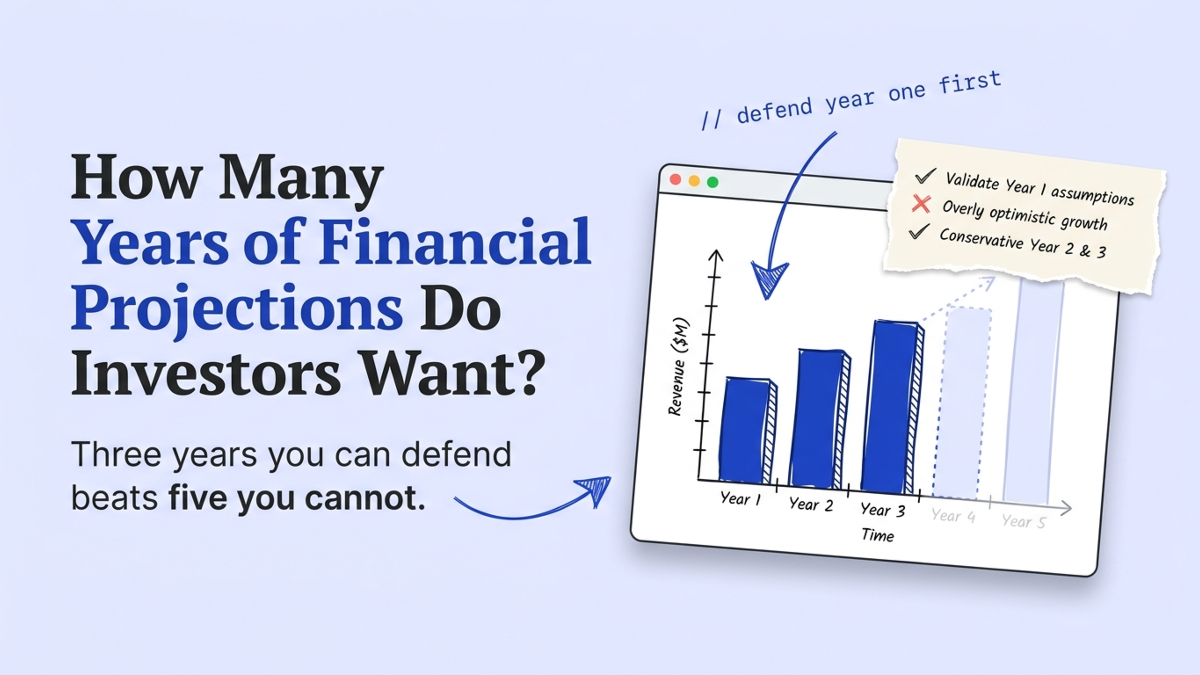
Financial projections are your startup’s forecast of revenue, costs, and cash over the next few years, and the first thing founders ask is how far out to go. The honest answer surprises people. In the decks we review, the year count matters far less than whether year one holds up. A five-year model built on a hopeful curve gets read in seconds. It isn’t believed for one of them. Investors skim fast, about 3.2 minutes for a whole deck (Papermark, 2024), so the horizon is a much smaller decision than it feels when you’re staring at a blank spreadsheet.
How many years of financial projections do investors want?
Most investors want three to five years of projections, and three years is the number you’ll see recommended most. That range holds across the guides ranking for this question, from SlideModel to Story Pitch Decks. Three years covers enough to show a trajectory. Five starts to read as fiction for a company that is barely two years old.
The people who study these slides are blunt about it. Story Pitch Decks, summarizing 25 investors, puts it plainly: investors know the projections are going to be wrong, and the only real question is how wrong. So the years are a container. What you put inside them is what gets judged.
We rarely see a founder lose a meeting over three versus five. They’ll lose it on the inputs.
Why your assumptions matter more than the number of years
Your assumptions matter more than the horizon because investors reverse-engineer every projection back to the handful of inputs driving it. Change the conversion rate, the price, or the hiring plan, and the year-five number swings by millions. They know this. So they spend their attention on whether your inputs survive a hard question, not on the shape of the curve.
This is where most models break. Waveup, which reviews early-stage decks, says that in roughly 60% of the financial models they see, founders’ revenue projections run 2 to 3 times too aggressive for their stage (Waveup, 2026). A hockey stick with no engine under it drags down every other slide.
Investors don’t fund your year-five revenue. They fund whether your first year of assumptions survives one hard question.
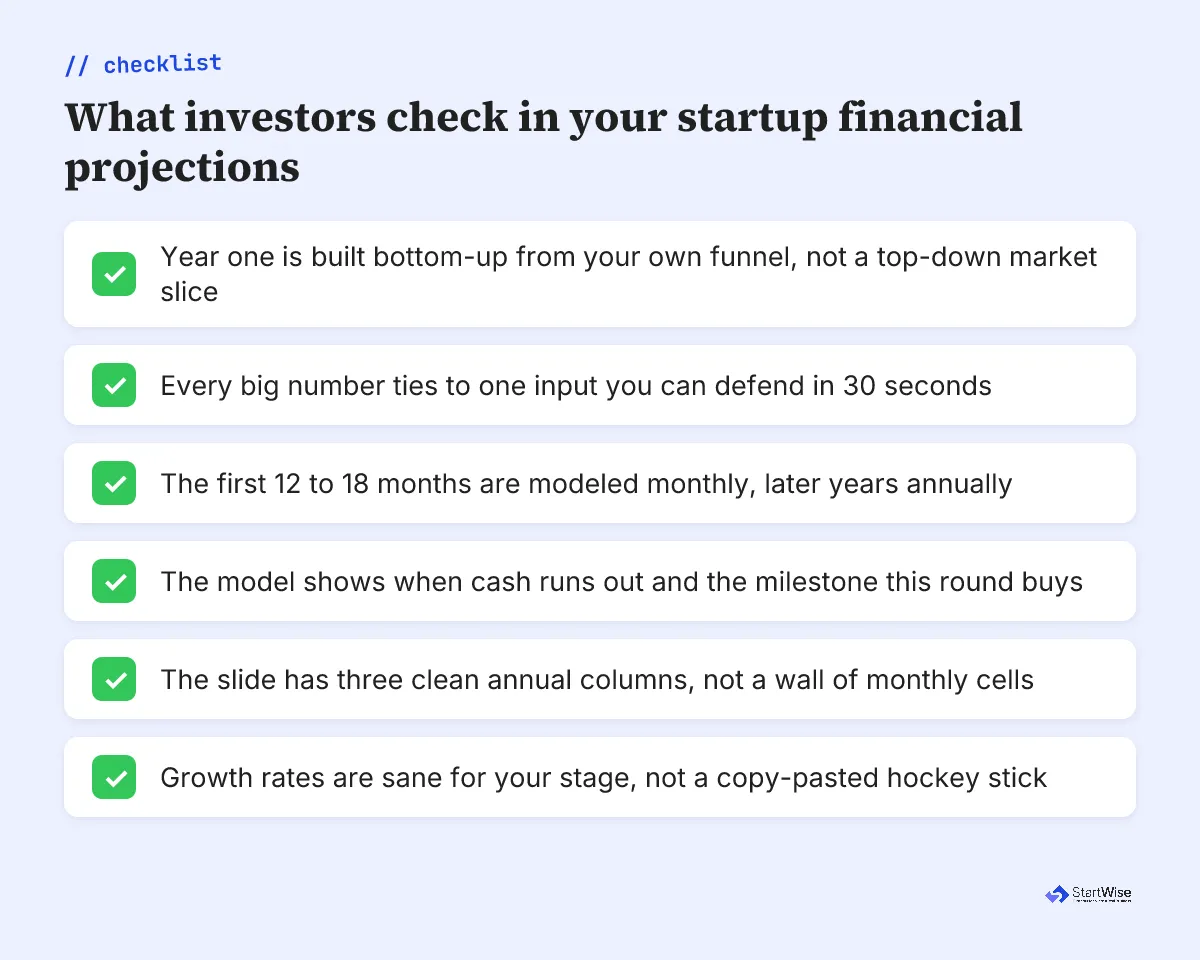
The fix is to build the near term from the bottom up. Start from your own funnel: leads, conversion rate, price, churn. A bottom-up forecast that ties to real numbers beats a top-down slice of a giant market, and it is the part investors actually interrogate.
Here’s our position after reviewing decks daily: a defensible two-year model beats an impressive five-year one at pre-seed, every time. The assumptions a sharp investor will test first:
- The price and how you landed on it
- Your conversion rate from lead to paying customer
- How fast you can hire and how much each hire costs
- Churn, and whether it improves or you just assumed it would
How many years to show by stage
How many years you show should track your stage, because each round funds a different amount of proof. A pre-seed check buys 18 to 24 months, so your detailed horizon should roughly match the runway that money buys. By Series A, investors expect a longer, driver-based model backed by real history. We’ll tell founders to model what they can defend, then stop.
| Stage | Years to show | Detail level | What investors weigh |
|---|---|---|---|
| Pre-seed | 2 to 3 | Assumptions plus 18-month runway | Are the inputs believable? |
| Seed | 3 | Monthly year 1, then annual | Does it tie to real traction? |
| Series A | 3 to 5 | Full model plus historicals | Do actuals match the old plan? |
The runway framing matters more than it looks. CB Insights found 70% of failed startups had run out of cash (CB Insights, 2026). So a projection that shows exactly when the money runs out, and what milestone you hit before then, does real work in the room. It also connects your financial model to a number every investor cares about: how long your runway lasts.
Not sure your projections will survive an investor's questions?
Should a pre-seed deck include projections at all?
A pre-seed deck doesn’t strictly need a full projections slide, and plenty of funded ones skip it. At the earliest stage you’re selling an insight and a team, not a spreadsheet. A shaky five-year model can hurt you more than no model.
Waveup goes further: in roughly 95% of the pre-seed and seed pitches they review, the projections slide actively hurts the deal (Waveup, 2026). That tracks with what we see. When the numbers read as fantasy, they’ll pull down the slides that were working.
StartWise's position
A five-year projection at pre-seed is theater. What we flag in the review room is a founder defending a year-five revenue number they can't tie to a single real assumption. Show two years you can defend, add a directional line, and say out loud which inputs you trust least.
My honest take: at pre-seed, replace the five-year model with one clear line about what this round buys. Put the milestone on your ask slide, keep a light model in the financials slide or the appendix, and let the story carry the rest.
How detailed should each year be?
Each year needs a different level of detail, front-loaded to the near term. Model the first 12 to 18 months month by month, then collapse later years into annual columns. Nobody studies your revenue for month 47.
Remember the skim. At 3.2 minutes for the whole deck and about 15 seconds a slide after the first (Papermark, 2024), a wall of 60 monthly columns on a slide is wasted ink. Keep the granular version in your model and the data room. Put three clean annual columns on the slide.
That is why SlideModel tells founders to use one column per year on the slide and skip the monthly grid unless an investor asks. On the slide, less detail reads as more confidence. In the model behind it, we keep seeing that the founders who win are the ones who can zoom all the way in when they’re asked.
What to do this week
Here’s where we’d start if you’re building projections for a raise this quarter. Work top to bottom and stop when the model is defensible, not impressive.
- Set your horizon to three years, and model the first 12 to 18 months monthly.
- Rebuild year one bottom-up from your own funnel, then have a peer attack each assumption.
- Tie the model to a runway number and the one milestone this round buys.
- Put three annual columns on the slide; keep the monthly detail in the data room.
- If you’re pre-seed with no traction, cut the slide to a use-of-funds line and move the model to the appendix.
Three years you can defend beats five you can’t. Get year one right, name the assumptions you’re least sure of, and the rest is arithmetic a good investor will forgive while they decide whether to write the check.