
 By
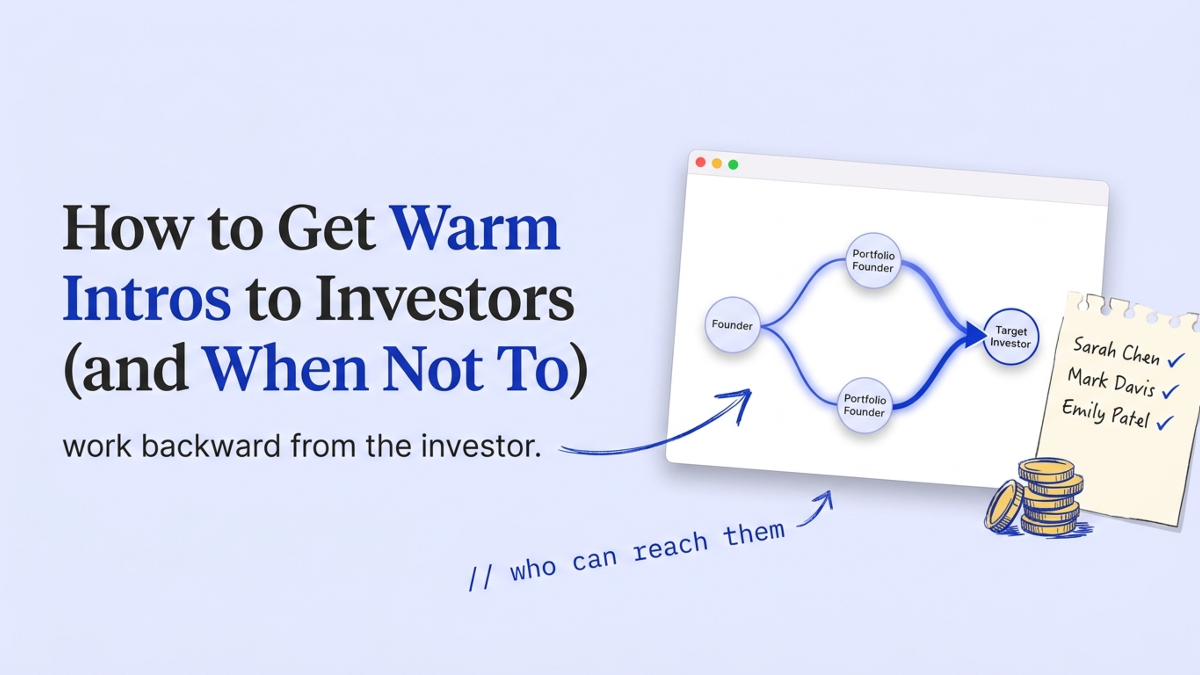
A warm introduction is when someone the investor already trusts forwards you to them, instead of you emailing cold. That borrowed trust is why founders chase intros so hard. We review fundraising materials every week at StartWise, and the pattern repeats: founders spend days hunting for any intro and almost no time on who makes it. The introducer is the whole game. Get the right person to vouch for you and a lukewarm deck still gets read.
Why do investors prefer a warm intro?
Investors prefer a warm intro because it filters their inbox for them. A trusted referral tells them someone credible has already vetted you, which is worth more than any subject line you could write. The edge is real. It is also softer than it looks.
The number founders repeat comes from DocSend’s 2017 research: referred startups were cited as roughly 13 times more likely to get funded than cold ones (Angels Partners). That figure is nine years old, and the world it described has changed. Cold outreach works today in a way it barely did then, and I wouldn’t bet a raise on a stat from before SAFEs took over pre-seed.
So treat the 13x as a reason intros help, not proof that cold is hopeless. The honest 2026 read: a warm intro is a strong tailwind, and a weak one is close to noise.
Rank your introducers before you ask
Ranking your introducers first is what separates a warm intro that works from one that backfires. Who makes the intro matters more than whether you get one at all. The best introducer is a founder the investor has already funded, because portfolio founders are the people VCs trust most. Next comes a co-investor or an advisor with a real relationship. A co-investor carries weight because funds pass deals to the partners they syndicate with, and an advisor carries weight when they have real skin in your outcome. Near the bottom sits a casual LinkedIn connection who met the partner once.
Here is the uncomfortable part we keep flagging. A weak intro can hurt you. When someone who barely knows the investor forwards your deck, the investor reads the weakness of that tie, and your email inherits it.
A sharp cold email beats a limp introduction every time.
Rank your possible introducers by how close they genuinely are to the target. Then only use the top of that list. If your best available connector is a stretch, you’re better off going direct.
How do you find a path to a specific investor?
You find a path by working backward from the investor, not forward from your contacts. Most founders scroll their own network and ask whoever feels friendliest. Reverse it. Pick the specific investor first, then trace the shortest credible line from you to them.
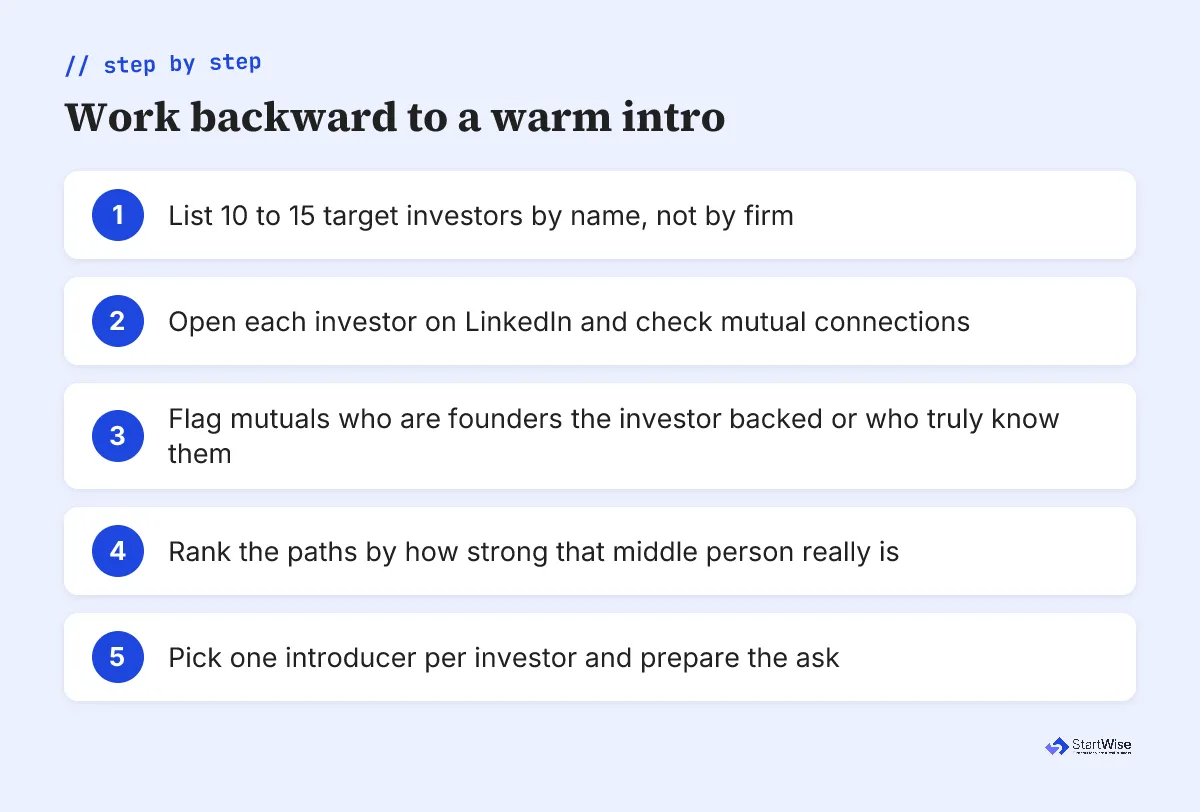
The mechanics are tedious but simple, and they’re the part founders skip:
- List your 10 to 15 target investors by name, not just their firms, pulled from a qualified pre-seed investors list.
- For each one, open their LinkedIn and read your mutual connections.
- Flag the mutuals who are founders they backed, or people who clearly know them.
- Rank each path by the strength of that middle person.
- Pick one introducer per investor, and prepare the ask for them.
Target people, not logos. A fund doesn’t decide anything; a specific partner does, and your mutual has to actually know that partner rather than just follow the firm. So when you scan mutual connections, look for a real working history: they co-founded something together, one backed the other, they shipped a product at the same company. A shared alumni group is not a warm tie, and pretending it is wastes the ask.
Doing this by hand across a full target list is slow, and it’s where most founders quit and revert to spraying whoever is easy. That’s exactly the mapping I’d automate before writing a single email.
Mapping who can reach each investor by hand is the slow part. Atlas by StartWise does it free, in about 15 seconds.
How do you ask without burning the connector?
You ask by making the introduction effortless to forward. The person doing you the favor is busy and doesn’t want to compose anything, so write it for them. Send a short note with a two-line blurb they can paste and send in ten seconds.
Something like this works, and we suggest founders keep it this tight:
Subject: intro to [Investor], if you’re open to it
[Name] is raising a pre-seed for [one line on what you do plus one proof point]. She’s a strong fit for [Investor] because [specific reason]. Deck is attached, and I’m happy to make the intro if it’s useful.
Give the connector an easy out in the same message, because a forced intro helps no one. And don’t wait until the week you want to raise. spectup, a fundraising advisory, recommends lining up intro requests well before you need them to land, so your asks don’t all arrive at once and read as panic.
What happens after the intro lands?
After the intro lands, the investor opens your deck, and that’s all the intro bought you. It doesn’t buy a check. It buys a few minutes of real attention, which is exactly where most founders lose the deal they worked so hard to reach. Clear that bar and the meeting brings its own set of questions.
Investors spend about 3.2 minutes on a pitch deck, 23 seconds on the first slide and roughly 15 seconds on each one after, across 3,000 decks (Papermark, 2024-2025). DocSend’s newer data puts the average under three minutes. The intro got you into the room. The first three slides decide whether you stay in it.
StartWise's position
Decks die in the first 90 seconds of a skim. Build for the skim first: if reading only your slide titles tells the story, you pass. The warm intro gets you opened; the skim decides whether anyone keeps reading.
The fix is almost always the opening slide. If slide one makes the investor work to understand what you do, those 23 seconds are gone and the intro you fought for was wasted on a bad first impression.
This is why we tell founders to send the deck as a tracked link, not a PDF, so you can see how long each investor actually spends. A 20-second view after a great intro is a content problem, not an access problem.
When should you skip the warm intro and cold email?
You should skip the warm intro when the only one available is weak, or when your network genuinely doesn’t touch your targets. A first-time founder in a new city often has neither portfolio-founder friends nor investor advisors, and that’s fine. Hundreds of funds now list themselves as open to cold pitches, so a founder outside the usual networks isn’t locked out anymore. I have watched founders with no network raise cleanly on cold email that was specific and well matched.
| Warm intro | Cold email | |
|---|---|---|
| Best when | A strong introducer truly knows the investor | Your network does not reach the target |
| Response signal | High, borrowed from the introducer | Lower, earned by your first two lines |
| Main risk | A weak tie drags your credibility down | Getting lost in a full inbox |
| Effort | Mapping and asking the right person | Deep research on each investor |
If your best introducer barely knows the partner, don’t use them. A specific cold email that shows you understand the fund will do more. Our cold email templates for investors are built for exactly that case.
What to do this week
Do the unglamorous mapping work before you ask anyone for anything. Most founders invert the order, and we keep watching it cost them their best intros on their weakest targets.
- Write down 10 target investors by name.
- For each, find your single closest real connection to them.
- Draft one forwardable blurb per intro, tailored to that investor.
- Send your deck through a tracked link and log every response in your investor pipeline tracker.
If you’re mid-raise, this fits inside the wider pre-seed playbook rather than replacing it. The founders who raise are rarely the ones with the biggest networks. They’re the ones who figure out the right single person to ask.