
 By
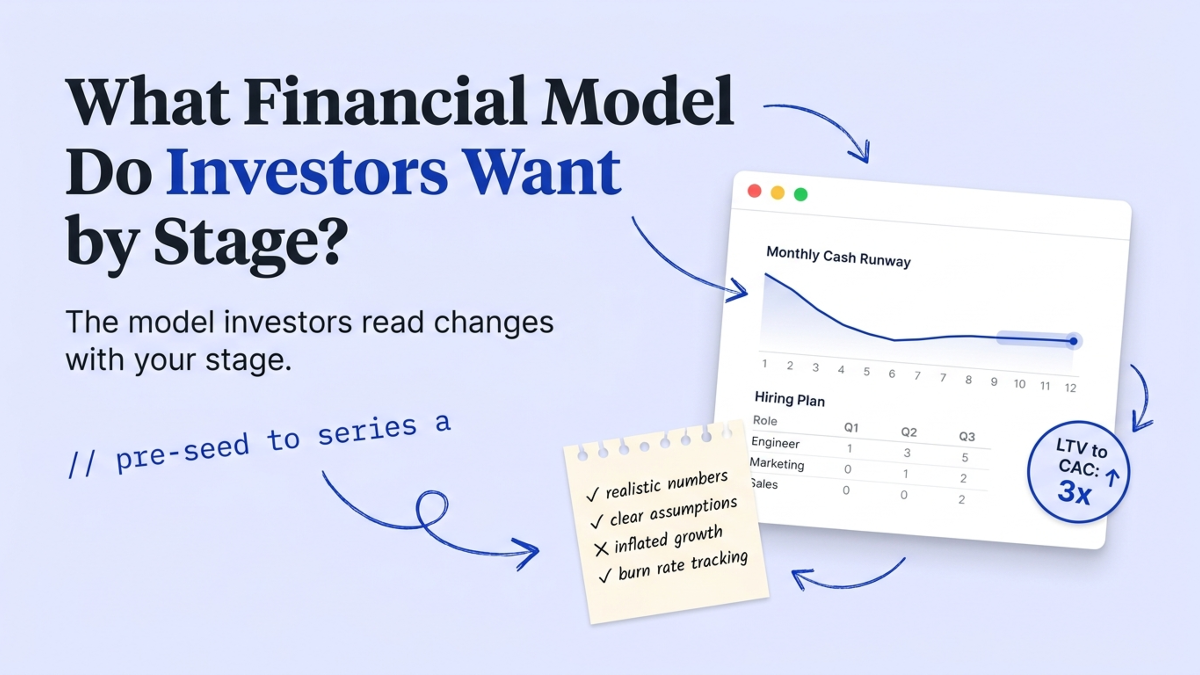
A financial model is the spreadsheet that turns your plan into numbers: revenue, costs, hiring, and the cash it all burns. What investors want from it changes with your stage, and that’s where first-time founders get bad advice. A pre-seed founder gets handed a Series A checklist and burns two weeks on a five-year forecast nobody reads. We review the decks and models that come out the other side, and the same pattern shows up every time: the model was rarely the problem, the wrong model for the stage was. So skip the guesswork. Here’s what each stage actually asks for.
Does a pre-seed startup even need a financial model?
A pre-seed startup needs a financial model, but not the kind most guides picture. At that stage investors aren’t buying a forecast. They’re testing whether you can think in numbers. Sifted framed the whole debate around one blunt question: is it nonsense for an investor to ask a pre-seed founder for a model? Jenny Fielding, the former Techstars managing director, tweeted “Financial models are back!” in 2024, and plenty of pre-seed investors now ask for one.
Here’s my honest take after reviewing these every week. Most pre-seed founders should not build a five-year three-statement model. It signals you spent two weeks on the wrong artifact instead of talking to customers.
The model still matters. It just has a different job here: proof you understand your own business, not a prediction anyone believes. Vestd put it well, writing that early-stage investors “probably aren’t looking for watertight financial forecasts” but they do want clarity.
A pre-seed model isn’t a prediction. It’s proof you can think in numbers.
What financial model do investors want at each stage?
Investors want a financial model scaled to your stage, and the jump between stages is bigger than most templates admit. A pre-seed model and a Series A model aren’t the same document with more rows. They answer different questions, and we keep seeing founders miss that.
| Stage | What investors want | Time horizon | Depth |
|---|---|---|---|
| Pre-seed | Assumptions + cash and hiring plan | 18-24 months | One tab, defensible |
| Seed | Driver-based model, real unit economics | 24-36 months | A working workbook |
| Series A | Three-statement model + historicals | 2-3 years back, 3-5 forward | Audit-grade |
At pre-seed, the model is a thinking tool: one tab of assumptions plus an 18-to-24-month cash and hiring plan (Vestd, Forecastr). At seed, investors want a driver-based model with unit economics they can pressure-test, because now you’re asking them to fund a repeatable motion. For subscription businesses, that means the SaaS metrics investors read on the model: LTV to CAC, payback, and retention. At Series A, Forecastr’s readiness checklist raises the bar hard: two to three years of clean historical financials, a full three-statement model, and a burn multiple under 1.5x to prove capital efficiency.
The Series A version is the one pre-seed founders love to build too early, and it’s the most common way we see founders waste two good weeks.
What goes in a pre-seed financial model?
A pre-seed financial model needs five pieces, and none of them require a finance background. Forecastr’s pre-seed guide warns against the “complicated fifty-tab spreadsheet” and says to focus on the three or four factors that truly drive growth. That’s the whole game this early.
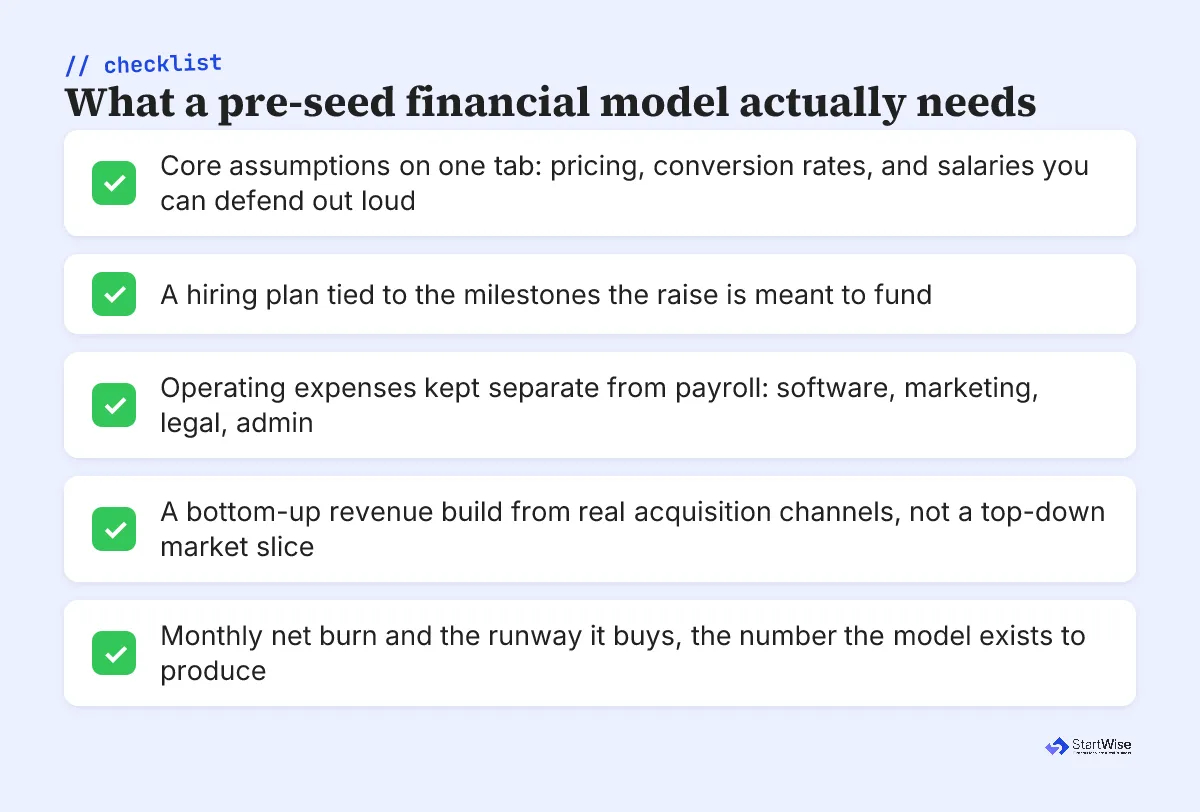
- Core assumptions on one tab: pricing, conversion rates, and salaries you can defend out loud.
- A hiring plan tied to the milestones the raise is meant to fund, since headcount is your biggest cost.
- Operating expenses kept separate from payroll: software, marketing, legal, admin.
- A bottom-up revenue build from real acquisition channels, not a top-down slice of a giant market.
- Monthly net burn and the runway it buys, the number the whole model exists to produce.
Build those five and you’ve covered what a pre-seed investor will read. In the models we review, the ones that land keep exactly this shape.
Everything past that is you talking to yourself.
Top-down or bottom-up: which model do investors trust?
Investors trust a bottom-up model and quietly distrust a top-down one. Bottom-up starts from how you win a single customer and multiplies up. Top-down starts from a giant market and claims a slice. One shows your mechanics. The other shows your optimism.
StartWise's position
A bottom-up model built from three or four real growth drivers beats a five-year top-down forecast every time. If your year-one revenue can't survive a napkin check, the extra tabs are hurting you, not helping.
The unit economics carry this section, and it’s where we see the most models quietly fall apart. Forecastr’s guide sets a simple bar: your customer lifetime value should be three times or more your cost to acquire a customer. If your model can’t show that math from real channel assumptions, more tabs won’t fix it. They’ll just hide the hole better.
Your model lands on an investor's desk as one deck slide. Make sure it reads in seconds.
How does the financial model show up in your pitch deck?
Your financial model shows up in the deck as one slide, not as the workbook. Usually it’s the use-of-funds line or a traction slope with a believable mechanism behind it. The full model is diligence material. It gets opened after an investor is already interested, not on the cold read.
That distinction matters because of how little time you get. Papermark’s 2024 analysis of 3,000 pitch decks found investors spend about 3.2 minutes on a deck and 23 seconds on the first slide. Nobody audits your assumptions tab in 3.2 minutes. They check whether the one number on your ask slide reads fast and ties to a milestone.
We see founders confuse the two constantly, pasting a dense model screenshot onto a slide investors skim in seconds. So the model does two jobs. It produces the numbers you put on the deck, and it survives the diligence those numbers earn you.
Get the first job wrong and there’s no diligence to survive.
What to build before your next investor meeting
Build the model your stage asks for, then stop. For a pre-seed raise, that’s a short, honest, bottom-up model you can walk through without notes. Here’s the order I’d build it in.
- Write your assumptions first and get them defensible before you touch a chart.
- Build the hiring plan against one dated milestone the raise funds.
- Layer in a bottom-up revenue build and your monthly net burn, then read the runway.
- Model your SAFE conversion and dilution before you sign, so the raise size and the model agree.
- Pull the one number that belongs on the deck, and test it against real pre-seed deck examples.
If a pre-seed investor asks for the model, Sifted’s advice is the right instinct: send it within 24 hours. A model you can produce on request, and defend line by line, does more for your raise than a five-year forecast ever will.