
 By
By 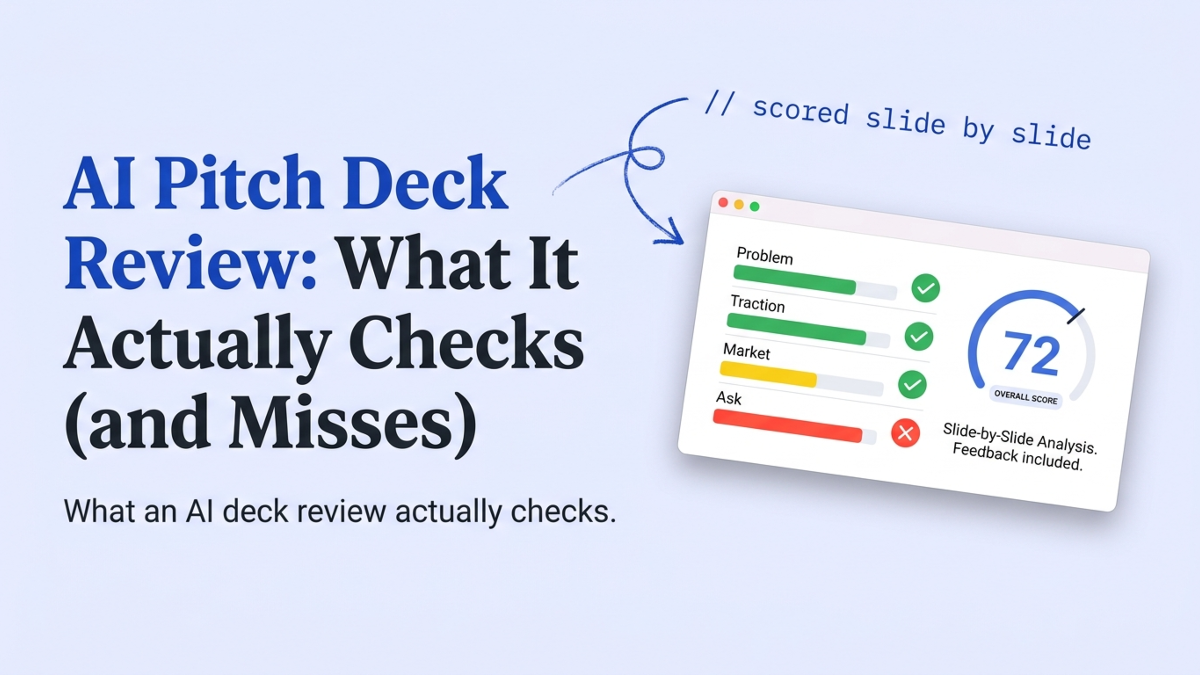
An AI pitch deck review is an automated pass that scores your deck against a fixed set of criteria and hands back slide-by-slide feedback, usually in under five minutes. It reads the way a rushed investor reads. We run these reviews every day at StartWise, and the same gaps surface deck after deck: a problem slide that buries the pain, an ask with no milestone, a traction slide counting the wrong thing. Here’s exactly what an AI review checks, where it beats a human, and where it goes blind.
AI review, human review, or a DIY pass: which does your deck need?
Three ways to get a deck reviewed exist, and they solve different problems. An AI tool scores the mechanics in minutes for nothing. A human reviewer or agency brings judgment for a few hundred dollars and a few days. A DIY review you run yourself costs only an evening, if you can stay honest about your own work.
| Review type | Speed and cost | Best at | Blind spot |
|---|---|---|---|
| AI review (Pitch Deck Doctor) | Free, minutes | Structure, clarity, every slide scored | Can’t tell if the business is fundable. Check your deck free → |
| Human or agency review | Paid, a few days | Market judgment, narrative, investor fit | Slow, pricey, quality swings by reviewer |
| DIY self-review (checklist) | Free, an evening | Catching your own obvious gaps | You stopped seeing your deck weeks ago |
My honest take after reviewing decks daily: most first-time founders should run the free AI pass first, fix the obvious damage, then spend human-review money on a version that’s already clean. Paying a person to find your typos is the most common way founders waste a review budget. If you’re weighing what to spend, we broke down every pitch deck review service by price and tier.
The machine is better at typos anyway.
What does an AI pitch deck review actually check?
An AI pitch deck review checks your deck against a rubric: a fixed list of slides and the one question each has to answer. Most tools keep that rubric hidden behind a score. Here’s the one we use, slide by slide, with the failure we flag most on each.
| Slide | What the review checks | Most common flag |
|---|---|---|
| Cover + one-liner | A stranger gets what you do in one read | Vague tagline, no category |
| Problem | The pain is real, frequent, expensive | Problem stated as a missing feature |
| Solution / product | The mechanism is clear, and it exists | Telling instead of showing |
| Why now | What changed to make this fundable today | Slide missing entirely |
| Market | A bottom-up count of reachable customers | A $1T number with no path to it |
| Business model | Who pays, how much, how often | Pricing buried in a footnote |
| Traction | Direction and speed, with a believable cause | A vanity total and no slope |
| Competition | An honest map and your wedge in it | ”We have no competitors” |
| Team | Why this team won’t get out-executed | Credentials answering the wrong question |
| The ask | Amount, runway, and the milestone it buys | A number with no milestone attached |
Most tools roll those ten checks into section scores, then one overall number. The overall is the least useful part. A 72 out of 100 tells you almost nothing; the slide-level flags tell you everything. Read the breakdown and skip the headline grade.
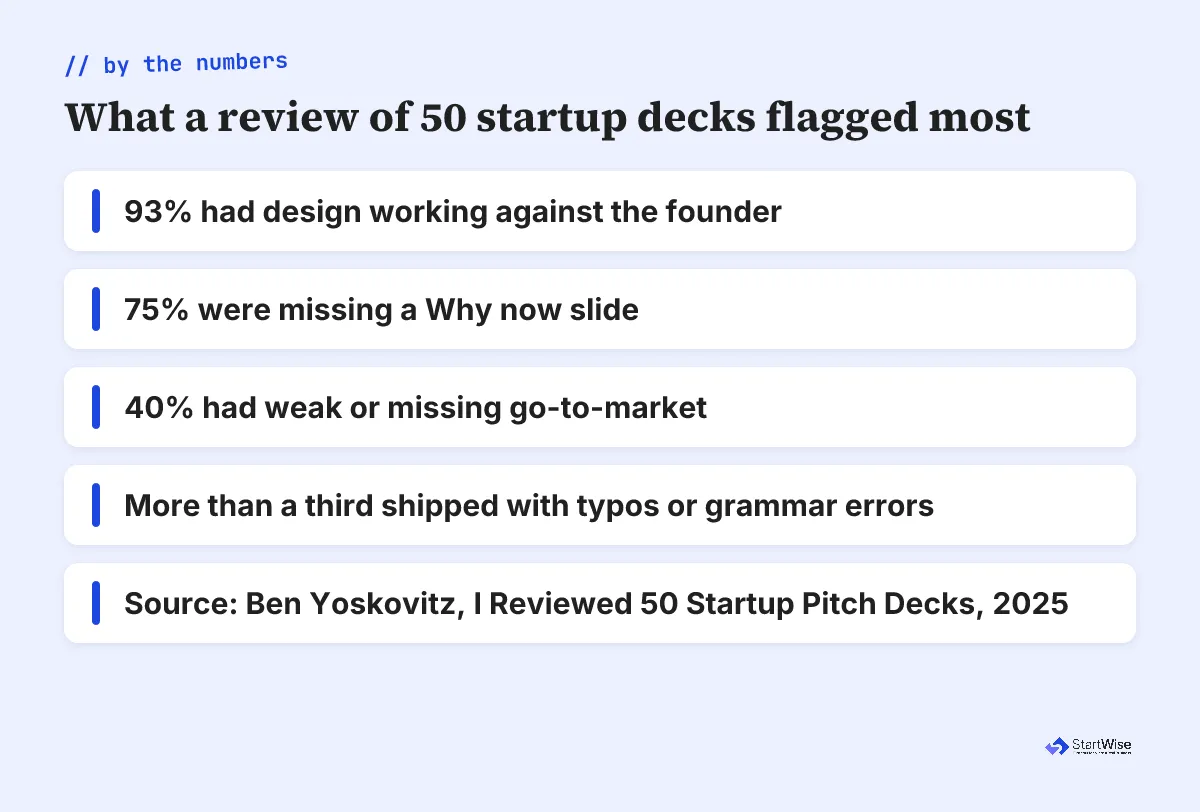
The pattern holds well outside our review room. When Ben Yoskovitz read 50 startup decks in 2025, 93% had design working against the founder and 75% were missing a “Why now?” slide. Another 40% had weak or absent go-to-market, and more than a third still shipped with typos. Every one of those is a mechanical flag an AI catches in seconds.
A deck rarely dies on one bad slide. It dies on three mechanical gaps the founder stopped seeing weeks ago.
This is the layer AI owns.
We read the famous decks against this same rubric in our pitch deck examples teardown, and even the legendary ones break a row or two.
Where does an AI deck review beat a human, and where is it blind?
An AI review beats a human on speed, consistency, and the mechanical layer; it goes blind right where judgment starts. It never gets bored on slide nine. It scores deck one and deck four hundred against the same rubric. What it can’t do is decide whether your market is real or your founding team is the one to win it.
Here’s what no AI review can see yet:
- Whether the business is fundable at all, or just tidy
- Whether you’re the right team for this specific problem
- Whether your “why now” argument actually holds up
- Whether the story lands for one particular partner on a Friday
The team slide is where we watch this gap open up. SeedBlink built its reviewer on more than 10,000 analyzed decks, and Slidebean trained its model on the decks behind over $350 million raised. Both can score whether your team slide is clear. Neither can tell you the team is wrong.
StartWise's position
The team slide is a risk slide. Its real question is "why won't this team fall apart or get out-executed?" Credentials answer the wrong question. Relevant scars (shipped X, sold Y, lived the problem) answer the right one, and that's a judgment a human reviewer makes, not a score.
So treat the two as a sequence. The AI clears the mechanical debt; the human spends their attention on the calls only a person can make.
Which AI pitch deck review tool should you use?
The right AI pitch deck review tool depends on what you want out of it. The category grew up fast. What was a handful of free reviewers a year ago is a crowded field now, and by mid-2026 almost every one crowns its report with a letter grade or a score out of 100. The smart move hasn’t changed: run two, compare what they flag, whatever tool you built the deck in. Where they agree, you’ve found a real problem.
Here’s the field as it stands in 2026:
- Slidebean and SeedBlink score your slides against an investor-style rubric built on large deck libraries (SeedBlink cites more than 10,000 analyzed decks).
- SaaStr.ai returns three numbers: a Traction Score, a Deck Quality Score, and an Investment Grade from A+ to F, drawn from patterns across 139,000-plus founder conversations.
- Futureproof’s reviewer, Nia, hands back a 90-second verdict plus slide-by-slide rewrites you can ship in an hour.
- Evalyze scores your deck out of 1,000 and benchmarks it against thousands of funded decks.
- OpenVC folds a free review into its founder platform, handy if you’re already there to raise. Pitch Deck Doctor, our own tool (so weigh the bias), hands back a concrete fix list instead of a grade.
What none of them replaces is a reader who hasn’t seen your deck. So here’s a test we hand founders: run two AI reviews, then give the deck to a sharp friend outside your space for three silent minutes. Fix what the tools agree on first. Where your friend stalls but both tools stayed quiet, you’ve found the judgment gap no rubric catches yet.
I’d skip any tool that only hands back a number. A score says something’s wrong; a fix list says what to change. The second one is the whole point of getting reviewed.
How accurate is an AI pitch deck review?
An AI pitch deck review is accurate on the things it can measure and silent on the things it can’t. It reliably catches a missing slide, a paragraph where a chart should be, a title that carries no meaning. The score is a readiness signal. It isn’t a prediction that you’ll raise.
That gap got louder in 2026. Every serious reviewer now tops its report with a verdict. SaaStr.ai calls it an Investment Grade from A+ to F, Evalyze a score out of 1,000, Futureproof a set of letter grades across six vectors. Not one of them has published data showing its grade predicts whether you raise. The verdict looks more authoritative than ever, and it means exactly what it always did.
Why does the mechanical layer matter so much? Because investors barely read. Decks average just 3.2 minutes of attention, with 23 seconds on the first slide and roughly 15 seconds on each one after, across Papermark’s 2024 analysis of 3,000 decks and 8 million data points. DocSend’s research puts the standard deck near 20 pages at about 50 words per slide, and found the decks that work put product and “why now” early and skip the table of contents.
Read that against the rubric. A reviewer with three minutes can’t reward a buried number or a clever slide twelve. An AI review scores your deck under the same constraint, which is the whole point. We did the slide-by-slide math on that attention budget in how many slides a pitch deck should have.
A high score won’t raise your round.
A pile of mechanical flags will sink it before anyone reads to your team slide.
Want this rubric run on your actual deck? Get a free, slide-by-slide review with a concrete fix list, in minutes.
How to act on your pitch deck review feedback
Acting on a review means fixing in priority order, not top to bottom. A review hands you ten flags. Three of them decide whether the deck works, and the rest are noise until those three are closed. Founders who improve fastest treat the report as a queue, never a checklist.
- Fix the first three slides first. Slide one gets 23 seconds (Papermark, 2024). A buried problem on slide two costs you the whole read.
- Close every “missing slide” flag before you polish an existing one. A missing “why now” hurts more than an ugly chart.
- Rewrite your slide titles so the story survives a title-only skim. If the titles alone tell the arc, the deck reads at 15 seconds a slide.
- Fix design and typos last. They matter, and they’re also the cheapest pass, so they wait until the structure is sound.
One pass through that queue beats five passes of polish. We see founders rerun the review after step three and watch the score jump, because structure was carrying the damage the whole time. The fundraising context for all of this lives in our pre-seed raising guide.
What to do this week
You can clear most of a deck’s mechanical debt in an evening. Here’s the order that works:
- Run a free AI review today. Get the flagged list before you touch a single slide. You can’t prioritize what you haven’t measured.
- Triage to the top three. Pick the three flags that change whether an investor finishes the deck, and ignore the rest for now.
- Rebuild those three, then re-review. Fix, rerun, confirm the flags cleared. Two cycles usually does it.
- Then, and only then, book a human. Pay for judgment on a clean deck. Every number in this post comes from a source we fetched the day it was written; the rules we publish under are on the About page, and the byline is accountable at the author profile.
The score was never the goal. A deck that survives a three-minute skim is, and the mechanical pass is simply how you get there before a human weighs in.