
 By
By 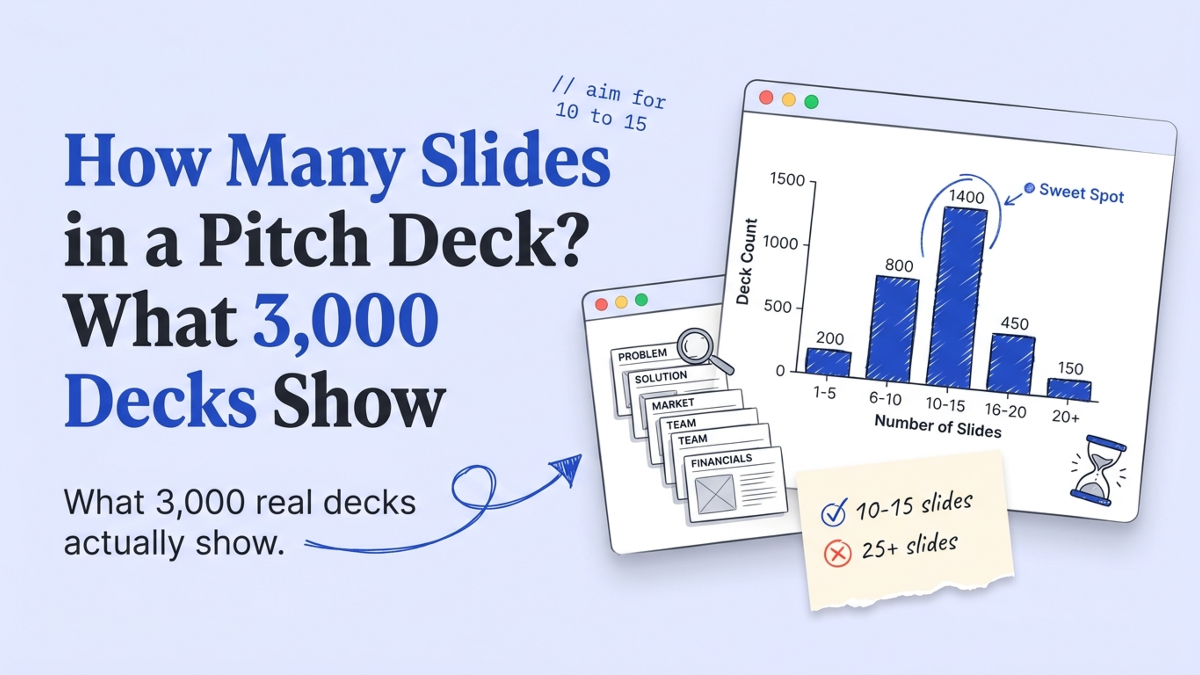
A pitch deck’s slide count is the rare fundraising question with measured data behind it: deck-sharing platforms publish what investors open, finish, and abandon. The working answer is 10 to 15 slides. The engagement numbers keep pointing at 12. We review founder decks daily at StartWise, and length is the first thing we check. The count predicts the cuts. Here’s what the data supports, who the number bends for, and when you’ll want to break it.
How many slides do investors actually see?
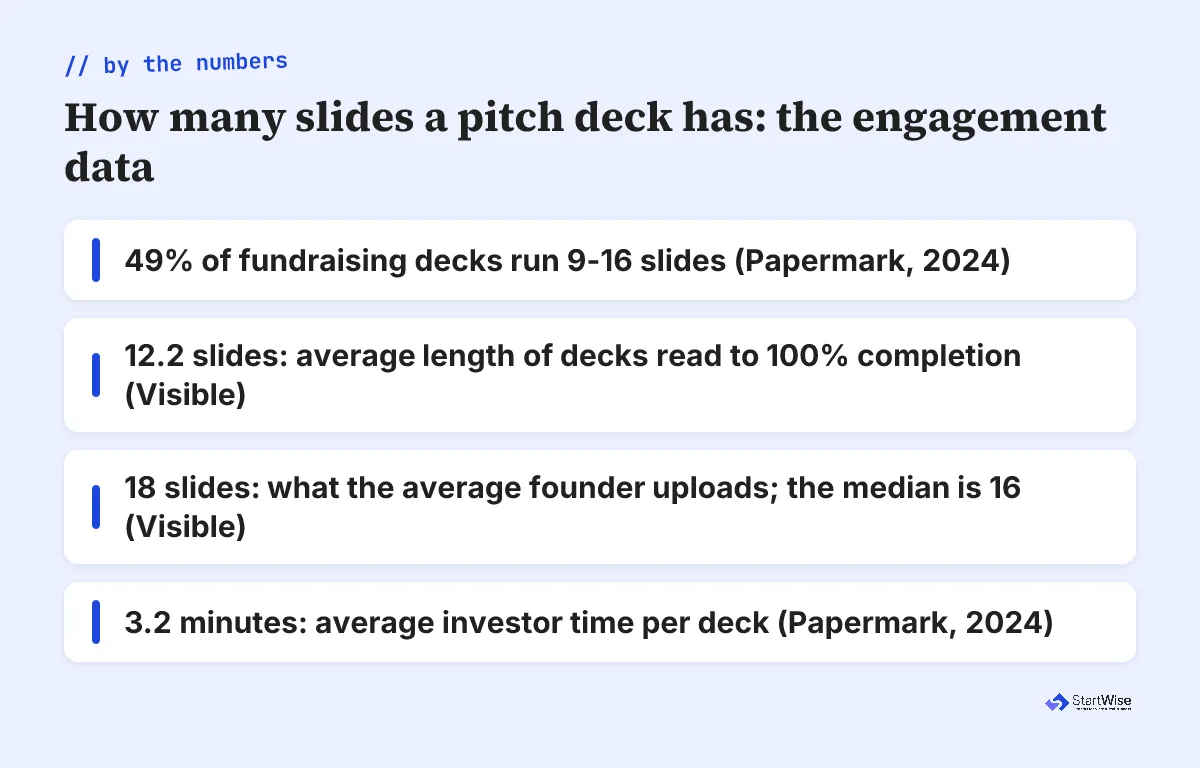
Most decks investors receive run 9 to 16 slides: that band holds 49% of the 2,239 fundraising decks Papermark analyzed in 2024 across 8 million data points. The same dataset puts 17-24 slides as the second most common band, with very short decks of 1-8 slides the rarest.
The reading side tells a stricter story. Decks that investors read to 100% completion average 12.2 slides, per Visible’s engagement data, and that’s where Visible’s stated ideal of 12 slides or fewer comes from.
Note what’s missing from the distribution: the 1-8 band is the rarest. Founders fail this question long, almost never short, and the decks they send us for review skew exactly the same way.
Three datasets, one shape:
- Papermark, 2024: 49% of decks run 9-16 slides; 17-24 is the next most common band
- Visible: the average uploaded deck runs 18 slides (median 16); full reads average 12.2
- DocSend: the standard deck is roughly 20 pages at about 50 words per slide, per Dropbox’s summary of DocSend’s research
Founders build long; investors finish short.
Why do founders build decks six slides too long?
The gap is about six slides: the average deck founders upload runs 18 slides, median 16, while the decks investors actually finish average 12.2 (Visible). That’s a point-of-view problem, not a design problem.
A deck gets written in outline logic: every question answered, every objection pre-empted. It doesn’t get read that way. It gets skimmed, often on a phone, between two other decks. DocSend’s research backs the reader’s side: successful decks skipped the table of contents and got right to the point.
In the decks we review, the extra six slides are nearly always defensive. A second market slide. A features tour.
A slide answering an objection nobody has raised yet.
Founders write decks to survive questions; investors read decks to decide whether to ask any.
The defensive slides feel safe to keep because each one, alone, seems cheap. They aren’t. The data above prices them: every addition pushes the deck away from the 12.2 slides that full reads average, toward the 18 that get abandoned partway.
Don’t fix it by deleting six slides at random. Rebuild from the reader’s budget, stopwatch in hand.
What does the 15-second attention budget change?
After the opener, an investor spends roughly 15 seconds per slide. The first slide gets 23 seconds, and the whole deck averages 3.2 minutes, in Papermark’s 2024 numbers. That total keeps shrinking, which is why how long investors spend on a pitch deck matters as much as the slide count.
Run the arithmetic. 23 seconds on the opener plus eleven slides at 15 seconds each is 188 seconds, and Papermark’s 3.2-minute average is 192. The attention budget works out, almost to the second, to a 12-slide deck.
The same arithmetic convicts long decks. A 20-slide deck at that pace asks for just over five minutes from a reader who budgeted three.
Fifteen seconds also defines what a slide is for. One claim, stated in the title, with the evidence directly under it: close to DocSend’s observed norm of about 50 words per slide. A slide needing a full minute of study was built for a meeting. On a cold read it gets 15 seconds.
StartWise's position
Decks die in the first 90 seconds of a skim. Build for the skim first (slide titles that carry the narrative on their own) and for the deep read second. If reading only your slide titles tells the story, you pass.
Slide count is just this budget, restated.
Every slide you add spends seconds the slide after it needed. That’s the real cost of slide nineteen: the asks it starves, not its own weak read.
Where in the deck do investors quit?
Investors quit early or not at all: nearly a third bounce inside the first 10 seconds, and readers who’ve survived to the fourth slide almost always finish. Storydoc’s 2026 report, built on 1.3 million presentation sessions, found 31% of readers drop off in the first 10 seconds and another 15% leave inside the first minute.
The survivors behave differently. 82% of readers who reach slide four finish the whole deck (Storydoc). The first four slides are the gate. Everything after them is read by a self-selected audience that already decided they’ll keep going.
82%
of readers who reach slide four finish the entire deck, so the first four slides decide who ever sees the rest (Storydoc, 2026)
Length feeds the same pattern. Storydoc found decks of around 10 slides had the highest completion rate, 32% against a 22% average across all lengths. A short deck respects the 3.2-minute budget and gets finished more often.
We’ve seen this in the review room over and over. The decks that stall never make it past slide four when a stranger reads them cold. The fix is always the same: move your sharpest proof forward.
The first four slides don’t earn the meeting. They earn the next four.
So slide count and drop-off are the same lever pulled from two ends. A tight deck front-loads its best four slides and earns the read; a bloated one buries the ask behind pages most readers never reach.
Which deck length fits which audience?
The right slide count depends on who’s reading and when. A cold-outreach teaser, a send-ahead deck, a live presentation, and a diligence pack are four different documents:
| Deck type | Slides | The job |
|---|---|---|
| Teaser, for cold outreach | ~5 (Visible) | Earn the meeting, not explain the whole business |
| Send-ahead full deck | 10-13 (Visible); the 9-16 band (Papermark) | Survive a 3.2-minute unaccompanied skim |
| Live presentation | 10 (Kawasaki’s 10/20/30 rule) | Hold a room while you do the talking |
| Diligence / appendix pack | The 17-24 band (Papermark) | Answer the questions the short deck earned |
Guy Kawasaki’s 10/20/30 rule (ten slides, twenty minutes, no font smaller than thirty points) anchors the live-presentation row. His reasoning: a normal person can’t absorb more than ten concepts in a meeting. The rule predates the send-ahead skim, which is why it doesn’t work without the table around it.
Most founders we review send one deck to do all four jobs. It can’t. That’s exactly how an 18-slide compromise gets built: too long for the skim, too thin for diligence.
Pick the audience first; the count follows.
The 12-slide skeleton, slide by slide
A 12-slide skeleton covers everything a first fundraising deck must prove, one job per slide, each earning its roughly 15 seconds. DocSend’s research adds one ordering note: successful decks placed product and “why now” earlier.
| # | Slide | What it must earn in ~15 seconds |
|---|---|---|
| 1 | Cover + one-liner | A stranger can say what you do; the 23-second slide |
| 2 | Problem | The reader believes the pain is real and frequent |
| 3 | Solution | The mechanism is clear: the how, not the what |
| 4 | Product | Proof it exists; one screen beats four |
| 5 | Why now | What changed to make this fundable today |
| 6 | Market | A bottom-up count of reachable customers |
| 7 | Business model | Who pays, what they pay, who keeps paying |
| 8 | Traction | Direction and speed, not a vanity total |
| 9 | Competition | An honest map and your wedge in it |
| 10 | Team | Why this team won’t be out-executed |
| 11 | Financials | A believable path, not a hockey-stick poster |
| 12 | The ask | Amount, runway, and the milestone it buys |
Two of these rows fail more than the rest in our reviews. Market and ask.
The market slide fails because founders argue size instead of reachability: TAM (total addressable market) theater instead of a countable first segment. The ask fails by going vague: an amount with no milestone attached, the fix we flag more than any other. Those are two of the rows an AI pitch deck review scores against, slide by slide.
StartWise's position
Most market-size slides are theater. A bottoms-up count of reachable customers in year one tells investors more than any $1T TAM. If your SAM math can't survive a napkin check, the slide is hurting you.
The famous decks mostly fit this skeleton, and where they don’t, the deviations are instructive: our pitch deck examples teardown reads Airbnb, Uber, and Buffer against exactly these mechanics.
Got 18 slides and a 12-slide skeleton? Get a free slide-by-slide review with a concrete fix list: see which slides earn their 15 seconds, in minutes.
When should you break the 10-15 band?
Break the band downward for cold outreach, and upward only through an appendix. Never inside the core narrative.
Going shorter. A teaser of about 5 slides is Visible’s guidance for the deck that travels before any meeting. My honest take, after reviewing decks daily: most “perfect deck” advice optimizes for the partner meeting. A cold-outreach deck has one job: earn a 20-minute call. That’s why you’ll usually want fewer slides and a sharper problem slide than the pitch deck template suggests.
Going longer. The 17-24 band is real (it’s Papermark’s second most common), but the completion data says the core read happens short. If you need 20 pages, structure them as 12 plus appendix, the shape DocSend’s roughly-20-page standard deck usually hides anyway.
Going long is an appendix decision, not a slide-count decision.
One honest caveat about stage: the engagement datasets don’t publish slide counts split by pre-seed, seed, and Series A. Treat stage as changing what each slide must prove. Not how many slides you get. Inside the same band, a seed traction slide carries numbers a pre-seed deck honestly can’t.
In practice, a pre-seed deck trims toward 10-12 because it has fewer proven claims, while a seed deck spends the same band on deeper traction and model slides. For what each slide should actually carry at the early stage, see our breakdown of pre-seed pitch deck examples. Visible’s only stage-flavored number caps early-stage decks at 14-15 slides: the ceiling of the band, not its center.
Cut an 18-slide deck to 12 in five passes
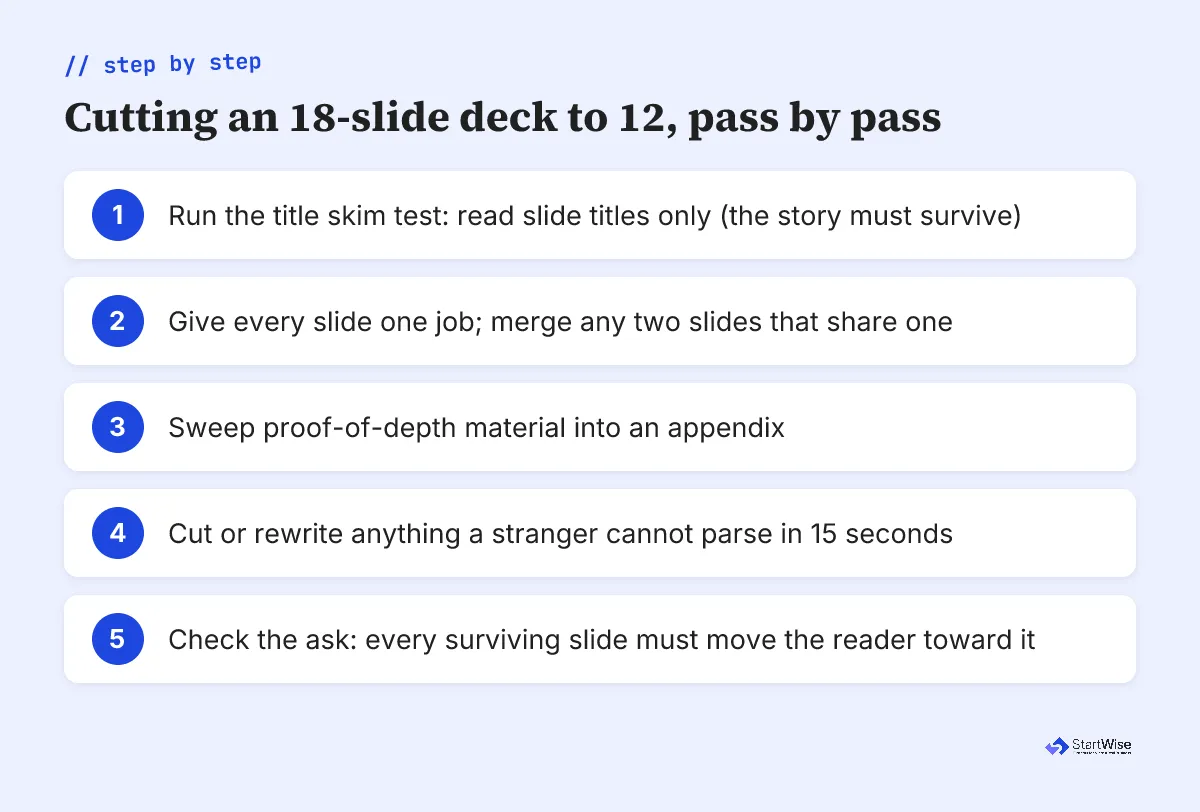
Cutting an 18-slide deck to 12 takes five passes, each with a single test:
- Run the title skim test. Read only your slide titles, in order. If the story doesn’t survive, fix titles before counting anything.
- Give every slide one job. Two slides sharing a job (two market slides, two product views) merge into the stronger one.
- Sweep depth into the appendix. Full financial model, pipeline detail, methodology, second case study: appendix. The core keeps the claim; the appendix keeps the proof.
- Apply the 15-second test. Anything a stranger can’t parse in 15 seconds gets rewritten toward DocSend’s ~50-words-per-slide norm, or cut.
- Re-read against the ask. Every surviving slide must move the reader toward the ask. A slide that doesn’t is decoration, however pretty.
You’ll find the first pass hurts the most and saves the least.
In our reviews, the big cuts come from passes two and three, where duplicate jobs and misplaced proof hide. Pass four is where the 50-words-per-slide discipline earns its keep. A slide that survives the merge but fails the stranger test usually has a paragraph where a chart should be.
What to do this week
Four jobs, in order, none longer than an evening:
- Count your deck against the data. The band is 9-16, full reads average 12.2, and the budget arithmetic lands on 12. Know which side you’re on.
- Run the 188-second read. Hand the deck to someone who’s never heard the pitch, start a stopwatch, and watch where they stall. That’s your cut list.
- Split the jobs. Build the ~5-slide teaser and the 10-13-slide core as separate documents, with an appendix behind the core. Stop sending one deck to do four jobs.
- Get a cold read before an investor gives you theirs. Three minutes, a stranger, and you don’t say a word. Every number in this post comes from a source we fetched the day it was written. The rules we publish under are on the About page, and the byline is accountable at the author profile.
The count was never really the question. The question is whether each slide earns its 15 seconds, and 12 slides is simply how many usually can.