
 By
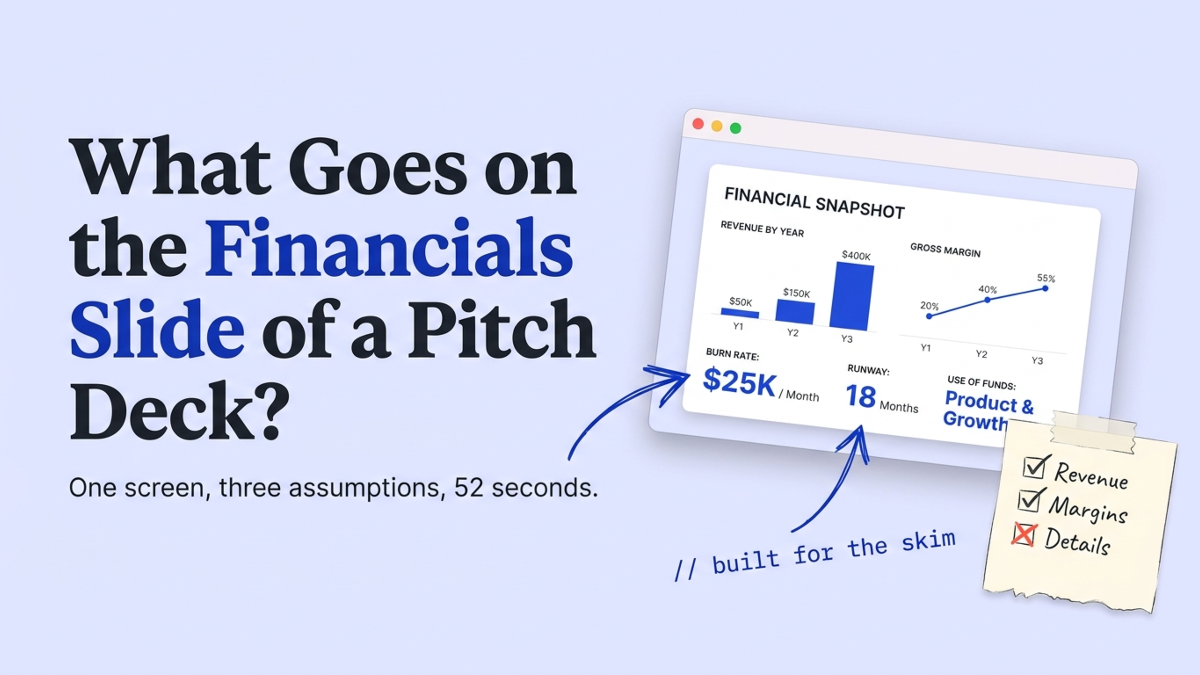
The financials slide is the one slide in your pitch deck that turns your plan into numbers: revenue, margin, burn, and how long the money lasts. Most guides treat it as a place to dump a five-year forecast. It isn’t. We review the decks founders send before they raise, and investors barely stop here. DocSend’s 2024 data clocks about 52 seconds on it, the second-most of any slide after the team slide. Fifty-two seconds is a summary, not a spreadsheet. So the real question is what earns those seconds.
What goes on the financials slide of a pitch deck?
A strong financials slide shows six things and no more: your revenue model, a three-year top-line projection, gross margin and its path, monthly burn, current runway, and the use of funds this raise pays for. That’s the whole slide. Everything else belongs in the model behind it.
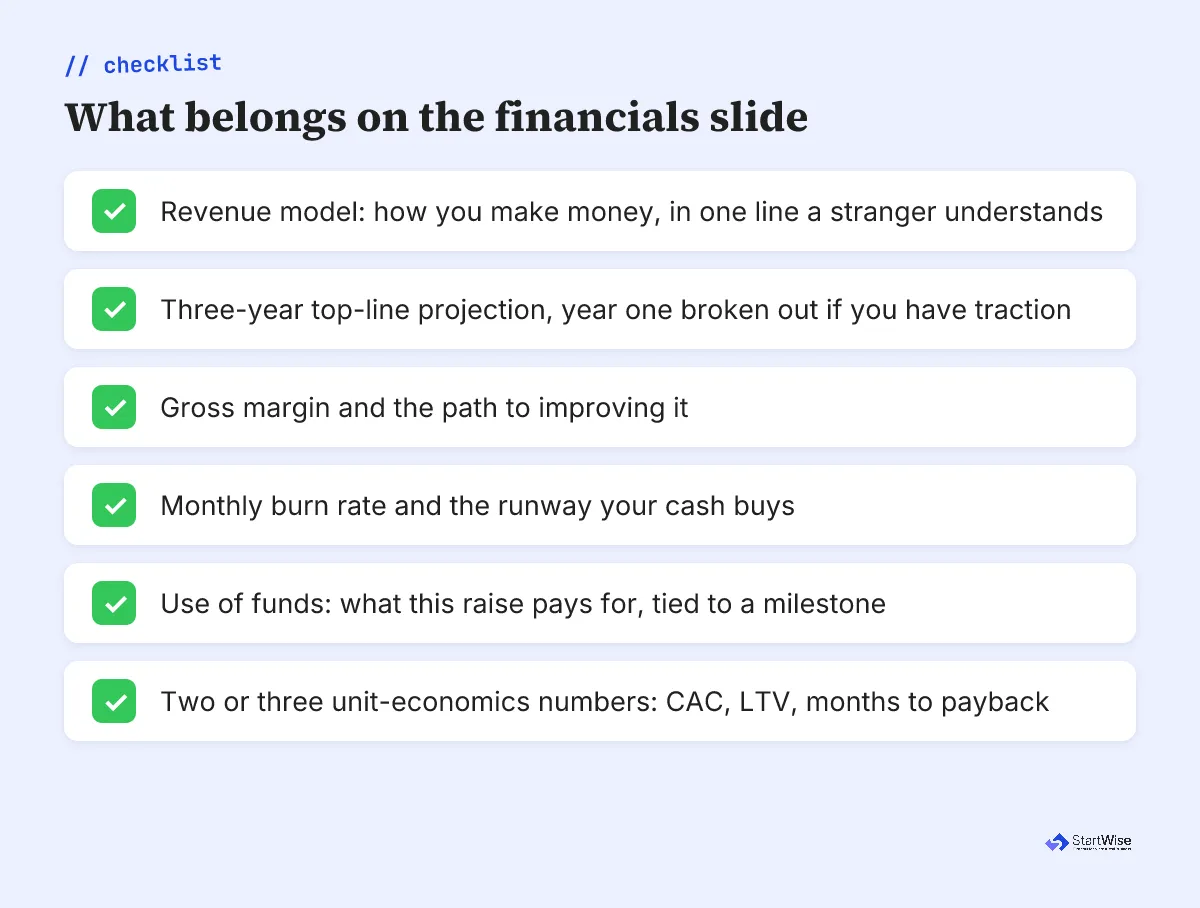
Here’s what earns space, top to bottom:
- Your revenue model: how you make money, in one line a stranger understands (the business-model slide expands this).
- A three-year top-line projection, with year one broken out if you have traction.
- Gross margin, and the honest path to improving it.
- Monthly burn rate and the runway your current cash buys.
- Use of funds: what this specific raise pays for, tied to a milestone.
- Two or three unit-economics numbers, like CAC, LTV, and months to payback.
CAC is what it costs to win a customer. LTV is what that customer is worth to you over time. Notice what’s missing from the list. No balance sheet, no five-year model, no line-by-line operating budget. Those exist, but they live in your financial model, not on the slide a partner skims in under a minute.
The slides we see work stay this lean.
How long do investors actually look at your financials slide?
Investors look at your financials slide for about 52 seconds, and that’s the second-most attention they give any slide, behind only the team slide. The figure comes from DocSend’s 2024 pitch-deck data, compiled by PitchGrade. It matters because 52 seconds is barely enough to read six numbers, let alone parse a dense projection table.
Here’s roughly how that attention splits across a deck (DocSend, 2024):
- Team: 1 minute 2 seconds
- Financials: 52 seconds
- Traction: 49 seconds
- Problem: 38 seconds
There’s a second number worth sitting with. DocSend’s data, via PitchGrade, puts an average cold deck at 2 minutes 31 seconds of reading with a 3% to 5% meeting rate, against 4 minutes 18 seconds and a 40% to 50% rate for a warm intro.
A cold investor skims fast. The dense financials slides we review lose the reader before the numbers ever register, and no amount of detail rescues a slide nobody finishes.
What belongs on the slide at each fundraising stage?
What belongs on the slide changes with your stage, because a pre-seed investor and a Series A investor are buying different things. Pre-seed buys the founder and the insight. Series A buys a machine that already works. The slide follows the money.
| Stage | What the financials slide shows | What stays in the model or data room |
|---|---|---|
| Pre-seed | Unit economics, pricing, burn, runway, use of funds | The full monthly model and cohort assumptions |
| Seed | Three-year top-line, key drivers, gross-margin path | Monthly build, scenario toggles, hiring plan |
| Series A | Three to five years of projections, historicals | Full three-statement model, cohort detail |
At the earliest end, you might not need the slide at all. Jonah Midanik, a General Partner at Forum Ventures, says a pre-seed initial deck has no need for financial projections until your second meeting or later. The first deck’s job is to earn that second meeting. So if you’re pre-revenue, a clean unit-economics story beats a projection you both know is fiction. The pre-seed decks we review rarely need a full projection to land the call. Match the depth to what investors want by stage, and the slide stops overreaching.
Which numbers do investors actually want to see?
The numbers investors want cluster tightly around income and cost. In a StoryPitchDecks study of 25 investors (2024), income drew 35.8% of what they said belongs on the slide, expenses 24.1%, and business KPIs 20.4%. Profitability, market sizing, and past funding trailed far behind. The lesson we take from that: lead with how much comes in and how much goes out, then prove you understand the drivers underneath.
For a SaaS company that means annual recurring revenue, gross margin, CAC, LTV, and months to payback. For a marketplace it’s gross merchandise volume, take rate, and unit economics per transaction. Pick the two or three that actually explain your business. The numbers we see win are the ones a founder can defend without notes.
Accuracy is not the point, and pretending otherwise backfires. Dave Parker, a five-time founder quoted in the StoryPitchDecks roundup, puts the accuracy question to rest:
Investors know this is going to be wrong. The question is just how wrong.
StartWise's position
The financials slide is a discipline test, not a forecast. At pre-seed, its job is to prove you know your unit economics and can defend three assumptions out loud, not to predict year-five revenue nobody believes.
Your slide is not your model
Your slide is not your model, and confusing the two is the most common way this slide goes wrong. The slide is a one-screen summary a stranger reads in 52 seconds. The model is the working spreadsheet that proves the summary, and it belongs in your data room, not on a slide.
The trap is building the slide out of the model, cramming every row onto one page because the rows exist. Build it the other way. Decide the six numbers that tell your story, put those on the slide, and let the model back them up for anyone who asks to dig. When we review a deck, we read the financials slide the way an investor will: one glance, does it hold together? Then we open the model behind it and try to break it.
That’s where the two get separated fast. A slide that reads clean but hides a five-year hockey stick with no runway math falls apart the second someone opens the sheet. The reverse is worse: a solid model buried under a slide so busy nobody reads it. The slide earns the meeting. The model survives the diligence. They’re different jobs, and the founders who treat them as one lose both.
If reading only your slide titles tells the story, your numbers are doing their real job: pointing at the model, not replacing it.
Not sure your financials slide reads in the 52 seconds investors give it? See what a reviewer would flag before an investor does, free and slide-by-slide, in minutes.
What makes a financials slide fail?
A financials slide fails when it tries to be the model. The failures we flag most are a five-year projection presented as fact, a hockey-stick chart with no mechanism behind the curve, and a slide so dense nobody can read a single number in the time they have. Each one signals the same thing: a founder who hasn’t decided what matters.
Here’s what to cut before you present:
- Five-year precision at pre-seed, which signals you built a document investors don’t read at your stage.
- A hockey stick with no driver, because the curve means nothing without the assumption that bends it.
- Burying the burn, so a reviewer can’t find your runway in five seconds and assumes you can’t either.
- More than six numbers, where every extra one reads as not knowing which is the important one.
5 years
The projection length most templates default to, and the fastest way to signal you built the wrong document at pre-seed. A pre-seed initial deck needs no projections until the second meeting, per Forum Ventures
What to do this week
You don’t need a designer or a finance degree to fix this slide. Give it an afternoon. The slides we see raise fastest are the ones a founder can talk through without flipping to the model.
- Cut your slide to six numbers: revenue model, three-year top-line, gross margin, burn, runway, use of funds.
- Move everything else into the model and drop it in your data room where it belongs.
- Read the slide out loud in under a minute. If you can’t defend a number, cut it or fix the assumption behind it.
- Tie your use of funds to one milestone that de-risks the next round, so the ask has a reason.
Then hand the slide to someone who’s never seen your company and time them. If they can’t tell your financial story in 52 seconds, the slide is the problem, not the investor.