 By
An investor’s email is the direct address of the specific partner you want to pitch, not a fund’s info@ catch-all. Finding one is mostly free. The firm’s own team page, the partner’s LinkedIn, and a quick guess at the firm’s address pattern get you most of the way there.
We read founders’ outreach every week, and the fastest closers spend about ten minutes per name instead of an afternoon inside a paid database. Finders have their place. They just aren’t the first move, and they aren’t where the reply comes from.
How do you find an investor’s email address?
You find an investor’s email by working three free routes in order before you pay for anything: the firm’s team page, the partner’s public profiles, then the firm’s address pattern. Each route hands you addresses the last one missed, and a paid finder is route four, for the names the first three miss.
Treat it like a funnel, the same way you’d treat your investor shortlist. Start with the cheapest route. Spend money only when the free ones run dry.
On a focused list of forty names, I almost never reach route four.
| Route | What it gives you | Cost | Best for |
|---|---|---|---|
| Fund team or about page | A listed address or the firm’s format | Free | Established funds with real sites |
| LinkedIn Contact Info and bio | Direct addresses the partner chose to share | Free | Angels and smaller firms |
| Guess the address pattern | A likely address to verify | Free | Any firm once you know the format |
| Email finder tool | Addresses at volume, with a validity score | Paid | Long, multi-sector lists |
The order matters because each step costs more effort or money than the one above it. Work top to bottom. Stop the moment you’ve got a verified address.
Start with the free routes before any tool
The free routes cover most of your list, so work them before you open your wallet. Three sit right on the public web, and none of them charge you a cent.
The fund’s own site is first. Most funds list their partners on a team or about page, and plenty print the email or at least a press contact next to the name. That one real address tells you the format for everyone at the firm.
When we go looking for a partner’s address, the team page answers it before anything clever more often than founders expect.
LinkedIn is second. Connect with the partner, open the Contact Info tab, and the direct address is often sitting there, because they put it there on purpose (LeadLoft). Their public bio, a conference profile, or a podcast page can carry it too.
Third, lean on the people around them: a portfolio founder you already know can confirm the address in one message, the same warm-path logic behind how to find investors for a startup.
Free database tiers round out the set. Crunchbase and AngelList both list a firm’s team members and sometimes a contact, and they’re a quick way to confirm which partner actually covers your stage and sector before you go hunting for the address.
Get the right name first. The address is the easy part once you’ve got it.
What are the common VC email formats?
Most firms run one of four email formats, so a careful guess is usually right. Once you know the pattern a firm uses, you’ll build any partner’s address without asking a soul.
firstname.lastname@firm.comfirstname@firm.com(common at smaller funds)flastname@firm.com(first initial, then last name)firstnamelastname@firm.com
Those four cover the large majority of funds (VC Boom). To find the pattern, grab any public address at the firm, a careers or press contact works fine, and copy its shape. Hunter.io does the same job from the domain alone, returning the format it sees most across a company’s known addresses.
A guess isn’t a green light, though; it’s a candidate you still have to verify, which we get to below.
Should you email the partner or a generic inbox?
Email the partner who leads deals like yours, not the fund’s general inbox. A generic address is a triage queue where cold mail gets sorted slowly, and plenty of investors never read what lands in info@ at all.
Send the exact same note to the right partner and it gets read by the person who can actually say yes.
This one choice decides more than any other in the hunt. The copy comes second. We keep seeing founders polish a cold email over and over when the real fix was the recipient line, not the wording.
StartWise's position
Pitch the partner, not the fund. The unit of outreach is the named person who leads deals like yours, never an info@ address. The same fund says yes or no depending on who reads the email, so spend your effort finding the right partner before you polish a single sentence.
The data backs the instinct. Across 1,962 cold emails sent since April 2026, VC Boom found verified partner addresses replied at 2.7%, against 1.7% for catch-all inboxes, on the same outreach. That gap is the difference between a dead list and a live one.
It also lines up with what DocSend’s research shows: only a weak link between how many investors you contact and how many meetings you get. Who you reach beats how many you reach.
A verified address for the right partner beats a flawless email to info@.
Skip the hunt entirely: get matched investors with a named partner and a verified email for each, free.
How do you verify an investor’s email before you send?
Verify every guessed address before you send, because a bounce is a deliverability problem, not just a wasted email. Mailbox providers read your bounce rate as a signal of whether you’re a real sender or a spammer, and one bad guess to the right partner can drag down the inbox placement of every message after it.
The thresholds aren’t vague. A healthy cold email bounce rate stays under 2%, the mark of a well-maintained list, and crossing 3 to 5% reads as a spam signal to mailbox providers (Unify, 2026). Google’s 2024 Gmail sender guidelines tell senders to keep spam complaints under 0.3% or risk rate limiting and blocking, reported on the same page.
So verification isn’t housekeeping; it’s what keeps your sends reaching inboxes at all.
In the outreach we review, a short bounce list almost always traces back to addresses nobody checked first. A verifier tests whether the mail server will accept the address without actually sending anything, which is how you catch a wrong guess before it bounces.
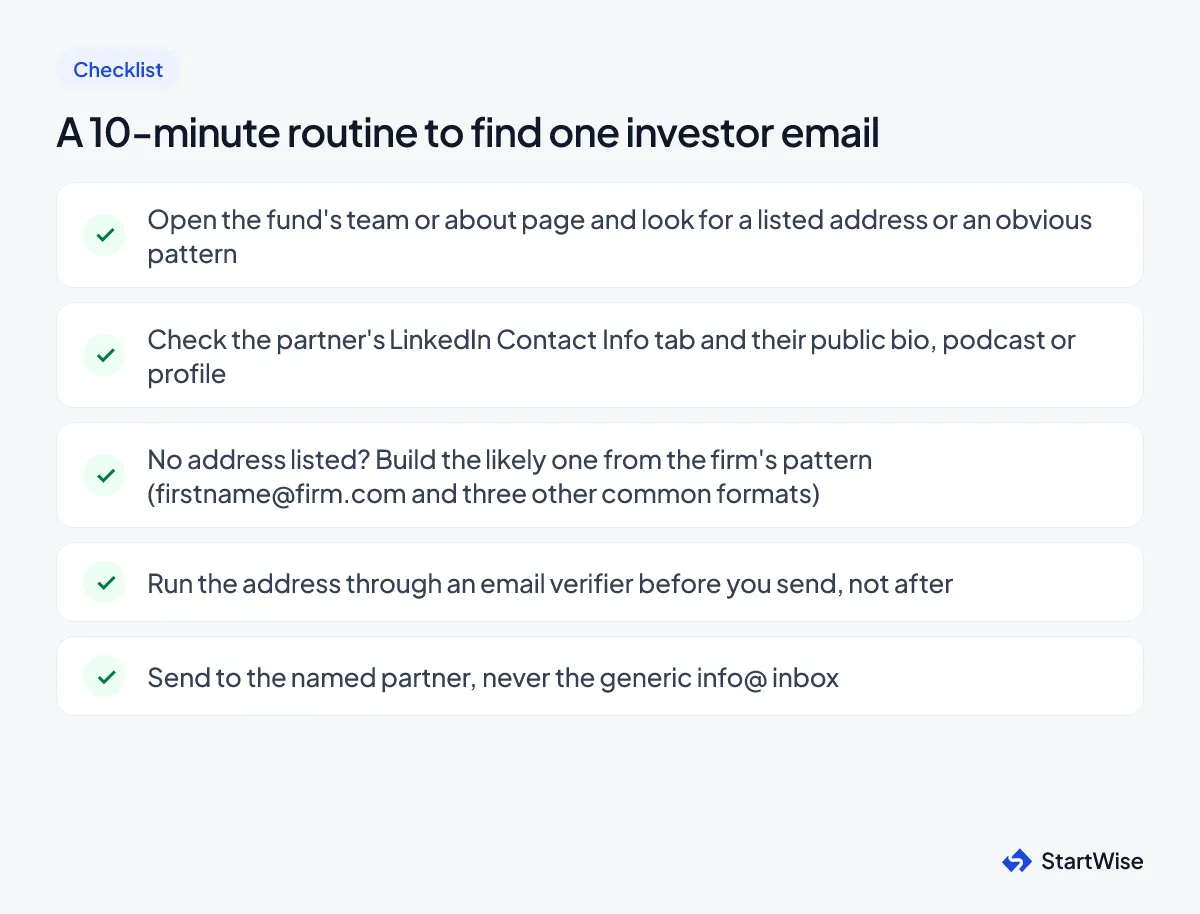
Run each candidate through one, then follow the routine below. It’s a minute of work that protects every send after it.
Are investor email finder tools worth it?
Email finder tools earn their price when your list is long, and feel like overkill when it’s short. Scale is the test. They pull addresses from a domain, enrich a profile, and hand you a validity score, which saves real hours once you’re chasing hundreds of names across sectors.
Hunter.io runs about a 91% valid-email rate, with a free tier and paid plans from $34 to $104 a month, and Apollo starts free then runs $49 to $119 per user (Metal, 2026). RocketReach leans toward the personal addresses firm sites don’t list. If you’re weighing options, we compared the main ones in the best tools to find investors for a pre-seed startup.
My honest read: on a focused forty-name round, the free routes beat a subscription. Pay for a finder the day manual lookups start costing you more than the tool does.
The tool finds the address. It won’t tell you which partner is worth the email, and it won’t write the cold message that earns the reply.
What to do this week
Pick the ten names at the top of your list and find each partner’s email the free way first. Do it by hand. The routine takes about ten minutes a name, and it’s the same one we run before any outreach.
- Open each fund’s team page and note the address or the format you see.
- Check the partner’s LinkedIn Contact Info tab and public bio for a direct address.
- Where none is listed, build the address from the firm’s pattern and verify it before saving.
- Confirm every address is the named partner’s, not a shared info@ inbox.
- Only then reach for a paid finder, and only for the names the free routes missed.
Do that, and you’ll walk into your raise with a clean, verified list aimed at the people who can say yes, not a pile of guesses pointed at inboxes nobody reads.
